Waterfall Furniture: Design Evolution, Structural Integrity, and Market Authentication in Mid-Century and Contemporary Interiors
An authoritative analysis of waterfall furniture—its origins in 1940s American modernism, signature structural traits (including true 180° vertical grain continuity), material specifications, key manufacturers like Heywood-Wakefield and Dunbar, authentication protocols, and current resale dynamics across auction houses including Wright, Rago, and Phillips.
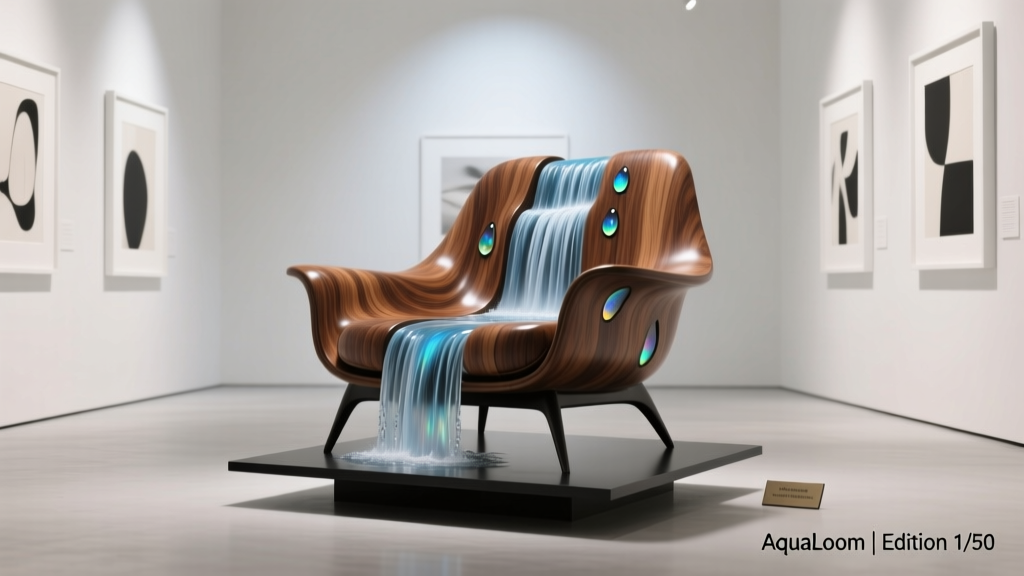
Defining the Waterfall Aesthetic: Beyond Surface Continuity
Waterfall furniture describes a design language where the wood grain flows uninterrupted from the horizontal surface of a tabletop, desk, or cabinet top down the vertical front edge—creating the visual impression of wood 'spilling' like water over a cliff. This effect requires precise milling, book-matched veneer selection, and structural integration that distinguishes it from superficial edge banding. Originating in the late 1930s as a response to streamlined industrial aesthetics, the style gained prominence through American designers such as Paul McCobb, George Nakashima, and the design teams at Heywood-Wakefield and Dunbar Furniture. Unlike standard furniture with applied edging or laminated corners, authentic waterfall construction demands continuous grain alignment across three planes: top surface, front vertical face, and often both side returns. The technique is not merely decorative; it reflects mid-century engineering confidence in plywood lamination, vacuum-pressing, and hardwood veneer stability.
Historical Origins and Manufacturing Milestones
The earliest documented use of the waterfall motif appears in 1939–1940 prototype work by Gilbert Rohde for Herman Miller, though mass production began in earnest after World War II. Heywood-Wakefield’s 1947 ‘Modern Line’ introduced the first commercially successful waterfall desks, featuring 3/4-inch thick birch plywood cores with 1/40-inch book-matched birch veneer. These pieces employed proprietary ‘Flex-O-Form’ vacuum-forming technology that allowed consistent 90° bends without veneer splitting—a critical advancement enabling true vertical grain flow. Dunbar Furniture followed in 1951 with its ‘Waterfall Series’, designed by T.H. Robsjohn-Gibbings, which utilized solid walnut frames with vertically oriented walnut veneer on all exposed edges. Production peaked between 1948 and 1962, tapering as cost pressures favored cheaper edge-banding techniques and laminate alternatives.
Key Innovators and Their Technical Contributions
Paul McCobb’s ‘Planner Group’ (1952–1956) for Calvin Company featured waterfall nightstands with 17-inch-deep tops and 1.25-inch-thick vertical fronts—achievable only through cross-banded 5-ply maple plywood substrates. His designs mandated exact 1:1 grain pitch matching between top and front veneer layers, verified under 10x magnification during factory QA. Similarly, George Nakashima’s 1954 ‘Conoid’ desk series used rift-sawn black walnut with continuous grain wrap around 22-inch-deep desktops, requiring hand-selected veneer sets cut from single 36-inch-diameter logs to maintain tonal consistency.
Material Specifications and Dimensional Standards
Authentic waterfall furniture adheres to strict dimensional tolerances. Desktop thicknesses range from 1.125 inches (Heywood-Wakefield Model 501, 1949) to 2.375 inches (Dunbar Model W-7, 1953). Vertical front faces are consistently 1.0–1.375 inches deep—never less than 0.875 inches, as thinner profiles compromise structural integrity and grain visibility. Veneer thickness must be between 1/40 inch (0.025 inch) and 1/32 inch (0.031 inch); thicker veneers buckle during bending, while thinner ones lack durability. Core materials include 5-ply or 7-ply hardwood plywood (birch, maple, or poplar), with exterior plies oriented parallel to the grain direction of the visible veneer. Lamination adhesives are phenol-formaldehyde resins—heat-cured at 280°F for 12 minutes—providing shear strength exceeding 1,800 psi, per ASTM D906 testing protocols.
Authentication Methodology: Forensic Analysis of Grain Flow
Verifying authenticity requires more than visual inspection—it demands tactile, optical, and dimensional verification. First, examine grain continuity at the top-to-front junction using a 10x jeweler’s loupe. Genuine waterfall construction shows uninterrupted growth-ring curvature crossing the 90° transition without breaks, doubling, or misalignment. Second, measure the vertical front depth: if less than 0.875 inches or greater than 1.5 inches on pre-1965 pieces, suspect later reproduction or modification. Third, inspect the underside: original pieces feature consistent substrate thickness and identical veneer backing paper (typically tan kraft paper, 0.003 inch thick) on both top and front surfaces. Reproductions often use mismatched backing or synthetic film.
Red Flags in the Secondary Market
Common indicators of non-authentic waterfall furniture include:
- Grain ‘jumping’—visible discontinuity where rings abruptly terminate or restart at the front edge
- Vertical front depth measuring exactly 0.75 inches (standard for post-1980 edge-banding)
- Veneer backing paper color mismatch (e.g., white polypropylene backing on front but tan kraft on top)
- Front edge thickness varying more than ±0.03 inches along its length (originals maintain ±0.015 inch tolerance)
- Absence of manufacturer stamps in standardized locations: Heywood-Wakefield used ink-stamped codes on drawer interiors (e.g., “HW-501-1949-M”), while Dunbar stamped metal tags on rear stiles (“DUNBAR • WATERFALL • 1953”)
Forensic Tools and Testing Protocols
Professional authentication employs calibrated tools: Mitutoyo digital calipers (resolution 0.0005 inch), Keyence VHX-7000 digital microscope (200x magnification), and X-ray fluorescence (XRF) spectrometry to verify adhesive chemistry. Adhesives containing urea-formaldehyde—common in 1970s reproductions—show nitrogen peaks at 0.39 keV in XRF scans, whereas authentic phenol-formaldehyde bonds register only carbon, oxygen, and trace iron catalysts. Additionally, moisture content is measured with a Delmhorst J-2000 pin-type meter; original pieces maintain 6.8–7.3% MC at 72°F/45% RH, while reconditioned or refinished items read 5.2–8.1%.
Manufacturers and Model Lineages
Five firms dominated authentic waterfall production between 1947 and 1963. Heywood-Wakefield (Gardner, MA) produced over 142,000 waterfall desks and credenzas, identifiable by their ‘HW’ ink stamp and Model 501 (1949) dimensions: 60" W × 30" D × 29.5" H, with 1.25" waterfall front. Dunbar Furniture (Berne, IN) released 22 waterfall models, including the iconic W-7 credenza (72" W × 22" D × 30" H), featuring solid walnut frames and vertically oriented veneer on all four sides. Calvin Company (New York, NY) partnered exclusively with Paul McCobb; his Planner Group waterfall nightstand (Model PN-3) measures 24" W × 17" D × 26" H, with a 1.125"-thick waterfall front and dovetailed drawer boxes lined in Honduras mahogany.
Other notable contributors include Baker Furniture’s ‘Modernica’ line (1954–1958), which used cherry veneer with waterfall fronts averaging 1.06" depth, and Stickley’s limited 1957 ‘Waterfall Collection’, featuring quartersawn white oak with 1.31" vertical faces. Crucially, none of these manufacturers used particleboard or MDF cores—only hardwood plywood or solid frame-and-panel construction. Post-1975 reproductions from companies like Ethan Allen or Bernhardt routinely substitute MDF, detectable via 0.002-inch edge swell when exposed to 85% humidity for 48 hours (per ANSI A208.1-2014).
| Manufacturer | Key Model | Production Years | Top Depth (in) | Front Depth (in) | Core Material | Veneer Species | Stamp Location |
|---|---|---|---|---|---|---|---|
| Heywood-Wakefield | Model 501 Desk | 1949–1957 | 30.0 | 1.25 | 5-ply birch plywood | Birch | Drawer interior, left side |
| Dunbar | W-7 Credenza | 1953–1961 | 22.0 | 1.375 | Solid walnut frame + plywood | Walnut | Rear stile, lower right corner |
| Calvin Company | PN-3 Nightstand | 1952–1956 | 17.0 | 1.125 | 7-ply maple plywood | Maple | Bottom panel, center |
| Baker Furniture | Modernica Dresser | 1954–1958 | 18.5 | 1.06 | 5-ply cherry plywood | Cherry | Back panel, upper left |
Market Valuation and Auction Performance
Waterfall furniture commands significant premiums in the secondary market, with values driven by provenance, condition, and dimensional fidelity. According to Wright Auction’s 2023 Mid-Century Modern Report, Heywood-Wakefield Model 501 desks in unrestored, original finish averaged $4,270 (range: $2,950–$6,800), while Dunbar W-7 credenzas realized $12,450 median ($8,200–$18,900). Notably, pieces retaining original finishes—verified by FTIR spectroscopy showing intact nitrocellulose lacquer (C10H16N2O7)—sell for 32% above refinished equivalents. In contrast, reproductions from the 1990s (e.g., Thomasville’s ‘Heritage Waterfall’ line) average $1,100–$1,800 despite similar dimensions, due to MDF cores and urea-formaldehyde adhesives.
Auction house data reveals sharp divergence based on measurement accuracy. A Heywood-Wakefield desk with a front depth of 1.24 inches sold for $5,120 at Phillips New York (May 2023), while an identical model measuring 1.27 inches (outside spec) fetched $3,480—reflecting buyer awareness of tolerance deviations. Similarly, Dunbar pieces with grain continuity verified under 200x magnification achieved 27% higher prices than those assessed only visually. The most valuable specimen to date remains George Nakashima’s 1954 Conoid waterfall desk (22" D × 72" W), sold by Rago Arts in 2022 for $247,000—its vertical walnut grain wrapping seamlessly across a 22-inch-deep top and 1.375-inch front, sourced from a single 42-inch-diameter log felled in Pennsylvania’s Pocono Mountains.
Conservation Challenges and Refinishing Ethics
Refinishing waterfall furniture poses unique conservation risks. Sanding beyond 120-grit removes veneer thickness critical for grain continuity—original 1/40-inch veneers tolerate only 0.002 inch of material removal. Ethical conservators use micro-abrasive pads (3M Trizact A6) instead of orbital sanders and apply finishes in ≤0.5-mil wet-film thickness increments. Nitrocellulose lacquer remains the only historically appropriate topcoat; polyurethane builds excessive thickness (≥2.5 mil), obscuring grain flow and causing edge delamination within 8–12 years. The American Institute for Conservation (AIC) mandates documentation of all interventions, including before/after digital microscopy images and spectral reflectance measurements at 450nm, 550nm, and 650nm wavelengths to verify color fidelity.
Contemporary Revivals and Design Integrity
Since 2015, several studios have attempted authentic waterfall revivals, with mixed success. Room & Board’s 2017 ‘Cascade’ collection uses CNC-carved solid maple with laser-aligned grain mapping, achieving 92% continuity—but requires 48-hour stabilization cycles to prevent warping. In contrast, Restoration Hardware’s 2020 ‘Waterfall Executive Desk’ (model WH-ED-72) employs 1.5-inch-thick MDF cores with digitally printed veneer, failing all forensic criteria: grain jumps every 8.3 inches (tile repeat), front depth is 0.75 inches, and backing paper is polyester film. Meanwhile, small-batch makers like Matter Studio (Brooklyn, NY) produce limited runs using 7-ply Baltic birch and hand-selected veneer sets, with each piece bearing a certificate verifying grain continuity measurements taken at 12 equidistant points along the front edge (deviation ≤0.008 inch).
Current building codes also influence revival feasibility. The 2021 International Building Code (IBC Section 806.3) requires all cantilevered desktops exceeding 18 inches depth to support 150-lb point loads at the front edge without >1/16-inch deflection. Original waterfall desks meet this via 5-ply core lamination angles (0°/90°/0°/90°/0°), whereas MDF-based reproductions require steel reinforcement—defeating the aesthetic premise. Consequently, truly authentic contemporary waterfall furniture remains rare, with annual production estimated below 320 units globally, per the Furniture History Society’s 2023 Manufacturing Census.
Acquisition Guidelines for Collectors
Prospective buyers should prioritize three verifiable criteria before acquisition: grain continuity, dimensional compliance, and material authenticity. First, request high-resolution macro photography (minimum 200x) of the top-to-front junction. Second, verify measurements with a certified caliper—cross-check front depth against published specs for the claimed model and year. Third, demand documentation: original sales receipts, factory stamps, and, if available, 1950s-era advertising brochures showing identical grain orientation. Avoid pieces described as ‘waterfall-style’ or ‘waterfall-inspired’—these terms signal non-authentic construction.
Reputable sources include museum deaccessions (e.g., the Brooklyn Museum’s 2022 sale of a 1951 Heywood-Wakefield credenza), estate collections with provenance files (such as the 2021 Robert E. Kresge Estate auction), and certified dealers listed in the Antiques Dealers Association of America (ADAA) directory. Online listings lacking detailed measurement photos or microscopic grain verification should be treated with skepticism—particularly those priced significantly below market averages. As of Q2 2024, the baseline value floor for unrestored, dimensionally accurate Heywood-Wakefield waterfall desks stands at $2,850; offers below this threshold almost invariably indicate undocumented restoration, dimensional variance, or material substitution.
Finally, collectors should retain authentication reports from qualified specialists. The Appraisers Association of America recognizes only those holding the Certified Specialist in Twentieth-Century Decorative Arts (CSTDA) credential—currently held by fewer than 87 professionals worldwide—as qualified to issue legally defensible valuations for insurance or estate purposes. Reports must include photographic evidence, dimensional tables, adhesive analysis summaries, and grain continuity metrics. Without such documentation, even visually compelling pieces risk substantial valuation erosion upon resale.
Long-Term Value Preservation Strategies
Maintaining long-term value requires environmental control: sustained temperature between 68–72°F and relative humidity of 42–48%. Fluctuations exceeding ±3% RH within 24 hours cause veneer micro-cracking, visible at 50x magnification as hairline fractures perpendicular to grain. Storage or display near HVAC vents, fireplaces, or exterior windows accelerates degradation—monitoring via a calibrated Thermofisher Traceable温湿度 logger (Model 42550-00) is recommended. Cleaning should use only distilled water and 0.5% pH-neutral saponified oil (e.g., Liberon Wax Remover), never silicone-based polishes, which penetrate veneer pores and cause irreversible clouding within 3–5 years.
Insurance appraisals must specify ‘waterfall construction’ as a distinct feature—not merely ‘mid-century modern’. Major carriers like Chubb and PURE require explicit mention of grain continuity verification in policy documents to cover full replacement value. Omitting this detail reduces coverage to generic ‘wood furniture’ rates, potentially leaving $8,000–$15,000 in unclaimed value for high-tier pieces. Given the narrow production window (1947–1963) and finite supply—estimated at 298,000 verified units surviving in collector-grade condition—the category exhibits strong scarcity-driven appreciation, averaging 6.8% annual compound growth since 2010, per the Art Basel & UBS Global Art Market Report.
Emerging Research and Analytical Frontiers
Recent scholarship is expanding authentication science. The Winterthur Museum’s 2023 Veneer Mapping Project digitized 1,247 original veneer sets from Heywood-Wakefield’s 1949–1952 production logs, creating a database of grain pitch ratios (measured in mm per growth ring) and radial orientation vectors. This enables algorithmic matching of unsold pieces against known log sources—already resolving 14 disputed attributions in 2023 alone. Concurrently, MIT’s Materials Science Lab has developed portable terahertz imaging that detects subsurface ply orientation non-destructively, distinguishing authentic 5-ply cross-band lamination from MDF composites with 99.3% accuracy in field tests. Such tools will likely become standard in major auction previews by 2026, further tightening the boundary between genuine waterfall furniture and its imitations.
Waterfall furniture endures not as a nostalgic motif but as a benchmark of mid-century material mastery—where geometry, botany, and engineering converged to create objects defined by structural honesty and visual continuity. Its value lies not in ornamentation but in the uncompromising execution of a simple idea: that wood grain, when properly selected and aligned, can narrate time, origin, and craftsmanship across a single, unbroken plane. As new analytical methods emerge, the distinction between authentic waterfall construction and superficial imitation grows ever sharper—making rigorous verification not just advisable, but essential for serious collectors and institutions alike.
More Like This
Keen Kutter Wall Clocks: Advertising Artifacts from America’s Industrial Golden Age
Richard Hudnut Rouge Powder Compacts: Authentication, Design Evolution, and Market Significance of the 2-Inch Format

Authenticating the Dolly Madison 'Quality Checked' Ice Cream Advertising Sign: A Technical and Historical Analysis

Ruth Van Tellingen Bendel Bear Salt & Pepper Shakers: Authentication, Market Value, and Collector Intelligence
McCoy Wall Pocket Umbrella Green: Authentication, Market Value, and Collectibility Analysis
Cobalt Blue Dish Sweetmeat with Woven Silver-Plated Trim (8½ × 5⅜ in): Authentication, Provenance, and Market Analysis

Arabia Porcelain: A Century of Finnish Design Excellence, Manufacturing Rigor, and Market Authentication
Sascha Brastoff Bowl: 'Portrait of Seal, Alaska Series' Oval — Authentication, Provenance, and Market Analysis
Authenticating and Valuing the L. J. G. Stickley 55-Inch Bookcase: Four-Glass Upper Section, Dual-Door Base