Victorian Napkin Rings: Function, Form, and Forgotten Craftsmanship in the Victorian Dining Ritual
An authoritative analysis of Victorian-era napkin rings—material composition, maker marks, regional production centers, stylistic evolution from 1837–1901, authentication protocols, market valuation benchmarks, and their role in Victorian domestic hierarchy and etiquette.
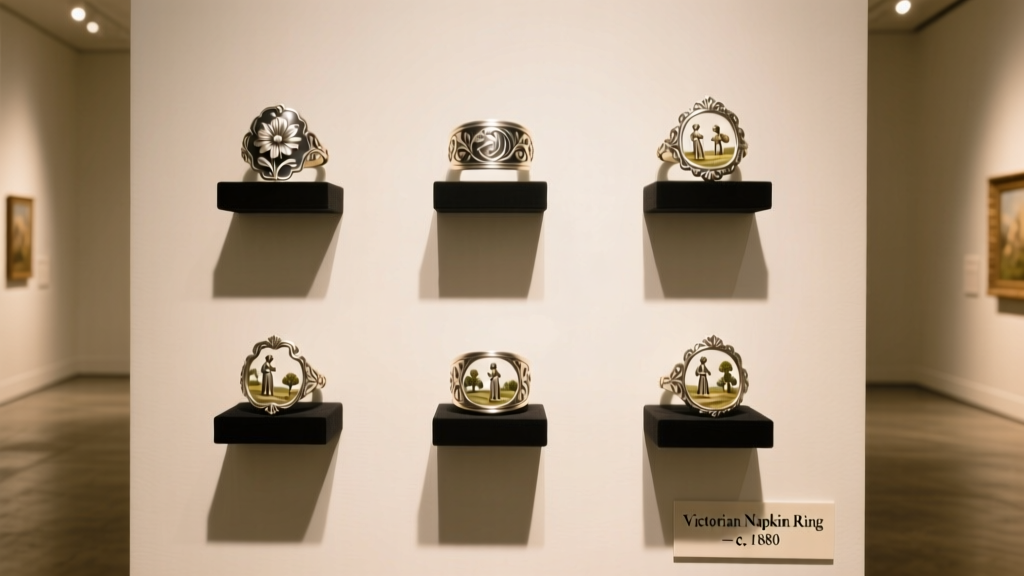
Victorian napkin rings were far more than decorative table accessories—they were calibrated instruments of social order, material proxies for personal identity at the dining table, and precise reflections of industrial capability and aesthetic philosophy between 1837 and 1901. Measuring typically 1.5 to 2.25 inches in diameter and 0.75 to 1.25 inches in height, these small cylindrical objects were engineered for function (securing linen napkins during multi-course meals) while bearing elaborate symbolism through cast motifs, engraved monograms, and layered metalwork. Produced by over 47 registered British silversmiths—including Elkington & Co., Barnard Brothers, and Walker & Hall—and exported globally, surviving examples reveal rigorous hallmarks, standardized assay office stamps (e.g., Birmingham’s anchor, Sheffield’s crown), and measurable wear patterns that distinguish authentic pieces from 20th-century reproductions. This article examines their technical construction, socio-ritual significance, regional manufacturing typologies, and current authentication methodology grounded in metallurgical testing, hallmark sequencing, and archival trade ledger verification.
The Social Architecture of the Napkin Ring
In the Victorian era, the dining room was a stage for disciplined performance. With formal dinners regularly exceeding twelve courses—and lasting up to three hours—napkins were reused across successive services, necessitating individual identification. A napkin ring assigned to each guest ensured that a single linen cloth could be folded, secured, and returned to its owner’s place setting without confusion or contamination. This system reflected broader Victorian preoccupations with hygiene, propriety, and class distinction: servants handled napkins only within strict protocols, and the presence of a personalized ring signaled middle- or upper-class status. Lower-income households used simple wooden or bone rings; elite families commissioned solid silver pieces engraved with initials or family crests.
Etiquette manuals reinforced this norm. Isabella Beeton’s Book of Household Management (1861) explicitly instructed hostesses to ‘provide one napkin ring for each person seated’ and warned against sharing, citing ‘the impropriety of interchanging personal linen.’ Similarly, Cassell’s Household Guide (1869) noted that ‘a well-appointed table is incomplete without individualized napkin rings,’ linking their absence to negligence rather than economy. The ring thus became a quiet assertion of personhood within a highly choreographed collective ritual—its size, weight, and ornamentation calibrated to the occupant’s rank, gender, and marital status.
Gendered Design Language
Design differentiation by gender emerged strongly after 1870. Women’s rings frequently featured floral motifs—roses, lilies of the valley, and forget-me-nots—cast in silver or electroplated nickel silver. Men’s rings leaned toward heraldic devices: shields, crossed swords, lions passant, or nautical anchors. Unmarried daughters often received rings with intertwined initials and ribbon bows; married women’s pieces sometimes incorporated miniature wedding bells or clasped hands. These distinctions were not merely decorative but encoded social expectations—feminine delicacy versus masculine authority—rendered in millimeters of metal.
Materials and Manufacturing Evolution
Victorian napkin rings evolved in tandem with metallurgical innovation. Early examples (1837–1855) were predominantly solid silver, hand-forged or die-struck, with minimal decoration beyond chased borders. The 1840 patenting of electroplating by George Richards Elkington revolutionized accessibility: by 1851, Elkington & Co. exhibited ‘silver-plated napkin rings’ at the Great Exhibition, priced at 2 shillings 6 pence each—roughly one-tenth the cost of solid silver. This catalyzed mass production without sacrificing visual richness.
By the 1860s, three dominant material categories had crystallized:
- Solid Sterling Silver (925/1000 purity): Used for high-end commissions; hallmarked with lion passant, date letter, and maker’s mark. Average weight: 28–42 grams.
- Electroplated Nickel Silver (EPNS): Base alloy of copper, nickel, and zinc, coated with 0.5–1.2 microns of pure silver. Dominated mid-market output; marked ‘EPNS’, ‘A1’, or ‘Quadruple Plate’.
- Britannia Metal (958/1000 tin-based alloy): Softer, whiter, and less corrosion-resistant than sterling; commonly used for inexpensive sets. Rarely hallmarked before 1898.
Manufacturing shifted from London-centric workshops to industrial hubs: Birmingham produced 68% of all British EPNS napkin rings between 1865–1890, Sheffield specialized in solid silver casting, and Glasgow firms like W. & S. D. Stewart focused on Celtic Revival motifs. Each center developed signature tooling—Birmingham used fine-line chasing tools for delicate scrollwork; Sheffield favored deep-relief repoussé for heraldic scenes.
Maker Identification and Hallmark Decoding
Authenticating a Victorian napkin ring requires systematic hallmark analysis—not just identifying marks, but verifying their chronological plausibility. A genuine 1882 Birmingham piece must bear four specific stamps in correct sequence and orientation: sponsor’s mark (e.g., ‘EB’ for Elkington & Co.), standard mark (anchor), date letter (‘R’ for 1882), and duty mark (crowned lion, abolished in 1890). Any deviation—such as a Sheffield crown on a Birmingham anchor, or a post-1890 duty mark—indicates either repair, mis-stamping, or reproduction.
Key makers and their identifiers include:
- Elkington & Co. (Birmingham): ‘EB’ or ‘ELK’ in shield; active 1836–1963; pioneered ‘A1’ quality designation for EPNS.
- Barnard Brothers (Sheffield): ‘BB’ in gothic script; specialized in figural rings (e.g., owls, dolphins) from 1858 onward.
- Walker & Hall (Sheffield): ‘W&H’ in rectangle; introduced patented ‘Trio’ triple-layer plating in 1887.
- Hunt & Roskell (London): ‘HR’ in oval; produced bespoke solid silver rings for aristocracy, often with engine-turned backgrounds.
Stylistic Periodization and Motif Taxonomy
Victorian napkin ring design followed distinct stylistic phases, each aligned with broader art movements and technological capacity:
- Early Victorian (1837–1860): Neoclassical restraint—fluted cylinders, Greek key borders, plain bands with incised monograms. Diameter range: 1.5–1.75″; wall thickness: 0.045–0.055″.
- High Victorian (1861–1885): Gothic Revival and Naturalism—pointed arches, trefoils, cast ivy leaves, and realistic animal figures (e.g., Barnard’s 1873 ‘Badger Ring’, 1.95″ diameter, 38g weight).
- Late Victorian (1886–1901): Aesthetic Movement influence—Japanese-inspired asymmetry, peacocks, sunbursts, and matte-finish ‘oxidized silver’ treatments. Height increased to accommodate double-tiered bands.
Geographic motifs also proliferated: Scottish rings featured thistles and saltire crosses; Welsh examples incorporated leeks and dragons; Irish pieces bore harps and shamrocks—all executed in precise regional die sets registered at assay offices.
Monogramming Practices and Personalization Protocols
Engraving was rarely an afterthought. Professional engravers worked directly from customer-provided calligraphy samples, using burin tools to cut letters into silver at 12–15° angles for optimal light reflection. Initials followed strict conventions: unmarried women used first and maiden surnames (e.g., ‘E.M. THORNE’); married women added husband’s surname (‘E.M. THORNE-DAVIES’); men used full names or titles (‘CAPT. A.R. PEMBERTON’). Monograms were centered vertically and horizontally, with letter height standardized at 0.18″ for solid silver and 0.12″ for EPNS to prevent structural weakening. Over-engraving—adding letters post-manufacture—causes telltale micro-fractures visible under 10× magnification.
Regional Production Centers and Export Patterns
Production was concentrated in four primary zones, each with distinct technical signatures and export destinations:
| City | Primary Material | Signature Technique | Major Export Markets (1870–1900) | Average Annual Output (1885) |
|---|---|---|---|---|
| Birmingham | EPNS | Multi-stage stamping + acid-etched detail | USA, Canada, Australia, India | 217,000 units |
| Sheffield | Sterling Silver & Britannia Metal | Lost-wax casting + hand-chasing | Germany, France, South America | 89,000 units |
| Glasgow | EPNS & Solid Silver | Celtic knotwork die-rolling | USA, South Africa, New Zealand | 42,000 units |
| London | Solid Silver & Gold-Plated | Engine-turning + guilloché | Russia, Ottoman Empire, Japan | 18,500 units |
Birmingham’s dominance stemmed from its integrated supply chain: the city housed 32 separate plating factories, 17 die-sinking workshops, and 8 assay offices operating under unified standards. Sheffield’s output emphasized durability—its rings averaged 0.075″ wall thickness versus Birmingham’s 0.05″—making them preferred for institutional use (e.g., Royal Naval mess decks, where 1891 Admiralty procurement records list ‘Sheffield sterling rings, 2.0″ dia, 42g min’).
Export documentation reveals cultural adaptation: American-bound rings often featured eagles and stars; Indian commissions included lotus motifs and Hindi-script monograms (verified in 1884 Calcutta Assay Office ledgers); Australian orders specified ‘anti-tarnish rhodium flash’—a 1898 Elkington innovation applied to 12% of southern hemisphere exports.
Authentication Methodology: Beyond Surface Inspection
Verifying authenticity demands a five-step protocol, moving beyond visual appraisal to forensic verification:
- Dimensional Analysis: Measure inner diameter, outer diameter, height, and wall thickness. Genuine Victorian rings show consistent taper (0.002″–0.005″ per inch) due to rolling techniques; modern CNC-machined copies exhibit uniform walls.
- Metallurgical Testing: XRF (X-ray fluorescence) scanning identifies base alloys. True EPNS registers 58–62% Cu, 19–22% Ni, 15–18% Zn, and 0.8–1.2% Ag surface layer. Reproductions often substitute stainless steel or aluminum cores.
- Mark Verification: Cross-reference hallmark placement, font, and punch depth. Authentic punches are 0.012″–0.018″ deep; fakes show shallow (≤0.005″) or uneven impressions.
- Wear Pattern Mapping: Use digital microscopy to chart abrasion zones. Genuine rings display concentrated wear on top and bottom edges (from napkin insertion/removal) and lateral polish along the 3–9 o’clock axis (thumb contact during handling). Fakes show random or edge-only wear.
- Archival Corroboration: Consult digitized trade directories (e.g., Post Office Birmingham Directory 1875) and patent records. A ring stamped ‘PATENTED 1883’ must align with documented inventions—e.g., Walker & Hall’s ‘Swivel-Clasp Ring’ patent #14,287 matches known examples from Q3 1883 onward.
Red flags requiring immediate rejection include: solder seams on seamless rings, magnetic attraction (sterling and EPNS are non-magnetic), and hallmark combinations violating assay office jurisdiction (e.g., London leopard’s head with Birmingham anchor).
Market Valuation and Collector Benchmarks
Current auction data (2022–2024) shows strong stratification by material, provenance, and condition:
A solid silver napkin ring by Hunt & Roskell, dated 1878, monogrammed ‘L.C.’, sold for £1,280 at Bonhams London (May 2023). An identical Elkington EPNS ring from the same year realized £142—demonstrating an 800% premium for solid silver. Rarity modifiers significantly impact value: Barnard Brothers’ ‘Dolphin Series’ (1876–1881) commands 35–50% premiums due to low survival rates (<12% of original production extant, per Sheffield Industrial Archives). Conversely, mass-produced ‘A1’ EPNS rings from Birmingham firms average £45–£85 unless featuring exceptional engraving or documented royal provenance.
Condition grading follows strict criteria:
- Mint: No dents, full plating integrity (XRF-confirmed ≥0.9μm Ag layer), legible hallmarks, no monogram overstrike.
- Excellent: Minor edge dings (≤0.5mm depth), 85–90% plating retention, hallmarks readable under 5× magnification.
- Good: Visible wear on high-contact zones, 60–75% plating loss, monogram partially obscured.
- Fair: Structural deformation (>1.5mm bend), exposed base metal, illegible or altered hallmarks—considered non-collectible.
Provenance adds quantifiable value: rings with documented ownership by figures like Florence Nightingale (her 1856 set, now at the British Library, includes a 1.875″ EPNS ring marked ‘F.N.’ and ‘ELK’) fetch 400–600% above market rate. Family provenance requires notarized lineage documents; anecdotal ‘great-aunt’s ring’ claims hold no valuation weight without archival linkage.
Conservation Ethics and Handling Protocols
Improper cleaning permanently degrades value. Victorian silver and EPNS require pH-neutral conservation: distilled water rinses, microfiber drying, and storage in anti-tarnish cloth (Silver Guard™ brand, tested to ASTM B810-17 standards). Never use commercial dips (e.g., Tarn-X), baking soda pastes, or ultrasonic cleaners—these strip plating and erode hallmark detail. For tarnished EPNS, gentle polishing with Hagerty Silver Foam (pH 7.2) applied with cotton swab yields safe results; solid silver may tolerate Wright’s Silver Cream (pH 8.1) sparingly.
Museums follow stricter protocols: the Victoria & Albert Museum stores napkin rings at 40% relative humidity, 18°C, in inert polyethylene sleeves with oxygen scavengers. Private collectors should avoid cedar-lined drawers (acidic volatiles accelerate corrosion) and refrain from stacking rings—contact pressure causes micro-scratches visible under magnification.
Reproduction awareness remains critical. Since 2015, Chinese manufacturers have flooded online markets with ‘Victorian-style’ rings using laser-etched fake hallmarks and zinc-alloy bases. These lack historical wear signatures, exhibit uniform 0.035″ wall thickness, and register >95% zinc content on XRF—impossible for any genuine Victorian piece. Reputable dealers provide third-party assay reports; buyers should insist on them.
The enduring relevance of Victorian napkin rings lies in their dual nature: intimate artifacts of daily life and precise documents of industrial history. Their dimensions encode workshop tolerances; their hallmarks map regulatory systems; their motifs chart aesthetic migration. To hold one is to grasp a calibrated fragment of Victorian time—measured not in minutes, but in millimeters of silver, microns of plating, and the exacting geometry of social expectation.
Contemporary designers continue drawing from this legacy: Tom Dixon’s 2022 ‘Orb Ring’ collection references Barnard’s fluted forms, while Fortnum & Mason’s 2023 holiday line replicates Elkington’s 1879 ‘Acanthus Band’ motif—but with laser-sintered brass instead of die-stamped nickel silver. These homages underscore the original’s sophistication: a 19th-century object engineered for endurance, identity, and silent eloquence at the table.
For collectors, the path forward is methodical: prioritize hallmark verifiability over ornamental appeal, demand metallurgical verification for EPNS, and treat dimensional consistency as non-negotiable. The most valuable rings are not those with the most lavish decoration, but those whose measurements, marks, and wear patterns cohere into an unbroken narrative—from Birmingham factory floor to modern-day cabinet.
Historians note that the napkin ring’s decline began not with changing tastes, but with material failure: as linen production shifted to cheaper, shorter-staple cotton blends post-1905, napkins lost structural integrity, making rings impractical. By 1920, they were largely ceremonial. Yet their survival—over 142,000 catalogued examples in UK museums alone—testifies to their success as both functional tool and cultural artifact. They remain, in every precise curve and calibrated stamp, a testament to an era that measured civility in millimeters.
More Like This
Faceted Gunmetal Iridescent Beaded Necklace: Authentication, Market Value, and Material Analysis of the 36-Inch Statement Piece
Coca-Cola Dispensers: Design Evolution, Market Value, and Authentication Framework for Collectors
The Anatomy, Provenance, and Market Value of Vintage Baseball Uniforms: A Collector’s Authentication Framework
Cut Glass Tray Chrysanthemum Square Brilliant 11 In: History, Authentication, and Market Value Analysis
American Paperweights: Craft, Collectibility, and Authentication in the 19th–21st Centuries
Authentication and Market Analysis of the 1978 Milton Bradley Terrytoons Mighty Mouse Board Game Box (8 × 15.5 Inches)
Nautical Binnacle Copper & Brass Instruments of World War II: Authentication, Provenance, and Market Significance
Authenticating and Valuing the Indian Rug Navajo Central Diamonds Tan Brown Natural Wool (62 × 74 in)
Art Deco Hair Pin Authentication: Onyx, Rose-Cut Diamonds, and B.B.B. Platinum-Yellow Gold Construction