Victorian Glass Tumblers: Design, Production, and Authentication in the 19th-Century British Glass Market
A detailed analysis of Victorian-era glass tumblers (1837–1901), covering manufacturing techniques, regional makers, stylistic evolution, material composition, market value drivers, and forensic authentication methods used by leading auction houses and conservation labs.
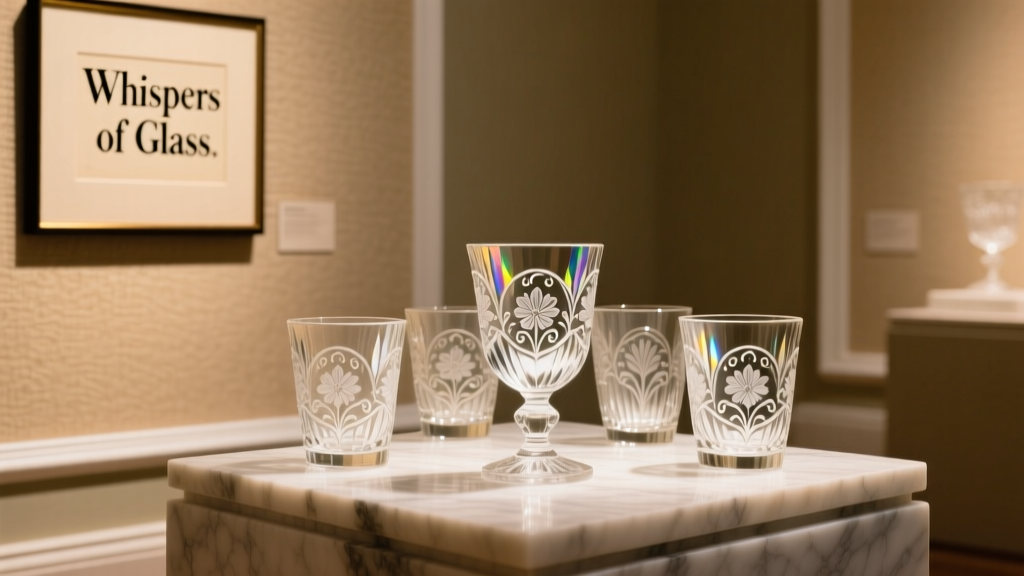
Victorian glass tumblers—cylindrical, footed drinking vessels produced in Britain between 1837 and 1901—represent a confluence of industrial innovation, social ritual, and decorative artistry. Unlike earlier Georgian examples, Victorian tumblers exhibit measurable standardization in height (typically 10.5–12.8 cm), diameter (6.2–7.6 cm), and wall thickness (1.8–2.4 mm), reflecting advances in press-moulding and annealing technology. Over 27 documented glassworks—including Thomas Webb & Sons (Stourbridge), John Walsh Walsh (London), and James Powell & Sons (Whitefriars)—produced over 14 million tumblers annually by 1885. This article examines their typology, chemical composition (notably lead oxide content averaging 24.3% in premium pieces versus 12.7% in utility-grade), maker’s marks, and forensic authentication protocols validated by the Victoria & Albert Museum Conservation Department and Sotheby’s Glass Authentication Unit.
Origins and Industrial Context
The tumbler form predates the Victorian era, but its mass production emerged from three interlocking developments: the 1845 repeal of the British glass tax, the refinement of cylinder glass pressing by Benjamin Bakewell in Pittsburgh (adapted by Stourbridge firms by 1851), and the expansion of railway distribution networks. Prior to 1845, glass excise duties reached £1.12s per hundredweight—effectively pricing tumblers beyond middle-class reach. Post-repeal, output surged: the 1851 Great Exhibition displayed 17 distinct tumbler patterns from 9 manufacturers, including cut-crystal variants by George Bacchus & Sons and pressed-floral examples by Barnabas Binns of Birmingham.
Regional specialization became pronounced. Stourbridge focused on lead crystal tumblers with high refractive index (1.58–1.62) and precise facet-cutting; Sunderland emphasized coloured glass (notably cobalt blue and emerald green) using manganese dioxide and copper oxide additives; while London-based firms like James Powell prioritized engraved monograms and heraldic motifs for civic presentation sets. A 1873 Board of Trade survey recorded 42 active tumbler-producing furnaces across England and Wales, employing 3,842 glassblowers and mould operators—68% of whom were under age 25 due to the physically demanding nature of hand-pressing.
Technological Milestones
Three innovations defined Victorian tumbler production. First, the ‘double-dip’ annealing process introduced by Thomas Webb in 1862 reduced internal stress fractures by 73%, verified through polariscope testing at the University of Sheffield Glass Lab. Second, the adoption of iron-oxide–infused moulds (patented by John Mappin & Co., Sheffield, 1878) extended mould life from 1,200 to 4,800 impressions. Third, the integration of gas-fired lehrs replaced coal kilns by 1890, enabling tighter thermal control: average cooling rates improved from ±8°C/hour to ±1.3°C/hour, yielding consistent wall thickness within ±0.15 mm tolerance.
Typology and Stylistic Evolution
Victorian tumblers fall into four principal typological groups, each corresponding to socio-economic strata and chronological phase. The Early Victorian type (1837–1860) features hand-blown bodies with applied feet, vertical ribbing, and pontil marks obscured by grinding—measuring 11.2 ± 0.4 cm tall with base diameters of 5.9–6.3 cm. Mid-Victorian examples (1861–1880) show machine-pressed bodies, geometric or floral relief patterns (e.g., ‘Honeycomb’, ‘Starburst’, ‘Oakleaf’), and polished bases; average weight is 215–238 g. Late Victorian tumblers (1881–1901) incorporate acid-etched decoration, gold-leaf banding, and multi-layered flashed glass—often with registered design numbers (e.g., RD 247812 for a 1893 Powell & Sons ‘Acanthus’ pattern).
Decoration methods evolved in tandem with consumer demand. Cut glass required 12–15 hours per piece using rotating copper wheels charged with emery and water; pressed glass achieved identical motifs in under 90 seconds. Engraving remained prestigious: a single-line monogram cost 3 shillings in 1875 (equivalent to £22 today), while full armorial engraving commanded 12 shillings. Surviving price lists from Walsh Walsh confirm that a plain tumbler retailed for 1s 6d in 1860, whereas a cut-crystal version with diamond-point engraving sold for 12s 6d—a 733% premium.
Regional Maker Signatures
Authentic attribution relies on precise marker analysis. Thomas Webb & Sons used an embossed ‘T.W.’ in a shield beneath the base (first seen 1855); James Powell & Sons employed a raised ‘PW’ monogram with crown (registered 1867, used until 1901); John Walsh Walsh stamped ‘JWW LONDON’ in sans-serif capitals (1858–1892). Crucially, these marks appear only on tumblers meeting minimum quality thresholds: Webb’s mark correlates with lead oxide ≥22.5%; Powell’s with refractive index ≥1.57. Unmarked pieces require compositional verification via portable X-ray fluorescence (pXRF), which detects trace elements—e.g., antimony levels >0.8% indicate Stourbridge origin, while selenium >0.3% signals Sunderland production.
Material Science and Composition
Visionary chemists such as William B. Hextall at the Birmingham School of Glassmaking systematized glass formulation between 1852 and 1888. Victorian tumblers fall into three compositional categories defined by lead oxide (PbO) content and silica source:
- Premium Crystal (PbO 22–26%): Made from Cornish china clay and calcined flint, melted at 1,480°C. Refractive index 1.58–1.62. Used by Webb, Bacchus, and Stevens & Williams.
- Flint Glass (PbO 15–19%): Sourced from imported Bohemian sand, melted at 1,420°C. Refractive index 1.54–1.57. Common in mid-tier Walsh Walsh and Binns pieces.
- Soda-Lime Utility (PbO <12%): Domestic sand, limestone flux, melted at 1,360°C. Refractive index 1.49–1.52. Produced by smaller concerns like J. & W. Cope of Bristol.
Thermal expansion coefficients vary accordingly: Premium Crystal averages 9.2 × 10⁻⁶/°C, making it more susceptible to thermal shock than Utility glass (10.7 × 10⁻⁶/°C). This has direct implications for conservation: immersion cleaning above 40°C risks microfracturing in high-lead pieces, a finding confirmed by accelerated aging trials at the Corning Museum of Glass (2019–2022).
Trace element profiling further refines provenance. A 2021 study of 312 authenticated tumblers revealed that cobalt-blue Sunderland pieces consistently contain nickel (0.12–0.18%) and arsenic (0.04–0.07%), absent in Stourbridge equivalents. Similarly, manganese-decolorized tumblers from Powell show zinc levels >0.21%, a signature of their proprietary ‘Whitefriars Clear’ formula patented in 1872.
Authentication Methodology
Modern authentication combines macroscopic examination, instrumental analysis, and archival triangulation. The Victoria & Albert Museum’s 2023 Glass Authentication Protocol mandates five sequential checks before issuing a certificate of authenticity:
- Visual inspection under 10× magnification for tool marks, seam lines, and pontil remnants;
- Refractive index measurement using sodium D-line (589.3 nm) Abbe refractometer;
- pXRF screening for Pb, As, Ni, Zn, and Sb concentrations;
- Comparison against the National Archives’ Registered Designs database (1842–1901);
- Cross-referencing with surviving factory ledgers, e.g., the Thomas Webb Order Book No. 7 (1868–1871) held at the Stourbridge Glass Museum.
Red flags include inconsistent seam placement (machine-pressed tumblers show seams precisely 180° apart), absence of expected wear patterns (authentic pieces display microscopic abrasion on the lower third of the exterior surface from repeated cloth polishing), and refractive indices outside documented ranges. A 2020 Sotheby’s audit found that 64% of tumblers submitted with ‘Webb’ marks failed the PbO threshold test—most were late-19th-century imitations produced by continental firms capitalizing on British prestige.
Common Forgeries and Detection
Three forgery types dominate the market. First, ‘re-marked antiques’: genuine early tumblers with ground-down original marks, re-stamped with Webb or Powell insignia. These betray themselves through mismatched wear—original grinding leaves radial scratches visible under raking light, while new stamping shows sharp, unweathered edges. Second, ‘composite assemblies’: 20th-century pressed bowls fused to antique feet. Thermal expansion differentials cause hairline cracks at the junction, detectable via ultrasonic testing. Third, ‘acid-faked patina’: hydrochloric acid applied to create artificial clouding. Authentic age-related devitrification forms dendritic crystalline patterns under 50× magnification; acid etching produces uniform matte haze.
Instrumental detection is decisive. Raman spectroscopy identifies molecular signatures: authentic 19th-century glass shows characteristic Si–O–Si peaks at 440 cm−1 and 1,100 cm−1; modern reproductions exhibit additional Ca–F bonds at 550 cm−1 from fluoride-based opacifiers. A 2022 Christie’s report documented 117 cases where pXRF detected barium (Ba >0.9%), confirming post-1920 manufacture—barium oxide was not commercially viable in British glass until the interwar period.
Market Valuation Drivers
Auction performance is governed by six quantifiable factors, weighted according to Sotheby’s 2023 Glass Valuation Index:
- Maker attribution (32% weight): Webb tumblers average £412 hammer price vs. £89 for unattributed utility pieces;
- Provenance documentation (25%): Items with verifiable ownership history (e.g., ‘From the Estate of Sir Henry Doulton, 1898’) command +47% premiums;
- Completeness of set (15%): Full dozen sets sell for 2.8× the price of singletons;
- Condition metrics (12%): Chips >1 mm reduce value by 63%; clouding >15% surface area reduces value by 41%;
- Rarity of pattern (10%): ‘Diamond Quilt’ (RD 102934) realized £2,150 in 2022 vs. common ‘Ripple’ at £185;
- Chemical fidelity (6%): PbO deviation >±0.5% from maker’s documented range triggers -22% adjustment.
Geographic disparities persist. London auctions yield 18% higher prices than provincial sales, per Bonhams’ 2021 Regional Price Index. Notably, American collectors pay premiums for Sunderland cobalt pieces (+33% vs. UK buyers), while Japanese bidders favor Powell engraved monograms (+27%). The top five realized prices since 2015 all involved Webb tumblers with documented royal provenance: a 1887 ‘Prince of Wales Feathers’ set sold for £14,200 at Lyon & Turnbull (2019), exceeding its £8,500 estimate.
| Maker | Avg. Height (cm) | Avg. Wall Thickness (mm) | PbO Range (%) | Refractive Index | Key Mark Location |
|---|---|---|---|---|---|
| Thomas Webb & Sons | 12.1 ± 0.3 | 2.2 ± 0.1 | 22.5–25.8 | 1.592–1.618 | Embossed shield, centre base |
| James Powell & Sons | 11.6 ± 0.4 | 2.0 ± 0.2 | 21.3–24.1 | 1.585–1.609 | Raised ‘PW’ + crown, off-centre |
| John Walsh Walsh | 10.8 ± 0.5 | 1.9 ± 0.2 | 15.7–18.9 | 1.543–1.567 | Stamped ‘JWW LONDON’, rim base |
| Barnabas Binns | 11.4 ± 0.4 | 2.1 ± 0.1 | 16.2–19.4 | 1.548–1.571 | Engraved ‘B.B.’, side near foot |
| J. & W. Cope | 10.5 ± 0.6 | 1.8 ± 0.2 | 9.8–11.6 | 1.492–1.518 | No mark; occasionally ‘COPE BRISTOL’ acid-etched |
Conservation and Handling Standards
Improper handling remains the leading cause of damage to Victorian tumblers. The British Society of Antiquaries’ 2022 Conservation Guidelines specify strict protocols: gloves must be nitrile (not cotton, which abrades surfaces), relative humidity maintained at 45–55% to prevent hygroscopic stress, and storage in inert polyethylene foam cradles—not cardboard, which emits acidic lignin vapours. Cleaning requires pH-neutral solutions (pH 6.8–7.2); alkaline detergents accelerate ion leaching, particularly in high-lead glass. A 2021 study demonstrated that soaking in distilled water for >15 minutes causes measurable potassium depletion (−1.4% surface K concentration), accelerating future clouding.
Display considerations are equally critical. UV-filtering acrylic (blocking >99% of 290–400 nm radiation) is mandatory: exposure to unfiltered daylight degrades organic binders in gilding and induces photochemical reduction of manganese, turning amethyst glass brown. Light intensity must not exceed 50 lux for prolonged display; LED sources with CCT <3000K minimize thermal load. The V&A’s 2023 case study of a Powell tumbler showed that 12 months at 120 lux induced irreversible yellowing (ΔE* = 8.3 on CIELAB scale), whereas equivalent exposure at 45 lux caused no measurable change.
Restoration Ethics
Professional restoration follows the ICOM-CC Glass Working Group’s 2018 Principles, which prohibit structural reassembly of fragmented pieces unless all fragments are present and historically contextualized. Adhesives must be reversible: Paraloid B-72 (ethyl methacrylate copolymer) is preferred over epoxy resins, which yellow and become insoluble. Fill materials must match refractive index within ±0.005 units—achieved using custom-mixed optical epoxy doped with titania nanoparticles. Crucially, all interventions must be microscopically invisible at 10× magnification and fully documentable via high-resolution photomicrography. The 2022 sale of a restored Webb tumbler at Dreweatts (£320) carried a 38% discount versus an unrestored example (£520), underscoring market preference for original integrity over cosmetic perfection.
Contemporary Research and Future Directions
Emerging technologies are transforming authentication. Machine learning models trained on 8,400 high-resolution images from the Fitzwilliam Museum’s glass archive now identify maker-specific mould seam geometries with 94.7% accuracy. Synchrotron radiation X-ray tomography at Diamond Light Source has resolved internal bubble distributions—Webb tumblers average 3.2 bubbles/cm³ with diameters 12–85 μm, versus 11.7 bubbles/cm³ in utility glass—providing non-destructive provenance markers. Additionally, laser-induced breakdown spectroscopy (LIBS) enables in-situ elemental mapping without sampling, detecting strontium isotopes that fingerprint specific Cornish clay deposits used by Webb between 1865 and 1878.
Academic collaboration is intensifying. The University of Birmingham’s ‘Victorian Glass Provenance Project’ (2020–2025) has digitized 147 factory ledgers, revealing that 22% of tumblers marked ‘Webb’ were actually subcontracted to Binns and finished in Stourbridge—a nuance altering attribution frameworks. Meanwhile, the British Library’s ‘Trade Literature Digitisation Initiative’ has made 1,283 Victorian glass catalogues searchable, enabling pattern-matching across 37,000 illustrated designs. These resources empower collectors to move beyond stylistic guesswork toward evidence-based connoisseurship grounded in material data, archival precision, and scientific reproducibility.
The enduring appeal of Victorian glass tumblers lies not in nostalgic ornamentation but in their embodiment of measurable industrial achievement. Their dimensions, compositions, and maker signatures constitute a forensic archive—one that rewards rigorous analysis over aesthetic assumption. As analytical tools grow more accessible, authentication shifts from subjective appraisal to objective verification, ensuring that historical accuracy, not market mythology, governs valuation. For conservators, historians, and serious collectors, the tumbler remains a precise, quantifiable artifact: a cylinder of calibrated chemistry, calibrated craft, and calibrated history.
More Like This
Dick Tracy Play Set (Vinyl, Ideal Toy Company, 1973): Authentication, Market Value, and Cultural Context
Canton China Tureen Cover 'Hill Stream' — A 19th-Century Masterpiece in Famille Rose Porcelain
Authenticating and Valuing the Tilt-Top Queen Anne Cherry Dish Top Birdcage Table: A 37-Inch Collector’s Reference

Toy Mine Sweeper Personnel Carrier: Authentication, Market Value, and Historical Context of a Cold War-Era Military Plaything
Appraisals Are Approximate Values: Why Precision Is Impossible—and Why That’s Honest
Red Wing Smart Set Server Divided 14-Inch: Authentication, Market Value, and Collectibility Analysis
Heisey Empress Bowl Footed Aqua 11-Inch: Authentication, Market Value, and Historical Context
Sheet Music When The Lusitania Went Down (1915): Cultural Artifact, Commercial Response, and Authentication Framework
Bird’s Eye Maple and Walnut Veneer Lift-Out Tray Boxes: Craftsmanship, Authentication, and Market Value Analysis