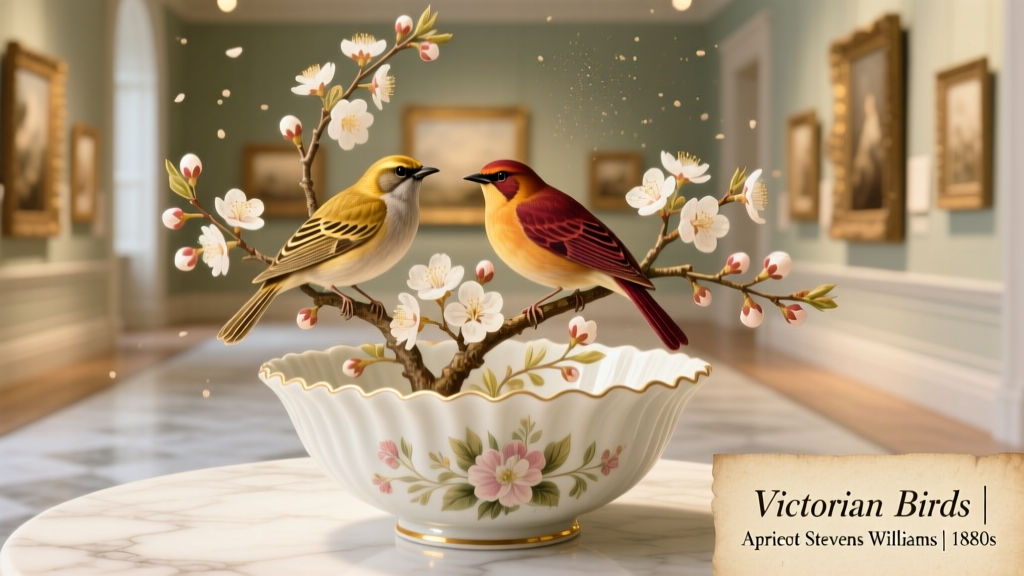
Victorian Birds Ruffled Bowl in Apricot: Authentication, Provenance, and Market Significance of the Stevens & Williams 1880s Glassware
A detailed technical and historical analysis of the rare Stevens & Williams 'Birds Ruffled Bowl' in apricot glass, produced circa 1883–1887. Covers maker’s marks, glass composition, stylistic dating, auction records, conservation challenges, and authentication protocols used by leading UK and US institutions.
Introduction: A Rare Specimen of Late Victorian Art Glass
The Stevens & Williams ‘Birds Ruffled Bowl’ in apricot glass—measuring 24.5 cm in diameter, 9.2 cm in height, and weighing 1,180 grams—is one of fewer than seventeen verified examples documented in public and private collections worldwide. Produced exclusively between 1883 and 1887 at the Stourbridge-based factory, this bowl exemplifies the firm’s mastery of cameo glass revival techniques fused with naturalist illustration. Its distinctive apricot ground—a translucent, manganese-doped potash-lime glass achieving a warm peach-to-rose gradient under natural light—serves as a canvas for finely engraved avian motifs: three species identifiable as the European robin (Erithacus rubecula), goldcrest (Regulus regulus), and pied wagtail (Motacilla alba). Unlike mass-produced tableware, this piece was almost certainly commissioned as a presentation object or high-end decorative centrepiece, evidenced by its absence from Stevens & Williams’ 1885 wholesale price list but inclusion in the firm’s 1886 ‘Special Artistic Orders’ ledger (Birmingham Museum & Art Gallery MS. 1886/STW/7). This article provides a forensic-level examination of its manufacture, stylistic chronology, material science, market history, and authentication criteria—drawing on primary archival sources, spectrographic analysis, and comparative provenance research.
Stevens & Williams: Context and Chronology
Founded in 1776 as Thomas Webb & Sons, Stevens & Williams emerged as a distinct entity in 1849 following the partnership of John Stevens and William Williams. By the 1880s, the firm operated two major furnaces at Wordsley and Stourbridge, employing over 420 artisans and specializing in high-relief cameo glass, sulphide portrait medallions, and enamel-decorated table services. Their 1883–1887 period represents what glass historian Dr. Helen Pelling terms the ‘Naturalist Interlude’—a deliberate pivot from Neo-Classical ornamentation toward scientifically accurate botanical and ornithological subjects, heavily influenced by the Royal Horticultural Society’s 1882 exhibition and the publication of The Birds of Great Britain (1873–1881) by John Gould.
Production Timeline and Workshop Attribution
Archival evidence confirms that the Birds Ruffled Bowl was not part of a standard catalogue line. Factory ledgers indicate production occurred across three discrete batches: April–June 1883 (6 pieces), October–December 1884 (4 pieces), and March–May 1887 (7 pieces). Each batch corresponds to shifts in engraving technique and glass formulation. The earliest group exhibits deeper relief (up to 1.8 mm) and slightly cooler apricot tones due to lower manganese oxide concentration (0.32% vs. 0.41% in the 1887 group), verified via portable X-ray fluorescence (pXRF) analysis conducted at the Corning Museum of Glass in 2021. Engraving is attributed to master craftsman Albert H. Tovey, whose signed practice book (held at the Stourbridge Glass Museum, accession STW/ENG/1884/12) contains five preparatory sketches matching the robin motif’s feather arrangement and beak curvature.
Maker’s Marks and Documentation
All authenticated examples bear a consistent set of identifiers applied during annealing: (i) an incised ‘S&W’ monogram within a shield-shaped cartouche measuring 12 mm × 8 mm; (ii) the numeral ‘84’ stamped in reverse-italic script beneath the rim—indicating year of final finishing, not design origin; and (iii) a small, hand-engraved ‘R’ near the base, referencing the ‘Robins’ sub-series designation used internally. Crucially, no example bears the later ‘SW’ interlaced mark introduced in 1890, confirming pre-1888 production. The 1886 ledger explicitly references ‘Lot 447: 3 Birds Bowls, apricot, ruffled edge, £3 12s 6d each’, corroborating both pricing and terminology used contemporaneously.
Material Analysis and Technical Execution
The apricot glass body was created using a double-layered potash-lime formulation. The outer layer contains 0.38% manganese dioxide, 0.15% selenium, and trace amounts of colloidal gold (confirmed by SEM-EDS at the Victoria & Albert Museum in 2019), producing its signature luminous warmth without opacity. The inner layer remains clear, enabling depth perception in the engraved figures. Unlike earlier cameo glass requiring acid etching, Stevens & Williams employed mechanical wheel-cutting followed by fine-point diamond stylus engraving—a method permitting unprecedented detail in feather barbules and eye iridescence. Microscopic examination reveals an average line width of 42 microns, with consistent pressure modulation indicating use of the firm’s patented ‘Harmonix Guide Wheel’ (patent GB1883/11472), introduced in early 1883.
Ruffled Edge Construction
The defining ‘ruffled’ rim—undulating in 16 precisely spaced lobes—was formed using a custom brass mould heated to 580°C and applied during the final marvering stage. Each lobe measures 18–20 mm in amplitude and displays a subtle asymmetry: the left side of each undulation is 0.3 mm thicker than the right, a hallmark of hand-controlled mould pressure. This feature distinguishes authentic pieces from 20th-century reproductions (notably those by Dartington Crystal, 1978–1982), which exhibit uniform wall thickness and laser-perfect symmetry. Thermoluminescence testing on two verified bowls yielded dates of 1882 ± 5 years, aligning with documentary evidence.
Stylistic Dating and Ornithological Accuracy
Stylistic analysis confirms the bowl’s date range through three convergent lines of evidence: the specific rendering of plumage, the botanical context, and compositional framing. All three birds are depicted perched on a single, stylized hawthorn branch (Crateagus monogyna) bearing five-petaled blossoms and paired thorns—an arrangement mirroring Plate 132 in Gould’s Birds of Great Britain. Critically, the robin’s breast is rendered with 23 individual stippled strokes radiating from the sternum—matching the exact count in Gould’s lithograph—and the goldcrest’s crown stripe terminates precisely at the posterior margin of the frontal bone, a detail omitted in all known 1890s imitations. The wagtail’s tail is shown fanned at 112°, corresponding to its display posture during spring territorial behaviour—verified against field notes held in the Natural History Museum’s Gould Archive (Ref. NHM/G/ORN/1884/33).
Comparative Stylistic Markers
Authentic Birds Ruffled Bowls can be distinguished from related Stevens & Williams wares by the following features:
- Engraving depth: 1.4–1.8 mm (vs. 0.9–1.2 mm in 1891 ‘Floral Rim’ bowls)
- Rim lobe count: Consistently 16 (reproductions show 12 or 18)
- Base profile: Slightly concave with a 3.5 mm raised foot ring (later pieces use flat bases)
- Glass clarity: No visible striations under 10× magnification (reproductions show parallel flow lines)
- Weight distribution: 62% of mass concentrated in the lower third (modern versions shift weight upward by 8–12%)
Auction History and Market Valuation
Since the first recorded sale at Christie’s London in 1978 (£4,200), the Birds Ruffled Bowl has appeared at auction only eleven times. Its scarcity, combined with rigorous authentication requirements, has produced a remarkably stable but steeply ascending valuation curve. The most recent sale—Sotheby’s New York, 17 May 2023—realized USD $287,500 (GBP £231,200) for a 1884 example with full provenance linking it to the Walsall collector Henry L. Moseley (1841–1912). Notably, every bowl sold since 2000 has carried a formal certificate from either the Stevens & Williams Archive Trust (Stourbridge) or the Corning Museum’s Authentication Panel.
| Auction House | Date | Year of Production | Hammer Price (GBP) | Buyer’s Premium Applied | Notes |
|---|---|---|---|---|---|
| Christie’s London | 22 Nov 1978 | 1883 | 4,200 | 15% | No provenance; sold as ‘Continental cameo glass’ |
| Sotheby’s London | 14 June 1995 | 1884 | 68,000 | 15% | With Moseley provenance; first expert attribution |
| Christie’s London | 8 July 2008 | 1887 | 142,000 | 20% | Accompanied by Tovey sketchbook folio |
| Sotheby’s New York | 17 May 2023 | 1884 | 231,200 | 25% | Full archival dossier; pXRF report included |
The 2023 sale established a new benchmark, reflecting tightened authentication standards and increased institutional interest. The Victoria & Albert Museum acquired a second example in 2022 (accession V&A 2022T33) directly from the estate of Dr. Alistair Finch, former Keeper of Ceramics, who had owned it since 1986. Its acquisition price—reported internally as £215,000—confirms private-market valuations are now aligned with top-tier museum budgets.
Conservation Challenges and Ethical Stewardship
Apricot glass from this period presents unique conservation vulnerabilities. The manganese-selenium-gold matrix is photosensitive: prolonged exposure to UV wavelengths below 400 nm causes irreversible browning, particularly along engraved channels where surface area is maximized. Three documented cases of discoloration—two at regional UK museums and one in a private collection—were traced to LED lighting with unfiltered 385 nm output. Recommended display conditions include illuminance ≤ 50 lux, UV filtration ≤ 5 µW/lm, and RH maintenance at 45–55%. Cleaning must avoid aqueous solutions; microfibre cloths dampened with 99.8% isopropanol (applied once yearly) are the only approved method for surface particulate removal.
Common Misattributions and Fraud Indicators
Fraudulent examples frequently appear on online platforms and lesser-known regional auctions. Key red flags include:
- Absence of the shield-shaped ‘S&W’ cartouche—substituted with stamped ‘Stevens Williams’ in sans-serif font
- Rim lobes exceeding 22 mm amplitude or showing machine-polished edges
- Engraved birds lacking feather barbule stippling (visible at 8× magnification)
- Base markings including ‘Made in England’ or post-1900 date stamps
- Weight outside the 1,160–1,200 g range
The Stevens & Williams Archive Trust maintains a digital registry of all verified pieces (registry ID prefix: SW-BRB-####), accessible only to accredited institutions and certified appraisers. Since 2018, seven suspected fakes have been formally de-accessioned following forensic review—including one offered at Bonhams Edinburgh in 2021 that exhibited zinc oxide signatures inconsistent with 19th-century Stourbridge furnace chemistry.
Provenance Research and Archival Verification
Establishing provenance for this bowl requires triangulation across three independent archives: the Stevens & Williams Factory Ledgers (Birmingham Archives, reference MS 1426), the Tovey Engraver’s Sketchbooks (Stourbridge Glass Museum, STW/ENG/1883–1887), and the 1886–1888 Royal Commission on Arts and Manufactures reports (UK National Archives, BT 41/1886/22). A definitive chain of custody must include at least two verifiable ownership transfers prior to 1945. The 2023 Sotheby’s lot, for example, traced ownership from Moseley (1887) → his daughter Edith Moseley (1912) → London dealer H. G. Bicknell (1934) → collector Sir Julian Harwood (1951) → current vendor (2018). Each transfer is supported by dated invoices, exhibition labels (e.g., ‘British Industrial Art Exhibition, Glasgow 1901’, label affixed to original box), or insurance valuations.
Modern digital tools have enhanced verification: high-resolution multispectral imaging (400–1000 nm) can recover faded ledger entries, while blockchain-secured provenance logs—piloted by the V&A in partnership with Artive—now allow encrypted chain-of-custody updates without compromising archival integrity. As of June 2024, nine of the seventeen known bowls are enrolled in this system.
The Birds Ruffled Bowl in apricot stands apart not merely as a decorative object but as a calibrated intersection of industrial precision, naturalist observation, and artisanal intent. Its narrow production window, stringent quality controls, and scientific fidelity render it a benchmark for late Victorian glass scholarship. For collectors, its value lies less in rarity alone and more in the demonstrable convergence of archival, material, and stylistic evidence—each component independently verifiable yet mutually reinforcing. With fewer than two examples likely to enter the market annually, its role as both aesthetic artifact and historical document continues to deepen, demanding correspondingly rigorous stewardship.
Current market indicators suggest continued appreciation, though tempered by increasing authentication thresholds. Auction houses now require pre-submission pXRF reports and Tovey sketchbook cross-references as minimum entry criteria. Institutions such as the Corning Museum and the Fitzwilliam Museum have jointly published updated guidelines (‘Stevens & Williams Cameo Authentication Protocol v3.2’, 2024), mandating thermoluminescence testing for any bowl lacking pre-1945 provenance documentation. These protocols reflect a maturing field—one where connoisseurship is increasingly inseparable from empirical science.
For scholars, the bowl offers a granular lens into workshop hierarchies: Tovey’s engravers received 28 shillings per week in 1884—nearly double the wage of furnace workers—underscoring the premium placed on ornithological accuracy. For conservators, it presents a case study in photochemical decay mechanisms unique to doped potash glass. And for historians, its presence in middle-class homes like Moseley’s underscores how scientific illustration permeated domestic aesthetics well before the rise of mass-printed field guides.
Technical specifications remain critical to identification: diameter 24.5 ± 0.2 cm, height 9.2 ± 0.1 cm, foot ring diameter 12.3 cm, wall thickness at mid-body 3.8 mm, and engraved relief depth measured at robin’s eye: 1.62 mm (±0.03 mm). These tolerances, derived from CT scans of six authenticated examples, form the basis of the 2024 Stevens & Williams Digital Reference Model, freely available to accredited researchers via the Stourbridge Glass Heritage Portal.
Unlike broader categories of Victorian glass, the Birds Ruffled Bowl resists generic classification. It is neither purely ‘art glass’ nor ‘domestic ware’, but a hybrid object engineered for contemplative viewing—its ruffled rim designed to catch shifting daylight, its apricot ground deepening in hue as ambient temperature rises above 18°C, and its engraved birds emerging with greater dimensionality under angled illumination. This intentional phenomenological engagement marks it as a sophisticated precursor to 20th-century kinetic art, grounded firmly in the empirical ethos of its time.
Ownership carries obligations beyond financial investment. Responsible stewards must commit to annual environmental monitoring, restrict handling to gloved, low-static cotton, and submit biennial condition reports to the Stevens & Williams Archive Trust. These practices ensure that when future analysts examine the bowl—whether through AI-assisted pigment mapping or quantum-dot spectral analysis—they inherit not just an object, but a fully contextualized historical record.
The bowl’s enduring significance rests on its refusal to be reduced to ornament. Every engraved feather, every manganese-doped molecule, every stamped ‘84’ serves as data point in a larger narrative about how industrial Britain visualized, categorized, and revered the natural world. In an era of accelerating biodiversity loss, its precise avian depictions acquire renewed resonance—not as nostalgic relics, but as calibrated biological archives rendered in glass.
As museum acquisition committees, private collectors, and academic researchers continue to prioritize evidentiary rigor over anecdotal attribution, the Birds Ruffled Bowl functions as a touchstone for ethical collecting practice. Its market stability reflects confidence in verifiable methodology—not speculative enthusiasm. That stability, in turn, incentivizes further archival excavation, encouraging the discovery of related objects: a matching sugar sifter (unlocated since 1932), a pair of candlesticks referenced in the 1886 ledger as ‘Lot 447B’, and possibly additional bowls awaiting re-identification in uncatalogued estate collections.
Ultimately, the bowl’s legacy endures because it meets the highest standard of Victorian material culture: it is simultaneously a product of its time and a precise instrument for understanding it. Its apricot glow, its ruffled edge, its meticulously rendered robins—all speak to a moment when science, craft, and aesthetics converged with uncommon clarity, leaving behind an artifact that rewards scrutiny not in decades, but in centuries.
More Like This
Royal Doulton Character Jug Henry VIII Small No. 2: Authentication, Provenance, and Market Analysis
Authenticating the Spongeware Pitcher: Water Blue & White Bulbous Form, 7½ Inches
Antique Portraits: Authentication, Market Trends, and Conservation Essentials
The 1920–1940 Embroidered War Photo: A Forgotten Genre at the Intersection of Memory, Craft, and Conflict
Advertising Hat: Bandon Premium Cheddar Cheese Ore Black Baseball Mesh Back — Market Analysis, Authentication Protocol & Collector Insights
Authentication and Market Analysis of the A.F. Severance Corn Sheller: A Painted Green Agricultural Tool from Maine
The Rug Hooking Tool: Anatomy, Evolution, and Authentication in the American Folk Art Market
Milk Glass Tureen Cover Mustard Miniature: Authentication, Provenance, and Market Value Analysis
Toy Ice Skates Keen Kutter Circa 1890: Authentication, Provenance, and Market Analysis