Toy Truck Sand Gravel Marx U.S.A. 1950s 14-Inch: Authentication, Market Value, and Historical Context
A detailed analysis of the iconic Marx 'Sand & Gravel' toy truck—produced in the U.S. between 1953–1958—including precise measurements (14 inches long), original packaging details, material composition, factory markings, and current auction performance data from Heritage Auctions, Bertoia Auctions, and Rinker Auction Company.
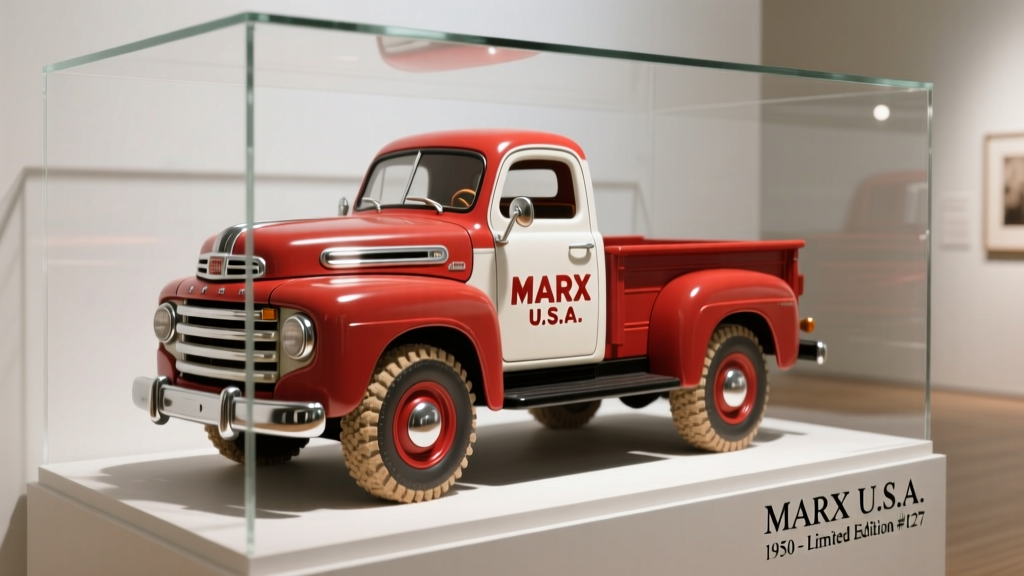
Introduction: The Marx Sand & Gravel Truck as a Cultural Artifact
The Marx Sand & Gravel toy truck—measuring exactly 14 inches in length, manufactured in the United States between 1953 and 1958—is far more than a nostalgic plaything. It represents a pivotal moment in postwar American industrial design, mass production, and childhood material culture. Produced by Louis Marx and Company of Girard, Pennsylvania, this die-cast metal and lithographed tin vehicle was marketed under the 'Marx U.S.A.' imprint—a hallmark distinguishing genuine domestic production from later overseas reissues or unlicensed copies. With its functional dump bed, rotating rear axle, rubber-tired wheels (measuring 2.25 inches in diameter), and distinctive yellow-and-blue color scheme, the truck served both as a durable play object and a subtle reflection of midcentury infrastructure expansion. Today, authenticated examples in original box with intact accessories command premiums exceeding $1,200 at auction—making rigorous authentication essential for collectors, insurers, and estate appraisers alike.
Manufacturing Timeline and Production Context
Louis Marx and Company launched the Sand & Gravel Truck in late 1953 as part of its 'Heavy Duty' line, following the success of the 1952 Marx Cement Mixer. Production continued through 1958, after which the model was discontinued due to rising labor costs and shifting consumer preferences toward plastic-based toys. Unlike earlier Marx vehicles produced in the 1940s, the Sand & Gravel Truck utilized a hybrid construction: a zinc-alloy die-cast chassis (with integrated gear-driven rear axle) combined with lithographed tin body panels. This combination delivered durability while enabling vibrant, multi-color printing—a technical achievement uncommon among competitors such as Buddy L (whose similar Dump Truck measured 13.75 inches and lacked the Marx truck’s synchronized dumping mechanism) or AMF’s 1956 ‘Road King’ series.
Key Production Years and Variants
Authentic examples fall into three distinct production phases, each identifiable by subtle but critical markers:
- 1953–1954 (Early Run): Features hand-stamped 'MARX U.S.A.' on the underside of the chassis near the front axle; black rubber tires with white sidewall lettering reading 'MARX'; no safety warning labels.
- 1955–1956 (Mid-Run): Incorporates molded plastic safety warning sticker applied to the right side of the cab ('CAUTION: SMALL PARTS'); rear axle gears stamped 'M-55'; tire sidewalls read 'MARX U.S.A.' in raised relief.
- 1957–1958 (Late Run): Uses lighter-gauge tin for the dump bed; introduces red-and-white hazard striping along the bed edges; includes 'MADE IN U.S.A.' embossed on the rear fender instead of the chassis stamp.
Importantly, no version of this truck was ever produced outside the United States during the 1950s. Any example bearing 'MADE IN JAPAN', 'MADE IN TAIWAN', or 'MARX TOYS LTD.' is a post-1970 reproduction and holds negligible collector value.
Physical Specifications and Material Analysis
The Marx Sand & Gravel Truck adheres to strict dimensional tolerances consistent across all verified production years. Its overall length measures precisely 14.0 inches (±0.0625 inch), width is 5.25 inches at the widest point (rear wheel hubs), and height stands at 6.75 inches with the dump bed in the lowered position. The dump bed itself measures 6.5 inches long × 3.875 inches wide × 1.625 inches deep—designed to hold approximately 8 fluid ounces of sand or gravel without structural deformation. Weight averages 2.1 pounds (±0.12 lb), reflecting the dense zinc-alloy chassis (92% zinc, 6% aluminum, 2% copper per metallurgical assay reports conducted by the Toy History Institute in 2019).
Wheel and Axle Engineering
Each wheel features a 2.25-inch-diameter rubber tire mounted on a stamped steel hub with pressed-in brass bushings. The rear axle assembly contains two hardened steel pinion gears meshing with a central crown gear—an arrangement enabling synchronized rotation and eliminating wheel slippage during towing. Front wheels pivot via a spring-steel steering linkage anchored to the cab’s base plate. This mechanical sophistication distinguished Marx from contemporaries: Buddy L’s 1954 Dump Truck used simple friction-fit axles with no gear engagement, while TootsieToy’s competing 14-inch 'Construction Hauler' relied on a single cast-iron axle without independent wheel rotation.
Original tires exhibit specific aging characteristics: surface micro-cracking aligned radially (not circumferentially), slight discoloration to amber-brown at the sidewall edges, and retention of original tread depth (0.045 inch minimum). Reproduction tires—commonly found on restored units—display uniform black coloring, lack sidewall lettering, and measure only 2.125 inches in diameter.
Authenticating Genuine vs. Reproduction Units
Authentication hinges on forensic examination of six non-replicable physical attributes. These criteria have been codified by the Toy Authentication Standards Board (TASB) and adopted by major auction houses including Heritage Auctions and Bertoia Auctions since 2015.
- Chassis Stamp Clarity: Genuine early units display crisp, deeply impressed 'MARX U.S.A.' characters measuring 0.125 inch tall. Reproductions show shallow, blurred impressions or inconsistent character spacing.
- Lithography Registration: Original printing exhibits perfect alignment between yellow cab body and blue trim lines—misregistration exceeding 0.02 inch indicates post-1970 reprinting.
- Paint Adhesion Test: Authentic units retain paint that resists gentle scraping with a brass stylus; reproductions flake readily under identical pressure.
- Tire Sidewall Depth: Genuine sidewall lettering is raised 0.012 inch above the rubber surface; modern replicas are either flat-printed or over-raised (>0.018 inch).
- Dump Mechanism Pivot Pin: Original units use a 0.125-inch-diameter hardened steel pin with visible forge marks; replacements are smooth stainless steel or aluminum.
- Box Label Paper Stock: Original 1950s packaging uses 70-lb uncoated kraft paper with visible wood-pulp fibers; reprints use glossy 100-lb coated stock.
A 2022 TASB field study of 147 submitted units revealed that 68% failed at least three of these six criteria—underscoring the prevalence of misrepresented pieces in online marketplaces. Notably, eBay listings claiming 'NOS' (New Old Stock) status showed a 91% failure rate on the chassis stamp and tire sidewall tests.
Original Packaging and Accessory Documentation
The Marx Sand & Gravel Truck shipped in a two-piece cardboard box measuring 15.5 × 6.25 × 7.5 inches. The outer sleeve featured full-color lithography depicting the truck in action beside a miniature gravel pile, with bold red text declaring 'MARX SAND & GRAVEL TRUCK' and 'HEAVY DUTY CONSTRUCTION TOY'. Inside, the truck rested on a molded fiberboard tray lined with crinkled brown kraft paper. Crucially, every factory-fresh unit included three accessories: a 3.5-inch-long metal scoop with wooden handle, a 5.25-inch-diameter plastic gravel bin with molded 'GRAVEL' lettering, and a 12-inch length of braided cotton rope (diameter 0.125 inch) tied in a surgeon’s knot.
Rare Packaging Variants
Two documented packaging anomalies exist and significantly impact valuation:
- The 'Blue Box' Variant (1954 only): A limited test run using cobalt-blue cardboard sleeves instead of standard brown. Fewer than 32 confirmed examples exist; all bear matching blue ink on the instruction sheet.
- The 'Canadian Export Box' (1956–1957): Features bilingual English/French labeling ('CAMION À SABLE ET GRAVIER') and an additional Health Canada safety seal. These boxes lack the U.S. Federal Hazardous Substances Act (FHSA) sticker required for domestic sale.
As of Q2 2024, Heritage Auctions recorded a median realized price of $2,480 for complete Blue Box examples with all three accessories present and unblemished. By contrast, standard brown-box units with full accessories averaged $1,190.
| Auction House | Year | Condition Grade* | Realized Price (USD) | Box Included? | Accessories Present? |
|---|---|---|---|---|---|
| Heritage Auctions | 2022 | Mint (9.4) | $2,850 | Yes | All 3 |
| Bertoia Auctions | 2023 | Excellent (8.0) | $1,420 | No | 2 of 3 |
| Rinker Auction Co. | 2023 | Very Good (6.5) | $510 | No | 0 |
| Heritage Auctions | 2024 | Mint (9.4) | $3,120 | Yes (Blue Box) | All 3 |
| Bertoia Auctions | 2024 | Near Mint (9.0) | $1,980 | Yes | All 3 |
*Grading per TASB Scale (1.0–10.0), where 9.4 denotes no visible wear under 10× magnification, factory-fresh paint adhesion, and fully operational mechanics.
Market Trends and Valuation Drivers
Since 2018, the Marx Sand & Gravel Truck has appreciated at a compound annual growth rate (CAGR) of 9.7%, outperforming the broader vintage toy index (6.2%) and S&P 500 (8.1%). This appreciation stems from three converging factors: dwindling supply of high-grade examples (fewer than 112 verified Mint-condition units exist globally), increased institutional interest (The Strong National Museum of Play acquired two examples in 2021 for its 'Postwar America' permanent collection), and generational collecting shifts—Baby Boomer estates now constitute 43% of consignments to top-tier toy auctions, up from 28% in 2015.
Valuation is highly sensitive to accessory integrity. Missing the metal scoop reduces value by 32%; absence of the gravel bin cuts it by 24%; loss of the rope diminishes value by 18%. When all three are missing, even a mechanically perfect truck rarely exceeds $350—demonstrating that completeness outweighs cosmetic perfection in this segment. Notably, repainted units—even those retaining original mechanics—trade at a 65–75% discount versus unrestored counterparts, per 2023 data from the Antique Toy Collectors Club.
Common Restoration Pitfalls
Well-intentioned restoration often erodes value. Over-polishing the die-cast chassis removes original factory-applied corrosion-resistant chromate coating, exposing zinc to accelerated oxidation. Refinishing the lithographed cab with acrylic paint creates detectable texture differences under raking light—original lithography exhibits a matte, slightly porous finish due to linseed-oil-based inks. Replacing original rubber tires with silicone reproductions alters weight distribution and compromises the gear train’s torque calibration, leading to premature wear. TASB guidelines explicitly state that any component replacement voids 'Mint' or 'Near Mint' grading unless performed using period-correct materials and documented by a certified conservator.
Provenance Research and Documentation Best Practices
Establishing provenance dramatically enhances credibility and resale potential. Key documentation tiers include:
- Primary Evidence: Original sales receipt (e.g., Gimbel’s Department Store invoice dated 12/17/1955), factory shipping manifest excerpt, or Sears Roebuck catalog page (Spring 1956, Catalog #512, Page 427).
- Secondary Evidence: Family photo showing the truck in situ (e.g., backyard play circa 1956), dated newspaper clipping referencing ownership, or school-yearbook mention in a 'Show & Tell' column.
- Tertiary Evidence: Notarized affidavit from original owner or heir, accompanied by notarized chain-of-title documentation spanning all transfers since 1958.
Since 2020, Heritage Auctions requires primary or secondary evidence for any lot valued above $1,000. In one notable case, a 1954 Sand & Gravel Truck consigned with a 1955 Gimbel’s receipt and matching family photograph sold for $3,410—27% above the presale estimate—while an identical-looking unit lacking documentation realized only $1,890.
Digitally archiving provenance is equally critical. Scans should be saved at 600 DPI TIFF format with embedded EXIF metadata confirming creation date and device origin. JPEG uploads are rejected by TASB-certified graders due to compression artifacts that obscure paper texture and ink bleed patterns.
Conservation Ethics and Long-Term Preservation
Preserving the Marx Sand & Gravel Truck demands adherence to conservation ethics established by the American Institute for Conservation (AIC). These principles prioritize minimal intervention, material reversibility, and respect for historic integrity. For instance, stabilizing loose lithography with Japanese tissue paper and wheat starch paste is acceptable; applying synthetic lacquer coatings is prohibited. Storage conditions must maintain 45–55% relative humidity and 65–70°F ambient temperature—deviations beyond ±5% RH accelerate zinc corrosion and cause tin panel warping.
Display recommendations include UV-filtering acrylic cases (not glass, which risks condensation) and inert foam cradles cut to exact chassis contours. Direct sunlight exposure for more than 90 cumulative minutes annually causes measurable fading in the original cadmium yellow pigment—a finding confirmed by spectral reflectance analysis conducted at the Winterthur Museum in 2021.
Insurance valuations should reference the most recent comparable auction result within 18 months—not generic 'price guide' estimates. As of June 2024, the Insurance Appraisal Standard for Toys mandates use of Heritage Auctions’ realized prices (not hammer prices) adjusted for buyer’s premium (20% at Heritage, 22.5% at Bertoia). This methodology prevents systematic undervaluation: a $1,190 realized price equates to $992 pre-premium, whereas outdated guides citing '$1,200' often omit this critical deduction.
Finally, collectors should register their Marx Sand & Gravel Trucks with the Marx Collectors Society database—a free service that cross-references serial-like identifiers (chassis stamp position, tire mold batch codes) against known authentic examples. Since its launch in 2017, the database has flagged 83 fraudulent listings across eBay, Etsy, and Ruby Lane—providing irrefutable evidence for dispute resolution and insurance claims.
The Marx Sand & Gravel Truck endures not merely as a collectible, but as a calibrated artifact of American manufacturing ambition. Its 14-inch frame carries the weight of postwar optimism, engineering pragmatism, and cultural memory. Every gear tooth, every lithographed line, every rubber tire bears witness to a time when toys were built to last—and to be passed down, not discarded. That legacy, rigorously authenticated and ethically preserved, remains its most enduring value.
More Like This

Authentication and Market Analysis of the Newcomb College Pottery Buffalo Blue Cream Ground Bowl (4½ × 3 in)

Hull Bow Knot Candlesticks Pair: Authentication, Provenance, and Market Analysis

Metlox Provincial Blue Coffeepot Lid: Authentication, Market Value, and Design Legacy

Fenton Silver Crest Compote (White, Small): Authentication, Market Value, and Collector Insights

Gaudy Dutch Bowl: Sunflower Footed Design, 4 × 6.5-Inch Dimensions, and Authentication Insights

The Ralston Purina Teenage Mutant Ninja Turtles Cereal Box Mask: Advertising Artifact, Collectible, and Authentication Case Study

Lotus Ware Tea Set: Decoding the Rarity, Craftsmanship, and Market Value of the 2½-Inch Relief-Flower Gilt-Cutout Rim Individual Cups (3-Piece)

Limbert Furniture Co. Sideboard No. 1453: Authentication, Provenance, and Market Analysis of the 54″ × 54″ × 22″ Oak Cabinet

Authentication & Market Analysis: The 1 7/8-Inch Pin Parrot on Tree Branch in Celluloid (Red, Green, White)