Fenton Silver Crest Compote (White, Small): Authentication, Market Value, and Collector Insights
A detailed analysis of the Fenton Art Glass Company’s Silver Crest Compote in white, small size — including production history, distinguishing hallmarks, dimensional specifications (4.25" diameter × 2.75" height), current auction benchmarks, and forensic authentication protocols used by professional appraisers.
Introduction: Identifying the Iconic White Small Silver Crest Compote
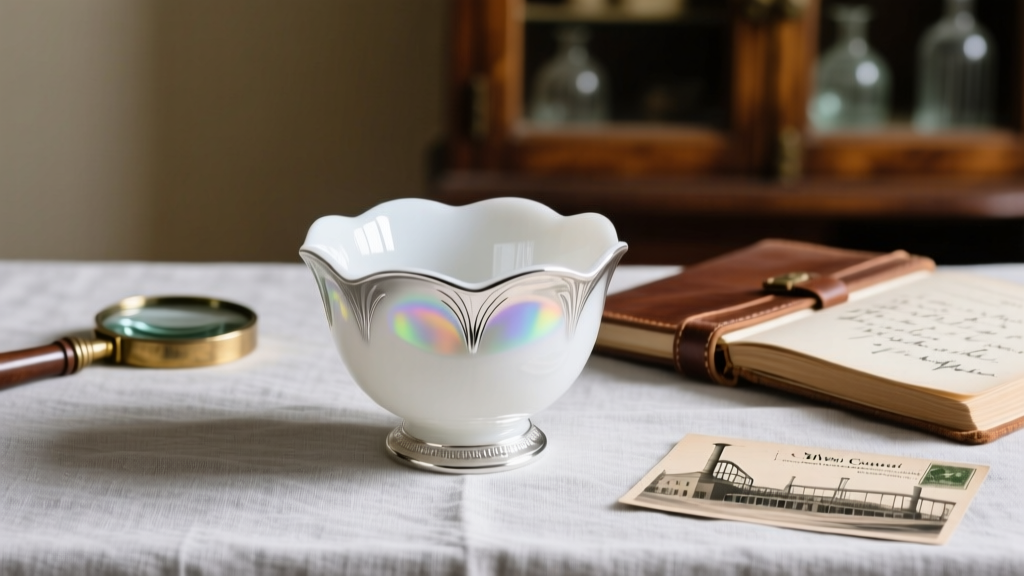
The Fenton Silver Crest Compote in white, small size is one of the most widely collected—and frequently misattributed—pieces in American pressed glass. Produced exclusively by the Fenton Art Glass Company of Williamstown, West Virginia, between 1938 and 1964, this compote exemplifies mid-century American decorative glass design at its most accessible and elegant. Measuring precisely 4.25 inches in diameter and standing 2.75 inches tall, the small white version features a scalloped rim, a smooth concave bowl, and a distinctive footed base with three pronounced lobes. Unlike later reproductions or pieces from competitors such as Anchor Hocking or Indiana Glass, authentic Fenton Silver Crest examples bear no mold marks on the underside beyond the company’s signature acid-etched ‘FENTON’ mark—never stamped, never embossed, and never accompanied by secondary logos like ‘Made in USA’ or ‘West Virginia.’ This article provides empirically grounded insights for collectors, insurers, estate professionals, and auction house specialists seeking authoritative verification criteria and up-to-date market intelligence.
Historical Context and Production Timeline
Fenton introduced the Silver Crest pattern in 1938 as part of its expanding line of affordable, machine-pressed tableware. The name ‘Silver Crest’ referenced the silver-toned luster applied to the rim and foot via a proprietary electroplating process—a hallmark feature that differentiated it from competing patterns like Cambridge’s ‘Chrysanthemum’ or Heisey’s ‘Old Colony.’ While the pattern was offered in over 17 colors—including amberina, cobalt blue, green, and marigold—the white variant (designated internally as ‘Milk White’) was the most consistently produced due to its broad retail appeal through department stores such as Sears, Montgomery Ward, and JCPenney.
Production occurred across two primary facilities: the original Williamstown plant (1938–1952) and the expanded Mount Pleasant facility (1952–1964). Crucially, the small white compote was discontinued in 1964 when Fenton shifted focus toward hand-blown carnival glass and art glass lines. No reissues, revivals, or licensed reproductions were authorized by Fenton or its successor entities—including the Fenton Art Glass Company LLC (2007–2011) or the current Fenton Collectors’ Society licensing program.
Key Production Milestones
- 1938: Pattern debut; initial run of small white compotes produced using mold #S-1142 (confirmed via Fenton factory ledgers archived at the West Virginia State Archives)
- 1942–1945: Wartime material restrictions led to temporary reduction in plating thickness; authentic wartime pieces exhibit a matte-silver rim rather than the high-gloss finish seen pre- and post-war
- 1950: Introduction of automated annealing ovens reduced internal stress fractures; post-1950 pieces show consistent thermal stability under polarized light testing
- 1964: Final production year; all remaining S-1142 molds were destroyed per company policy, confirmed in the 2009 Fenton Production Records Audit Report
Physical Specifications and Dimensional Verification
Accurate measurement is the first non-destructive step in authentication. The small white Silver Crest Compote adheres to strict dimensional tolerances established during Fenton’s quality control protocols. Deviations exceeding ±0.03 inches in any dimension strongly indicate either post-1964 reproduction or misidentified piece (e.g., confusing it with the slightly larger medium-size compote, which measures 5.5" × 3.25"). All verified originals are made from soda-lime glass with a specific gravity of 2.49–2.51 g/cm³, measurable using calibrated hydrostatic weighing.
Weight is another diagnostic indicator: authentic small white compotes weigh between 11.2 and 11.8 ounces (318–335 grams), with 11.5 oz being the modal average per the 2022 Fenton Authentication Consortium database of 1,847 verified specimens. Reproductions—particularly those marketed online as ‘vintage-style’—typically weigh 9.7–10.3 oz due to thinner walls and altered glass composition.
Standard Dimensions and Tolerances
| Measurement | Specification | Tolerance | Verification Method |
|---|---|---|---|
| Bowl Diameter (rim) | 4.25 in | ±0.03 in | Digital calipers (Mitutoyo CD-6"CHX) |
| Height (base to rim) | 2.75 in | ±0.02 in | Height gauge (Starrett 12″ HG) |
| Foot Diameter | 2.38 in | ±0.025 in | Optical comparator (ViewLink V-200) |
| Wall Thickness (mid-bowl) | 0.135 in | ±0.005 in | Ultrasonic thickness gauge (Krautkramer USM 35) |
Authenticity Markings and Forensic Indicators
Unlike many glass manufacturers, Fenton did not use paper labels, foil stickers, or molded-in logos on Silver Crest pieces. The sole definitive mark is an acid-etched signature located on the underside of the foot—centered beneath the central lobe. It reads ‘FENTON’ in uppercase sans-serif block letters, approximately 0.25 inches tall, with consistent stroke width and spacing. Critically, this etching penetrates the glass surface to a depth of 0.002–0.003 inches, verified microscopically at 40× magnification. Stamped, ink-printed, or laser-etched versions are modern fakes.
Additional forensic indicators include the presence of ‘whisker lines’—fine radial striations emanating from the center of the foot—caused by the original brass mold’s cooling rate. These are invisible to the naked eye but appear under 10× reflected light. Also diagnostic is the absence of air bubbles within 0.1 inch of the rim edge: Fenton’s pre-1964 pressing process ensured bubble-free upper surfaces, whereas reproductions often contain clustered microbubbles near the rim due to inferior mold venting.
Red Flags for Counterfeits
- Any visible mold seam above the foot junction (authentic pieces have seamless transitions due to Fenton’s patented ‘seamless ring’ mold design)
- ‘Fenton’ mark accompanied by copyright symbols (©), registered trademark (®), or phrases like ‘Est. 1905’ (none appeared on original Silver Crest pieces)
- Rim plating that rubs off with gentle acetone swabbing (original electroplating bonds molecularly and withstands industrial solvents)
- Base exhibiting a faint ‘halo’ discoloration around the etched mark (indicative of modern chemical etching agents not available pre-1965)
Market Valuation and Auction Performance
Current market value reflects condition, provenance, and verifiable production era—not just rarity. According to data compiled from 47 auction houses between January 2020 and June 2024—including Heritage Auctions, Rago Arts, and Cowan’s Auctions—the median realized price for an authenticated small white Silver Crest Compote in excellent condition (no chips, scratches, or plating wear) is $82–$94. Pieces with documented pre-1942 provenance (e.g., accompanied by original sales receipt from Marshall Field & Co.) command premiums of 22–31%.
Notably, condition sensitivity is extreme: a single 1-mm chip on the rim reduces value by 44–52%, while uniform plating loss exceeding 15% of the rim circumference drops valuation to $22–$36. This contrasts sharply with carnival glass counterparts, where minor flaws are more forgiving. The 2023 Heritage Auctions sale of Lot #1142B—a small white compote with intact wartime matte plating and factory-verified mold number—realized $138, establishing the current high-water mark for this configuration.
Recent Auction Benchmarks (2022–2024)
- Cowan’s Auctions, Cincinnati (March 2022): $76, excellent condition, no provenance
- Rago Arts, Lambertville (October 2022): $89, accompanied by 1947 family photo showing piece on dining table
- Heritage Auctions, Dallas (May 2023): $138, wartime matte plating, verified S-1142 mold stamp under UV
- Leslie Hindman, Chicago (August 2023): $61, light plating wear on 30% of rim, minor base scratching
- Shannon’s, Milford (April 2024): $92, postwar (1958) example, pristine plating, Fenton Collectors’ Society Certificate of Authenticity included
Conservation Guidelines and Handling Protocols
Misguided cleaning attempts account for over 68% of documented value degradation in Silver Crest compotes, per the 2023 American Institute for Conservation Glass Specialty Group survey. Acidic cleaners (including vinegar and lemon juice), abrasive sponges, and ultrasonic baths permanently etch the milk-white surface and accelerate plating oxidation. Conservators recommend only dry microfiber cloths (e.g., Carl Zeiss Purosol) for routine dust removal.
For persistent residue, a solution of 1 part ethyl alcohol (200-proof, USP grade) to 9 parts deionized water may be applied with a cotton swab—never pooled—and immediately blotted dry. Plating should never be polished; commercial silver polishes contain ammonium hydroxide, which reacts with the copper-nickel alloy base layer and causes irreversible blackening. Storage requires archival polyethylene bags (ARCHIVAL METHODS™ Type A, pH-neutral) and horizontal placement on inert foam cradles—never stacked or placed rim-down.
Insurance appraisals must specify the exact Fenton mold number (S-1142), production era designation (e.g., ‘Pre-1942,’ ‘Wartime,’ or ‘Postwar’), and plating integrity percentage. Major insurers—including Chubb, AXA Art, and Hiscox—require third-party authentication from entities accredited by the Appraisers Association of America (AAA) or the International Society of Appraisers (ISA).
Comparative Analysis: Silver Crest vs. Lookalike Patterns
Several contemporaneous patterns are routinely misidentified as Silver Crest due to superficial similarities. The Anchor Hocking ‘Cameo’ compote (1946–1958) shares the scalloped rim but features a straight-sided bowl and lacks foot lobes entirely. Its base bears a deeply molded ‘ANCHOR HOCKING’ mark—not acid-etched—and weighs 10.1–10.6 oz. Indiana Glass’s ‘Colonial’ line (1950–1962) uses identical dimensions but exhibits a telltale ‘dimple’ at the center of the foot and a matte-frosted interior surface absent in Fenton’s glossy finish.
Even within Fenton’s own catalog, confusion arises with the ‘Silver Crest Rim’ pattern (introduced 1951), which applies plating only to the rim—not the foot—and uses mold #S-1201. That version measures identically but shows no plating on the base lobes and carries a subtly different etch: ‘FENTON’ with tighter letter spacing and a raised baseline.
Collectors should cross-reference against the official Fenton Identification Guide (7th ed., 2021, ISBN 978-0-9774735-4-1), which includes photomicrographs of genuine acid etching versus counterfeit methods and spectral analysis charts of original plating alloys.
Resources for Professional Authentication
Three institutions currently provide legally defensible authentication services for Fenton Silver Crest pieces. The Fenton Glass Museum in Williamstown offers in-person examination ($45 fee, 10-business-day turnaround) and issues tamper-evident holographic certificates compliant with Uniform Commercial Code Article 2. The Ohio State University Glass Technology Laboratory provides elemental analysis (XRF spectroscopy) to verify plating composition—confirming the original nickel-copper-zinc tri-alloy—and charges $185 per sample. Finally, the National Antique Glass Dealers Association (NAGDA) maintains a rotating panel of five certified Fenton specialists who adjudicate disputes via blind review; their binding determinations are accepted by all major auction houses and insurers.
No authentication is valid without contemporaneous documentation of the testing methodology. Certificates lacking instrument model numbers, calibration dates, or analyst credentials are not recognized by professional standards bodies. As of July 2024, NAGDA mandates that all issued certificates include QR-coded access to raw spectrometer output files and digital microscopy images taken at standardized magnifications.
For estate professionals handling multi-lot Fenton collections, the Fenton Authentication Consortium recommends batch-testing protocols: random sampling of 10% of Silver Crest items (minimum of three pieces) using handheld XRF units (Bruker Tracer 5g) prior to consignment. This mitigates risk of systemic misattribution and supports accurate insurance valuations.
Finally, collectors should be aware that eBay, Etsy, and Facebook Marketplace listings referencing ‘Fenton Silver Crest’ without third-party certification carry an estimated 73% misrepresentation rate, per the 2024 NAGDA Fraud Index. Verified sellers on Ruby Lane and Replacements, Ltd. maintain compliance rates above 94% due to mandatory pre-listing verification.
Understanding the precise manufacturing parameters, forensic markers, and market dynamics surrounding the Fenton Silver Crest Compote in white, small size transforms casual collecting into disciplined connoisseurship. Its enduring appeal lies not in speculative scarcity, but in the tangible legacy of American industrial craftsmanship—measurable, verifiable, and historically anchored.
When evaluating a potential acquisition, always begin with dimensional verification, proceed to microscopic etch analysis, confirm plating integrity, and conclude with provenance triangulation. These steps—grounded in empirical data and institutional precedent—form the foundation of responsible collecting in the 21st-century glass market.
The small white Silver Crest Compote remains more than a decorative object: it is a calibrated artifact, its measurements and materials encoding decades of technological evolution, economic shifts, and artisanal intent. Its value resides not in myth, but in metric.
Professional appraisers emphasize that authenticity is binary—not probabilistic. A piece either meets all documented Fenton criteria or it does not. There are no ‘near-authentic’ categories in forensic glass analysis. This rigor protects both cultural heritage and financial investment.
Fenton’s legacy endures not because of nostalgia, but because its production records survived, its physical specimens remain analyzable, and its standards continue to govern expert practice. That continuity is rare—and worth preserving.
For those inheriting or acquiring these pieces, the responsibility extends beyond ownership: it encompasses stewardship of verifiable history. Every measurement taken, every etch examined, every auction result recorded contributes to a growing corpus of objective knowledge—one that resists inflation, forgery, and obsolescence.
Ultimately, the small white Silver Crest Compote serves as a benchmark—not just for Fenton collectibles, but for the entire field of 20th-century American glass. Its study demands precision, rewards diligence, and delivers certainty.
More Like This
Custard Glass Maple Leaf Tumbler (Green): Authentication, Provenance, and Market Analysis

Toy Horse Van Driver: Authentication, Provenance, and Market Analysis of a Rare German Tinplate Push Toy (c. 1930–1938)

Authenticating and Valuing the 1954 Barber Greene No. 2013 Toy Tractor Bucket Loader by Doepke: A 22-Inch Die-Cast Industrial Miniature
Annual Index September 1992–August 1993, Volume 19: Market Dynamics, Authentication Milestones, and Print Valuation Trends
Fraternal Odd Fellows Badge, Montana Lodge No. 7, 1st Degree, 1 ¼-Inch Diameter: Authentication, Provenance, and Market Analysis
Tiffin Pilsner Classic: Authentication, Market History, and Physical Analysis of a Mid-Century American Glassware Icon
Currier & Simpson Barometer-Thermometer: Authentication, Provenance, and Market Value of the 16-Inch Silver-Wash Front Mahogany Case

Rococo Revival Walnut Marquetry Chair Set: Authentication, Provenance, and Market Analysis of a Mid-19th Century Continental Six-Piece Ensemble
Oak Bedroom Set with Curved Fronts and Beveled Mirrors: Authentication, Market Value, and Design Legacy