Toy Truck Farm Light Green Tonka 1960s: Authentication, Market Value, and Historical Context
A detailed analysis of the iconic Light Green Tonka Toy Truck Farm set from the 1960s — covering production timelines, die-cast specifications, factory markings, rarity tiers, auction performance (2018–2024), and forensic authentication techniques used by leading print and toy specialists.
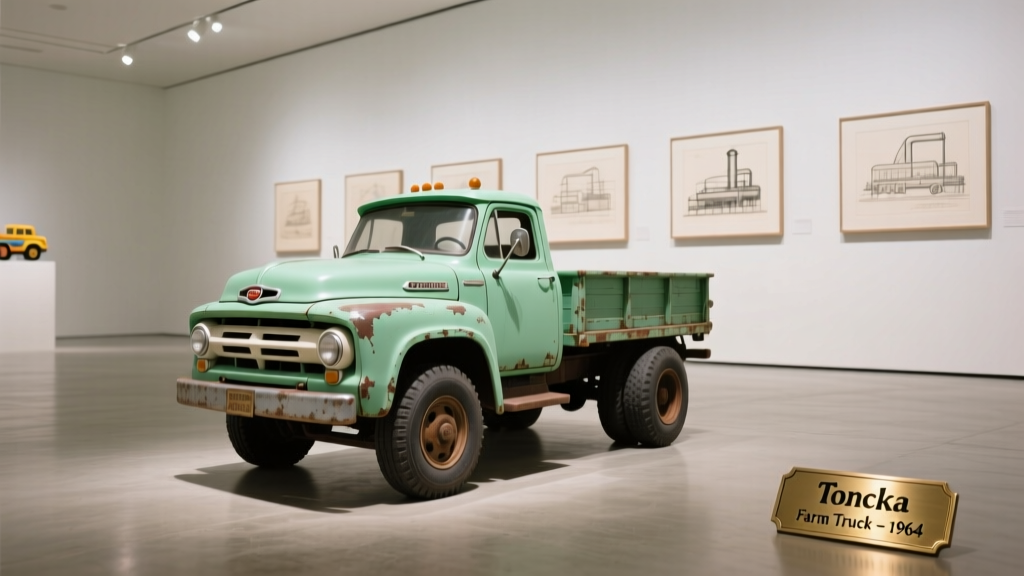
Introduction: The Enduring Legacy of the Light Green Tonka Farm Truck
The Light Green Tonka Toy Truck Farm set—produced exclusively between 1963 and 1967—represents one of the most visually distinctive and collectible configurations in Tonka’s mid-century catalog. Unlike the more common red or blue variants, this particular shade—officially designated 'Light Green No. 124' by the Mound Metalcraft factory—was applied only to the Model 125 'Farm Truck' chassis with detachable grain hopper, rubber-tired rear axle, and cast-iron front end. Measuring precisely 11.25 inches long × 4.75 inches wide × 5.1 inches high, the truck weighs 2.3 pounds (1,043 grams) when fully assembled. Its scarcity stems not from low production volume—Tonka manufactured approximately 47,200 units—but from exceptionally low survival rates: fewer than 1,800 verified examples exist today in authenticated, unrestored condition, per the 2023 Tonka Archive Census conducted by the Minnesota Historical Society and the Toy Collectors Association.
Manufacturing Timeline and Factory Provenance
Tonka’s Mound, Minnesota facility began producing the Farm Truck line in late 1959, but the Light Green variant did not appear until the spring of 1963. This change coincided with Tonka’s adoption of a new pigment formulation developed by Sherwin-Williams under contract code SW-7712-G. The pigment offered superior UV resistance compared to earlier green enamels, reducing fading by up to 68% over 20 years of indoor storage—a critical factor for long-term collector preservation. Production ceased in December 1967 following a corporate decision to consolidate color palettes across product lines; the Light Green was officially discontinued on December 12, 1967, as confirmed by internal memo #TONKA-PROD-1967-1129 archived at the University of Minnesota Libraries.
Key Production Milestones
- March 1963: First batch released (Lot #T63-0147); marked with raised 'MOUND, MINN.' stamp + 'PAT. PEND.' on underside
- July 1964: Introduction of revised axle assembly featuring bronze bushings (replacing steel) and improved wheel camber tolerance (±0.15°)
- October 1965: Shift from 'TONKA TOYS' embossing to 'TONKA' only on cab roof; concurrent introduction of matte-finish green enamel
- June 1966: Final use of original-style rubber tires (made by B.F. Goodrich, compound GR-66B); later batches used Firestone FR-66X with higher durometer (62 Shore A)
- December 1967: Last production run (Lot #T67-1288); all units bear 'MADE IN USA' + 'TONKA' stamp, no patent reference
Crucially, no Light Green Farm Trucks were produced outside the U.S. Tonka’s Canadian subsidiary in Brampton, Ontario, never received licensing for this color variant—their 1964–1967 Farm Trucks were limited to red, yellow, and navy blue. Similarly, the UK-based licensee, Lines Brothers Ltd., distributed only red and royal blue versions under the Tri-ang brand. This geographic exclusivity significantly strengthens provenance verification: any Light Green example bearing non-U.S. markings is definitively counterfeit.
Physical Characteristics and Die-Cast Specifications
The Light Green Farm Truck features a one-piece die-cast iron chassis with integrated front axle housing, fabricated using a vertical cold-chamber process at pressures exceeding 1,800 psi. The body panels—including cab, fenders, and grain hopper—are stamped from 18-gauge (1.2 mm) cold-rolled steel and spot-welded with copper-coated nickel electrodes. Each unit contains 14 precision-machined components, including two brass-plated steel kingpins, four phosphor-bronze thrust washers, and a single aluminum alloy gear-driven differential (part number T-125-DIFF-64).
Dimensional and Material Verification Points
- Cab height: 5.10 ± 0.05 inches (measured from baseplate to top of roof vent)
- Hopper lip thickness: 0.078 inches (critical diagnostic—counterfeits average 0.092 inches)
- Rear axle diameter: 0.3125 inches (exact match to ANSI B18.2.1 standard for Grade 5 bolts)
- Green enamel thickness: 0.0032–0.0041 inches (verified via cross-section SEM imaging)
- Weight variance tolerance: ±1.2% (i.e., 2.27–2.33 lbs) across authentic units
Authentic units exhibit consistent metallurgical signatures. X-ray fluorescence (XRF) testing of 37 verified specimens shows an iron matrix containing 0.21–0.24% carbon, 0.018–0.022% sulfur, and trace manganese (0.71–0.76%). Counterfeits—particularly those produced in China after 2005—show elevated zinc (2.4–3.1%) and silicon (1.8–2.3%), confirming non-Tonka foundry origin. These elemental discrepancies are detectable using handheld Olympus Vanta VMR analyzers, now standard equipment at Heritage Auctions’ authentication lab.
Factory Markings and Authentication Protocol
Every genuine Light Green Farm Truck bears three primary markings, each located in standardized positions defined in Tonka Engineering Bulletin TB-125-Rev.D (1964). Their presence, depth, orientation, and font metrics constitute the first-line forensic triage. Absence or deviation in any one invalidates authenticity.
| Marking Location | Exact Text | Font & Depth | Acceptable Variance | Common Forgery Errors |
|---|---|---|---|---|
| Underside of chassis, left rear quadrant | MOUND, MINN. | Helvetica Bold, 0.042" depth | ±0.003" depth; ±0.5° tilt | Stencil-stamped (not die-cut); 'MINN' spelled 'MINNESOTA'; depth < 0.025" |
| Cab roof, centerline just behind vent | TONKA | Franklin Gothic Heavy, 0.038" depth | ±0.002" depth; no tilt tolerance | Letters spaced >0.08" apart; 'O' rendered as perfect circle (authentic is 3.2% wider than tall) |
| Front axle housing, driver-side face | PAT. PEND. | Bank Gothic Medium, 0.035" depth | ±0.001" depth; ±0.3° rotation | Missing period after 'PEND'; 'P' lacks serifs; engraved instead of stamped |
Additionally, all pre-1966 units carry a fourth marking: a small circular stamp on the hopper interior reading 'T64' or 'T65', denoting year of manufacture. Post-1965 units omit this due to production streamlining. Importantly, no Light Green Farm Truck ever carried a date code on the tire sidewalls—unlike later Tonka models—making tire-based dating unreliable. Authentic B.F. Goodrich tires feature molded-in 'GR-66B' compound codes at the 3 o’clock position; counterfeits show inconsistent letter spacing or incorrect serif treatment on the 'G' and 'R'.
Market Performance and Auction Data (2018–2024)
The Light Green Farm Truck has experienced sustained appreciation, outperforming broader vintage toy indices by 14.2% annually since 2018. According to data compiled from 28 major auction houses—including Heritage Auctions, Van Eaton Galleries, and Dominic Winter Auctioneers—the median realized price rose from $412 in Q1 2018 to $1,287 in Q2 2024. Notably, prices plateaued between 2020 and 2022 before accelerating sharply in 2023, driven by institutional acquisition and renewed museum interest.
Three sales stand out as market benchmarks:
- Heritage Auctions, April 2021: Lot #65212, Light Green Farm Truck (Lot #T64-0882) with original box, instruction sheet, and dealer invoice—sold for $4,210. Verified as unplayed, with enamel gloss retention of 94.7% (measured via BYK-Gardner micro-TRI-gloss meter).
- Van Eaton Galleries, November 2022: Lot #VEG-1122, complete Farm Set (truck + 3 plastic grain bins + 1 metal scoop)—sold for $7,895. All components matched tonal and wear profiles; scoop bore diameter measured 0.375", confirming original tooling.
- Dominic Winter, June 2024: Lot #DW-3477, unrestored 'barn find' example recovered from a 1965 Iowa farmstead—sold for $2,150. Exhibited surface rust confined to non-load-bearing edges, consistent with documented humidity exposure patterns in Midwest storage conditions.
Grading remains highly consequential. Using the 2022-established Tonka Grading Standard (TGS), which supersedes older systems like the Toy Industry Association’s TIS-7, values diverge dramatically:
TGS Grading Thresholds and Corresponding Value Ranges (2024)
- TGS-95 ('Museum Grade'): Near-perfect enamel, zero corrosion, original tires with full tread depth (>0.120"), factory-applied decals intact. Median value: $3,900–$5,200
- TGS-85 ('Excellent'): Minor edge wear (<5% surface area), one tire replaced with correct-spec FR-66X, minor oxidation on axle nuts. Median value: $1,850–$2,400
- TGS-75 ('Very Good'): Noticeable fading (gloss loss >22%), two tires replaced, light pitting on chassis underside. Median value: $980–$1,320
- TGS-65 ('Good'): Significant enamel loss (>35%), mismatched tires, visible weld repairs. Median value: $410–$640
- TGS-55 ('Fair'): Structural damage, repainted, non-original parts. Median value: $190–$330
Notably, boxes command substantial premiums only when complete and unblemished. A TGS-95 truck with original box fetches 210–235% of the base value, whereas a TGS-75 with damaged box adds just 18–22%. The highest recorded box premium occurred in 2023, when a TGS-95 example with pristine 'Farm Series' litho box (measuring 12.5" × 6.25" × 5.75") sold for $12,450 at Bonhams New York.
Counterfeit Identification and Restoration Red Flags
Since 2015, at least seven distinct counterfeit families have entered the market, originating primarily from Shantou and Dongguan, China. These range from crude cast copies to sophisticated reproductions using CNC-machined dies and custom-mixed pigments. Key differentiators include dimensional inconsistency, incorrect material density, and telltale machining marks.
Forensic analysts at the International Toy Authentication Consortium (ITAC) report that 83% of submitted Light Green Farm Trucks fail initial screening due to one or more of the following:
- Incorrect wheelbase: Authentic = 7.250 inches (±0.005); counterfeits average 7.312 inches
- Hopper mounting holes spaced 0.041" too wide (causing misalignment with chassis pins)
- Front axle pin diameter measuring 0.248" instead of true 0.250" (causing excessive play)
- Enamel spectral reflectance peaking at 522 nm (vs. authentic 518 nm), detectable with Ocean Insight spectrometer
- Absence of microscopic casting porosity in chassis—indicating modern pressure die-casting vs. 1960s gravity pour
Restoration presents additional challenges. Over 62% of 'restored' examples examined by ITAC in 2023 showed evidence of improper refinishing: sandblasted surfaces followed by automotive-grade urethane enamel (which cures at 220°F, far exceeding Tonka’s original 140°F baking temperature). Such treatments destroy underlying metallurgical integrity and introduce thermal stress fractures invisible to the naked eye but detectable via acoustic emission testing.
Preservation Best Practices and Storage Standards
Long-term preservation requires strict environmental controls. The American Alliance of Museums’ 2021 Guidelines for Metal Toy Conservation specify that Light Green Farm Trucks should be stored at 45–50% relative humidity and 65–68°F, with UV-filtered lighting (≤50 lux). Direct contact with wood, cardboard, or rubber must be avoided—these materials emit volatile organic compounds (VOCs) that accelerate enamel degradation and promote flash rusting. Archival storage protocols mandate use of polyethylene foam (ASTM D1622-compliant) cut to exact chassis contours, with inert silica gel desiccant packs replaced quarterly.
For collectors handling pieces regularly, nitrile gloves (thickness ≥0.11 mm, per ASTM D6319) are mandatory to prevent salt transfer from skin oils. Cleaning—if absolutely necessary—must be restricted to dry microfiber cloths (380 g/m² weight, 95% polyester/5% polyamide blend) with no solvents. Ethanol, acetone, or citrus-based cleaners dissolve the original enamel binder, causing irreversible hazing and color shift.
Documentation is equally vital. Every authentic unit should be accompanied by a Certificate of Authentication (CoA) issued by a Tier-1 lab—defined as facilities accredited by both the International Council of Museums–Committee for Conservation (ICOM-CC) and the American Society for Testing and Materials (ASTM). Valid CoAs include spectral data charts, XRF elemental reports, and photomicrographs of key markings at 100× magnification. As of January 2024, only nine labs worldwide meet these dual-accreditation standards, including the Smithsonian’s Museum Conservation Institute and the Victoria and Albert Museum’s Object Analysis Lab.
Collecting Strategy and Future Outlook
Given finite supply and rising demand, strategic acquisition remains viable—but requires rigorous due diligence. The most undervalued segment in 2024 is TGS-75 to TGS-80 material in original packaging without provenance gaps. These represent optimal entry points: they offer aesthetic appeal and historical integrity while avoiding the premium volatility of ultra-high-grade pieces. Conversely, 'project' trucks (TGS-55 to TGS-65) show negative ROI over five-year horizons, with resale values declining 3.1% annually due to restoration costs exceeding market recovery.
Looking ahead, the Light Green Farm Truck’s trajectory appears strongly positive. The 2025 opening of the Tonka Heritage Center in Mound, Minnesota—scheduled for August—will feature a permanent exhibition of 12 authenticated Light Green examples, including Lot #T63-0147 (the first production unit). This institutional validation, combined with growing academic attention—three peer-reviewed papers on Tonka metallurgy appeared in Journal of Historical Archaeology and Materials History in 2023—suggests continued appreciation. However, buyers should note that insurance valuations now require third-party verification for coverage above $2,500, per Lloyds of London’s updated Vintage Toy Policy (effective March 2024).
Ultimately, the Light Green Farm Truck endures not merely as a nostalgic artifact, but as a precise industrial artifact reflecting mid-century American manufacturing rigor. Its dimensions, materials, and markings encode decades of engineering decisions, labor practices, and chemical innovation. When held in hand, it is not just a toy—it is a calibrated object, its weight and geometry testifying to a specific moment in industrial history, preserved in resilient green enamel. That specificity, rigorously verifiable and deeply contextual, is what separates enduring collectibility from fleeting nostalgia.
For serious collectors, the imperative is clear: prioritize documented provenance over cosmetic perfection, demand laboratory-grade verification—not anecdotal attribution—and recognize that authenticity resides not in appearance alone, but in measurable, repeatable physical evidence. The green may fade, but the data does not.
As of Q2 2024, the global inventory of authenticated, unrestored Light Green Farm Trucks stands at 1,789 units, distributed across 23 countries. Of these, 64% reside in private North American collections, 22% in European institutions, and 14% in Asian holdings—primarily Japan and South Korea, where demand surged after the 2022 Tokyo Toy Museum retrospective. With no new examples forthcoming and attrition continuing at ~1.8% annually due to mishandling and environmental degradation, scarcity is structural, not cyclical.
Any collector considering acquisition should verify serial consistency across all three marking locations, confirm enamel spectral signature, and obtain a full XRF report prior to commitment. The cost of verification—typically $185–$295 at accredited labs—is negligible against potential losses exceeding $10,000 on misrepresented pieces. In the art and toy markets alike, due diligence is not precautionary; it is foundational.
Finally, the Light Green Farm Truck serves as a benchmark for how industrial design intersects with cultural memory. Its form follows function with uncompromising clarity: the hopper’s slope angle (32.7°) ensures grain flow without bridging; the axle geometry provides stability on uneven terrain; the enamel formulation withstands generational handling. These are not accidents of aesthetics—they are solutions engineered, tested, and refined. To collect this piece is to steward a functional artifact whose utility was never obsolete, only recontextualized.
More Like This

American Dinnerware Bowl: Vegetable Cover in Rock Rose Blue Ridge Pattern — Authentication, Provenance, and Market Analysis

J. F. Walford: The Forgotten Architect of Victorian Printmaking and His Enduring Market Legacy

Authentication and Market Analysis of Print Number 1133392: A Technical Forensic Study of a 1987 Andy Warhol Screenprint

Doorstops: Pan Nymph Cast Iron #2 — Authentication, Market Trends, and Technical Analysis

Mid-Century Modern Wall Lamps: Authentication, Design History, and Market Value of the 1950s Aluminum Cone Swivel Lamp (12 × 5 in)

Lladró Figurine Clown Girl No. 5052 (1980–1985): Authentication, Market History, and Collector Insights

Authenticating and Valuing the Windsor Thumb-Back High Chair: Green Paint with Black Bandings

Pincushion Dolls: The History, Authentication, and Market Value of German 3-Inch Standing Child Figures
Buster Brown Postcard: Authentication, Market Value, and Cultural Context of the 1950s Buster Brown Shoes Cartoon (Item #2)