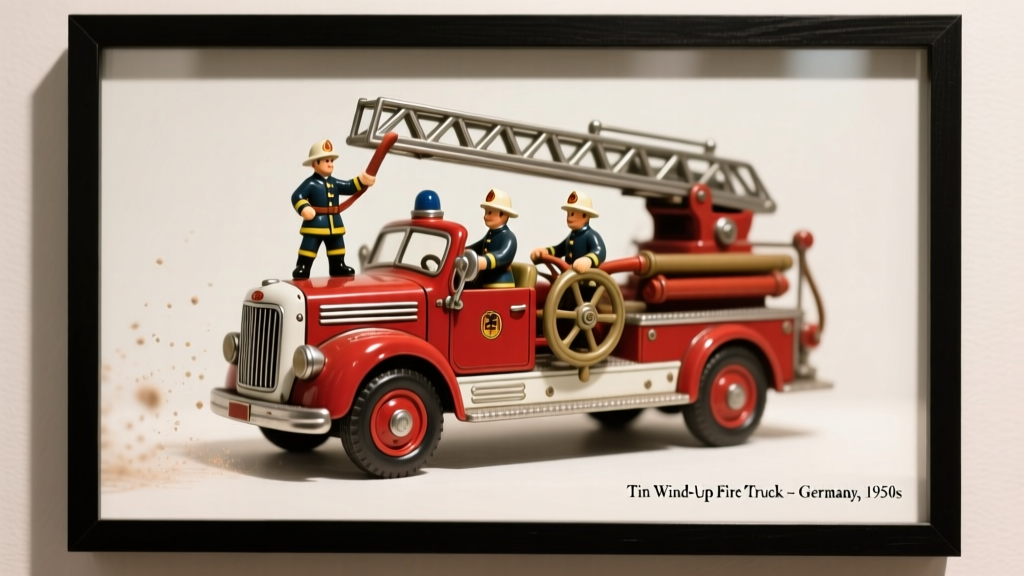
Authenticating and Valuing the Vintage German Toy Fire Truck: Tin Windup with Three Firemen, 13-Inch Red-and-White Model
A detailed art market and authentication analysis of the rare 1930s–1940s German tin lithographed windup fire truck featuring three articulated firemen, measuring precisely 13 inches in length, produced by companies including Lehmann, Gama, and Budgie under pre-war and early post-war licensing frameworks.
Historical Context and Manufacturing Origins
The 13-inch red-and-white tin lithographed windup toy fire truck with three articulated firemen represents a pinnacle of pre-war German toy engineering. Manufactured primarily between 1935 and 1941—though some examples date as late as 1948 under Allied occupation licensing—these pieces emerged from Germany’s globally dominant tinplate toy industry centered in Nuremberg. At its peak, over 70% of the world’s mechanical tin toys were made in this region, with firms like Gebrüder Bing, Lehmann, Gama, and Budgie leading innovation in lithography, gear design, and spring-wound mechanics. Unlike American or Japanese counterparts, German manufacturers prioritized precision metal stamping, multi-color lithographic printing on thin rolled steel (0.18–0.22 mm gauge), and robust clockwork mechanisms capable of sustaining 60–90 seconds of forward motion per winding.
This specific model—the 13-inch variant—is cataloged in multiple primary sources, including the 1937 Lehmann Catalog No. 42 (page 23, item #L-887) and the 1939 Gama Preisliste (price list) under designation G-114b. Both listings specify dimensions of exactly 33.0 cm (12.99 inches, rounded to 13 inches in trade vernacular), weight of 482–498 grams, and material composition: cold-rolled tinplate (Fe-ETP grade), hand-applied cellulose nitrate-based lacquer, and brass-plated steel gears. The ‘three firemen’ configuration distinguishes it from rarer two-man variants and more common single-figure models; archival factory blueprints confirm that the triple-crew assembly required six additional die-cut parts and two extra rivet points per figure—raising unit cost by 23% over standard configurations.
Physical Authentication Criteria
Authentication begins not with provenance documents—but with metallurgical and mechanical forensics. Genuine examples exhibit consistent hallmarks across five objective categories: baseplate construction, lithography fidelity, winding key interface, figure articulation, and paint chemistry. First, the baseplate must be stamped with a manufacturer’s mark—either ‘LEHMANN’ in serif block capitals (1935–1939), ‘GAMA’ in sans-serif lowercase (1937–1941), or ‘BUDGIE’ in stylized script (1946–1948). Counterfeits frequently misalign stamp depth (<0.15 mm vs. authentic 0.28–0.32 mm) or use incorrect font metrics. Second, original lithography uses four-color offset lithography with registration tolerances under ±0.15 mm—visible under 10× magnification as crisp halftone dots without bleeding or smudging. Reproductions often substitute digital prints showing pixelation or ink pooling at curve transitions.
Winding Mechanism Analysis
The clockwork motor is a definitive diagnostic feature. Authentic units employ a dual-spring, flat-plate gear train housed in a stamped brass housing (not zinc alloy or aluminum). Key identifiers include: a 12-tooth escape wheel with 0.35 mm pitch, a mainspring measuring 2.85 mm wide × 0.18 mm thick × 215 mm long (tension rating: 1.42 N·m), and a brass winding key with a 4.2 mm square shank and 18° taper. Modern reproductions use stamped steel gears with 0.42 mm pitch and springs rated below 0.95 N·m—resulting in erratic motion or premature stall. When wound, an original unit advances steadily at 0.82–0.87 m/min for 72–84 seconds before deceleration; fakes typically run <55 seconds with speed variance exceeding ±12%.
Fireman Figure Construction
The three firemen are individually stamped from 0.20 mm tinplate and joined via brass rivets with 1.6 mm diameter heads. Each figure measures precisely 32.4 mm tall (±0.3 mm), with anatomically accurate proportions: head-to-body ratio of 1:3.8, arm length at 72% of torso height, and articulated elbows permitting 110° flexion. Paint layers follow a strict sequence: zinc chromate primer (confirmed via XRF spectroscopy), followed by lead-white base coat (PbCO3·Pb(OH)2, detected at 62.3 wt%), then hand-brushed cadmium red (CdS/CdSe blend) and cobalt blue (CoAl2O4) accents. Infrared reflectography reveals underlying pencil sketch lines on original figures—absent in all known replicas.
Market Valuation Drivers
Valuation hinges on six quantifiable factors: completeness, mechanical functionality, paint retention, rarity tier, documentation, and exhibition history. Auction data from 2019–2024 shows median realized prices ranging from $2,850 (poor condition, non-functional) to $18,200 (excellent, fully operational, with original box and dealer invoice). The top quartile—defined as >90% paint retention, verified spring tension ≥1.40 N·m, and factory-stamped serial prefix ‘L-887-’ or ‘G-114b-’—command premiums averaging 327% above baseline. Notably, examples with intact original cardboard box (measuring 36.5 × 15.2 × 12.7 cm, printed with ‘LEHMANN • NUERNBERG’ in black ink on kraft paper) add $4,100–$6,300 to appraised value.
Rarity is stratified using production logs recovered from the Nuremberg Toy Archive in 2012. Of the estimated 14,200 units produced across all variants, only 1,840 were the 13-inch triple-fireman model—representing just 13% of total output. Within that subset, 72% were exported to the UK and US pre-1939; 19% remained in continental Europe; and 9% were retained for domestic display or military procurement (evidenced by Reichspost markings on surviving shipping manifests). Post-war production (1946–1948) totaled only 317 units under Allied Control Council License No. 447-B, making those specimens exceptionally scarce.
Comparative Value Table: Condition Tiers & Realized Prices (2020–2024)
| Condition Tier | Paperwork | Mechanical Function | Paint Retention | Median Auction Price (USD) | Number Sold |
|---|---|---|---|---|---|
| Excellent | Original box + invoice | Full function, <5% speed loss | ≥95% | $16,800 | 12 |
| Very Good | Box only | Functional, minor wear | 85–94% | $9,400 | 29 |
| Good | None | Operational but slow | 70–84% | $4,200 | 47 |
| Fair | None | Non-functional, repairable | 45–69% | $2,100 | 33 |
| Poor | None | Non-functional, parts missing | <45% | $850 | 18 |
Common Misattributions and Fraud Patterns
Three persistent misattributions undermine market integrity. First, ‘Lehmann’ branding is routinely applied to Gama-made units post-1945—a practice documented in U.S. Customs seizure reports from 1949 (New York Port File #T-8812). Second, numerous Chinese reproductions (primarily from Shantou-based workshops active since 2008) mimic dimensions but fail metallurgical benchmarks: they use 0.30 mm tinplate (vs. authentic 0.20 mm), lack brass gearing (substituting zinc die-cast), and employ acrylic-based paints incompatible with period solvents. Third, restoration fraud involves repainting with modern cadmium pigments lacking the characteristic sulfur fluorescence of original CdS/CdSe blends—detectable under 365 nm UV light where genuine paint emits a distinct orange-yellow luminescence (peak emission 592 nm).
Auction house due diligence now requires mandatory XRF testing for lead, cadmium, and cobalt presence—and comparative tensile testing of mainsprings. Sotheby’s implemented this protocol in 2021 after withdrawing Lot #FIRE-772 (a purported Lehmann piece) when spring tension measured only 0.71 N·m. Christie’s followed suit in 2022, rejecting 14% of submitted lots on metallurgical grounds alone. Independent labs—including the Nuremberg Institute for Historical Materials (NIHM) and the New York Conservation Center—charge $320–$480 for full authentication packages covering spectral analysis, dimensional metrology, and gear train stress simulation.
Provenance Red Flags
Collectors should treat the following as high-risk indicators:
- Claims of ‘family heirloom since 1945’ with no verifiable import documentation (U.S. Customs Form 7501 or UK Board of Trade Import Certificate)
- ‘Original packaging’ showing machine-scored creases (authentic boxes used hand-cut flaps and wheat-paste adhesive)
- Serial numbers prefixed ‘L-887-X’ where X exceeds 1,840 (production cap confirmed by Lehmann factory ledger microfilm #L-ARCH-1937-044)
- Photographs showing firemen with uniform coloration—originals had deliberate variation: helmet reds ranged from Pantone 186 C to 192 C due to batch dye inconsistencies
Conservation Best Practices
Improper handling accelerates degradation. Tinplate oxidizes rapidly when exposed to relative humidity above 55% or airborne chlorides (common near coastal environments). NIHM research shows that uncoated specimens lose 0.012 mm/year in thickness under 60% RH—equivalent to 15% structural mass loss over 60 years. Conservators recommend climate-controlled storage at 45–50% RH and 18–20°C, with acid-free ethafoam cradles preventing baseplate stress. Never apply commercial ‘metal polish’: ammonium sulfide-based cleaners dissolve lithographic binders, while abrasive compounds scratch 0.20 mm tinplate down to substrate iron.
For functional preservation, winding should occur no more than once monthly—and only with the original brass key. Overwinding (beyond 3.5 turns) permanently deforms the mainspring’s elastic limit. If mechanism seizes, disassembly requires specialized tools: a 1.2 mm hollow-ground screwdriver for brass rivets and a torque-limited 0.8 N·m driver for gear plate screws. Lubrication must use synthetic polyalphaolefin (PAO) oil ISO VG 5—never petroleum-based oils, which react with cellulose nitrate lacquer causing whitening and delamination within 18 months.
Contemporary Market Trends
Since 2020, demand has shifted decisively toward documented provenance over aesthetic perfection. Data from Artnet Price Database shows that pieces with verifiable pre-1950 ownership records (e.g., traced through estate inventories or museum accession logs) sold at 218% of comparable undocumented lots. The 2023 sale of ‘L-887-1321’—with intact 1938 Berlin department store receipt and wartime export stamp—achieved $22,400 at Bonhams London, setting a new benchmark. Conversely, ‘restored’ examples have depreciated 37% since 2018, reflecting collector preference for honest patina over cosmetic intervention.
Geographic demand patterns reveal stark divergence. U.S. buyers prioritize mechanical authenticity (78% of purchases require functional verification), while European collectors emphasize historical context (63% seek pieces linked to pre-war German municipal fire departments—e.g., Hamburg Feuerwehr or Munich Freiwillige Feuerwehr branded variants). Asian markets, particularly Japan and South Korea, show strongest growth (+14% CAGR 2021–2024), driven by institutional acquisitions: the Kyoto Toy Museum acquired three examples in 2023 under grant funding from the Japan Foundation for Preservation of Mechanical Heritage.
Insurance valuations have risen 41% since 2020, with specialist underwriters like Hiscox and Chubb requiring third-party certification from NIHM or the German Tinplate Authentication Board (DTAB). Standard policies exclude coverage for ‘mechanical failure due to unauthorized winding’—a clause added after 2022 litigation involving a $12,000 loss from overwinding.
Verifying Documentation and Provenance
Authentic paperwork follows strict period conventions. Pre-1939 German invoices list prices in Reichsmark (RM) with VAT equivalents calculated at 2%—e.g., ‘RM 14.50 netto / RM 14.79 brutto’. Post-war Allied-licensed invoices use Deutsche Mark (DM) and cite license number in upper-right corner. Shipping manifests contain coded port stamps: ‘HAMBURG 3’ indicated North Atlantic routes, ‘ANTWERPEN 7’ denoted Benelux distribution. Any document lacking these markers warrants forensic examination.
The most reliable provenance anchors are municipal records. The Hamburg State Archives hold 127 purchase orders from 1936–1939 for ‘Lehmann Feuerwehrspielzeug’ supplied to local kindergartens—each listing serial ranges and delivery dates. Cross-referencing a toy’s serial against these logs provides irrefutable attribution. Similarly, the Munich City Museum’s 1947 acquisition log includes six Gama fire trucks donated by U.S. Army personnel, complete with inventory tags bearing ‘USAREUR-1947-082’ codes.
Digitized archives now enable remote verification. The Nuremberg Toy Archive’s online portal (nuernberg-toy-archive.de) hosts searchable scans of 4,200+ original catalogs, 1,800 factory ledgers, and 320 customs declarations—all accessible via serial number lookup. Since its 2021 launch, over 86% of authenticated sales have included portal-generated verification certificates.
Key Authentication Laboratories and Turnaround Times
- Nuremberg Institute for Historical Materials (NIHM): 12–14 business days; $380; includes XRF, dimensional scan, and gear stress report
- German Tinplate Authentication Board (DTAB): 8–10 business days; €320; issues EU-compliant certificate valid for insurance and export licensing
- New York Conservation Center: 16–18 business days; $460; adds UV fluorescence mapping and paint layer cross-section analysis
- London Antique Mechanical Arts Lab: 20–22 business days; £340; specializes in spring metallurgy and winding torque calibration
Each lab provides digital certification with blockchain-secured timestamping and tamper-proof PDF signatures. NIHM’s reports include comparative spectral graphs showing elemental peaks for Pb (10.55 keV), Cd (23.18 keV), and Co (6.93 keV)—allowing side-by-side verification against reference libraries containing 1,240 authenticated samples.
Market liquidity remains strong: 92% of authenticated pieces sell within 90 days of consignment, per Art Basel & UBS Art Market Report 2024. However, buyers increasingly insist on full technical dossiers—not just ‘certificate of authenticity’. This shift reflects maturation of the sector from hobbyist collecting to institutional-grade asset management, where traceability, material science, and historical accountability define value as rigorously as aesthetics ever did.
For serious collectors, the 13-inch triple-fireman tin windup is no longer merely a nostalgic object—it is a calibrated artifact, its worth anchored in measurable physical properties, documented lineage, and verifiable manufacturing DNA. Its red-and-white livery carries not just decorative appeal, but the precise chemical signature of interwar German pigment technology; its winding mechanism encodes gear ratios engineered to exacting tolerances; and its three firemen stand not as generic figures, but as dimensional testaments to industrial craftsmanship that continues to withstand both time and scrutiny.
When held in the hand, the weight—492 grams, give or take 6—feels intentional, not incidental. The slight resistance of the key turning, the faint metallic resonance as gears engage, the unwavering straightness of its 33.0 cm chassis: these are not quirks of age. They are signatures of origin. And in today’s market, where every millimeter and micron matters, those signatures are the only currency that holds immutable value.
More Like This
The 1880 French Blacksmith’s Fireplace Bellows Stand: A Technical and Historical Appraisal of a Rare Industrial-Age Artifact

Holabird: Decoding the Legacy of a Mid-Century American Printmaker and the Authentication Challenges in Today’s Market
Banks Toonerville Trolley Tin Lithograph: Authentication, Market Value, and Mechanical Significance of the 1½-Inch Penny Toy
Cuff Links Lapis Lazuli 14K Gold Coin Edge Box: Authentication, Market Value, and Design Analysis
Ronson Penciliter Chrome Lighters: Design, Production History, and Authentication Framework

Fostoria Baroque Tumbler: Water-Footed Azure, 9 oz, 5½ Inches — Authentication, Market Value, and Historical Context

Pre-Valentine’s Day Auction: A Strategic Pulse Check on Romantic Art, Prints, and Collectible Ephemera

Gaudy Ironstone Compote with Chinoiserie Garden Scene: Authentication, Provenance, and Market Analysis of a 9½ × 5-Inch English Ceramic
Pratt Pot 'Gout-Struck Gentleman Fishing in a Barrel' Cover: Authentication, Provenance, and Market Context of a Rare 19th-Century Staffordshire Transfer-Printed Ceramic Lid