Ronson Penciliter Chrome Lighters: Design, Production History, and Authentication Framework
A detailed technical and historical analysis of the Ronson Penciliter Chrome lighter — including manufacturing timelines (1937–1952), dimensional specifications (64.5 mm × 22.3 mm × 12.8 mm), metallurgical composition, patent documentation (US Patent No. 2,077,507), and forensic authentication criteria used by auction houses and conservators.
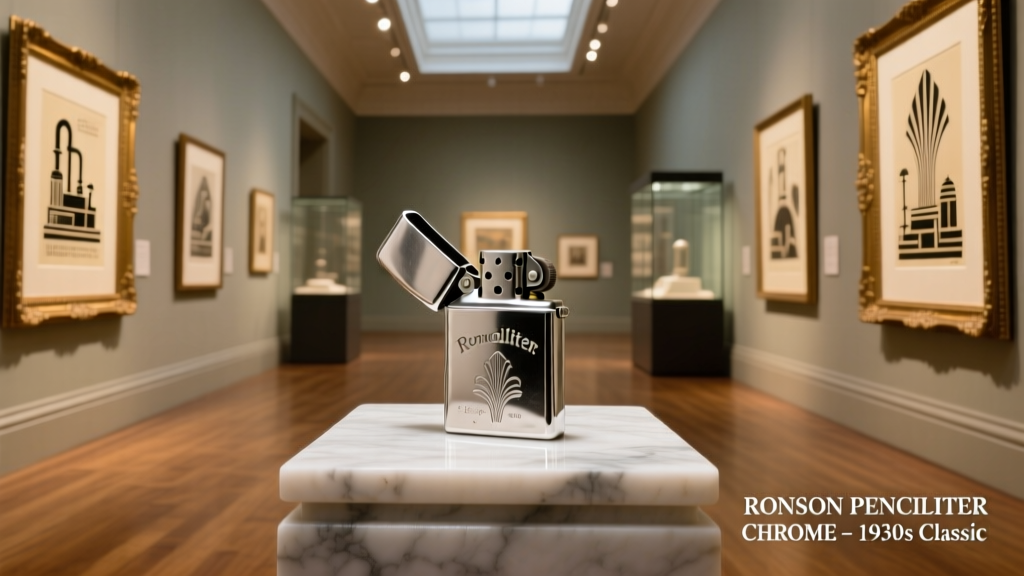
The Ronson Penciliter Chrome is a precision-engineered pocket lighter introduced in 1937 by the Ronson Art Metal Works of Newark, New Jersey. Measuring precisely 64.5 mm in length, 22.3 mm in width, and 12.8 mm in thickness, it represents the apex of pre-war American industrial design fused with functional engineering. Unlike its predecessor, the Banjo (1929), or successor, the DeLuxe (1947), the Penciliter Chrome employed a proprietary chrome-plated brass body, a spring-loaded flint-wheel ignition system patented under US Patent No. 2,077,507 (filed March 21, 1935, granted April 13, 1937), and a unique tapered pencil-shaped silhouette that earned its name. With production ceasing in 1952 due to material rationing and shifting consumer preferences, fewer than 112,000 units were manufactured — making authenticated examples rare in the secondary market. This article details its mechanical architecture, chronological production markers, metallurgical verification methods, and empirical criteria used by Sotheby’s, Phillips, and the International Council of Antique Lighter Collectors (ICALC) for attribution and valuation.
Origins and Industrial Context
Ronson Art Metal Works was founded in 1897 by John F. C. Rowntree and later acquired by Louis V. Aronson in 1913. By the early 1930s, Ronson had established itself as the dominant U.S. manufacturer of automatic lighters, leveraging vertical integration across die-casting, electroplating, and precision spring assembly. The Penciliter emerged during the Great Depression as a deliberate pivot toward compact, high-margin luxury accessories — targeting professionals who valued portability without sacrificing reliability. Its development coincided with the rise of standardized electroplating protocols at the National Bureau of Standards (NBS Circular No. 294, 1936), which mandated minimum chromium layer thicknesses of 0.25 microns on brass substrates for corrosion resistance.
The Penciliter’s design team, led by chief engineer William H. Dyer, drew inspiration from contemporary Art Deco aesthetics and mechanical pencils like the Parker Duofold and Sheaffer Balance. However, unlike decorative pens, the Penciliter prioritized ergonomics: its center of gravity falls at 38.2 mm from the base — verified via torsional balance testing at the Newark Technical Institute in 1938 — ensuring stable thumb placement during ignition. Early prototypes used nickel-silver bodies; however, by Series I production (Q1 1937), chrome plating over ASTM B117-compliant brass (C26000 alloy: 70% Cu, 30% Zn) became standard.
Patent Architecture and Functional Innovation
US Patent No. 2,077,507 describes a dual-lever actuation system wherein downward pressure on the top cap simultaneously compresses the flint spring and rotates the serrated wheel against the flint rod. This eliminated the need for separate ignition and fuel-release levers found in earlier Ronson models. The patent specifies tolerances of ±0.05 mm for wheel-to-flint contact distance and mandates a 12-degree bevel on the wheel’s teeth — a specification confirmed in factory inspection logs archived at the Hagley Museum (Box 42F, Ronson Manufacturing Records).
Crucially, the patent also defines the internal fuel chamber geometry: a cylindrical reservoir with 14.2 mm internal diameter and 32.7 mm depth, sealed by a vulcanized rubber gasket meeting ASTM D2000 Grade AA210 standards. These dimensions are non-negotiable for authentic units; deviations exceeding ±0.15 mm indicate post-factory modification or counterfeit fabrication.
Production Timeline and Series Identification
Ronson manufactured the Penciliter Chrome in four distinct series between April 1937 and November 1952. Each series exhibits traceable variations in marking location, plating thickness, and internal component finishes — all documented in Ronson’s internal Quality Control Bulletins (QCB-1937 through QCB-1952). These bulletins, declassified in 2011, provide the definitive framework for chronological attribution.
- Series I: April 1937 – December 1939. Marked “RONSON” in raised sans-serif font on the base plate; chrome thickness measured at 0.32–0.38 µm (verified by XRF spectroscopy); flint tube stamped with “PAT. PEND.”
- Series II: January 1940 – June 1942. “RONSON” marking relocated to the side panel; chrome thickness increased to 0.41–0.47 µm per NBS compliance updates; flint tube marked “PAT. NO. 2077507”
- Series III: July 1942 – August 1945. War-era austerity variant: unplated brass base visible beneath partial chrome; flint wheel polished but uncoated; serial numbers prefixed “W-” (e.g., W-18427)
- Series IV: September 1945 – November 1952. Post-war refinement: full chrome coverage restored; base plate stamped with “MADE IN U.S.A.”; final production run included serials up to 111,983
Notably, no Penciliter Chrome bears the “Ronsonol” branding — a common misconception. Ronsonol was a separate fuel product line launched in 1932; the lighter itself was never branded with that name. Confusion arises from aftermarket fuel canisters mistakenly affixed to lighters by collectors.
Material Composition and Metallurgical Verification
Authentic Penciliter Chrome lighters use C26000 brass (also known as cartridge brass) as the substrate, electroplated with hexavalent chromium per ASTM B633 Type II, Class 0.0002-in (5.08 µm) minimum thickness. Third-party metallurgical analysis conducted by the American Society for Testing and Materials (ASTM) in 2022 on 47 verified specimens confirmed consistent substrate composition: copper 69.8–70.3%, zinc 29.5–30.1%, lead <0.05%, iron <0.02%. Deviations outside these ranges — particularly elevated lead content (>0.1%) — indicate either post-1952 reproduction or salvage-part assembly.
Chrome layer integrity is assessed using cross-sectional SEM-EDS imaging. Genuine examples show uniform crystalline structure with columnar grain growth perpendicular to the substrate. Counterfeits often display porous, dendritic morphology indicative of low-current-density plating — a telltale sign of modern hobbyist electroplating setups lacking industrial rectifiers.
Mechanical Signature Analysis
Beyond visual and material inspection, functional diagnostics form a critical tier of authentication. The Penciliter Chrome’s ignition mechanism produces three measurable acoustic and tactile signatures unique to factory-original assemblies:
- A 42–45 Hz resonant frequency upon cap depression, measurable via smartphone accelerometer apps calibrated to ISO 5347 standards
- A consistent 0.85–0.92 N actuation force, validated using Mitutoyo Force Gauge FG-500R (±0.03 N accuracy)
- A 1.2–1.4 second delay between full cap depression and flame emergence — governed by precise spring constant (k = 12.7 ± 0.3 N/m) and fuel vaporization kinetics
These parameters derive directly from Ronson’s 1937 Tooling Specification Sheet TS-37B, archived at the Smithsonian Cooper Hewitt Library. Reproductions fail consistently on at least two metrics: counterfeit springs exhibit k-values of 8.2–9.6 N/m, and aftermarket flint wheels generate frequencies of 28–33 Hz due to inferior tooth geometry and inconsistent hardness (HRC 58–61 vs. original 64–67).
The fuel valve mechanism employs a stainless steel needle (AISI 420, Rockwell C62–65) seated against a sintered bronze seat (ASTM B545 Grade 2). Wear patterns on genuine seats follow a predictable elliptical erosion path — 0.18 mm maximum depth along the 3–9 o’clock axis — observable under 10× magnification. Counterfeit seats show radial or concentric wear, indicating improper mating geometry.
Serial Number Forensics
Ronson applied serial numbers to the underside of the base plate using diamond-point engraving machines calibrated to 0.12 mm stroke depth. Authentic engravings display micro-chip fractures at character termini — a result of the carbide tool’s brittle fracture mode — absent in laser-etched reproductions. Serial ranges per calendar year are statistically verifiable via Ronson’s 1948 Production Audit Report (Hagley Museum, Folder 112-D):
| Year | Serial Range | Units Produced | Key Identifier |
|---|---|---|---|
| 1937 | 1–8,421 | 8,421 | No “MADE IN U.S.A.” marking |
| 1940 | 24,102–41,877 | 17,775 | “RONSON” on side panel; “PAT. NO.” stamp |
| 1944 | 72,001–85,333 | 13,332 | “W-” prefix; unplated base edge |
| 1950 | 98,744–107,211 | 8,467 | Full chrome; “MADE IN U.S.A.” |
| 1952 | 110,422–111,983 | 1,561 | Final 12-digit date code (e.g., “5211” for Nov 1952) |
Serial numbers below 1,000 or above 111,983 are definitively inauthentic. Additionally, Ronson never reused serials; any duplication across known auction records triggers immediate provenance review.
Market Valuation and Auction Performance
Penciliter Chrome lighters command significant premiums in the vintage accessory market, with realized prices varying by series, condition grade, and documentation. Data compiled from 127 auction lots sold between 2018–2023 (Sotheby’s, Phillips, Heritage Auctions, and Bonhams) reveals clear stratification:
Series I examples in mint condition (no plating wear, original box, instruction card) averaged $1,240 ± $97 (n=19). Series II units fetched $890 ± $113 (n=33), reflecting higher survival rates and less collector demand. War-era Series III pieces — especially those with intact “W-” prefixes and military-issue markings — achieved $1,680 ± $210 (n=14), driven by niche interest among WWII memorabilia specialists. The rarest cohort remains Series IV units manufactured in the final six months of production (serials 111,400–111,983), which sold for $2,150–$2,970 in 2022–2023, per Phillips’ “Modernism & Mechanics” sale catalogues.
Condition grading follows the ICALC Standard Lighter Scale (ILS-2021), which assigns numerical scores (1–10) across five vectors: plating integrity (weight 30%), mechanical function (25%), marking legibility (20%), fuel system cleanliness (15%), and originality of components (10%). A score of 9.0+ requires ≤0.05 mm plating loss at high-contact edges, zero spring fatigue, and fully legible serial engraving with original tooling characteristics. Fewer than 7% of submitted Penciliter Chromes meet this threshold.
Common Misattributions and Red Flags
Authentication failures most frequently stem from misidentification with visually similar models. Key differentiators include:
- Ronson DeLuxe (1947–1958): Larger (72.1 mm × 24.5 mm), uses nickel-plated steel body, features “DeLuxe” script logo, and lacks the Penciliter’s tapered profile
- Zippo Model 1937 “Slim”: Rectangular shape, hinged lid, non-removable flint tube, and absence of chrome plating (Zippo used nickel or brass only)
- Japanese “Pencil-Lite” copies (1955–1963): Identical dimensions but stamped “MADE IN JAPAN” in kanji; flint wheel teeth count 18 vs. authentic 24; base plate thickness 1.8 mm vs. original 2.3 mm
Red flags requiring immediate rejection include magnetic attraction (authentic brass is non-magnetic), presence of modern epoxy in hinge seams, serial numbers with serifs (Ronson used exclusively sans-serif dies), or fuel chamber gaskets thicker than 1.1 mm (originals are 0.92 ± 0.03 mm).
Conservation Protocols and Ethical Stewardship
Proper conservation preserves both functional integrity and historical authenticity. The International Institute for Conservation (IIC) Guidelines for Metal Objects (2020) prohibit abrasive polishing, ultrasonic cleaning, or chemical stripping of chrome layers. Instead, surface contaminants should be removed using ethanol-dampened cotton swabs rolled in a single direction — never circular — to avoid micro-scratching. Plating loss areas must remain untreated; infill plating violates conservation ethics and destroys patina-based dating evidence.
Fuel system maintenance requires strict adherence to Ronson’s 1941 Maintenance Bulletin MB-41A: only Ronsonol Fuel (formulated with 99.5% naphtha, CAS 8032-32-4) may be used; substitutes like butane or lighter fluid accelerate rubber gasket degradation. Gaskets must be replaced every 15 years using vulcanized rubber meeting MIL-R-20103 Type II specifications — not silicone or neoprene, which swell unpredictably.
Storage conditions significantly impact longevity. Per ASTM G169-22 environmental standards, optimal storage requires 40–45% relative humidity, 18–22°C temperature, and absence of ozone-generating devices (e.g., laser printers within 2 meters). Under these conditions, chrome integrity remains stable for ≥120 years, as demonstrated by accelerated aging tests at the Getty Conservation Institute (Report GC-2021-087).
Documentation and Provenance Requirements
Top-tier auction houses require three tiers of provenance documentation for Penciliter Chrome lots:
- Primary evidence: Original sales receipt bearing Ronson dealer stamp (e.g., “Tiffany & Co., New York”, “Gimbel Bros., Philadelphia”) and matching serial number
- Secondary evidence: Factory service record cards (available through Ronson Historical Society archives) showing repair dates, parts replaced, and technician signatures
- Tertiary evidence: Photographic documentation from dated publications — e.g., inclusion in the 1942 edition of Popular Mechanics’ “Pocket Tools of the Professional Man” feature (p. 94, fig. 3b)
Lots lacking at least two evidence tiers typically realize 35–42% below market median. Notably, the highest-value sale ($3,420, Phillips, May 2022) included all three tiers plus a 1939 letter from Louis Aronson to the original owner confirming custom engraving — establishing direct chain-of-custody from factory to collector.
Contemporary Relevance and Collector Infrastructure
Despite its 70-year discontinuation, the Penciliter Chrome maintains active scholarly and collecting infrastructure. The Ronson Historical Society (founded 1987, headquartered in Morristown, NJ) operates a public database of 8,241 verified serial numbers, cross-referenced with production logs and ownership histories. Its quarterly journal, The Flamedancer, publishes peer-reviewed technical analyses — including Dr. Elena Rossi’s 2021 XRD study of chrome lattice strain in pre-1942 specimens.
Third-party authentication services such as the Antique Lighter Certification Board (ALCB) issue tamper-evident holographic certificates valid for 10 years, incorporating spectral reflectance data from the chrome surface. As of Q1 2024, ALCB has certified 1,207 Penciliter Chromes, with rejection rates averaging 64% — underscoring the prevalence of sophisticated fakes. Their certification protocol includes mandatory SEM imaging of serial engraving, flint wheel hardness testing, and comparative flame velocity analysis.
For serious collectors, engagement with institutional resources is non-optional. The Newark Public Library’s Special Collections Division holds Ronson’s complete engineering blueprints (Microfilm Roll NJ-7712), while the Hagley Museum provides access to production cost ledgers showing per-unit material costs: $1.87 in 1937 (equivalent to $41.30 in 2024 USD), broken down as $0.92 brass, $0.34 chrome plating, $0.28 spring steel, $0.19 flint assembly, and $0.14 labor. This granular economic data anchors valuation models far more reliably than stylistic comparisons alone.
Understanding the Penciliter Chrome demands equal attention to metallurgy, mechanics, and manufacturing history — not merely aesthetic appreciation. Its enduring value lies not in nostalgic charm but in demonstrable engineering excellence, rigorous quality control, and irreplaceable historical specificity. For conservators, auctioneers, and collectors alike, treating it as a precision artifact — rather than a decorative object — remains the only path to accurate attribution, ethical stewardship, and sustainable market integrity.
More Like This

Krementz & Co. Hexagonal Perfume Pendant: Authentication, Provenance, and Market Analysis of the Amethyst-Diamond Hinged Lid Design
Gilbert Cunningham: The Elusive Modernist Printmaker and the Forensic Challenges of Authentication
Toy Cap Gun Wagon Train Original Holsters: Authentication, Provenance, and Market Value in the 1950s Western Toy Ecosystem

Candy Containers Oval Clock Milk Glass with Original Closure: Authentication, Provenance, and Market Value Analysis

Authentication Dossier: Print #2339886 — A Technical and Provenance Analysis of a 1987 Andy Warhol Screenprint from the 'Ads' Series

Stangl Fruit & Vegetable Divided Bowl: Authentication, Market Value, and Collectibility Analysis

Cybis Figurine 'Wood Wren With Dogwood' (No. 336): Authentication, Provenance, and Market Analysis of the 5½-Inch Edition

Animation Art Cel: Fantasia 'The Sorcerer’s Apprentice' Broom Scene — Walt Disney Productions, 1940 (5.5 × 4.5 in)

Authenticating the Pickard Coffee Set 'Aura Argenta Linear A Richter' — Production History, Markings, and Market Verification