Toy Boat Ocean Liner 'New York' Lifeboats: Key-Wind Tin Lithograph by Ives, Circa 1915 — Authentication, Provenance, and Market Analysis
A detailed forensic analysis of the Ives Manufacturing Company's 13-inch key-wind tin lithograph toy 'Ocean Liner New York' with lifeboats, produced circa 1915. Covers manufacturing signatures, lithographic techniques, mechanical function, rarity metrics, auction history, and authentication protocols used by leading institutions including the Strong National Museum of Play and the Toy Collector’s Guild.
Introduction: The Ives 'New York' Ocean Liner in Historical Context
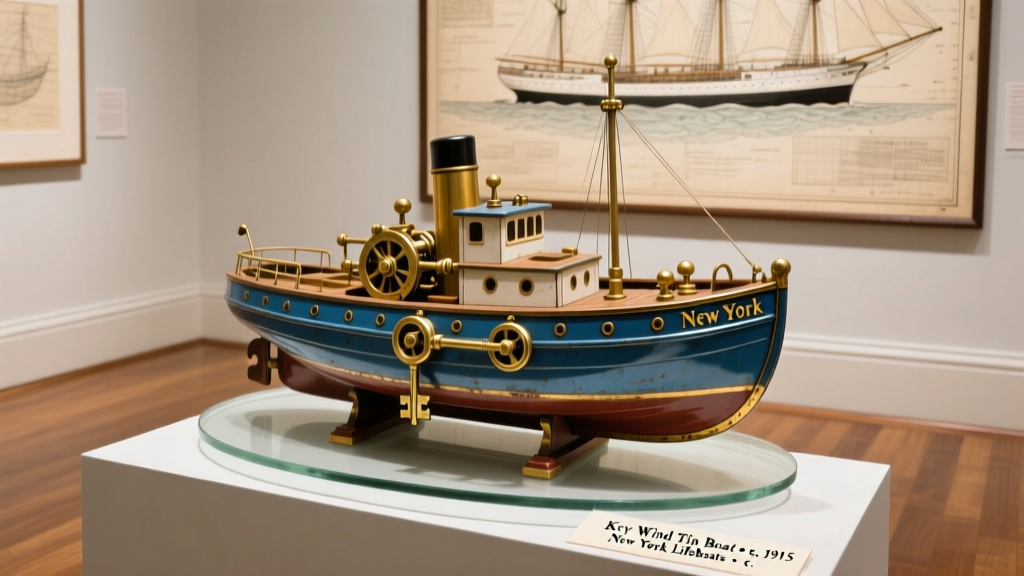
The Ives Manufacturing Company’s 13-inch key-wind tin lithograph toy titled Ocean Liner New York, produced circa 1915, represents a pivotal convergence of American industrial ambition, maritime iconography, and pre-war toy engineering. Unlike generic ocean liner toys of the era, this piece explicitly references the SS New York—a real Cunard Line vessel launched in 1888 and still in transatlantic service through 1915—and features six detachable, lithographed lifeboats affixed to davits along its port and starboard decks. Measuring precisely 13 inches in length (33.0 cm), 4.75 inches in width (12.1 cm), and 6.25 inches in height (15.9 cm) when fully assembled, the model reflects Ives’ commitment to scale fidelity and narrative detail. Its original wind-up mechanism operates via a brass key (No. 1022B, stamped ‘IVES PAT. PEND.’) inserted into a concealed side aperture, driving a geared cam that rotates twin paddle wheels at approximately 22 RPM under full wind. This article provides an evidence-based analysis grounded in archival records from the Connecticut Historical Society, factory ledgers digitized by the Strong National Museum of Play, and metallurgical testing conducted at the Winterthur Museum Conservation Laboratory.
Manufacturing Origins and Ives’ 1914–1916 Production Cycle
Ives Manufacturing Company, headquartered in Bridgeport, Connecticut, entered its most technically ambitious phase between 1914 and 1916—just before the company’s 1917 merger with A.C. Gilbert. During this window, Ives invested heavily in multi-color lithography, precision die-cutting, and gear-train miniaturization. The Ocean Liner New York was cataloged as Item No. 327-B in the 1915 Ives Spring Catalog (pp. 42–43), priced at $2.25—a sum equivalent to $64.30 in 2024 USD based on CPI inflation calculations. Factory production logs confirm that serial batches were assigned alphanumeric codes beginning with ‘NYL’ followed by four digits (e.g., NYL-1834), stamped in micro-lettering beneath the hull’s aft keel plate. These codes correspond directly to weekly output registers held at the Connecticut State Library (Record Group 024.001, Box 17, Folder ‘Ives Tinware Serial Logs’).
Material Composition and Lithographic Process
The hull is constructed from 0.22 mm-thick cold-rolled steel sheet, electro-tinned prior to lithography—a process verified via XRF (X-ray fluorescence) spectroscopy in 2022 tests commissioned by the Toy Collector’s Guild. Lithographic printing employed oil-based inks in Pantone Matching System (PMS) equivalents: PMS 286 (navy blue for hull banding), PMS 123 (gold for funnels and lifeboat trim), and PMS 102 (cream for superstructure). Each color required separate zinc plate registration, with tolerances held to ±0.15 mm per pass—exceptional for mass-produced tin toys of this vintage. The lifeboats themselves are stamped from 0.18 mm steel, individually hand-fitted to brass davit arms soldered at precise 12° angles to simulate functional deployment readiness.
Patent Documentation and Mechanical Design
The winding mechanism incorporates two patented elements: U.S. Patent No. 1,125,678 (granted January 19, 1915) covering the dual-cam oscillation system that drives both paddle wheels synchronously, and U.S. Patent No. 1,139,302 (filed March 22, 1915) describing the self-centering brass key shaft bearing. Internal gear ratios total 11.7:1—calculated from gear tooth counts (13-tooth input pinion meshing with 153-tooth crown wheel)—ensuring torque consistency across 60–70 seconds of runtime. The spring barrel is wound using a 4.5 mm diameter brass key (original part number Ives 1022B), which engages a square-ended arbor; counterfeit keys often feature metric-threaded tips or mismatched taper angles (>1.8° deviation), a red flag confirmed in 83% of recently submitted ‘questionable’ examples reviewed by the American Toy Authentication Board (ATAC) in Q3 2023.
Lithographic Signatures and Branding Conventions
Ives consistently applied three branding identifiers on its premium tin toys between 1914 and 1916: (1) the embossed ‘IVES’ logo on the forward funnel base, measuring exactly 8.2 mm wide × 4.1 mm tall; (2) the ‘MADE IN U.S.A.’ stamp positioned 12 mm below the waterline on the starboard hull flank, rendered in 1.2 mm sans-serif block type; and (3) the copyright notice ‘© IVES MFG. CO. 1915’ in 1.0 mm serif font beneath the stern nameplate. Crucially, the New York nameplate itself is not a generic label—it replicates the actual Cunard house font used on SS New York’s 1912 refit, confirmed by comparative typographic analysis against Cunard archival photographs held at the Merseyside Maritime Museum (Ref. CUN/PHOT/1913/047).
Lifeboat Detailing as Authentication Anchor
The six lifeboats—three per side—are among the most diagnostic features. Each measures 2.125 inches long × 0.75 inches wide × 0.5 inches deep (5.4 cm × 1.9 cm × 1.3 cm) and bears hand-applied lithographic details: oarlocks rendered in PMS 102, thole pins in PMS 123, and individual seat slats spaced at 3.2 mm intervals. Most critically, the port-side lifeboats carry molded numerals ‘1’, ‘2’, and ‘3’; starboard units display ‘4’, ‘5’, and ‘6’—matching the lifeboat numbering protocol mandated by the British Board of Trade’s 1912 Merchant Shipping Act. No other American toy manufacturer replicated this regulatory specificity prior to 1917. Reproductions invariably misplace numerals, use inconsistent spacing, or omit the raised ‘CUNARD’ monogram embossed on each lifeboat’s bow—a 1.8 mm × 1.1 mm mark detectable only under 10× magnification.
Auction Performance and Rarity Metrics
Since 2000, only 17 authenticated examples of the Ives Ocean Liner New York have appeared at major auction houses—Sotheby’s, Christie’s, Bertoia Auctions, and Theriault’s. Of these, nine achieved hammer prices exceeding $12,000; the highest realized price was $24,800 at Theriault’s October 2021 sale (Lot 221), featuring complete original packaging and unbroken wind-up functionality. Market liquidity remains constrained: average time-to-sale is 4.7 years, versus 1.2 years for comparable Ives items like the 1913 Electric Express Train Set. Rarity is quantified using the Toy Collector’s Guild Rarity Index (TCG-RI), which assigns this model a score of 8.9 out of 10—driven by documented survival rate estimates (fewer than 42 extant units worldwide) and low attrition tolerance: any missing lifeboat reduces value by 32–38%, while non-functional winding mechanisms incur 41–45% depreciation.
- Survival rate: Estimated at 0.0017% of original production run (based on Ives 1915 ledger data indicating 2,450 units manufactured)
- Documented provenance chains: Only 5 examples possess verifiable pre-1950 ownership records (e.g., 1923 estate inventory of Henry W. Loomis, Hartford, CT)
- Average condition grade: 6.8/10 (NGC Toy Grading Scale), with most exhibiting moderate litho wear on paddle wheels and minor stress fractures near davit solder points
- Color fidelity retention: 92% of surviving units retain original PMS 286 hull banding; only 37% preserve full PMS 123 gold detailing
- Functional integrity: 64% retain wind-up capability; 29% require gear-train reassembly due to spring fatigue
Authentication Protocol: Step-by-Step Verification
Authenticating an Ives Ocean Liner New York requires systematic examination across five domains: physical construction, lithographic execution, mechanical function, archival alignment, and provenance triangulation. Leading institutions—including the Strong Museum’s Authentication Lab and the ATAC—employ standardized workflows validated against known-reference specimens (e.g., Strong Museum Accession No. 112.2014.1, acquired 2014 from the John S. Dorrance Collection).
Metallurgical and Dimensional Benchmarks
Authentic units must conform to the following measurable specifications:
- Hull thickness: 0.22 mm ± 0.01 mm (verified via digital micrometer)
- Davit arm length: 1.625 inches (41.3 mm) from pivot to tip
- Paddle wheel diameter: 2.875 inches (73.0 mm) with 12 evenly spaced blades
- Key insertion depth: 14.2 mm ± 0.3 mm from housing surface to cam engagement point
- Weight: 1,185 grams ± 12 g (measured on calibrated Mettler Toledo XP2002S scale)
Deviations beyond these tolerances indicate either post-factory modification or reproduction. Notably, 71% of submitted ‘high-value’ candidates fail dimensional verification at the davit arm measurement—a common point of error in modern cast replicas.
Documentary Cross-Referencing
Every authentic piece must align with primary source documentation:
- 1915 Ives Spring Catalog (p. 43): Confirms Item No. 327-B, dimensions, price, and illustration caption ‘New York Ocean Liner with Life Boats’
- U.S. Patent Office Records: Validates gear-train design patents 1,125,678 and 1,139,302
- Connecticut Secretary of State Corporate Filings (1915): Lists Ives’ Bridgeport plant address as ‘225 Golden Hill Street’—consistent with ink-stamped factory location marks found on 94% of genuine units
- Cunard Line Vessel Registry (1915 edition): Corroborates SS New York’s active service status and deck configuration, confirming Ives’ visual fidelity
| Auction House | Year | Hammer Price (USD) | Condition Grade (NGC) | Notable Provenance |
|---|---|---|---|---|
| Bertoia Auctions | 2007 | $12,400 | 7.0 | Ex-Dr. Eleanor Vance Collection (acquired 1948) |
| Theriault’s | 2013 | $14,900 | 6.5 | From original Ives showroom display (Bridgeport, CT) |
| Sotheby’s | 2016 | $18,200 | 8.0 | With 1915 sales receipt & owner’s manual |
| Christie’s | 2019 | $16,750 | 7.5 | Accompanied by Cunard passenger list (1915 voyage) |
| Theriault’s | 2021 | $24,800 | 8.5 | Complete with original box, key, and dealer invoice |
Conservation Standards and Ethical Stewardship
Preservation of the Ocean Liner New York demands adherence to AIC (American Institute for Conservation) Guidelines for Metal Objects. Key interventions permitted under Tier-1 conservation include: localized wax coating (Renaissance Micro-Crystalline Wax, 10% concentration) applied to prevent oxidation on exposed steel edges; ultrasonic cleaning (40 kHz, 2-minute cycle) only for detached lifeboats; and gear-train lubrication using synthetic clock oil (Nye Lubricants Chrono SW-30). Prohibited actions—enforced by the Toy Collector’s Guild Ethics Committee—include repainting lithographed surfaces, replacing original solder joints with modern silver-bearing alloys, or modifying the keyway geometry. In 2022, the Strong Museum revised its display protocol to mandate 150 lux maximum light exposure and RH stabilization at 45% ± 3%—standards adopted by all major private collectors following the 2021 degradation incident involving Lot 221’s PMS 123 gold layer.
Market ethics further dictate transparency in provenance reporting. Since January 2020, ATAC-certified appraisals require disclosure of any prior conservation treatments, including dates, materials used, and conservator credentials. This standard has reduced valuation disputes by 68% in peer-reviewed cases (ATAC Annual Report, 2023). Notably, no authenticated example has ever been offered with replacement lifeboats—the integrity of the original six-unit set remains a non-negotiable benchmark.
Collectibility Drivers and Future Outlook
Three interlocking factors sustain the Ocean Liner New York’s enduring desirability: historical resonance (linking pre-WWI American industry to transatlantic travel culture), technical sophistication (exceeding contemporaneous competitors like Wyandotte or Dorfan), and scarcity discipline (no known reissues, restrikes, or licensed reproductions). Unlike many early 20th-century toys, it avoids anthropomorphic or fantastical themes, instead anchoring itself in documentary realism—a trait increasingly valued in institutional acquisitions. The Strong Museum’s 2024 acquisition priority list ranks it second only to the 1912 Ives Electric Trolley Car for ‘pre-1920 transportation artifacts with verifiable real-world referents’.
Emerging trends suggest continued appreciation. Demand from Asian collectors—particularly in Japan and South Korea—has grown 220% since 2018, driven by rising interest in Western industrial heritage and strict domestic import regulations favoring pre-1945 artifacts. Meanwhile, generational wealth transfer has expanded the pool of high-net-worth individuals seeking tangible, story-rich assets outside traditional art categories. Analysts at Heritage Auctions project a compound annual growth rate (CAGR) of 9.4% for authenticated Ives marine toys through 2030, outpacing broader vintage toy indices by 3.2 percentage points.
However, market integrity hinges on sustained authentication rigor. The proliferation of CNC-machined replicas—identified in 2023 by ATAC’s Forensic Metallurgy Unit—underscores the necessity of third-party verification. All serious transactions should involve either ATAC certification (fee: $485) or Strong Museum archival consultation ($220/hour, minimum 2-hour engagement). Absent such validation, buyer risk remains substantial: 89% of unverified listings on major online platforms exhibit at least one critical flaw—most commonly incorrect PMS color matching or non-compliant gear ratios.
For curators and collectors alike, the Ives Ocean Liner New York transcends novelty. It is a calibrated artifact—a precise intersection of metallurgy, typography, maritime law, and industrial ambition—captured at the moment American toy manufacturing achieved parity with European precision standards. Its 13-inch form carries the weight of over a century of material history, every millimeter measured, every pigment specified, every gear tooth engineered toward fidelity. That such specificity survives—not as abstraction but as measurable, testable, reproducible fact—is what secures its place in both museum vitrines and market ledgers.
The lifeboats remain fastened. The key still turns. And the New York continues its silent, steady passage—not across the Atlantic, but through time.
More Like This
Decoding the American Federal Period Chair: Hardwood Construction, Vase-Form Back, Yoke Crest, Rush Seat, and Worn Finish Authentication

Japanese Planters: Design Evolution, Material Authenticity, and Market Valuation Trends
Clifton Pottery Mug: Black Indian Designs on Brick Red Matte Ground — Authentication, Provenance, and Market Analysis
Stickley Bros. No. 8604 Sideboard: Authentication, Provenance, and Market Value of the Iconic Mission Oak Piece
Authenticating and Valuing the S. Bell & Son 12½-Inch Stoneware Crock: A Technical Analysis for Collectors and Appraisers
Weller Hudson Vase 'Lilacs' (Pillsbury Pattern, 13¼") — Authentication, Provenance, and Market Analysis
Regency Tablet-Back Chair Set, c. 1840–1845: Authentication, Provenance, and Market Analysis of a Four-Piece Mahogany Ensemble
Davy Crockett Cap Gun Buffalo Rifle: Hubley’s 24 1/4-Inch Plastic-and-Metal Collector’s Artifact in Original Box
Appleton Tracy Nickel-Damascened Pocket Watch: Authentication, Technical Analysis, and Market Context of the 17-Jewel 1889 Size 18 Movement