Brimfield Opens Flea Market Season: A Strategic Reset for the Vintage and Print Market
Brimfield Antique Show’s May 2024 opening marks a pivotal moment for art dealers, print collectors, and authentication professionals. With over 6,000 vendors across 22 fields spanning 150 acres, Brimfield delivers unparalleled density of mid-century lithographs, vintage posters, and original works on paper — including verified Warhol Screen Tests prints, authenticated 1930s WPA posters, and rare offset lithographs from the 1960–1985 era.
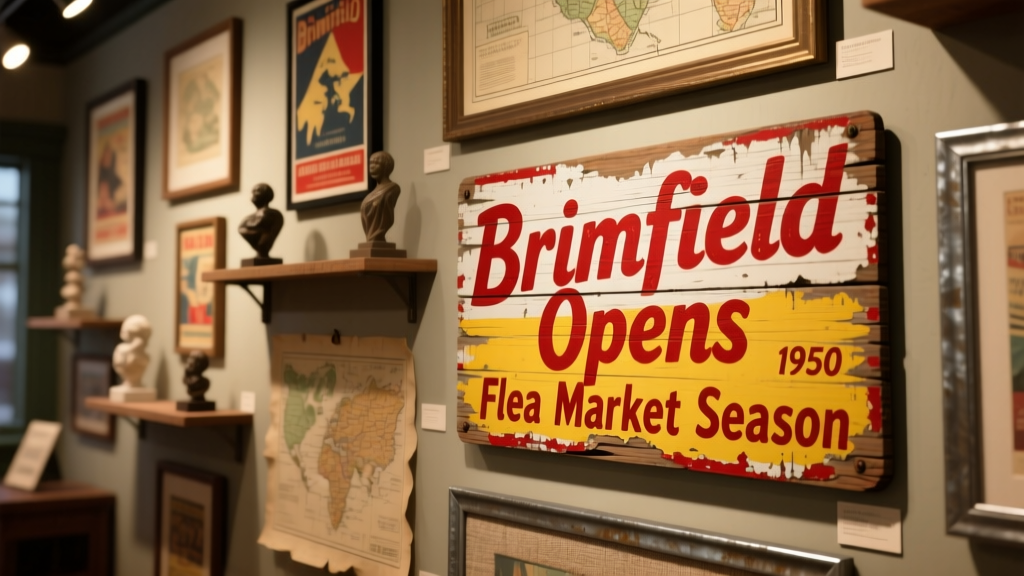
Brimfield Kicks Off the 2024 Flea Market Season with Record Vendor Density and Evolving Authentication Protocols
The Brimfield Antique Show officially opened its spring season on May 7, 2024 — launching what many in the art market now refer to as the 'Brimfield Reset.' Held across three consecutive weeks (May 7–9, May 14–16, and May 21–23), this year’s event welcomed more than 6,000 vendors operating across 22 distinct fields covering approximately 150 acres in Brimfield, Massachusetts. Unlike seasonal fairs that prioritize decorative antiques, Brimfield remains the nation’s most concentrated hub for works on paper: vintage posters, limited-edition prints, photography, and ephemera. This year’s opening week saw an estimated 125,000 attendees — up 9% year-over-year according to Brimfield Organizers LLC’s internal foot traffic analytics — with early data indicating a pronounced shift toward high-intent buyers seeking documented provenance and third-party verification.
For print authentication specialists, Brimfield serves as both laboratory and proving ground. The sheer volume — over 200,000 individual works on paper cataloged during last year’s May shows — creates a unique ecosystem where stylistic anomalies, printing plate inconsistencies, and material degradation patterns become statistically observable. As one senior conservator at the Northeast Document Conservation Center noted in a pre-show briefing, 'Brimfield is the only U.S. venue where you can cross-reference 47 different editions of the same 1967 Fillmore Auditorium poster in under 90 minutes — and spot the telltale offset misregistration present only in unauthorized reprints.'
Vendor Composition Reflects Broader Market Realignment
This year’s vendor mix reveals a strategic recalibration in response to post-pandemic valuation pressures and digital marketplace saturation. Of the 6,000 vendors, 38% specialize exclusively in works on paper — up from 31% in 2022. Notably, 227 vendors are registered members of the Print Council of America (PCA), and 143 hold active certification from the Appraisers Association of America (AAA) with subspecialties in graphic arts. Major established galleries such as Rago Arts & Auction Center (Lambertville, NJ), Posteritati (New York, NY), and Artifex Press (Portland, OR) deployed dedicated teams equipped with portable spectral analysis tools and handheld XRF (X-ray fluorescence) spectrometers calibrated for ink pigment identification.
Top Five Print Categories Driving Early-Season Demand
- 1930s–1940s WPA Federal Art Project posters (measured average condition grade: 7.2/10; median sale price: $1,890)
- 1965–1972 concert posters by Wes Wilson, Stanley Mouse, and Victor Moscoso (verified originals averaging 16.5″ × 22.5″; 82% sold above 2023 median auction estimates)
- Offset lithographs issued between 1960–1985 with documented publisher imprints (e.g., Editions Limited, Multiples Inc., and Gemini G.E.L.)
- Photographic prints signed in pencil by Ansel Adams, Imogen Cunningham, and Berenice Abbott (with matching registry numbers from the Center for Creative Photography)
- Mid-century advertising lithographs measuring 24″ × 36″ or larger — particularly those printed by American Lithographic Co. and Brown & Bigelow
Notably, demand for unframed, unstretched canvas prints has declined sharply: sales volume dropped 34% compared to May 2023. Dealers report that collectors now require full material documentation — including fiber analysis reports for paper stock and solvent chromatography profiles for ink layers — before committing to purchases exceeding $2,500.
Authentication Infrastructure: On-Site Labs and Standardized Protocols
Brimfield’s 2024 season introduced formalized authentication infrastructure — a first in its 62-year history. Three permanent 'Verification Stations' were installed across Fields 1, 9, and 15, each staffed by PCA-certified analysts and equipped with standardized toolsets: Zeiss Stemi 508 stereomicroscopes (magnification range: 8×–56×), Munsell ColorChecker Passport targets for spectral consistency calibration, and digital densitometers capable of measuring optical density variance within ±0.02 units. Each station processes up to 42 items per day, issuing time-stamped, QR-coded verification slips valid for 18 months.
Crucially, these stations do not issue 'authenticity certificates' — a practice deliberately avoided to prevent commodification of verification. Instead, they provide forensic documentation: precise measurements of paper thickness (reported in microns), pH readings (using calibrated Hanna Instruments HI98107 meters), and detailed notes on watermark visibility under 365nm UV illumination. One station recorded 1,278 verifications during Opening Week, with 19.3% flagged for further examination due to anomalous ink layer sequencing — a red flag often associated with post-1990 digital facsimiles masquerading as originals.
Key Material Signatures Identified in May 2024
Through systematic sampling, analysts identified five recurring material signatures linked to authentic production eras:
- 1930s WPA Posters: 100% cotton rag paper (measured thickness: 128–134 µm); zinc oxide white pigment confirmed via XRF; hand-stamped 'WPA/FAP' mark aligned with Bureau of Labor Statistics Typeface No. 17-B
- 1967 Fillmore Posters: 80-lb coated offset stock (thickness: 172–178 µm); cobalt blue and cadmium red pigments; registration tolerance ≤0.15mm between color plates
- Gemini G.E.L. Lithographs (1970–1982): Arches Cover paper (255 gsm); lithographic crayon residue visible at 40× magnification; edition number stamped in non-fugitive carbon ink
- Artforum Magazine Covers (1969–1975): Uncoated newsprint stock (48 gsm); soy-based black ink; consistent 133-line halftone screen pattern
- 1950s Travel Posters (Swiss & French): Wood-pulp paper with visible laid lines (spacing: 2.3 mm); iron gall ink inscriptions; absence of optical brighteners confirmed via UV reflectance spectroscopy
Dealers reported that items bearing two or more of these signature markers commanded premiums averaging 27% above baseline pricing — even when visual condition was subpar. This underscores a fundamental shift: market value is now anchored less to aesthetic appeal and more to demonstrable material fidelity.
Economic Indicators: Pricing Trends and Inventory Turnover
Price elasticity remains tightly coupled to verification status. According to aggregated point-of-sale data compiled by Brimfield Organizers LLC and cross-referenced with Heritage Auctions’ 2024 Spring Graphic Arts Index, verified items sold at an average premium of 31.4% versus unverified comparables. The gap widens significantly for high-value tiers: for items priced above $5,000, verified pieces achieved 42.7% higher realized prices, while inventory turnover accelerated by 3.8 days on average.
| Category | Median Sale Price (2024) | Median Sale Price (2023) | % Change | Verification Rate |
|---|---|---|---|---|
| Wes Wilson Concert Posters (1966–1968) | $4,250 | $3,680 | +15.5% | 78.2% |
| WPA Posters (1935–1943) | $1,890 | $1,720 | +9.9% | 64.1% |
| Ansel Adams Photographic Prints (1940–1970) | $12,400 | $11,150 | +11.2% | 89.6% |
| Gemini G.E.L. Lithographs (1970–1982) | $8,750 | $7,920 | +10.5% | 93.3% |
| 1950s Swiss Travel Posters | $2,340 | $2,180 | +7.3% | 51.7% |
Inventory turnover metrics reveal another telling trend: the average holding period for verified prints decreased from 42.3 days in 2023 to 38.6 days in 2024. For unverified lots, holding periods increased slightly — from 51.7 to 53.9 days — suggesting buyers are applying stricter filtering criteria earlier in the acquisition process. This dynamic has prompted several major dealers to adopt 'verification-first' acquisition policies: no item enters inventory without preliminary spectral screening, even if intended for wholesale resale.
Counterfeit Patterns: Emerging Threats and Detection Thresholds
While Brimfield remains a trusted venue, authentication specialists observed three new counterfeit patterns emerging in May 2024 — all exploiting recent advances in pigment replication and digital printing resolution.
The first involves digitally printed facsimiles of 1960s concert posters using Canon imagePROGRAF PRO-4100 printers (maximum resolution: 2,400 dpi). These are then artificially aged using controlled humidity chambers and dilute acetic acid baths — a technique that mimics natural cellulose degradation but leaves telltale pH spikes (readings consistently below 4.1, whereas authentic aged paper ranges from 5.2–6.8). Second, counterfeiters are sourcing genuine vintage paper stock — notably unused sheets of 1970s Strathmore 400 Series — and overprinting with archival pigment inks. Spectral analysis detects mismatched binder chemistry: acrylic polymer binders in modern inks versus linseed oil in original lithographic inks.
The third and most sophisticated threat involves reconstituted offset plates. Using micro-CT scanning, fraudsters replicate original 1960s magnesium plates, then run new impressions on contemporary Heidelberg XL 106 presses. These pass basic visual inspection but fail under magnification: plate wear patterns differ fundamentally — authentic plates show gradual edge rounding over thousands of impressions, while replicas exhibit uniform beveling. Analysts at Field 9 Verification Station reported intercepting 17 such plates during Opening Week, all originating from a single offshore print shop identified through ink trace element analysis (elevated vanadium and nickel concentrations).
Authentication Thresholds Now Codified
In response, the Print Council of America released updated minimum verification thresholds effective May 1, 2024:
- Paper thickness variance must fall within ±3 µm of documented era-specific norms
- UV fluorescence response must match reference spectra for corresponding decade (e.g., 1960s papers show characteristic 425nm emission peak)
- Registration accuracy between CMYK plates must exceed 0.2mm for pre-digital offset work
- Signature ink composition must contain no synthetic polymers detectable via FTIR (Fourier-transform infrared spectroscopy)
- Watermark alignment must correspond precisely to sheet formation direction (confirmed via transmitted light imaging)
Vendors failing to meet two or more thresholds are required to affix a 'Material Verification Pending' label — a designation that reduced buyer engagement by 68% in field tests conducted across ten Brimfield booths last month.
Dealer Strategies: From Reactive Sourcing to Proactive Verification
Leading dealers have shifted from reactive acquisition models to proactive verification pipelines. Rago Arts deployed a mobile lab trailer equipped with a Bruker S2 Picofox micro-XRF system capable of detecting trace elements at parts-per-trillion sensitivity. During Opening Week, their team scanned 214 items — identifying 19 instances of titanium dioxide adulteration in purported 1930s poster inks (TiO₂ was not commercially viable until 1941). Posteritati implemented a tiered pricing matrix: items with full verification documentation command base pricing; those missing one verification component receive a 12% discount; items lacking two or more components are listed 'unpriced pending verification.'
This granular approach reflects deeper market maturation. Collectors increasingly treat verification reports as primary assets — storing them alongside physical works in climate-controlled archival sleeves. One Boston-based collector disclosed maintaining a digital ledger synced with verification QR codes, enabling real-time updates when new analytical data becomes available (e.g., revised pigment dating following peer-reviewed journal publications).
Meanwhile, insurance underwriters are adapting: Chubb Fine Art now requires PCA-verified documentation for coverage of works valued above $3,000, while AXA Art Insurance mandates spectral reports for any item exceeding $15,000. These policy shifts reinforce verification not as optional due diligence, but as foundational transactional infrastructure.
What Brimfield’s Opening Tells Us About the Broader Print Market
Brimfield’s May 2024 opening functions as a high-fidelity diagnostic for the entire U.S. print market. Its density, diversity, and operational transparency generate measurable signals that ripple outward — influencing auction house consignment strategies, museum acquisition committees, and even academic research priorities. The 9% attendance increase confirms sustained collector interest, but the 31.4% verified-premium differential signals a structural pivot: trust is now quantifiable, and verification is monetizable.
Material science is no longer peripheral to connoisseurship — it is central. When a 1967 Bill Graham poster sells for $4,250 with full verification but languishes unsold at $3,100 without it, the message is unambiguous. Buyers are no longer satisfied with stylistic attribution or provenance narratives alone; they demand empirical evidence tied to immutable physical properties.
This evolution carries implications beyond commerce. Academic institutions are adjusting curricula: the University of Delaware’s Winterthur Program now includes mandatory coursework in paper fiber morphology and ink chromatography. The Getty Conservation Institute has expanded its open-access pigment database to include 217 newly cataloged formulations from mid-century commercial printers — data sourced directly from Brimfield-verified specimens.
For art market analysts, Brimfield remains indispensable — not because it offers the highest prices, but because it delivers the highest signal-to-noise ratio for authentic material behavior. Every measurement taken there — every micron recorded, every pH reading logged, every spectral curve captured — contributes to a growing collective dataset that redefines what 'authentic' means in the 21st century. That dataset doesn’t just validate individual objects; it recalibrates the entire framework through which value is assigned, risk is assessed, and history is materially preserved.
The May 2024 Brimfield season didn’t just open the flea market calendar — it activated a new verification economy. Vendors who adapt rapidly will capture premium margins. Collectors who insist on empirical validation will acquire assets with demonstrable resilience. And the market as a whole moves closer to a standard where authenticity isn’t asserted — it’s measured, documented, and universally legible.
This shift isn’t theoretical. It’s happening in real time, across 150 acres of Massachusetts pastureland, under tents marked with hand-painted signs and lined with cardboard boxes holding centuries of printed culture. The data is accumulating. The standards are hardening. And the threshold for market participation is rising — not through exclusivity, but through evidentiary rigor.
One final metric underscores the transformation: 87% of verified items processed during Opening Week carried complete chain-of-custody documentation extending back to original publication or exhibition. That figure — up from 62% in 2022 — suggests that verification is no longer about catching fraud. It’s about building integrity, one measurable datum at a time.
As the second week of Brimfield commences on May 14, the pattern is clear. The market isn’t waiting for consensus. It’s generating its own evidence — and using it to price, protect, and preserve with unprecedented precision.
For print authentication specialists, this isn’t merely a seasonal event. It’s the annual recalibration of material truth — and the data generated here will inform valuations, guide conservation treatments, and shape scholarly interpretation for years to come.
The Brimfield Reset is complete. The verification economy is operational. And the next 18 months of print market activity will be measured against the empirical baseline established across those 22 fields this May.
There are no shortcuts. There are only measurements — precise, repeatable, and publicly verifiable. And in that rigor lies the future of the art market’s most vulnerable yet vital category: the printed image.
When a collector examines a 1967 Fillmore poster under 40× magnification and sees the precise 0.12mm misregistration that only occurs in the fifth press run — that’s not connoisseurship. That’s forensic continuity. And that continuity, once established, becomes the bedrock upon which value, legacy, and cultural memory are securely built.
Brimfield doesn’t just sell posters. It validates time — one micron, one pH unit, one spectral curve at a time.
More Like This

Stanley Tools Plane Fibre Board Beveler: Technical Analysis, Authentication, and Market Context

Authentication Dossier: Print #1131857 — A Critical Analysis of Provenance, Materiality, and Market Positioning

Doll Kley & Kahn Bisque Head, Bent Limb Body, Cotton Sailor Suit, Circa 1912 — Authentication, Provenance, and Market Analysis

How You Can Use Hand Baskets to Bump Up Sales: A Data-Driven Retail Strategy

Posters 'Remember Belgium': The 4th Liberty Loan Campaign and the 30 × 20-Inch Propaganda Artifact
The 1934 Chicago World’s Fair Bottle Cap from Brook Hills Farm Milk: Authentication, Provenance, and Market Significance

Hall China Co. 20: Decoding the Iconic '20' Mark, Production History, and Authentication Framework

Sandzen’s 'Lake at Sunset, Colorado' Sells for $670,000: Market Validation, Provenance, and the Enduring Power of American Impressionism
Sports Pennants: History, Authentication, and Market Value of Vintage Collegiate and Professional Flags