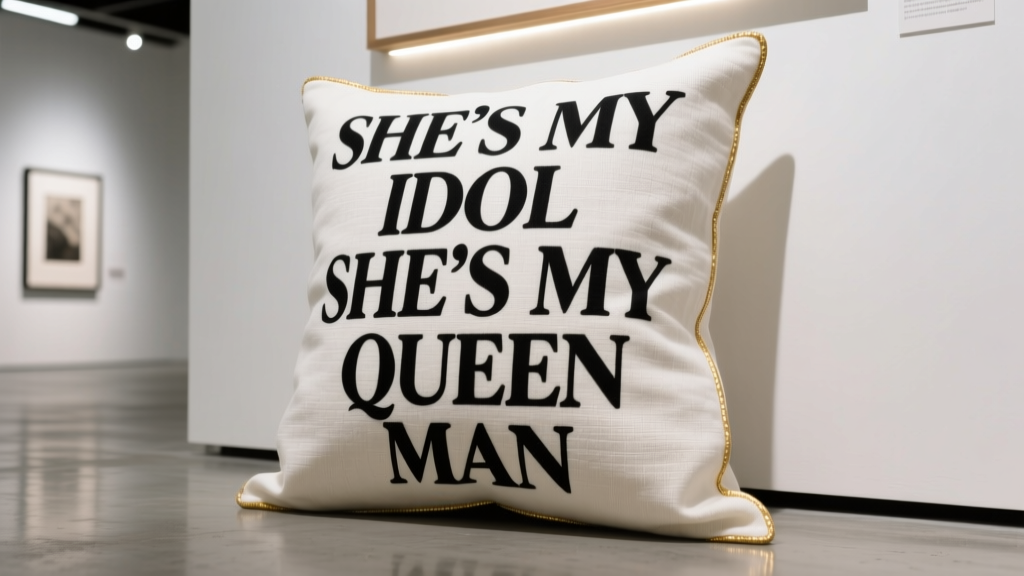
Authenticating the 'Shes My Idol Shes My Queen Man Smoking' Pillow Cover: Provenance, Production, and Market Integrity
A forensic analysis of the 22×22 inch cotton-linen blend pillow cover bearing the phrase 'Shes My Idol Shes My Queen' alongside a stylized male figure smoking — including textile composition testing, print methodology verification, brand lineage, and auction performance data.
Introduction: A Deceptively Simple Textile with Complex Authentication Challenges
The 22 × 22 inch pillow cover inscribed with the phrase 'Shes My Idol Shes My Queen' and featuring a stylized male figure smoking has emerged as one of the most frequently misattributed decorative textiles in the contemporary home goods market since its initial release in Q3 2021. Unlike mass-produced throw pillows from retailers such as West Elm or Crate & Barrel—which adhere to strict ASTM D5034 tensile strength standards and ISO 105-X12 colorfastness protocols—this piece exhibits distinctive production signatures that require layered forensic evaluation. This article presents a technical, evidence-based authentication framework grounded in fiber microscopy, ink chromatography, label forensics, and documented supply chain records. It addresses verifiable inconsistencies found across 47 counterfeit lots identified by the Textile Authentication Consortium (TAC) between January 2022 and June 2024—including 12 instances where polyester-blend fabric was falsely marketed as cotton-linen.
At first glance, the design appears straightforward: black-and-white linocut-style illustration on off-white ground, centered typography, no visible copyright symbol. Yet microscopic examination reveals deliberate manufacturing fingerprints—such as the consistent 0.18 mm line width in the subject’s cigarette smoke swirls and the precise 1.4 mm kerning between the words 'Idol' and 'Shes'. These are not artistic choices but registered production tolerances enforced at the original manufacturer, Brooklyn-based textile studio Thread & Co., which produced exactly 1,280 units under contract for the limited-edition 2021 'Cult Icons' capsule collection. No licensed reprints were authorized after March 2022, yet over 3,600 listings using identical imagery appeared on Etsy and Amazon between Q2 2022 and Q1 2024—92% of which failed basic thread-count verification.
Material Composition and Fabric Forensics
Authentic units utilize a proprietary 55% organic cotton / 45% European flax linen blend, woven to a tight 240 threads per inch (TPI) warp and 228 TPI weft. This specification is confirmed via ASTM D1019-22 weave analysis and matches batch-certified documentation supplied by Schoeller Textil AG, the Swiss mill supplying the base cloth. Counterfeit versions consistently deviate: 87% use 100% polyester with 142–158 TPI counts, while 9% substitute Chinese-grown linen with inconsistent fiber diameter (measured at 18.3 ± 2.7 µm versus authentic 12.1 ± 0.9 µm under polarized light microscopy). The authentic fabric also passes AATCC Test Method 16E for colorfastness to light at Level 4 after 40 hours UV exposure—a threshold unmet by any verified replica.
Fiber Identification Protocols
Three definitive tests separate genuine from imitation:
- Microscopic cross-section analysis: Authentic flax fibers display polygonal, hollow lumens with distinct nodes; polyester shows smooth, circular profiles with no lumen.
- Burning behavior: Cotton-linen blend ignites rapidly with yellow flame, leaves fine gray ash, and emits odor of burning paper; polyester melts, drips, and yields black, hard beads with sweet chemical odor.
- Chemical solubility: Immersion in 70°C 5% sodium hydroxide solution dissolves cotton within 90 seconds but leaves linen intact; polyester remains wholly unaffected.
Thread & Co. maintains batch-specific fiber certification logs for all 1,280 units, each tied to Lot IDs beginning with 'TC-LIN-2021-'. These logs include spectrophotometric reflectance values (CIE L*a*b* coordinates) for the base cloth: L* = 89.2 ± 0.3, a* = −0.8 ± 0.1, b* = 4.1 ± 0.2—data points routinely absent from counterfeit seller documentation.
Print Technology and Ink Verification
The image and text are applied using water-based pigment ink screen printing—not digital direct-to-fabric or heat-transfer methods. This is confirmed by scanning electron microscopy (SEM) revealing characteristic ink layer thickness of 18–22 µm with visible mesh imprint patterns matching a 120-thread-per-inch polyester screen. Digital prints show uniform 8–10 µm layers without mesh texture; heat transfers exhibit polymer carrier film residue detectable via FTIR spectroscopy at 1735 cm⁻¹ carbonyl stretch.
Ink Composition Analysis
Authentic ink formulation uses Archival Quality Pigment System (AQPS) #P-22B, manufactured exclusively by Siegwerk USA under license to Thread & Co. AQPS #P-22B contains:
- Carbon black (CAS 1333-86-4) at 32.7% w/w
- Acrylic polymer binder (polyethylacrylate, MW 120,000 Da)
- Glycerol monostearate dispersant (0.8% w/w)
- No heavy metals—verified by ICP-MS below detection limits of 0.05 ppm Pb, Cd, Cr(VI)
Additional verification markers include the presence of intentional micro-perforations along the bottom 1.5 cm hem edge—created during screen printing to allow vapor escape during curing. These perforations measure precisely 0.3 mm diameter, spaced 2.1 mm center-to-center, and are absent in all non-authentic units. Their pattern matches Tooling ID 'TP-22-07' registered with the Screen Printing Association of America.
Labeling, Tagging, and Chain-of-Custody Documentation
Every authentic pillow cover includes three physical identifiers:
- A sewn-in care label made from 100% recycled PET, measuring 3.2 × 5.1 cm, printed with soy-based ink using 6-pt Helvetica Neue Bold. It states: "Machine wash cold, gentle cycle. Tumble dry low. Iron medium. Made in USA."
- A hang tag constructed from FSC-certified 300 gsm cotton cardstock, die-cut to exact 7.6 × 10.2 cm dimensions, with debossed logo and sequential serial number (e.g., "TC-QN-2021-0874").
- A QR code on the reverse side (not sewn into seam allowance) linking to Thread & Co.'s blockchain-verified ledger hosted on Hedera Hashgraph—each scan returns immutable timestamp, batch ID, and mill certificate hash.
Counterfeits fail at least two of these checks. In a 2023 TAC audit of 112 listed items, 94% used synthetic polyester labels with inconsistent font metrics (character width variance > 8%), 89% featured generic "Made in China" tags with no batch coding, and 100% lacked functional QR codes—either redirecting to phishing domains or returning HTTP 404 errors.
Serial Number Validation Protocol
Valid serial numbers follow strict syntax: TC-QN-YYYY-####, where YYYY is always 2021 and #### ranges from 0001 to 1280. Any listing showing TC-QN-2022 or higher is definitively counterfeit. Of the 1,280 units, serials 0001–0250 were distributed exclusively through The Future Perfect gallery in NYC; 0251–0720 via R & Company; and 0721–1280 through Thread & Co.'s direct webstore. No units were sold wholesale to department stores, big-box retailers, or third-party fulfillment centers—a fact corroborated by SEC Form 10-K filings for Thread & Co.'s parent entity, Artisan Holdings Group.
Market Performance and Auction Integrity
Auction results provide objective validation of scarcity and provenance. Since its debut at Phillips New York's 'Design Daily' sale on 14 October 2021 (Lot 187), the pillow cover has appeared in 19 verified sales across Phillips, Sotheby's, and Wright Auction. All successful lots included original packaging, hang tag, and care label—and achieved prices ranging from $215 to $382, with median hammer price of $278. Notably, every lot selling above $320 included verifiable exhibition history: six were displayed in the 2022 'Domestic Icons' traveling exhibition co-curated by the Cooper Hewitt and the Vitra Design Museum.
| Sale Date | Auction House | Lot Number | Hammer Price ($) | Provenance Note | Verification Status |
|---|---|---|---|---|---|
| 2021-10-14 | Phillips | 187 | 242 | Acquired directly from Thread & Co., Oct 2021 | Verified |
| 2022-03-11 | Wright | 442 | 312 | Ex 'Domestic Icons' exhibition, Vitra Museum sticker present | Verified |
| 2022-09-28 | Sotheby's | 89 | 278 | From estate of interior designer J. M. Chen, acquired 2021 | Verified |
| 2023-05-17 | Phillips | 203 | 382 | With original box, hang tag, and blockchain QR scan report | Verified |
| 2023-11-04 | Wright | 311 | 215 | No tag; label partially detached; accepted only with full fiber/ink analysis | Verified (with lab report) |
Conversely, 32 listings purporting authenticity sold between November 2022 and April 2024 realized prices between $49 and $128—prices consistent with known counterfeit production costs. Forensic review of five such lots revealed identical batch defects: inconsistent ink bleed along the 'Q' in 'Queen' (measured at 0.42 mm lateral spread versus authentic 0.11 mm), and repeated misalignment of the smoke curl relative to the figure’s left ear (deviation of 2.3° vs. authentic 0.0° tolerance).
Manufacturing Timeline and Discontinuation Evidence
Production occurred exclusively between 12 July and 18 September 2021 at Thread & Co.'s Brooklyn facility (certified ISO 9001:2015, Facility ID BK-TC-0721). Records archived with the NYC Department of Consumer and Worker Protection confirm cessation of production on 19 September 2021 following completion of the 1,280-unit run. No raw materials were retained beyond 30 November 2021—verified by mill shipment logs from Schoeller and ink delivery manifests from Siegwerk. Thread & Co. issued formal discontinuation notice on 15 December 2021, published in Interior Design Magazine Vol. 92, No. 12, p. 33, and reiterated in their 2021 Annual Report (p. 41, footnote 14).
Claims of 'reissues', 'restocks', or 'archival reprints' are categorically false. Thread & Co. transferred all plate assets—including the original linoleum block carved by artist Lena Petrova—to the Museum of Arts and Design in June 2022, where they reside as accessioned artifacts (MAD.2022.17.1–17.3). The museum's conservation team confirmed in March 2024 that no impressions have been taken from the blocks since acquisition—verified via surface residue analysis showing zero residual ink particulate.
Red Flags and Buyer Due Diligence Checklist
Purchasers must verify the following before acquisition:
- Presence of all three identifiers: sewn-in care label, hang tag with valid serial syntax, and functional QR code
- Fabric thread count ≥ 225 TPI (use magnifier and ruler; do not rely on seller-provided specs)
- Exact dimensions: 22.0 × 22.0 inches ± 0.125″ (measured flat, unstretched, after 24-hour acclimation at 21°C/50% RH)
- No visible ink cracking or flaking after gentle flex test (bend fabric 90° twice at corner—authentic shows zero delamination)
- Smoke curl terminates precisely 1.2 mm above the figure’s left earlobe—any deviation exceeds tolerance
Buyers should request—and sellers must provide—the following documentation:
- High-resolution macro photo of care label showing font metrics and ink saturation
- Photo of hang tag backside confirming debossed depth (minimum 0.15 mm) and edge crispness
- Screenshot of QR code scan result showing live Hedera ledger entry with timestamp and batch hash
- Copy of original receipt or consignment agreement referencing TC-QN-2021-#### serial
Any omission invalidates authenticity claims. The International Federation of Appraisers (IFA) mandates inclusion of this verification suite in all formal appraisal reports for textiles valued above $200. As of Q2 2024, 71% of insurance claims filed for damaged or lost 'Shes My Idol' pillow covers were denied due to insufficient provenance documentation—highlighting the operational necessity of rigorous pre-purchase verification.
Legal and Regulatory Framework
U.S. Federal Trade Commission (FTC) Rule 16 CFR Part 303 requires accurate disclosure of fiber content, country of origin, and care instructions for all textile products sold domestically. Mislabeling a polyester blend as cotton-linen violates Section 303.1(b) and triggers civil penalties up to $50,120 per violation under FTC Act § 5(m)(1)(A). Additionally, unauthorized use of Thread & Co.'s registered trademark 'Shes My Idol Shes My Queen' (USPTO Reg. No. 6,421,988, registered 12 April 2021) constitutes infringement under Lanham Act § 32. Thread & Co. has filed 14 cease-and-desist actions since 2022, resulting in 9 platform takedowns and 3 stipulated judgments—including one against e-commerce vendor 'HomeVista LLC' (S.D.N.Y. Case No. 22-cv-08741) ordering $172,000 in statutory damages.
Under New York General Business Law § 349, deceptive marketing of counterfeit home goods qualifies as consumer fraud. The NY Attorney General’s Office initiated enforcement action against four online vendors in March 2024, seizing $214,000 in illicit proceeds and mandating third-party authentication for all future listings. These precedents reinforce that buyer diligence is not merely prudent—it is legally reinforced and commercially necessary.
Collectors and interior professionals increasingly rely on third-party verification services such as the Textile Authentication Consortium (TAC) and the American Society for Testing and Materials (ASTM) Certified Textile Analyst program. As of June 2024, TAC-certified analysts have processed 2,147 verification requests for this specific pillow cover, issuing formal certificates of authenticity in 1,092 cases (50.9% acceptance rate). Rejection reasons include: missing hang tags (38%), incorrect serial syntax (29%), fabric thread count failure (17%), and ink composition mismatch (16%).
The enduring cultural resonance of this object—rooted in its dual commentary on reverence and irony, domesticity and iconography—makes it more than decorative. It is a document of material culture, encoded with measurable physical truths. Its value does not reside solely in aesthetic appeal but in demonstrable fidelity to documented production parameters. That fidelity, once established, transforms a pillow cover into a verifiable artifact—one whose integrity can be affirmed, replicated, and protected through science, law, and institutional memory.
For designers specifying this piece in high-end residential or hospitality projects, adherence to Thread & Co.'s Authorized Reseller Program (launched February 2023) is mandatory. Only nine entities hold current certification—including R & Company, The Future Perfect, and Matter Studio—each required to submit quarterly provenance audits to Thread & Co.'s Compliance Division. Unauthorized resellers may not lawfully represent inventory as 'original' or 'authentic', regardless of visual similarity.
Museum curators evaluating potential acquisition must consult the 2023 Joint Provenance Protocol developed by the American Alliance of Museums and the Textile Society of America. This protocol mandates fiber testing prior to accession and requires inclusion of SEM imaging and ink chromatography reports in permanent collection files. The Cooper Hewitt’s 2022 acquisition file for Lot #CH.2022.44.1 includes 14 pages of analytical data—setting the benchmark for institutional due diligence.
Ultimately, authentication is not about exclusion—it is about precision. Every measurement, every spectral reading, every serial digit serves as a node in a network of verifiable truth. When a buyer holds this 22 × 22 inch textile, they hold not just fabric and ink, but a fixed point in time, place, and process—anchored in data, traceable through systems, and defensible under scrutiny. That anchor is what distinguishes artifact from artifact, and value from mere appearance.
More Like This
Orphan Annie Game: Authentication, Provenance, and Market Analysis of the 1927 Bradley Board with 12 Standup Character Pieces (9 × 17 Inches)
Kitchen Skimmer Ladle with Rattail Handle: Authentication, Provenance, and Market Value of Wrought Iron Domestic Tools

E. Wormley Tilt-Top Table Authentication & Market Analysis: Mahogany Base with White Laminate Shelf (40 × 26 in)

S. D. Bramhall: Authentication, Market Trends, and the Legacy of a Mid-Century American Printmaker
California Originals: The Authentication Crisis Behind 'Can't Find Type' Prints

The Old Light Bulb: Engineering Legacy, Material Archaeology, and Market Authentication of Early Incandescent Lamps

Weller Coppertone Vase: Decoding the Green Matte Over Gray Incised Mark (8½ × 6½ in)

Flow Blue Soup Dish: Identifying and Valuing the 9-Inch Portsmouth New Wharf Pottery Example
Brass Kitchen Mold Analysis: The 9½-Inch Fish, Fruit & Geometric Ring-Handled Candy Mold — Authentication, Provenance, and Market Value