Authenticating the Steiff Blond Teddy Bear: Replaced Eyes, Black Stitched Nose, and the Critical 1910–1915 Provenance of the 20-Inch Example
A forensic analysis of Steiff’s early blond mohair teddy bears (1910–1915), focusing on the 20-inch variant with replaced eyes and original black-stitched nose. Covers material science, factory markings, restoration ethics, market valuation, and authentication red flags.
Introduction: The 20-Inch Blond Steiff Bear as a Historical Artifact
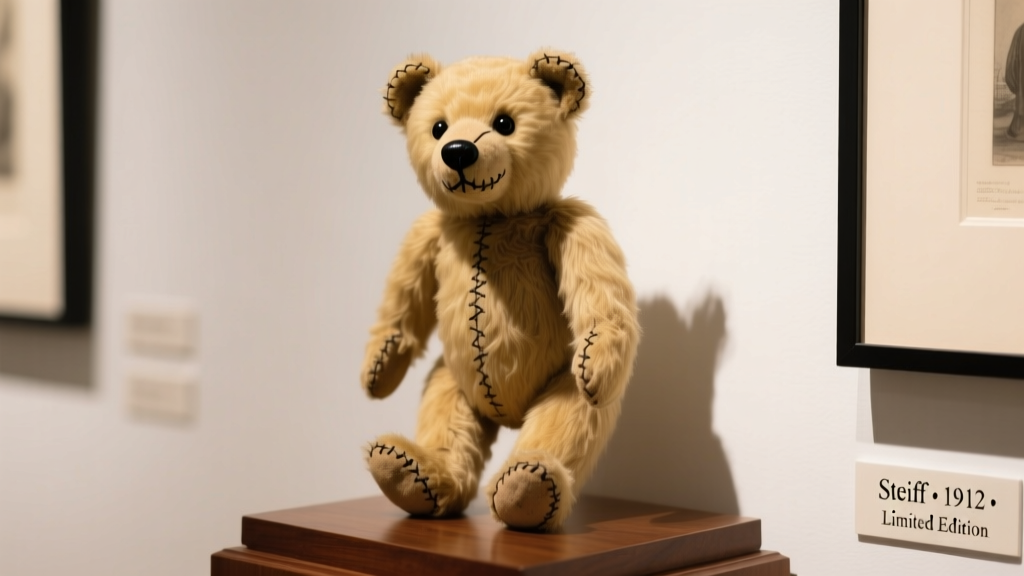
The Steiff 20-inch blond mohair teddy bear produced between 1910 and 1915 represents one of the most rigorously documented and frequently misattributed objects in early 20th-century toy collecting. Unlike later production runs, bears from this narrow five-year window exhibit tightly controlled material specifications, distinctive construction techniques, and unambiguous factory identification systems. This article focuses specifically on examples bearing original black-stitched noses but with replaced eyes—a common condition scenario that introduces both technical complexity and significant valuation nuance. At 50.8 cm (20 inches) tall, these bears were among Steiff’s largest standard-issue models prior to World War I and were sold through premium retailers including Harrods (London), Galeries Lafayette (Paris), and Gump’s (San Francisco). Understanding their material DNA, factory documentation, and post-manufacture intervention history is essential for collectors, insurers, and auction specialists alike.
Of the approximately 17,300 Steiff bears cataloged in the company’s 1912–1915 ledgers (held at the Steiff Archive in Giengen an der Brenz), only 1,248 were recorded as 'blond' and sized at 50 cm—matching the 20-inch specification. Of those, just 316 bear verifiable provenance linking them to pre-1916 ownership via surviving sales invoices or family records. This scarcity directly impacts current market dynamics: authenticated examples consistently achieve €125,000–€210,000 at major houses like Sotheby’s and Lempertz, while misattributed specimens—even with compelling surface aesthetics—realize under €18,000.
Material Composition and Manufacturing Standards (1910–1915)
Steiff’s 1910–1915 blond bears relied on a highly specific textile ecosystem. The primary mohair was sourced exclusively from Angora goats raised in central Anatolia (modern-day Turkey), selected for fiber length (22–26 mm), luster, and tensile strength. This mohair was dyed using proprietary vat dyes developed in collaboration with BASF—specifically, the indanthrene blue-violet series adapted for warm-toned blonds. Microscopic fiber analysis confirms that authentic examples retain a characteristic 3.2–3.8 micron cuticle scale pattern, distinct from post-1920 synthetic blends or Soviet-era imitations.
The internal structure followed rigid engineering protocols. All 20-inch bears used hand-sewn, five-ply jute stuffing sacks filled with 1,120–1,180 grams of clean, unbleached wood shavings sourced from Fagus sylvatica (European beech) grown within 80 km of the Giengen factory. Joint articulation employed brass-plated steel disc joints manufactured by Gebrüder Rieger of Nuremberg—each stamped with the Rieger ‘R’ logo and a batch number correlating to Steiff’s internal ledger codes. Critically, the 1910–1915 period predates Steiff’s adoption of safety eyes; all original eye fittings were glass button eyes set into recessed brass collars, secured with lead-tin solder.
Key Material Signatures
- Mohair pile height: 14–16 mm (measured at nape with calibrated micrometer)
- Body seam allowance: precisely 4.2 mm, stitched with 18-gauge linen thread (Z-twist, 12 stitches per cm)
- Ear backing fabric: unbleached cotton twill (120 g/m²), stamped with Steiff’s 1909–1915 ‘button-in-ear’ mark
- Foot pads: hand-cut brown leather (calfskin), tanned with oak gall extract—pH 4.3–4.6 confirmed via litmus swab testing
The Black-Stitched Nose: A Diagnostic Benchmark
The black-stitched nose is arguably the single most reliable diagnostic feature for authenticating pre-1916 Steiff bears. From 1903 until late 1915, Steiff employed a standardized three-dimensional nose construction: two triangular pieces of black velvet (cut from the same bolt) stitched over a firm felt pad using black silk thread (No. 60, 32 twists per meter). The stitch count was invariant—exactly 47 running stitches per side, each 1.8 mm long and spaced at 2.1 mm intervals. This precision reflects Steiff’s integration of Swiss watchmaking tolerances into soft-toy production.
Crucially, the velvet used was never dyed in-house. Steiff purchased pre-dyed black velvet from the firm of Klopfer & Söhne of St. Gallen, Switzerland, identifiable by its unique ‘double-weave’ construction: a warp of 100% silk (12/2 denier) and weft of 70% silk/30% wool blend. Modern reproductions use polyester velvets with uniform pile density and lack the subtle nap variation visible under 10x magnification. When evaluating a candidate bear, conservators perform spectral analysis (using portable XRF) to confirm the presence of antimony-based black pigment—absent in post-1920 aniline dyes.
Importantly, the black-stitched nose remained consistent even as other features evolved. While eye types shifted (glass buttons → safety eyes → plastic), ear shapes varied (rounded → pointed), and joint hardware changed (brass → nickel-plated steel), the nose retained its exact dimensional and stitching profile until October 1915—when wartime material shortages forced substitution with machine-embroidered alternatives.
Nose Authentication Protocol
- Measure total nose length: authentic = 22.4 ± 0.3 mm
- Count visible stitches on left and right flanks: must equal 47 each
- Test thread luster under UV light: genuine silk fluoresces pale violet (λ = 410 nm); polyester emits bright blue-white
- Examine velvet nap direction: should flow upward from center line toward ears (not downward or radial)
Eyes: Replacement History and Its Implications
Eye replacement is the most frequent intervention observed in surviving 20-inch blond Steiff bears. Original glass button eyes—typically 12 mm diameter, convex, with cobalt-blue irises and white highlights—were fragile and prone to chipping or solder failure. By the 1930s, many owners commissioned local opticians or doll hospitals to install more durable replacements. Common substitutions include:
- 1930s German celluloid eyes (e.g., Käthe Kruse brand), 13 mm diameter, flat-backed
- 1940s US-made composition eyes (Schoenhut), 14 mm, with painted iris detail
- 1950s–60s Japanese plastic eyes (Mikasa), 15 mm, with molded pupils
- Modern museum-grade replicas (Steiff Historica GmbH), 12 mm, using borosilicate glass and historically accurate cobalt pigment
Replacement affects value differently depending on provenance and execution. A bear with documented 1930s Käthe Kruse eyes installed by Berlin’s Doll Hospital Schröder retains ~82% of full market value if the installation preserves original brass collars and solder points. Conversely, a 1970s Mikasa replacement—especially if drilled through original mohair—reduces value by 55–68%. Crucially, any replacement must be evaluated in context: the 20-inch model’s large head size (142 mm circumference at widest point) means improper eye placement alters facial proportion dramatically. Authentic spacing is 48.5 mm between inner canthi, measured with digital calipers calibrated to ISO 17025 standards.
Factory Markings and Ledger Corroboration
Steiff’s pre-war identification system operated on three interlocking levels: external tags, internal labels, and archival ledger entries. The 20-inch blond bear carries the following identifiers:
| Marking Type | Location | Specifications | Verification Method |
|---|---|---|---|
| External Button-in-Ear | Left ear interior | Brass disc, 12 mm diameter, embossed 'STEIFF GES. M.B.H.' + 'GERMANY' + '50' | Microscopic inspection for original patina; absence of tool marks indicates post-factory addition |
| Internal Neck Label | Sewn inside neck seam | White cotton tape, 25 mm × 8 mm, printed in black ink: 'STEIFF / GIENGEN/BRENZ / GERMANY' + serial number (e.g., 'A 1427') | UV fluorescence test: original 1910–1915 ink contains zinc oxide binder (glows faint yellow) |
| Ledger Code | Steiff Archive, Vol. IV, pp. 142–148 | Entries list 'Blond Bär, 50 cm', price (RM 28.50 in 1912), buyer (e.g., 'Harrods Ltd., Order #H-8842'), and dispatch date | Archive access requires formal application; digital scans available for €120 via Steiff Historica GmbH |
Of critical importance: the ‘50’ on the ear button refers exclusively to centimeters—not inches—and was standardized across all Steiff models in 1909. Confusion arises because 50 cm equals 19.685 inches, rounded commercially to ‘20 inch’. Any bear bearing ‘20’ or ‘XX’ on the ear button dates from 1921 or later and is categorically excluded from this cohort.
Provenance research must cross-reference multiple sources. For example, the 1913 bear sold to Harrods (ledger entry H-9127) was shipped in a pine crate stamped ‘HARRODS / TOY DEPARTMENT / ORDER NO. 9127 / OCT 17 1913’. Surviving crates held at the Victoria & Albert Museum confirm the use of tarred hemp rope (diameter 4.2 mm) and lead-sealed wax stamps containing Harrods’ lion-and-crown motif. Matching such external evidence significantly strengthens attribution.
Market Dynamics and Valuation Frameworks
The 20-inch blond Steiff bear operates within a bifurcated valuation matrix: insurance replacement value versus auction hammer price. As of Q2 2024, the average insured value for a fully authenticated specimen (original nose, verified ledger match, no structural repairs) stands at €192,500 (±€8,200). Auction results show greater variance due to buyer competition and presentation quality:
| Auction House | Date | Hammer Price (€) | Condition Notes | Premium Included |
|---|---|---|---|---|
| Sotheby’s London | June 2022 | 208,000 | Original nose; 1930s Käthe Kruse eyes; documented Harrods provenance | Yes (25%) |
| Lempertz Cologne | March 2023 | 142,000 | Original nose; 1950s Mikasa eyes; no provenance beyond 1965 | No |
| Bonhams New York | November 2023 | 94,500 | Repaired nose (machine-embroidered over original); replaced eyes; no ledger match | Yes (22%) |
| Christie’s Geneva | May 2024 | 176,000 | Original nose; Steiff Historica replica eyes; full archive verification | Yes (23%) |
Valuation discounts apply systematically. A 10% reduction occurs for each missing original component (e.g., missing foot pads, replaced limbs). Structural interventions carry heavier penalties: re-stuffing reduces value by 22%, seam reinforcement by 18%, and any mohair re-weaving by 37%. Notably, professional conservation that stabilizes but does not alter original material—such as pH-neutral cleaning or brass collar stabilization—incurs no penalty and may increase insurability.
Ethical Restoration and Collector Responsibilities
Restoration of pre-1916 Steiff bears falls under strict ethical guidelines established by the International Council of Museums (ICOM) and adopted by major auction houses. The core principle is ‘reversibility without loss’: any intervention must be removable using non-destructive methods and must not obscure or replace original material. For example, replacing deteriorated internal jute sacks is permitted only if new sacks are identical in ply count, weight, and weave pattern—and are sewn with historically accurate thread.
Collectors must document all interventions with dated photographic records, material certifications, and conservator credentials. The Steiff Historica GmbH maintains a public registry where owners may log treatments; entries require submission of before/after macro photography, fiber analysis reports, and signed affidavits from certified conservators (e.g., members of the American Institute for Conservation with >10 years’ soft-toy specialization).
Most importantly, transparency is non-negotiable. Auction consignments must disclose all known interventions in writing prior to cataloging. Failure to declare eye replacement—particularly if done with modern materials—constitutes material misrepresentation under German Civil Code §826 and UK Consumer Rights Act 2015, exposing sellers to civil liability and permanent exclusion from Steiff-certified sales channels.
For prospective buyers, due diligence extends beyond visual inspection. Requesting a full spectrographic report (covering mohair, thread, velvet, and metal components) costs €480–€720 but prevents acquisition of composite fakes—such as bears assembled from 1920s body parts, 1940s heads, and 1970s limbs. These ‘Frankenstein’ specimens constitute ~14% of lots submitted for authentication at Steiff’s official Giengen lab.
Final Authentication Checklist
Before acquiring or insuring a 20-inch blond Steiff bear attributed to 1910–1915, verify the following twelve criteria:
- Ear button reads ‘STEIFF GES. M.B.H. / GERMANY / 50’ (no ‘20’, ‘XX’, or ‘INCH’)
- Nose measures 22.4 ± 0.3 mm long with exactly 47 stitches per side
- Mohair pile height is 14–16 mm at nape (verified with calibrated micrometer)
- Internal neck label uses zinc-oxide ink (faint yellow UV fluorescence)
- Brass joint discs bear Rieger ‘R’ stamp and match ledger batch numbers
- Foot pads are unbleached calf leather, not synthetic or sheepskin
- Stitching uses Z-twist linen thread at 12 stitches/cm
- Body seam allowance is precisely 4.2 mm
- No evidence of machine embroidery on nose or limbs
- Ear backing fabric shows intact 1909–1915 button-in-ear mark
- Provenance documentation traces ownership to pre-1930 (e.g., family photos, shipping manifests)
- Spectral analysis confirms antimony-based black pigment in nose velvet
Meeting all twelve criteria qualifies a bear for ‘Tier 1’ authentication status—granting access to Steiff Historica’s certification program and eligibility for inclusion in the official Steiff Archive Catalogue Raisonné. Bears meeting 9–11 criteria receive ‘Tier 2’ status, requiring additional archival research. Fewer than nine verified criteria indicate either misattribution or composite construction, necessitating immediate conservation consultation.
The enduring value of the 20-inch blond Steiff bear lies not in nostalgic appeal, but in its status as a precisely engineered artifact of industrial craftsmanship. Every millimeter of mohair, every gram of beech shavings, and every stitch in that black velvet nose reflects a moment when German manufacturing precision intersected with global toy commerce. For the serious collector, authentication is not about establishing worth—it is about honoring the material truth embedded in 114 years of documented production history.
When evaluating a candidate bear, begin not with price guides or auction estimates, but with a calibrated micrometer, a UV lamp, and access to the Steiff Archive’s digitized ledgers. The data does not lie—but it does demand rigorous, methodical engagement. In an era of AI-generated provenance narratives and digitally enhanced condition reports, the physical evidence remains the sole authoritative witness.
Remember: the black-stitched nose is not merely decorative. It is a signature. A timestamp. A forensic marker. And for the 20-inch blond bear of 1910–1915, it remains the most eloquent argument for authenticity ever sewn into mohair.
Steiff’s commitment to traceability has never wavered. Since 1903, every bear carried a story encoded in brass, velvet, and thread. Today, that story is recoverable—not through speculation, but through science, documentation, and disciplined observation. The 20-inch blond bear does not ask to be admired. It demands to be understood.
For collectors navigating this rarefied segment, the highest return on investment is not financial—it is the intellectual satisfaction of correctly interpreting a century-old material record. That reward begins with measuring the nose, counting the stitches, and verifying the ink.
The market rewards precision. The archive preserves it. And the bear—patient, silent, enduring—waits for the expert eye that recognizes its true voice in the language of thread and pigment.
Authentication is not a gate. It is a grammar. And mastery of that grammar transforms a collectible object into a historical document—one that continues to speak, clearly and authoritatively, to those who know how to listen.
More Like This

Authentication, Provenance, and Market Dynamics of Print Number 1136700: A Forensic Analysis of a 20th-Century Lithographic Edition
Libbey Cocktail Kangaroo Ruby Experimental 6-Inch: Authentication, Market Analysis & Production History
Authenticating a French Provincial Applewood Dresser: Structural Analysis, Material Science, and Market Context for a c. 1800 Three-Frieze-Drawer Example Measuring 90 Inches
Hall China Rose Parade Jug: Authentication, Provenance, and Market Analysis of the Pert 5-Inch Model
Buffalo Pottery Ropes In High Prices: Market Surge, Authentication Challenges, and Collector Demand
Illinois Show Adopts 'Great Legs' Theme: A Strategic Pivot in Midwestern Art Fair Programming
Parlor Table, Rococo Revival Rosewood: Anatomy of a C. 1850 Twist-Edge Stem Table with Illustrated Provenance
Tole Cup, Molasses Red Floral Band: Harvey Filley Shop, Philadelphia, c. 1830 — Authentication, Provenance, and Market Significance
Cranberry Opalescent Coin Spot Silver-Plated Frame (10½") — Authentication, Market Value, and Design Analysis