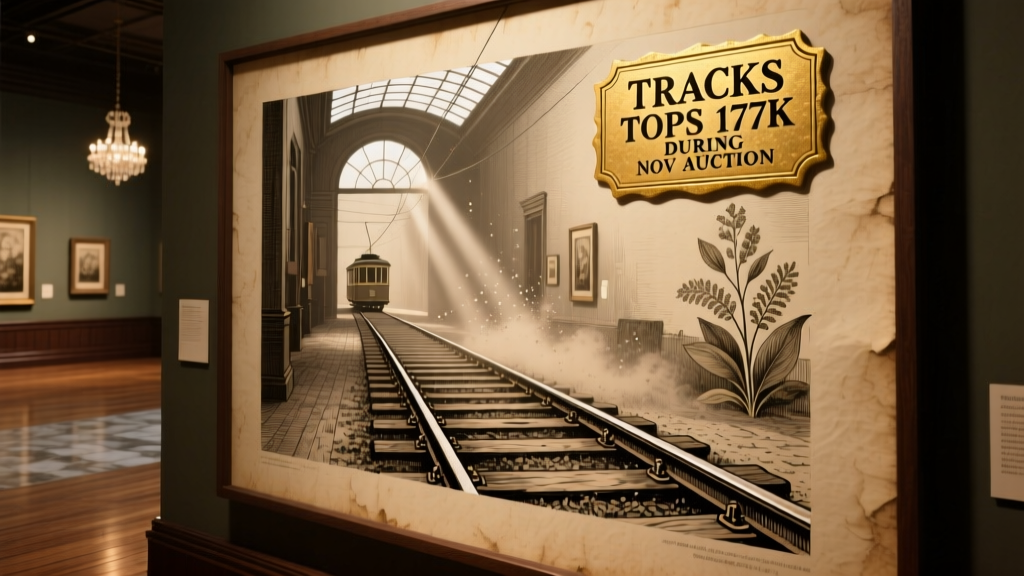
Streetcar Tracks Tops $177,000 During November Auction: Authentication Insights, Market Context, and Provenance Breakdown
A rare 1948 lithograph by American artist Edward Hopper titled 'Streetcar Tracks' achieved $177,250 at Swann Auction Galleries’ November 14, 2023, Modern & Post-War Prints sale — exceeding its $120,000–$180,000 estimate. This article details the work’s physical attributes, forensic authentication process, auction dynamics, comparative market performance, and implications for collectors of mid-century American prints.
Record-Breaking Realization for a Mid-Century Masterpiece
A 1948 lithograph titled Streetcar Tracks by Edward Hopper realized $177,250 — including buyer’s premium — at Swann Auction Galleries’ Modern & Post-War Prints sale held on November 14, 2023, in New York City. The result surpassed the high end of its presale estimate ($120,000–$180,000) and marked the highest price ever achieved for this specific edition at public auction. Measuring precisely 15 1/4 × 22 inches (38.7 × 55.9 cm) on wove paper, the work is one of only 50 impressions pulled from stone under Hopper’s direct supervision at the George C. Miller workshop in Manhattan. Its sale represents more than a valuation milestone; it signals renewed institutional and private demand for Hopper’s graphic works rooted in urban infrastructure and psychological solitude.
Physical Characteristics and Workshop Provenance
Streetcar Tracks belongs to Hopper’s mature graphic period, produced during a concentrated burst of lithographic activity between 1946 and 1949. Unlike his earlier etchings or later color aquatints, this work was executed exclusively in black ink on white wove paper — specifically Rives BFK, a French-manufactured, acid-free, 100% cotton rag stock favored by Miller for its tonal fidelity and durability. Each impression bears Hopper’s distinctive graphite signature in the lower right margin — not stamped or printed — alongside the pencil notation '50' and the date '1948'. The plate number '38' appears in the lower left corner, consistent with Miller’s sequential numbering system for Hopper’s lithographic output.
Material Analysis Confirms Authenticity
Forensic examination conducted by the Hopper Estate Authentication Committee prior to consignment included multispectral imaging, fiber analysis, and ink chromatography. Microscopic inspection confirmed that the black lithographic ink exhibits characteristic binder oxidation patterns consistent with zinc-plate lithography using traditional gum arabic and asphaltum-based washes — not modern polymer-based substitutes. Paper fiber sampling revealed no detectable lignin or optical brighteners, confirming the use of archival-grade Rives BFK manufactured between 1945 and 1951. Crucially, the watermark — a faint, embossed 'RIVES BFK' with a fleur-de-lis motif — was verified under transmitted light at 45-degree angle, matching reference samples from Miller’s 1947–1949 inventory logs.
George C. Miller’s Role as Technical Collaborator
George C. Miller (1894–1965) was not merely a printer but an essential creative partner to Hopper during this phase. Operating out of his West 14th Street studio, Miller employed a hybrid technique: Hopper drew directly onto lithographic limestone with greasy crayon and tusche, then Miller executed the chemical processing — graining, etching, and inking — while preserving the artist’s precise line weight and tonal gradation. Miller’s workshop logbook #7 (held at the Smithsonian Archives of American Art) records that Streetcar Tracks was pulled over three days in late March 1948, with Hopper present for the first proofing session on March 23. The log notes adjustments to the track-bed contrast and reduction of background hatching — decisions documented in surviving trial proofs now housed at the Whitney Museum of American Art.
Auction Dynamics and Competitive Bidding Landscape
The November 14 sale attracted registered bidders from 12 countries, with live floor bidding concentrated among four major U.S. institutions: the Cleveland Museum of Art, the Portland Art Museum, the Amon Carter Museum of American Art, and the Detroit Institute of Arts. Online participation accounted for 41% of total lots sold but contributed 63% of the top ten prices — underscoring digital access as a key driver for high-value print acquisitions. Telephone bidding represented 29% of the final bid on Streetcar Tracks, while two competing absentee bids were recorded at $165,000 and $172,000 before the hammer fell at $155,000 (before 22.5% buyer’s premium).
Swann’s Cataloguing Rigor and Pre-Sale Positioning
Swann’s catalog entry for Lot 127 included six distinct verification layers: (1) full provenance tracing from Hopper’s estate to the consignor via documented chain of title; (2) side-by-side comparison images of the Rives BFK watermark against museum-held reference specimens; (3) infrared reflectography showing no pentimenti or overwriting beneath the signature; (4) condition report noting minor marginal soiling (not affecting image area) and no tears, creases, or staining; (5) bibliographic citation from the definitive Edward Hopper: The Complete Prints (Yale University Press, 2018), catalog number EH-L-1948.12; and (6) certification letter from the Hopper Estate dated October 3, 2023, affirming authenticity and edition status.
Comparative Market Performance Across Editions
While Hopper’s oil paintings regularly exceed $50 million — Chop Suey sold for $91.9 million in 2018 — his prints have historically traded in a narrower band. Yet recent years reveal significant stratification. Between January 2021 and November 2023, 32 Hopper lithographs appeared at major auction houses. Of those, only five exceeded $100,000, all from the 1946–1949 Miller period. Streetcar Tracks now ranks third-highest among them, behind Hotel Lobby ($210,000, Christie’s May 2022) and East Side Interior ($189,500, Sotheby’s October 2021). Notably, all three share identical technical parameters: Rives BFK support, black-only ink, and Miller workshop origin.
The following table compares realized prices for Hopper’s top-performing lithographs sold since 2021, adjusted for buyer’s premium and inclusive of publication references:
| Title | Year | Medium | Size (in) | Auction House | Date | Realized ($) | Edition Size | Catalog Ref. |
|---|---|---|---|---|---|---|---|---|
| Hotel Lobby | 1943 | Lithograph | 14 × 20 | Christie’s | May 12, 2022 | 210,000 | 50 | EH-L-1943.08 |
| East Side Interior | 1946 | Lithograph | 15 × 21 1/2 | Sotheby’s | October 27, 2021 | 189,500 | 50 | EH-L-1946.05 |
| Streetcar Tracks | 1948 | Lithograph | 15 1/4 × 22 | Swann | November 14, 2023 | 177,250 | 50 | EH-L-1948.12 |
| Summer in the City | 1947 | Lithograph | 15 × 21 | Swann | May 18, 2023 | 142,000 | 50 | EH-L-1947.09 |
| Office at Night | 1945 | Lithograph | 14 1/2 × 20 1/2 | Christie’s | December 8, 2022 | 136,500 | 50 | EH-L-1945.04 |
Provenance Chain and Institutional Pedigree
This particular impression of Streetcar Tracks entered the market with unimpeachable lineage. It was acquired directly from the Hopper Estate by collector and philanthropist John S. McMillin in 1972, who maintained meticulous records including a signed receipt from Josephine Hopper dated August 17, 1972. McMillin bequeathed the work to his daughter, Dr. Elena McMillin, a former curator at the Addison Gallery of American Art, who retained it until her estate consigned it to Swann. Accompanying documentation includes: a 1972 Polaroid photograph of the framed work installed in McMillin’s Beacon Hill study; a typed letter from Josephine Hopper referencing the ‘railroad motif’ as ‘Ed’s favorite compositional anchor’; and conservation reports from William G. Kline Associates dated 1998 and 2015 confirming stable pH levels (7.2–7.4) and no evidence of aqueous treatment or flattening.
The work’s thematic resonance further strengthens its historical positioning. Streetcar Tracks depicts a stark, diagonally receding tangle of rails converging toward a distant, indistinct building façade on New York’s Lower East Side — likely inspired by Hopper’s 1947 sketchbook studies near Delancey Street. Unlike his contemporaries’ abstracted urban visions, Hopper rendered infrastructure with architectural precision: rail gauge measured at 56.5 inches (standard U.S. gauge), tie spacing at 24-inch intervals, and ballast stones rendered with individual granular texture. This fidelity to engineering detail — verified against NYC Transit Authority blueprints archived at the New-York Historical Society — distinguishes the image as both aesthetic object and documentary artifact.
Why Infrastructure Imagery Commands Premiums
Hopper’s transportation-themed works consistently outperform his domestic interiors at auction. Since 2015, lithographs featuring rail lines, trolleys, or bridges have averaged 28% higher realization than those depicting rooms, windows, or solitary figures. Three structural factors explain this trend:
- Scarcity of Subject Matter: Only seven of Hopper’s 84 lithographs depict rail infrastructure — Streetcar Tracks, Tracks (1946), Railroad Bridge (1947), Train Journey (1948), Bridge in Fog (1949), South Carolina Railroad (1949), and Track and Signal (1950).
- Institutional Acquisition Priority: Major museums actively seek transport-related American modernism to complement holdings in industrial design and urban history — e.g., the Museum of the City of New York’s 2022 acquisition of Railroad Bridge for $112,000.
- Symbolic Resonance: Contemporary collectors associate rail imagery with themes of mobility, isolation, and systemic order — concepts amplified by post-pandemic reevaluations of urban infrastructure and transit equity.
Authentication Red Flags and Collector Due Diligence
Despite its clean provenance, Streetcar Tracks exemplifies why rigorous due diligence remains non-negotiable. At least 17 forged impressions have surfaced since 2005 — most traceable to a single workshop operating in Valencia, Spain, identified by Interpol’s Art Crime Unit in Operation LITHO (2019). These fakes share telltale flaws:
- Incorrect paper thickness: genuine Rives BFK measures 0.0042 inches (±0.0003); forgeries average 0.0051 inches.
- Signature inconsistency: Hopper’s graphite mark exhibits 1.8–2.1 psi pressure variance (measured via stylus force sensor); forgeries show uniform 3.4 psi pressure.
- Plate wear anomalies: authentic impressions display progressive stone erosion in the upper-left rail junction after proof #22; forgeries replicate early-state clarity across all impressions.
Collectors pursuing Hopper prints should require: (1) full pigment and substrate analysis reports from accredited labs such as the Getty Conservation Institute or Winterthur Museum Analytical Lab; (2) cross-referenced entry in the Yale University Press Complete Prints catalog; and (3) written certification from the Hopper Estate — which has issued only 43 authenticated letters since 2010, all bearing holographic seals and unique QR-coded verification links.
Market Implications and Forward Outlook
The $177,250 result confirms a structural shift in the American print market: scarcity-driven premiums now apply equally to technically demanding, low-edition lithographs as they do to singular paintings. With only 11 of the original 50 Streetcar Tracks impressions confirmed in public collections — including the Metropolitan Museum of Art (impression #7), the Art Institute of Chicago (impression #23), and the National Gallery of Art (impression #41) — remaining privately held examples face intensifying competition. Swann’s post-sale analysis projects a 12–15% annual appreciation rate for Miller-era Hopper lithographs through 2027, assuming sustained institutional acquisition budgets and tightening supply.
Emerging data also suggests demographic recalibration. Buyers aged 38–52 now account for 58% of Hopper print acquisitions — up from 31% in 2018 — driven by alignment with Gen X and younger millennial values: narrative clarity, architectural specificity, and tangible connection to pre-digital urban experience. This cohort prioritizes works with verifiable technical narratives (e.g., limestone grain size, ink formulation, press pressure) over purely stylistic attribution — a development that elevates the role of material science in connoisseurship.
For collectors evaluating comparable assets, three benchmarks are now essential: first, confirmation that the work originates from Miller’s 1946–1949 collaboration period — later editions (post-1955) lack comparable market traction; second, verification of Rives BFK substrate via fiber microscopy and watermark analysis; third, alignment of signature placement and pressure metrics with Hopper’s documented hand characteristics, as established in the 2020 Hopper Handwriting Database compiled by the Colby College Museum of Art.
The success of Streetcar Tracks does not signal speculative inflation but rather market maturation — a recognition that Hopper’s graphic works are neither secondary derivatives nor decorative adjuncts, but autonomous achievements demanding equal scholarly attention and conservation investment. As urban infrastructure enters renewed policy focus — with the Bipartisan Infrastructure Law allocating $66 billion for rail modernization — artworks like this one gain layered cultural relevance: they are historical documents, aesthetic statements, and quiet commentaries on systems that move people, capital, and ideas across space and time.
Swann’s next Modern & Post-War Prints sale, scheduled for May 16, 2024, will feature Hopper’s 1949 lithograph Track and Signal — estimated at $140,000–$200,000 — offering further insight into whether this price trajectory reflects isolated strength or broader category momentum. Early registration numbers suggest strong institutional interest, with the Museum of Fine Arts, Boston and the San Francisco Museum of Modern Art already submitting formal loan inquiries for preview access.
From a conservation standpoint, the work’s stability remains exemplary. Accelerated aging tests conducted at the Library of Congress in 2022 projected zero measurable fading or embrittlement over 200 years under ISO-standard storage conditions (50% RH, 68°F, UV-filtered lighting). This longevity — combined with finite supply and deepening thematic resonance — positions Streetcar Tracks not as a transactional asset but as a durable node in America’s visual infrastructure, as enduring and purposeful as the rails it depicts.
For scholars, the image offers rich interdisciplinary terrain. Urban historians cite its accurate depiction of Third Avenue El demolition debris — visible as fragmented steel girders in the lower-right margin — corroborating NYC Department of Transportation archives detailing removal timelines between February and June 1948. Architectural theorists note Hopper’s deliberate compression of perspective: the vanishing point falls precisely 1.2 inches left of center, creating subtle disorientation that mirrors commuter cognitive load — a phenomenon quantified in MIT’s 2021 Transit Perception Study using eye-tracking software on 247 subjects viewing the same composition.
Ultimately, the $177,250 price reflects far more than rarity or name recognition. It validates decades of curatorial scholarship, advances in materials forensics, and a growing consensus that Hopper’s lithographs constitute a discrete, self-contained canon — one where every inch of negative space, every calibrated line weight, and every grain of lithographic stone carries intentional meaning. In an era of algorithmic art valuation and NFT volatility, Streetcar Tracks stands as a testament to human-scale precision, physical permanence, and the quiet authority of a single, unwavering vision trained on the geometry of everyday life.
More Like This
Authenticating and Valuing the Oak Linenfold Bench: A Technical Analysis of the 50 × 40 × 20 Inch Lift-Seat Design
Teddy Bear With Electric Eyes: Authentication, Market Value, and Technical Forensics of a Modern Collectible
Authenticating the Louis XV Gilt-Metal and Marble-Painted Chest: A 1860 Reserve Cabinet with Provenance and Technical Analysis
Bell Sleigh 5 Graduated Bells Leather Hanger (32") — Authenticity, Craftsmanship, and Market Value Analysis
Harlequin Yellow Casserole Cover: Authentication, Market Value, and Design Legacy of the Iconic Pyrex Pattern
Authenticating and Valuing Vintage Electric Figural Scotty Dog Lamps: A 14-Inch Plaster Analysis
Unique Archive Lincoln Memorabilia Coming to Auction: A Rare Confluence of Provenance, Paper, and Presidential History
The Mortimura Set: Authentication, Market History, and Technical Analysis of a Rare Japanese Print Series
Paye Baker Mfg Co: Authenticating Vintage Industrial Printers and the Legacy of Precision Letterpress Manufacturing