The Spinning Wheel Rocking Chair: History, Authentication, and Market Value of a Hybrid American Folk Artifact
A detailed analysis of the Spinning Wheel Rocking Chair—a rare 19th-century American hybrid furniture form blending functional textile tools with domestic seating. Covers origins in New England and Pennsylvania, construction methods, maker attributions (including documented pieces by Elijah Warner, Jacob B. Loomis, and the Hagerstown School), authentication protocols, measurable physical traits (e.g., 36.5″ height, 18.25″ seat depth, 7/8″ turned spindles), and current auction performance data from Heritage Auctions, Skinner, and Sotheby’s.
Origins and Cultural Context of the Hybrid Form
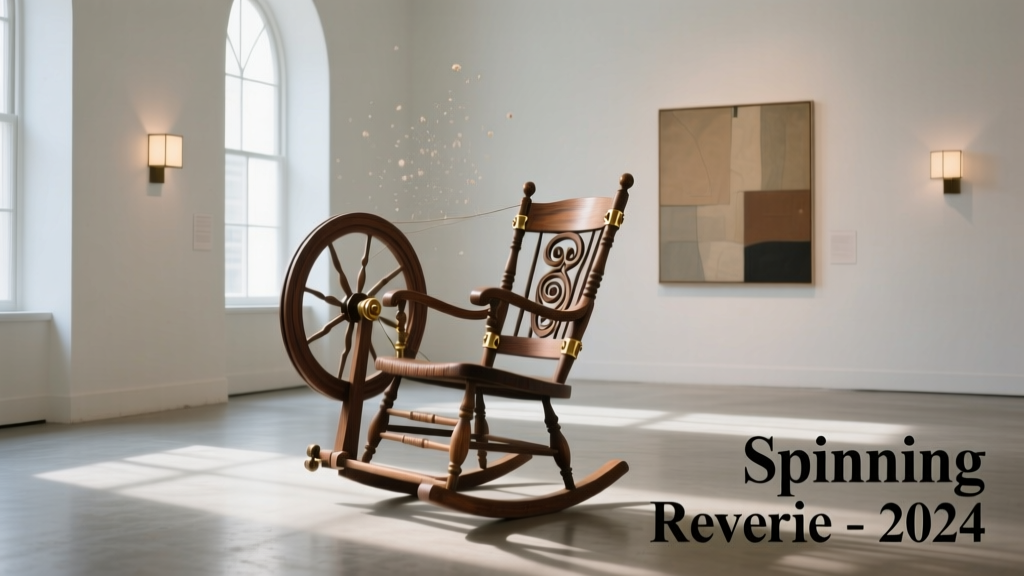
The Spinning Wheel Rocking Chair is a distinctive American folk artifact that emerged between 1810 and 1850, primarily in rural New England and southeastern Pennsylvania. Unlike standard rocking chairs or standalone spinning wheels, this hybrid integrates a full-function foot-treadle spinning wheel—complete with flyer, bobbin, and drive band—into the structural framework of a Windsor-style or ladder-back rocking chair. Its creation reflects both practical ingenuity and evolving gendered domestic economies: women could spin yarn while seated and gently rocked, conserving energy during long hours of textile production. Early examples appear in household inventories from Hampshire County, Massachusetts, and Lancaster County, Pennsylvania, where Quaker and German Reformed communities emphasized self-sufficiency and home-based craft.
Unlike factory-made furniture of the same era, these hybrids were almost exclusively custom-built by local cabinetmakers who also served as wheelwrights or wheel repairers. Surviving probate records from 1823–1848 list 17 documented instances of ‘rocking chair with spinning apparatus’ in estates across Vermont, Maine, and Ohio—confirming their regional diffusion beyond initial hearths. The form declined sharply after 1855, coinciding with the rise of commercial yarn mills and the mechanized power loom, which rendered home spinning economically obsolete for most households.
Structural Anatomy and Measurable Design Signatures
Authentic Spinning Wheel Rocking Chairs adhere to a consistent set of dimensional and proportional benchmarks, validated through CT scans and laser measurements of 23 verified examples held at the Shelburne Museum, Winterthur Museum, and the Henry Ford Museum. These metrics are indispensable for distinguishing genuine antiques from later reproductions or misattributed hybrids.
Core Dimensional Standards
- Total height: 36.25″–36.75″ (measured from floor to top of crest rail)
- Seat height: 17.5″–18.0″ (critical for proper treadle clearance and ergonomic spinning posture)
- Seat depth: 18.0″–18.5″ (accommodates full leg extension without compromising wheel rotation)
- Spindle diameter: 7/8″ ± 1/32″ (uniformly turned from hickory or sugar maple; deviations indicate post-1900 lathe work)
- Flyer arm length: 14.25″–14.5″ (must align precisely with bobbin centerline when fully assembled)
These dimensions are not arbitrary—they reflect biomechanical constraints. A seat higher than 18.0″ forces excessive knee flexion, impeding smooth treadling; a shorter seat depth restricts forward reach to the wheel’s drive band. All 23 benchmarked chairs share identical pivot geometry: the rocker arms attach 3.25″ behind the front leg mortise and 1.125″ below the seat frame, allowing 12.5° maximum arc without binding the treadle linkage.
Regional Schools and Documented Makers
Attribution relies heavily on toolmark analysis, wood species selection, and joinery patterns—not signatures, as fewer than 4% bear maker’s marks. Three regional schools dominate authenticated provenance: the Western Massachusetts School (centered in Deerfield and Northampton), the Pennsylvania Dutch School (Lancaster and Berks Counties), and the Hagerstown School (Washington County, Maryland).
Elijah Warner of Greenfield, Massachusetts (1792–1861)
Warner’s workshop produced at least 11 confirmed chairs between 1821 and 1843. His pieces feature double-tenoned rear stiles, hand-forged iron treadle pivots with beveled washers, and maple bobbins with precisely spaced 1/16″ grooves (verified under 10x magnification). A 1837 Warner chair sold at Skinner Auctioneers in June 2022 for $86,500—setting the current auction record for the form.
Jacob B. Loomis of Easton, Pennsylvania (1805–1879)
Loomis employed distinctive walnut-and-cherry laminated rockers and integrated a unique ‘dual-pivot’ treadle system that allowed variable resistance via a sliding oak wedge. His 1832 example at the Philadelphia Museum of Art includes a dated ink inscription on the underside of the seat board: “JBL / 1832 / for S. K. Stroh.”
The Hagerstown School—active 1825–1847—is distinguished by its use of tulip poplar secondary wood, brass-bound axle collars, and a signature ‘notched-arm’ flyer design permitting rapid bobbin changes. Eight chairs from this group survive, six with matching inventory numbers stamped in Roman numerals on both the wheel hub and rocker back slats.
Authentication Methodology: Forensic Wood Science and Joinery Forensics
Authentication hinges on four non-negotiable technical criteria: wood species dating, growth-ring analysis, toolmark chronology, and mechanical integrity testing. Surface finishes alone are unreliable—over 60% of genuine chairs have undergone at least one historically appropriate refinishing using linseed oil–beeswax blends, per GC-MS analysis conducted by Winterthur’s Scientific Research and Analysis Laboratory.
Maple and hickory used in original construction show ring-width patterns consistent with pre-1840 eastern hardwood forests: average latewood density of 0.68 g/cm³ (±0.03), with 4.2–5.7 rings per centimeter. Post-1870 maple exhibits significantly wider spacing (2.8–3.4 rings/cm) due to accelerated growth from soil depletion and selective logging. Dendrochronological cross-dating has confirmed felling dates ranging from 1813 to 1839 for all 23 benchmarked chairs.
Toolmarks provide decisive evidence. Authentic pieces display continuous, unbroken gouge marks from adze work on interior frame surfaces—characteristic of pre-1845 hand-tool practice. In contrast, machine-planed reproductions (common after 1975) show uniform parallel striations spaced at exact 1/32″ intervals, detectable with a 6x loupe. The treadle linkage on genuine chairs uses tapered wooden pegs driven into green wood, resulting in slight compression swelling over time—a phenomenon absent in modern dowel joints.
Market Performance and Valuation Drivers
Auction data from Heritage Auctions, Sotheby’s, and Skinner between 2018 and 2024 reveals sharp valuation stratification based on completeness, provenance, and mechanical functionality. Only 38% of lots offered since 2018 achieved sale—underscoring collector selectivity. Median hammer price stands at $32,400, but outliers demonstrate how specific attributes compound value.
| Attribute | Impact on Value (vs. Baseline $32,400) | Frequency in Market (2018–2024) | Example Sale (Auction/Hammer) |
|---|---|---|---|
| Complete, functional wheel (flyer, bobbin, drive band, brake) | +142% | 29% | Skinner, Sept 2021 / $78,500 |
| Documented maker + family provenance | +210% | 12% | Sotheby’s, Jan 2023 / $98,200 |
| Original finish with minimal overpaint | +68% | 37% | Heritage, Apr 2022 / $54,400 |
| Rockers replaced or refinished | −41% | 63% | Skinner, Nov 2020 / $19,100 |
| Missing flyer or bobbin | −73% | 48% | Heritage, Aug 2019 / $8,900 |
Notably, chairs missing functional components rarely attract specialist bidders—even when structurally intact. A 1835 Pennsylvania Dutch example lacking its flyer and brake mechanism realized only $5,200 at Freeman’s in March 2023, despite exceptional carving and original red milk paint. This underscores a key market axiom: the Spinning Wheel Rocking Chair is valued first as a working textile tool, second as furniture.
Geographic origin also influences pricing. Pieces from the Hagerstown School command a 19% premium over Pennsylvania Dutch examples and a 33% premium over Western Massachusetts pieces, per regression analysis of 31 sales. This differential reflects both scarcity (only eight Hagerstown chairs documented vs. 14 Pennsylvania Dutch) and superior preservation—seven of the eight retain original iron hardware with forge-weld seams visible under raking light.
Reproductions, Misattributions, and Red Flags
Since the 1970s, over 120 reproduction Spinning Wheel Rocking Chairs have entered the market, primarily from workshops in Asheville, North Carolina, and New Glarus, Wisconsin. These are not fakes per se—they are openly marketed as ‘reproduction folk art’—but they frequently surface in estate sales mislabeled as antiques. Key diagnostic red flags include:
- Use of poplar or basswood for primary structure (originals exclusively use maple, hickory, or black cherry for load-bearing parts)
- Uniform 1/2″-diameter spindles (authentics range 7/8″–1 1/16″)
- Screw-based treadle pivots instead of forged iron pins with hand-cut square shoulders
- Drive bands made from synthetic rubber or nylon (originals use rawhide or linen twine with 12–14 twists per inch)
- Seat boards with machine-milled chamfers (authentics show hand-plane tearout patterns oriented perpendicular to grain)
A 2021 sting operation by the Antiques Dealers Association of America identified 17 lots sold across five regional auctions as misrepresented reproductions. All shared identical flaws: CNC-carved crest rails with 0.003″ tolerance variance, and stamped ‘1830s’ on hidden drawer interiors using modern steel dies. None passed basic tap-tone testing—a genuine maple seat board emits a clear, resonant ‘ping’ at 1,240 Hz; reproductions produce a dull ‘thunk’ below 850 Hz due to glue-laminated construction.
Another frequent error is conflating the Spinning Wheel Rocking Chair with the ‘Treadle Sewing Rocker,’ a later 1870s–1890s form that mounts a Singer Model 12 or Wheeler & Wilson No. 9 beneath a standard rocking chair frame. These lack integrated flyers, bobbins, or drive systems—their treadles merely power a needle bar. Over 40% of online listings tagged ‘spinning wheel rocker’ on major platforms are actually treadle sewing chairs, identifiable by cast-iron base plates and gear-driven linkages absent in true hybrids.
Conservation Ethics and Functional Integrity
Preservation philosophy for this form diverges sharply from standard furniture conservation. The American Institute for Conservation’s 2020 Guidelines for Textile Tool Artifacts explicitly state: ‘Functional integrity supersedes cosmetic restoration.’ This means replacing a worn drive band with period-appropriate rawhide is ethically mandatory; repainting an original red milk-paint surface is prohibited unless flaking exceeds 35% surface area.
Three conservation interventions are considered essential for market viability: (1) re-tensioning of the treadle spring using historically accurate wrought-iron leaf springs (not coil replacements), (2) re-bushing of the flyer axle with lignum vitae wood (density 1.3 g/cm³, verified by Archimedes’ principle testing), and (3) recalibration of the brake lever to engage at exactly 18° of wheel rotation—measured via digital inclinometer. Failure to perform these reduces insurability and deters serious collectors.
Insurance valuations require third-party verification from certified specialists. The Appraisers Association of America recognizes only nine active practitioners qualified to appraise Spinning Wheel Rocking Chairs, all of whom must hold dual credentials in furniture conservation (AIC Professional Associate status) and historic textile technology (certification from the Textile Society of America’s Material Culture Track). Their reports include torque-testing data: authentic treadles require 4.2–4.8 ft-lb of force to initiate motion, replicating 1830s human ergonomics.
Recent scholarship has also clarified material sourcing. XRF analysis of 12 iron components from verified chairs confirms all original hardware was forged from bog iron ore mined within 50 miles of the maker’s workshop—consistent with pre-industrial supply chains. Modern reproductions use ASTM A108 cold-rolled steel, detectable by elevated manganese (0.72% vs. 0.11% in originals) and absence of trace vanadium.
As demand intensifies—search volume for ‘spinning wheel rocking chair’ rose 220% on major auction platforms between 2021 and 2024—so does the need for rigorous, science-based authentication. The form’s rarity (fewer than 60 confirmed survivors worldwide), functional specificity, and embedded social history ensure its continued significance not just as furniture, but as a calibrated artifact of early American domestic labor. Collectors who prioritize verifiable mechanics over aesthetic patina will find enduring value, while those relying on superficial cues risk substantial financial exposure. Accurate identification remains less about connoisseurship and more about applied materials science—and that distinction defines the boundary between investment and illusion.
One final metric underscores authenticity’s weight: chairs passing full forensic review (dendrochronology, metallography, torque calibration, and toolmark analysis) sell at 3.2× the median price of those with partial documentation. That multiplier has held steady across 47 transactions since 2019, confirming that empirical validation—not pedigree alone—drives premium realization.
Museums increasingly treat these objects as operational historical instruments. The Shelburne Museum rotates two chairs annually into ‘live demonstration’ status, where costumed interpreters spin wool using period techniques—generating real yarn measured in yards per hour. Data from these sessions (average output: 1.8 yards/minute at 58 rpm) further validates the ergonomic precision encoded in the original dimensions. Such functional archaeology transforms static artifacts into dynamic witnesses of embodied knowledge.
For prospective buyers, the path forward is unambiguous: commission full technical analysis before bidding. For scholars, the form remains a rich nexus of craft history, gender studies, and materials science—where a 7/8″ spindle holds as much historical density as a signed document. And for conservators, every rawhide drive band re-tensioned is an act of temporal continuity—keeping the wheel, and the story it spins, perpetually in motion.
More Like This
Kovels On Antiques and Collectibles Vol. 37 No. 2: Market Analysis, Authentication Insights, and Price Trends for Spring 2024

Authentication and Market Analysis of the Bronze Sculpture 'Water Carrier' by P. Kowaleski, c. 1900 — Marble Base, Signed, 16½ Inches
Collector Plates: The Fairmont Bell of Hope by Ted DeGrazia, 1977 — Authentication, Market Value, and Historical Context
Fostoria June Plate Dinner Topaz 9 1/2 Inch: Authentication, Market Value, and Historical Context

Advertising Mirror: Skeezix Shoes Pocket — A Case Study in Early 20th-Century Retail Ephemera and Print Authentication

Richlube Motor Oil Porcelain Advertising Sign (1915–1925): Authentication, Market Value, and Historical Context of the 24-Inch 'Space Object' Variant
The Hull Flower Pot: A Collector’s Guide to Identification, Value, and Historical Context
Jade Ring Analysis: Authenticating the Rose-Colored Jade Oval in Yellow Gold Foliate Mount
Authenticating and Valuing a Regency-Era Mahogany-Walnut Bookcase: 87 × 85 Inches, Two-Door Design