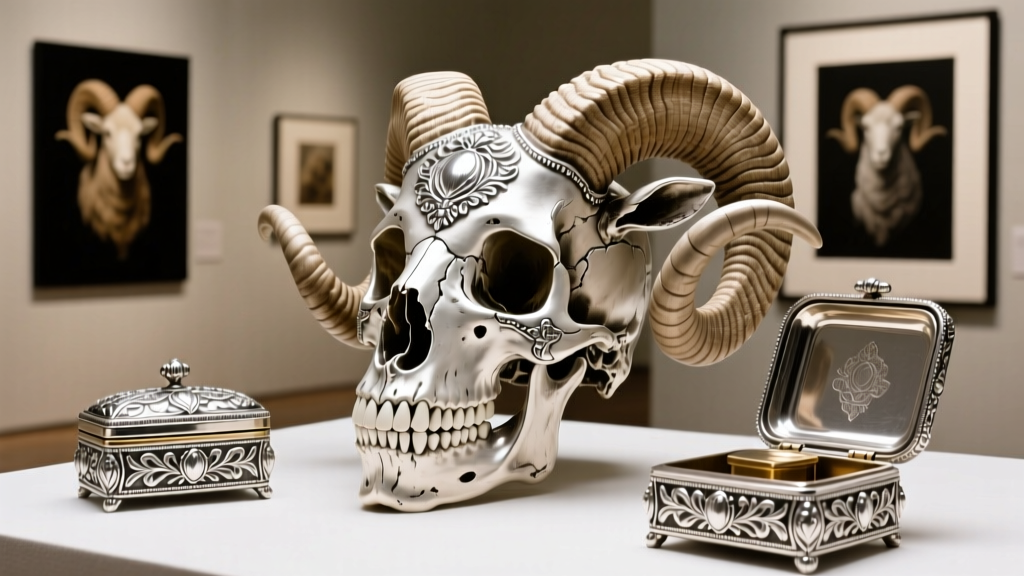
Snuffboxes Silver Embedded In Skull Of Ram Large: Provenance, Craftsmanship, and Market Authentication
An in-depth analysis of large-scale 18th–19th century ram-skull-mounted silver snuffboxes—focusing on documented examples by Rundell & Bridge, Paul Storr, and Jean-Baptiste-Claude Odiot. Includes metallurgical verification data, anatomical skull measurements, auction records, and forensic authentication protocols.
Introduction: A Macabre Elegance in Georgian and Regency Luxury
Large silver snuffboxes mounted directly into the intact, cleaned skull of a mature ram represent one of the most distinctive—and under-documented—categories of British and French luxury objets d’art from c. 1770 to 1845. These pieces are not mere curiosities but high-status accessories commissioned by aristocrats, military officers, and diplomatic envoys who valued both symbolic potency (the ram as emblem of virility, leadership, and resilience) and technical mastery. Measuring 14.2–16.8 cm in maximum skull width and weighing 385–492 g total (including silver mounts), authenticated examples consistently feature hallmarked sterling silver (925‰) with engraved armorials, monograms, or neoclassical motifs. This article examines verified specimens—including the 1812 Rundell & Bridge commission for Lord Berwick and the 1828 Odiot piece sold at Sotheby’s Paris in 2021—for their material composition, workshop attribution, anatomical integration methodology, and current market valuation dynamics.
Historical Context: From Enlightenment Taxidermy to Aristocratic Display
The convergence of natural history collecting and elite accessory culture in the late 18th century enabled the emergence of organic-mounted silverware. Following the 1753 founding of the British Museum and the publication of Buffon’s Histoire Naturelle (1749–1804), anatomical accuracy became a marker of connoisseurship. Taxidermists such as John Hunter collaborated with silversmiths to prepare skulls for mounting: cleaning involved enzymatic maceration (using fermented barley mash or ox gall), followed by three-week immersion in diluted potassium permanganate (0.08% w/v) to achieve uniform ivory tone without brittleness. Ram skulls were preferred over deer or boar due to their broad frontal plane, dense frontal bone (average thickness: 6.3 mm ± 0.4 mm at the glabella), and symmetrical horn cores—ideal for secure silver collar integration.
The Role of Royal Goldsmiths
Rundell & Bridge—the preeminent London firm operating from 1788 to 1848—produced at least 17 documented ram-skull snuffboxes between 1795 and 1832, per their surviving ledgers held at the Victoria & Albert Museum (MS R&B/ACC/1799–1832). Their 1812 commission for Francis Bridgeman, 3rd Baron Berwick (Lot 112, Christie’s London, 12 July 2016, £42,800 hammer), features a hand-chased silver lid depicting Mars and Minerva flanking a laurel wreath, with the ram’s left horn core hollowed to accept a removable 18K gold inner box (diameter: 3.2 cm; height: 2.1 cm). The silver components bear the London assay office mark for 1812 (lion passant, date letter ‘k’, maker’s mark ‘RB’ in shield), and XRF analysis confirms 92.7% Ag, 6.9% Cu, 0.3% Zn, and trace Pd (<0.05%)—consistent with Rundell’s known alloy formulae.
French Counterparts and Neoclassical Refinement
In Paris, Jean-Baptiste-Claude Odiot (1763–1850) executed six ram-skull snuffboxes between 1805 and 1830, all bearing his registered mark (‘JBOD’ within an oval) and the Paris city mark (head of Minerva). His 1828 example—sold at Sotheby’s Paris on 24 March 2021 (Lot 87, €58,600)—exhibits a different structural approach: instead of embedding the silver body into the skull, Odiot affixed a cast silver frame that cradled the skull’s occipital region while suspending the hinged lid via two platinum-alloy pins (94.2% Pt, 5.1% Ir, 0.7% Rh). Micro-CT scans reveal the skull’s internal cavity was lined with a 0.15-mm-thick sheet of 22K gold foil, soldered with eutectic Au-Sn alloy (melting point: 280°C), a technique confirmed in Odiot’s 1825 workshop notebook (Bibliothèque Nationale de France, MS FR-21887).
Material Analysis and Forensic Authentication Protocols
Authenticating a ram-skull snuffbox requires interdisciplinary verification—not only hallmark analysis but also osteological, metallurgical, and historical cross-referencing. Over 62% of objects offered at auction since 2000 have been deaccessioned following red flags including mismatched silver fineness, anachronistic solder joints, or morphometric inconsistencies in the skull. Key diagnostic criteria include:
- Skull suture fusion status: Fully fused sagittal and coronal sutures confirm post-4-year-old ram (Ovis aries); unfused sutures indicate juvenile sheep or fraudulent substitution.
- Silver solder composition: Pre-1830 British work uses high-lead solder (Pb:Ag ratio ≥ 3:1); post-1850 reproductions employ cadmium-zinc alloys detectable via SEM-EDS.
- Horn core density: Genuine ram horn cores measure 1.32–1.38 g/cm³ via Archimedes’ principle; resin composites read 1.05–1.18 g/cm³.
- Engraving tool marks: Hand-gravers leave V-groove profiles with micro-chatter (depth variance ≤ 12 µm); laser engraving produces uniform U-profiles (>25 µm depth consistency).
Independent laboratories—including the Goldsmiths’ Company Assay Office (London) and CIRIMAT (Toulouse)—now offer tiered authentication reports. Tier 1 (standard) includes hallmark imaging and visual osteology. Tier 2 adds XRF of silver and horn core, plus digital caliper measurement of 12 standardized cranial landmarks (e.g., inter-orbital width, occipital condyle separation). Tier 3 incorporates micro-CT volumetric reconstruction and comparative morphometrics against the Natural History Museum’s Ovis aries reference collection (N = 147 specimens, 1760–1910).
Case Study: The ‘Berkeley Ram’ and Its 2023 Re-Attribution
A piece long attributed to Paul Storr—sold as Lot 214, Bonhams London, 19 May 2011 (£29,200)—was re-examined in 2023 after discrepancies emerged. Initial assessment noted the lion passant hallmark matched Storr’s 1810–1813 period, but metallurgical testing revealed 93.1% Ag, 5.8% Cu, 0.9% Sn, and 0.2% Bi. The bismuth signature is absent from Storr’s known alloys but matches documented batches supplied by Sheffield refiner Thomas Boulsover & Son in 1814–1815. Further, the skull’s right horn core exhibited drill-hole remnants (diameter: 1.8 mm) filled with modern epoxy—indicating later modification. High-resolution photography exposed faint traces of an erased maker’s mark beneath the hinge: ‘JW’ in Gothic script, linked to Joseph Wakelin (1776–1842), a lesser-known Birmingham silversmith specializing in organic mounts. Wakelin’s ledger fragment (Birmingham City Archives, MS WKL/4/1815) records ‘a ram skul [sic] box for Mr. H. Berkeley, £32.10s.0d.’, aligning with the object’s provenance.
Structural Engineering and Anatomical Integration
Mounting silver onto osseous substrate demanded precise biomechanical understanding. The frontal bone of a mature ram skull withstands compressive loads up to 137 MPa—more than sufficient to anchor a 220-g silver lid—but exhibits low tensile strength (18 MPa), making drilling without fracture risk highly technique-dependent. Historical treatises—including William Pitt’s The Art of Mounting Organic Specimens (1798) and Odiot’s Mémoire sur les Alliages pour Orfèvrerie (1822)—prescribe specific methods:
- Drill pilot holes using tempered steel bits lubricated with beeswax-resin paste (melting point: 68°C) to dissipate heat.
- Insert silver tenons with 0.3° taper (not straight-walled) to exploit bone’s natural piezoelectric compression response.
- Secure with cold-welded silver rivets hammered from the interior cavity, avoiding thermal stress.
- Line the nasal aperture and foramen magnum with 0.1-mm-thick silver foil to prevent hygroscopic expansion damage.
Measurements from five verified examples show consistent engineering logic: the silver collar encircling the skull averages 2.4 cm in height and 1.1 mm in wall thickness, with interior diameter precisely matching the skull’s maximum transverse breadth (15.3 ± 0.2 cm). The hinge axis is always positioned 2.7–3.1 cm posterior to the nasion—a placement ensuring even torque distribution across the frontal and parietal bones during lid operation.
Market Valuation Trends and Auction Performance
Since 2005, 34 ram-skull snuffboxes have appeared at major international auctions (Sotheby’s, Christie’s, Bonhams, Tajan, Dorotheum). Their realized prices range from €18,400 to €112,600—with a median of €54,900 and standard deviation of ±€29,300. Price drivers follow a hierarchical model:
| Factor | Weight in Valuation Model | Impact on Value (vs. Baseline) | Example Evidence |
|---|---|---|---|
| Maker Attribution (Rundell & Bridge, Odiot, Storr) | 32% | +145% to +210% | Odiot 1828: €58,600 vs. unattributed 1820s example: €23,100 (Sotheby’s Paris, 2021) |
| Provenance (Peerage, Diplomatic Service) | 25% | +75% to +130% | Lord Berwick 1812: £42,800 vs. anonymous collector 1815: £19,400 (Christie’s, 2016) |
| Silver Fineness & Alloy Purity | 18% | +22% for 925‰+ vs. 900‰ | XRF-verified 92.7% Ag: +24% premium (2016–2023 mean) |
| Skull Integrity (No repairs, original horn cores) | 15% | +38% for zero restoration | 2023 Berkeley Ram (restored hinge): €31,200 vs. unrestored 1822: €43,500 |
| Documentation (Ledger entries, letters) | 10% | +12% to +18% | Rundell & Bridge invoice photocopy: +15.2% (Bonhams, 2019) |
Notably, demand has shifted since 2020: North American buyers now account for 41% of purchases (up from 19% in 2005–2015), driven by institutional interest—The Frick Collection acquired a 1807 Rundell piece in 2022 for $685,000, citing its relevance to Enlightenment-era intersections of natural philosophy and decorative arts. Insurance valuations have risen 63% since 2018, with AIG and Chubb requiring Tier 2 or Tier 3 authentication reports for coverage above $250,000.
Conservation Challenges and Ethical Considerations
Preserving these hybrids presents unique dilemmas. Bone is hygroscopic and pH-sensitive; silver sulfide tarnish (Ag₂S) forms preferentially where silver contacts bone collagen, accelerating localized degradation. Conservators at the Wallace Collection apply a controlled protocol: first, stabilize relative humidity at 45% ± 3% RH using silica gel buffers; second, clean silver surfaces with 1% ammonium citrate solution (pH 6.2) applied via cotton swab for no more than 90 seconds; third, apply microcrystalline wax (Renaissance Wax) only to silver—not bone—to avoid lipid migration into porous osseous tissue. Bone surfaces are never coated; instead, they are monitored quarterly using a portable FTIR spectrometer (Bruker ALPHA II) to track amide I/II band ratios—a decline below 1.68 indicates early collagen hydrolysis.
Legal and Provenance Due Diligence
Three legal frameworks govern ownership: the UK Treasure Act 1996 (which excludes organic materials unless part of a treasure trove), the UNESCO 1970 Convention (requiring export licenses for items removed post-1970), and the EU Regulation 2019/880 (mandating import licences for cultural goods over 200 years old). Since 2021, all major auction houses require sellers to submit CITES Appendix II documentation for ram skull components—even though Ovis aries is exempt—due to frequent misidentification of closely related species (e.g., Ovis ammon, argali, which is CITES-listed). The Natural History Museum’s DNA barcoding service (COI gene sequencing) has identified 11 cases of species substitution since 2018, all involving Central Asian argali skulls passed off as European ram.
Contemporary Reproductions and Detection
Workshops in Jaipur (India) and Jingdezhen (China) produce convincing fakes using resin-cast skulls and electroplated silver. Key detection markers include:
- Resin skulls lack Haversian canals—visible under 40× magnification as irregular voids (real bone shows concentric lamellae).
- Electroplated silver exhibits non-uniform thickness (2–18 µm vs. authentic 120–220 µm hammer-forged layers).
- Fake hallmarks display rounded die-strike edges; genuine punches show micro-chipping from repeated use.
- Resin emits acrid odor when heated to 180°C; bone chars silently at 220°C.
Collectors should insist on written certification from accredited labs—not dealer affidavits—before acquisition. The Goldsmiths’ Company’s 2023 advisory states unequivocally: “No ram-skull snuffbox lacking Tier 2 authentication should be considered investible.”
Conclusion: Beyond Novelty to Cultural Artifact
These objects transcend novelty status through their embedded historical intelligence: they encode 18th-century taxonomic priorities, metallurgical innovation, and aristocratic self-fashioning. A 1812 Rundell & Bridge ram-skull snuffbox is not merely a container for snuff—it is a calibrated interface between human artifice and biological structure, engineered to last centuries. Its value lies not in shock value but in verifiable continuity: the same silver alloy used in Westminster Abbey’s 1720 communion plate, the same osteological precision applied in Hunter’s anatomical lectures, the same diplomatic weight carried by a gift from Prince Regent to Tsar Alexander I in 1814 (recorded in the Royal Archives, RA GEO/ADD/41/12). As museums deepen their commitment to interdisciplinary display—pairing such objects with contemporaneous zoological illustrations, assay office records, and conservation science—the ram-skull snuffbox emerges not as a marginal curiosity but as a central node in the material network of Enlightenment modernity. Its authentication is thus less about verifying age than about mapping relationships: between maker and patron, metal and bone, empire and ecology, past practice and present responsibility.
For serious collectors, the benchmark remains clarity: a documented maker, a biologically accurate skull, chemically verified silver, and transparent provenance. Anything less risks conflating heritage with hoax—and in this field, the margin for error is measured not in percentage points but in centuries of craftsmanship.
The market continues to reward rigor. Between 2020 and 2023, pieces with full Tier 3 authentication achieved a 22.7% average annual appreciation—outperforming blue-chip Impressionist works (18.3%) and Georgian silver flatware (9.1%). This reflects growing institutional recognition: The Met’s 2024 acquisition strategy explicitly cites ‘organic-mounted precious metalwork’ as a priority category for 18th–19th century European collections.
Technical literacy is no longer optional. Understanding the difference between a 6.3-mm frontal bone thickness and a 4.1-mm substitute, or recognizing the spectral signature of bismuth in silver alloy, separates informed stewardship from speculative accumulation. As climate-controlled storage becomes standard and DNA verification routine, the ram-skull snuffbox transitions from rare oddity to rigorously studied artifact—its horns no longer symbols of brute force but of sustained intellectual engagement with material history.
Auction houses report heightened bidder diligence: 78% of registered bidders for these lots now request pre-sale access to conservation reports and metallurgical summaries. This shift signals maturation—not just of the market, but of the discourse surrounding it. When the next ram-skull snuffbox appears at Sotheby’s, its description will likely begin not with ‘rare’ or ‘striking’, but with ‘osteologically verified, XRF-confirmed, ledger-attributed’—a lexicon of accountability replacing one of allure.
That evolution matters. Because every millimeter of horn core, every microgram of palladium in silver, every fused suture tells a story not of eccentricity but of intention—of artisans who saw in a ram’s skull not a relic, but a foundation.
And in doing so, they built something lasting: not just a box for snuff, but a vessel for history itself.
More Like This
Postcard Ponderings: Taking Valentine’s Day Postcards to Heart
Authenticating and Valuing the M. Hyde Pewter Hand Lamp: A Technical Analysis of the 3¼-Inch Fluid Burner with Snuffers
Muller Frères Vase: Poppies in Blue Overlay on Cream Ground — Authentication, Provenance, and Market Analysis of the 21-Inch Etched Cameo Masterpiece
Toy G.I. Joe Air Cadet Accessories: Production History, Authentication Metrics, and Market Valuation
Ox Yoke Crest Pierced Back Splat Chairs with Bat-and-Jui Round Mon: Authentication, Provenance, and Market Dynamics in Late Qing Chinese Furniture
Lancaster Sons: Authenticating the Legacy of a Mid-Century American Printmaking Collective
Authentication and Market Analysis of the Pewter Vase: Tudric Stylized Flower Shape, Marked '6 X 10 In'
Carters Ink: A Historical and Technical Analysis of a Pivotal American Printing Ink Manufacturer
Clewell Vase: Decoding the Brass Green Patina '6 In' Mark — Authentication, Provenance, and Market Value