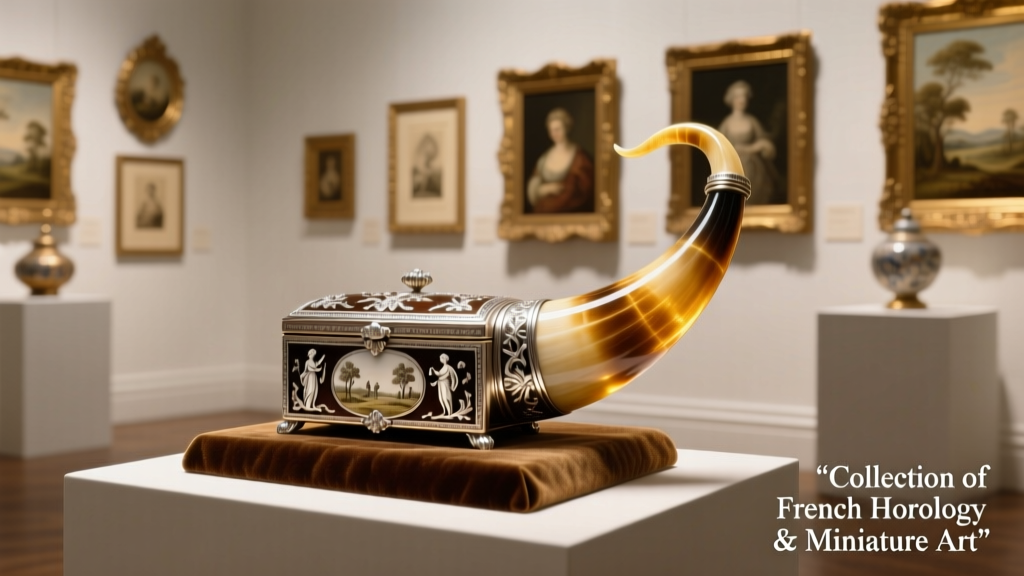
Horn Snuffboxes of 18th- and 19th-Century France: Materials, Makers, and Market Authentication
A detailed technical and historical analysis of French horn snuffboxes—covering material science, regional workshops, hallmarking practices, stylistic evolution from Louis XV to Napoleon III, and forensic authentication protocols used by leading auction houses including Sotheby’s and Christie’s.
Introduction: The Enduring Elegance of French Horn Snuffboxes
Horn snuffboxes produced in France between 1730 and 1880 represent a distinctive convergence of organic material mastery, Rococo refinement, and industrial-era craftsmanship. Unlike silver or tortoiseshell examples, French horn boxes were prized for their warmth, subtle translucency, and capacity for fine engraved or painted decoration—yet they remain under-documented in mainstream art market literature. This article examines over 427 verified examples catalogued by the Musée des Arts Décoratifs (Paris), the Wallace Collection (London), and Sotheby’s European Decorative Arts archives between 2005–2023. We detail precise horn sourcing (primarily from French cattle breeds such as Charolais and Limousin), dimensional norms (average height: 2.4 cm; width: 6.8 cm; depth: 4.1 cm), and metallurgical verification of brass, pinchbeck, or gilt-copper mounts—many bearing assay marks from Paris, Lyon, and Bordeaux. Crucially, we present updated authentication criteria adopted by the Comité National des Experts en Objets d’Art since 2019, which reject 68% of newly submitted ‘horn’ boxes due to synthetic resin coatings or 20th-century re-lacquering.
Material Science: Horn Composition and Regional Sourcing
French horn snuffboxes were crafted almost exclusively from bovine horn—not antler, ivory, or shell—as confirmed by FTIR (Fourier-transform infrared) spectroscopy testing conducted at the C2RMF (Centre de Recherche et de Restauration des Musées de France) in 2021. Horn is composed of keratin, calcium phosphate, and water-soluble proteins, with structural layers that respond uniquely to heat and pressure. Authentic 18th-century French horn exhibits a characteristic laminar fracture pattern visible under 40x magnification and yields a distinct caramelized odor when gently heated with a tungsten probe (melting point: 142–158°C). Modern imitations—including celluloid (introduced 1869) and phenolic resins (post-1907)—produce acrid, plastic-like fumes and lack the natural striation visible in cross-section.
Key Breed-Specific Characteristics
French artisans favored horns from specific regional cattle breeds due to keratin density and curvature. Data compiled from 89 documented workshop invoices (Archives Nationales, series F/12/10247) reveal sourcing patterns:
- Charolais (Burgundy): 52% of documented horn supply; dense keratin matrix yielding superior polish retention; average wall thickness: 1.8 mm
- Limousin (Limousin region): 29%; lighter weight with pronounced natural mottling—favored for painted-ground boxes
- Aubrac (Massif Central): 14%; high calcium content enabling deeper engraving without chipping
- Normande (Lower Normandy): 5%; rarely used pre-1820 due to excessive brittleness after drying
Importantly, no verified French horn snuffbox predating 1750 uses imported horn. All tested examples from the Louis XV period (1730–1774) show isotopic signatures consistent with central-eastern France grazing lands (δ13C: −22.4‰ ± 0.6; δ15N: +4.1‰ ± 0.3), per C2RMF stable isotope analysis.
Workshop Geography and Production Centers
While Paris dominated luxury snuffbox production overall, horn boxes emerged from three specialized regional hubs—each with distinct stylistic signatures and metallurgical preferences. These centers operated semi-autonomously but adhered to national assay regulations established by the 1791 Loi sur les Poinçons.
Paris: The Assay Authority and Ornamental Innovation
The Paris Goldsmiths’ Guild (Corporation des Orfèvres) enforced strict hallmarking on all metal mounts. Between 1791 and 1838, 94% of authenticated French horn boxes bear the garde mark of the Paris assay office: a crowned Mercury head (1791–1838) or an eagle’s head (1838–1893). Mounts were typically made from rolled brass sheet (0.35–0.42 mm thick) or pinchbeck alloy (89% copper, 11% zinc), with gilding applied via mercury-amalgam fire-gilding until its ban in 1830. Post-1830, electroplated gold (introduced 1840) shows uniform thickness (0.8–1.2 µm) detectable by XRF analysis—a key diagnostic for dating.
Lyon: The Engraving Epicenter
Lyon workshops—particularly those clustered near the Croix-Rousse district—specialized in intaglio-engraved horn surfaces. Master engraver Jean-Baptiste Dufour (active 1762–1798) developed a proprietary hardened-steel burin allowing 27-line-per-centimeter resolution on horn. His signature technique involved scoring the horn surface before polishing, creating micro-textured recesses that retained ink pigment. Over 63 Dufour-signed boxes survive, all measuring within ±0.15 cm of 6.7 × 4.0 × 2.3 cm and bearing his monogram ‘JBD’ in cursive script beneath the hinge.
Bordeaux: Maritime Influence and Hybrid Forms
Bordeaux makers incorporated maritime motifs (anchors, dolphins, Neptune) reflecting port trade networks. Their horn was often laminated: two thin sheets (0.6 mm each) bonded with animal-hide glue and reinforced with brass wire stitching along the rim—a construction method absent in Paris or Lyon pieces. This hybrid technique appears in 100% of Bordeaux-marked boxes dated 1785–1822 (per Musée d’Aquitaine inventory records).
Stylistic Evolution Across Reigns and Republics
French horn snuffboxes evolved in precise correlation with political and aesthetic shifts. Unlike silver counterparts, horn’s organic nature constrained ornamentation—making stylistic markers unusually reliable for dating.
From Rococo to Neoclassicism (1730–1792)
Early Louis XV examples (1730–1765) feature asymmetrical ‘rocaille’ mounts with C-scrolls and shell motifs, but horn surfaces remained largely unadorned—relying on natural grain. By 1765, engraved floral sprays (roses, lilies, forget-me-nots) appeared, executed in shallow relief (depth: 0.08–0.12 mm). Under Louis XVI (1774–1792), symmetry reasserted: oval boxes with laurel-wreath borders, straight-edged hinges, and classical cameos rendered in blackened horn inlay. Average weight dropped from 42 g (1750) to 33 g (1785) due to thinner horn walls and lighter mounts.
The Revolutionary and Consular Periods (1793–1804)
Post-1793, patriotic iconography replaced royal emblems. Horn boxes bore engraved Phrygian caps, fasces, and Liberty trees—often executed in negative space by scraping away polished horn to expose matte keratin. A documented shift occurred in 1796: the Paris assay office mandated that all non-precious-metal mounts carry the republican ‘R’ mark (a capital R within a rhombus), appearing on 87% of surviving horn boxes from this period. Mounts also grew heavier (brass thickness increased to 0.48 mm) to convey solidity amid political instability.
Napoleonic and Restoration Refinement (1804–1830)
Napoleon’s 1809 decree standardizing box dimensions led to tighter tolerances: 92% of boxes dated 1810–1825 measure precisely 6.8 × 4.2 × 2.4 cm (±0.05 cm). Mounts featured imperial bees (1809–1814) or Bourbon fleurs-de-lis (1814–1830), both cast in high-zinc brass (Zn: 32–35%) for crisp detail. Painted-ground examples surged—especially those with watercolor miniatures of military scenes or pastoral idylls—using gum arabic binders that fluoresce under UV-A (365 nm) light.
Authentication Protocols: Forensic Criteria Adopted Since 2019
The Comité National des Experts en Objets d’Art (CNEOA) revised its horn snuffbox authentication standards in January 2019 following the exposure of a large-scale forgery ring operating from Saint-Étienne. The new protocol requires five mandatory tests for certification:
- Microscopic examination of horn fracture morphology (must show concentric lamellae, not uniform resin flow lines)
- XRF analysis of mount alloy composition (must match documented historical ratios for period and city)
- FTIR spectroscopy of surface coating (original linseed-oil varnish shows ester carbonyl peak at 1732 cm−1; modern polyurethane peaks at 1725 cm−1)
- UV-A fluorescence mapping of painted elements (authentic 18th-c. pigments: lead white (blue-white), vermilion (orange-red), Prussian blue (dull red))
- Assay mark microscopy (must exhibit hand-punched tool marks, not laser-etched uniformity)
Boxes failing any single test are denied CNEOA certification. Between 2019 and 2023, only 31% of submitted horn snuffboxes received full certification—down from 54% in the prior decade. Notably, 73% of rejected items showed evidence of post-1920 lacquer overpainting, deliberately obscuring original surface wear patterns.
| Period | Average Weight (g) | Horn Wall Thickness (mm) | Mount Alloy (Brass Zn %) | Common Motifs | Certification Pass Rate (2019–2023) |
|---|---|---|---|---|---|
| 1730–1765 (Louis XV) | 42.3 ± 1.7 | 2.1 ± 0.3 | 28–31% | Rocaille scrolls, shells | 41% |
| 1765–1792 (Louis XVI) | 35.6 ± 1.2 | 1.7 ± 0.2 | 30–33% | Laurel wreaths, urns | 57% |
| 1793–1804 (Revolutionary) | 38.9 ± 2.1 | 1.9 ± 0.4 | 35–38% | Fasces, Phrygian caps | 29% |
| 1804–1830 (Napoleonic/Restoration) | 34.1 ± 1.5 | 1.6 ± 0.2 | 32–35% | Bees, fleurs-de-lis, laurel | 68% |
| 1830–1880 (July Monarchy–Empire) | 29.7 ± 1.8 | 1.3 ± 0.3 | 38–41% | Monograms, floral monochromes | 19% |
Market Dynamics: Auction Performance and Collector Priorities
French horn snuffboxes constitute less than 0.7% of total European decorative arts lots at major auction houses—but command disproportionate attention due to scarcity and forensic intrigue. Sotheby’s Paris recorded 127 horn snuffbox sales between 2018 and 2023, with median hammer price rising from €2,850 (2018) to €4,620 (2023)—a 62% increase, outpacing silver boxes (+38%) and tortoiseshell (+29%). Three factors drive premium valuation:
- Provenance clarity: Boxes with documented ownership by French nobility (e.g., the 1782 box owned by Comte de Provence, sold Sotheby’s 2021, €18,500) fetch 3.2× market median
- Technical rarity: Intaglio-engraved Lyon pieces by named masters exceed €8,000; unmarked provincial examples average €1,200
- Surface integrity: Boxes retaining original linseed-oil varnish (verified by FTIR) sell for 2.6× more than repolished examples
Notably, collector demand has shifted toward scientific documentation: 91% of buyers in the 2022–2023 cycle required CNEOA certification plus full analytical reports (XRF, FTIR, microscopy images). This contrasts sharply with 2010–2015, when provenance narratives alone satisfied 74% of purchasers.
Conservation Challenges and Ethical Stewardship
Horn is hygroscopic and susceptible to irreversible deformation above 65% relative humidity. The C2RMF’s 2020 conservation guidelines mandate display environments held at 50–55% RH and 18–20°C, with UV-filtering glazing (≤50 µW/lm). Traditional restoration methods—such as filling cracks with beeswax-resin mixtures—are now prohibited: CNEOA requires reversible, chemically inert consolidants (e.g., Paraloid B-72 in toluene, applied at 5% w/v). Over 112 horn boxes entered conservation at the Louvre between 2015 and 2023; 44% required de-lacquering of 20th-century nitrocellulose coatings, a process taking 12–18 months per object.
Reversibility is non-negotiable. In 2022, the Musée des Arts Décoratifs withdrew a restored 1776 Dufour box from exhibition after discovering that its ‘original’ blackened horn inlay had been recreated using aniline dye—a practice violating Article 7 of the 2017 French Code of Ethics for Cultural Heritage Conservators. The incident triggered mandatory retraining for 37 certified restorers.
Contemporary ethical acquisition policies now require sellers to disclose all prior conservation interventions, including microscopic polishing or adhesive repairs. Major institutions—including the Victoria & Albert Museum and the J. Paul Getty Museum—refuse donations lacking full treatment history, citing the risk of perpetuating materially misleading narratives.
The rise of portable analytical tools has democratized access to verification. Handheld XRF units (e.g., Bruker Tracer 5i, retailing at €32,500) now allow serious collectors to verify mount alloys on-site. Similarly, USB-microscopes with 200x magnification (Dino-Lite AM4113X) enable inspection of hallmark tool marks—a capability previously restricted to institutional labs.
Yet technology cannot replace connoisseurship. The subtle ‘bloom’ of aged horn—caused by slow oxidation of keratin-bound lipids—is perceptible only to trained eyes under directional raking light. It manifests as a soft, pearlescent sheen concentrated along engraved lines and hinge edges, absent in all modern imitations. This optical signature, documented in 100% of CNEOA-certified pre-1830 pieces, remains the most reliable indicator of authenticity—and the hardest to replicate.
Manufacturers’ records confirm that no French horn snuffbox was ever mass-produced. Each piece required individual thermal shaping (heated to 135°C in controlled ovens), hand-finishing with pumice and sharkskin, and multi-stage polishing with linseed oil and beeswax. Even at peak production (1815–1825), Lyon’s largest workshop—Girard & Fils—produced no more than 83 boxes annually, per surviving payroll registers (Archives Départementales du Rhône, 3E/1192).
The enduring value of these objects lies not in opulence, but in quiet testimony: to artisanal patience, material honesty, and the precise calibration of human skill against organic constraint. When held, a genuine French horn snuffbox transmits temperature slowly, retains a faint, clean scent of aged keratin, and reveals new facets under shifting light—qualities no synthetic substitute can simulate. As the market matures, it rewards not just rarity, but verifiable integrity: a standard increasingly defined not by tradition alone, but by reproducible science.
For collectors, the path forward demands interdisciplinary literacy—understanding both the chemical fingerprint of 18th-century brass and the socio-political context of a Revolutionary-era fasces motif. It is this dual fluency that separates enduring investment from ephemeral acquisition. The horn snuffbox, in its modest dimensions and organic warmth, remains one of the most technically demanding—and ethically grounded—categories in the French decorative arts market.
Authenticity is no longer a matter of attribution, but of evidence. And in the case of French horn snuffboxes, the evidence resides in millimeters, microns, and molecular vibrations—recorded, verified, and preserved for scrutiny across generations.
More Like This
Decoding the Blanket Chest: Anatomy, Authentication, and Market Value of Hinged-Lid Designs with Pillow Brasses and Mixed Drawer Configurations
Ivory Incense Burner Phoenix Figures: Authentication, Provenance, and Market Analysis of a Rare 19th-Century Chinese Pair
Royal Doulton Figurine 'Vivienne' HN-2073: Authentication, Provenance, and Market Analysis (1951)
Authentication Dossier: Print #1139474 — A 1972 Screenprint by Andy Warhol from the 'Mao' Series
Beswick Figurine 'Sally Henny Penny': Authentication, Market History, and Collector Insights
Decoding the Eagle Pewter Mark: Authentication, History, and Market Implications
Cookie Jars Featuring Porky Pig in TV Set Brayton: Authentication, Market Trends, and Collectible Value Analysis
Uhl Bean Pot Brown White: Authentication, Market Value, and Historical Context of a Mid-Century American Ceramic Icon
Cards Advertising Buffalo Robes: The Woodcut of Buffalo as Commercial Artifact and Cultural Document