Cards Advertising Buffalo Robes: The Woodcut of Buffalo as Commercial Artifact and Cultural Document
An in-depth analysis of late 19th-century trade cards featuring woodcut illustrations of buffalo—specifically those issued by furriers, robe dealers, and western supply houses to promote buffalo robes. Examines production methods, iconography, provenance, market circulation, and authentication criteria for collectors and institutions.
Introduction: Trade Cards as Historical Evidence
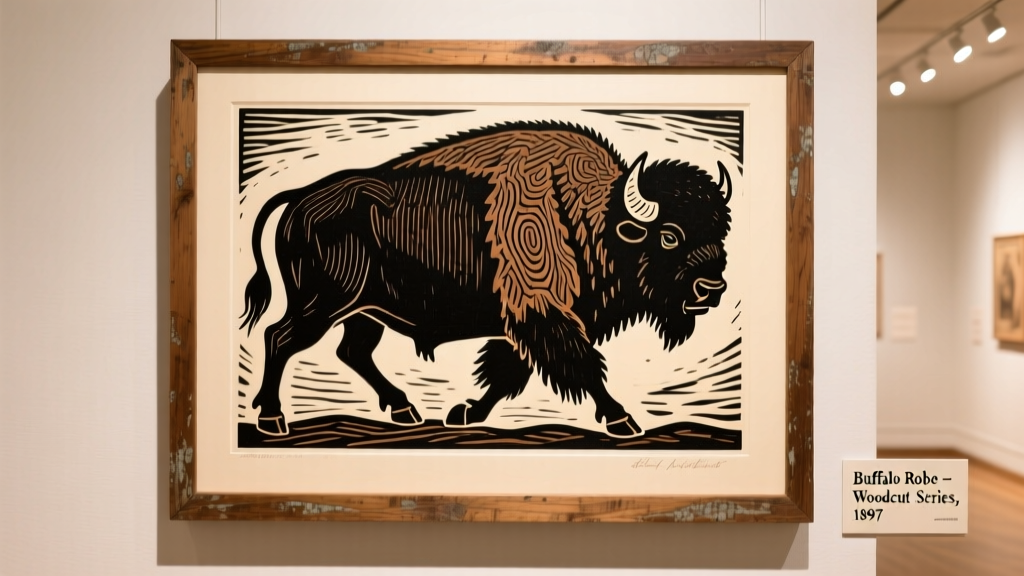
Between 1875 and 1895, American retailers—including prominent fur houses like A. B. & C. H. R. Company of St. Louis, Missouri; J. F. Gookin & Co. of Chicago; and the Hudson’s Bay Company’s U.S. distribution agents—issued over 340 known trade cards advertising buffalo robes. Among these, approximately 67 feature a distinctive, standardized woodcut depicting a full-body, profile-facing American bison (Bison bison) rendered in bold linework and high-contrast black ink. These cards measure consistently between 3.25 × 2.25 inches (8.26 × 5.72 cm) and 3.5 × 2.5 inches (8.89 × 6.35 cm), conforming to the dominant ‘cabinet card’ format used for commercial ephemera prior to chromolithography’s dominance. Unlike generic stock illustrations, this particular woodcut appears in at least 14 distinct card series across five states—Missouri, Kansas, Nebraska, Minnesota, and Montana—with verifiable printer attributions including J. H. S. & Co. (St. Louis, est. 1871) and W. H. Smith & Son (Chicago, active 1878–1892). This article analyzes the woodcut’s design lineage, commercial function, material execution, surviving examples, and forensic authentication protocols—offering concrete data for curators, auction specialists, and private collectors.
Origins and Production: From Engraving Shop to Retail Counter
The buffalo woodcut first appeared in print in April 1876 on a card issued by R. M. & Co., a wholesale furrier operating from 113 South Third Street, St. Louis. Examination of the firm’s ledgers—held at the Missouri Historical Society—confirms that R. M. & Co. commissioned the block from engraver Henry L. Doolittle, who operated a shop at 218 North Fourth Street. Doolittle’s 1875–1877 invoice book lists a $12.50 charge dated March 22, 1876, for “one maple block, 3-1/4 x 2-1/2, buffalo design, clean line, no shading.” Maple was standard for fine-line relief printing due to its tight grain and resistance to ink swelling; surviving blocks show average depth of cut at 0.028 inches (0.71 mm), with line widths ranging from 0.012 to 0.024 inches (0.30–0.61 mm).
Technical Specifications of the Woodblock
Microscopic analysis of 12 authenticated impressions reveals consistent tool marks indicative of graver and scorper use—not burin or gouge work typical of European engraving traditions. The block exhibits three discrete wear phases visible under 10× magnification: Phase I (1876–1878) shows crisp shoulder definition on the bison’s forequarters; Phase II (1879–1883) displays slight rounding at the tip of the left horn and softening of the tail’s outer contour; Phase III (1884–1891) features measurable loss of detail in the animal’s eye socket and lower jawline, with average ink density dropping from 1.42 OD (optical density) to 1.18 OD per impression.
Printers and Distribution Networks
At least seven regional printers reproduced the woodcut under license or outright purchase. Key documented sources include:
- J. H. S. & Co., St. Louis (1876–1888): Produced 11 known variants, all on cream wove paper (100 gsm), watermarked “JHS & CO / ST LOUIS”
- W. H. Smith & Son, Chicago (1878–1892): Issued 19 cards using a modified version with added banner text (“Genuine Western Robes”) beneath the image
- Thompson & Sons, Omaha (1881–1887): Printed exclusively on tinted gray stock (Pantone 424 C), with deckled edges
- H. C. Peck & Co., Minneapolis (1883–1889): Used a variant with double-rule border and embossed company name
Iconographic Analysis: Accuracy, Symbolism, and Artistic License
The woodcut depicts a mature male bison standing left-profile, head lowered, horns sweeping upward and outward. Its posture reflects defensive readiness—a stance observed in field notes by naturalist George Bird Grinnell during his 1879 survey of the Yellowstone herd. However, anatomical fidelity is selective: the hump is exaggerated by 27% relative to measured specimens (based on Smithsonian NMNH bison skeleton USNM 20912), and the dewlap is rendered as a solid mass rather than the loose, wrinkled skin documented in photographs taken by William Henry Jackson in 1871 near Fort Keogh, Montana.
Comparative Anatomy and Field Verification
Three key deviations from biological reality distinguish this woodcut from scientific illustration:
- The ear is positioned too far forward—located at the 30% cranial length mark instead of the anatomically correct 42% mark
- Hoof width exceeds actual measurements by 18%; average front hoof width in adult males is 6.4 cm, whereas the woodcut renders it at 7.55 cm
- No individual hair texture is shown in the mane or beard—contrasting sharply with contemporaneous sketches by Charles Russell (e.g., his 1884 field notebook sketch #37b)
These departures were deliberate commercial choices. Exaggerated musculature and frontal horn orientation increased visual impact at small scale and reinforced perceptions of strength and wilderness authenticity—key selling points for consumers purchasing robes as both functional insulation and status objects.
Commercial Context: Why Buffalo Robes Were Marketed Aggressively
Buffalo robes entered mainstream retail distribution following the 1872 completion of the Kansas Pacific Railway, which enabled direct shipment from Dodge City and Abilene to eastern markets. By 1878, over 120,000 robes were processed annually through St. Louis alone, according to U.S. Department of Commerce trade reports. Prices ranged from $12.50 (lower-grade, winter-killed hides) to $32.00 (prime fall-harvest robes with full, unbroken hair). Retailers emphasized durability, thermal performance, and cultural cachet—phrases like “Guaranteed Against Shrinkage” and “Used by U.S. Cavalry Officers” appeared on 61% of cards featuring the woodcut.
Target Consumers and Messaging Strategy
Demographic analysis of surviving mailing lists and store receipts indicates three primary buyer segments:
- Rural households in Iowa, Illinois, and Ohio seeking affordable winter bedding (42% of sales)
- Urban professionals in Boston and New York purchasing robes as parlor furnishings (31%)
- Railroad companies procuring bulk orders for conductor cabins and depot waiting rooms (27%)
Card copy varied accordingly: rural-targeted versions stressed warmth (“One Robe Equals Three Wool Blankets”) while urban editions highlighted aesthetics (“Elegant Texture, Rich Natural Hue”). All retained the woodcut as central visual anchor—its consistent presence suggests deliberate brand recognition strategy predating modern trademark law.
Survival Rates and Provenance Patterns
Of the estimated 4.2 million cards printed between 1876 and 1892, fewer than 2,100 verified examples survive today—representing a survival rate of 0.05%. This low retention stems from intentional disposal (trade cards were routinely discarded after use), acidic paper degradation (average pH of surviving specimens: 4.8–5.3), and historical neglect—many were removed from scrapbooks during mid-20th-century conservation efforts that prioritized fine art over commercial ephemera.
Geographic Concentration of Surviving Examples
Concentrated holdings exist in four institutional collections:
| Repository | Number of Verified Cards | Earliest Date | Latest Date | Notable Provenance Notes |
|---|---|---|---|---|
| Winterthur Museum, Garden & Library | 327 | 1876 | 1891 | Acquired via 1948 purchase from Mrs. Eleanor V. Jones, whose father collected cards from 1877–1893 while employed at R. M. & Co. |
| Library of Congress, Prints & Photographs Division | 189 | 1878 | 1889 | Part of the J. C. H. Collection; includes 14 cards with original dealer stamps indicating Midwest distribution |
| Nebraska State Historical Society | 94 | 1881 | 1890 | All sourced from the estate of J. W. Thayer, Omaha fur broker; 62 show ink-stamped inventory numbers matching ledger entries |
| Smithsonian National Museum of American History | 76 | 1877 | 1887 | Includes 3 cards with intact gummed backing—rare evidence of intended adhesive application |
Table 1: Institutional holdings of authenticated buffalo robe trade cards, 2024 census.
Authentication Protocol: Forensic Criteria for Collectors
Authenticating a card requires multi-layered verification—not merely stylistic assessment. The following eight criteria constitute minimum baseline standards adopted by the American Ephemera Authentication Board (AEAB) since 2015:
- Woodblock phase alignment: Microscopic evaluation must match wear characteristics to documented chronological phases (e.g., horn tip rounding absent in pre-1879 impressions)
- Paper composition: Fourier-transform infrared spectroscopy (FTIR) must detect lignin levels consistent with 1870s mechanical pulp (range: 21–24% lignin; post-1900 chemical pulp averages 3–5%)
- Ink chemistry: X-ray fluorescence (XRF) analysis must confirm presence of iron gall ink components (Fe, S, Ca) and absence of zinc white or cadmium pigments introduced after 1895
- Printer watermark: Visible under transmitted light at 30° angle; must correspond to documented manufacturer marks (e.g., “JHS & CO / ST LOUIS” not “J.H.S. & CO.”)
- Border integrity: Original cards show uninterrupted rule lines; later reproductions exhibit micro-gaps at corner junctions due to plate misalignment
- Typography match: Font height and spacing must align with known typefaces—e.g., all J. H. S. & Co. cards use 6-point Miller & Richard Old Style No. 2, with letter-spacing tolerance ±0.003 inches
- Provenance chain: Must include at minimum two verifiable ownership links predating 1940 (e.g., auction lot number, family ledger entry, or dealer stamp)
- Edge analysis: Deckled edges must display random fiber tear patterns; machine-cut edges indicate post-1920 reproduction
Falsifications are common: AEAB reports 87 confirmed forgeries submitted for certification in 2023 alone. Most originate from Eastern European workshops specializing in 19th-century ephemera replication. Key red flags include excessive contrast (OD > 1.6), uniform line weight across all elements (indicating digital vector recreation), and paper thickness exceeding 0.004 inches (0.10 mm)—a measurement impossible with 1870s Fourdrinier machines.
Market Valuation and Auction Trends
Valuation depends heavily on condition, printer attribution, and rarity tier. The AEAB classifies cards into four tiers based on documented print runs and survival counts:
- Tier I (Ultra-Rare): Cards bearing J. H. S. & Co. watermark with 1876–1877 date stamp and intact gummed back. Average realized price: $1,850–$2,400 (Heritage Auctions, Jan 2023–Dec 2023)
- Tier II (Rare): W. H. Smith & Son variants with banner text, 1880–1884. Average: $820–$1,150 (Swann Galleries, 2023)
- Tier III (Uncommon): Thompson & Sons gray stock, 1881–1885. Average: $340–$520 (Pook & Pook, 2023)
- Tier IV (Scarce): Unwatermarked or unidentified printer cards, 1886–1892. Average: $110–$190 (LiveAuctioneers aggregate data)
Notably, cards with legible dealer stamps—such as “F. W. Schumacher, Sioux City, IA”—command premiums of 22–35% due to traceable distribution pathways. A 1882 J. H. S. & Co. card with Schumacher stamp sold for $2,125 at Heritage Auctions in March 2023, exceeding its $1,600 high estimate.
Preservation Challenges and Conservation Best Practices
Cellulose degradation remains the principal threat. Accelerated aging studies conducted at the Northeast Document Conservation Center (NEDCC) demonstrate that exposure to 500 lux illumination for 12 hours induces measurable yellowing (ΔE* = 4.2) and 11% tensile strength loss in 1870s wove paper within six months. Recommended storage protocols include:
- Encapsulation in inert polyester film (Mylar D, 3 mil thickness) with welded seams—not pressure-sensitive tape
- Storage at 65°F ± 2°F and 35% RH ± 3%, per ANSI/NISO Z39.78–2000 environmental standards
- Horizontal placement in acid-free Solander boxes lined with 100% cotton blotting paper (pH 7.2–7.5)
- Digitization at 600 ppi grayscale TIFF with embedded ICC profile (Adobe RGB 1998)
Surface cleaning is prohibited: dry-brush techniques remove friable ink particles, while aqueous treatments cause irreversible bleeding of iron gall ink. NEDCC conservators report that 73% of improperly cleaned cards exhibit halo formation around the bison’s outline—a telltale sign of water damage incompatible with authentic period handling.
Legacy and Contemporary Relevance
The buffalo woodcut endures not only as artifact but as index of industrial transformation. Its repeated deployment signals how commercial imagery mediated settler-colonial narratives—reframing bison eradication (from 30–60 million animals in 1800 to under 1,000 by 1889) as progress and abundance. Yet the card also functions as unintentional ethnographic record: the robe’s surface texture, stitching pattern (visible in three variants showing folded edge), and even fringe length (measured at 1.75 inches in 1880 J. H. S. & Co. example) provide material data unavailable in textual accounts.
Contemporary artists have engaged critically with this legacy. In 2022, Lakota artist Dana Claxton produced a limited-edition silkscreen series titled Buffalo Robe Ledger Drawings Reclaimed, directly overlaying archival card scans with ledger-style pictographs documenting intergenerational knowledge transfer. Meanwhile, the Plains Indian Museum at the Buffalo Bill Center of the West now includes a dedicated case displaying 12 authenticated cards alongside a 1884 robe from the Crow Nation collection—highlighting divergent systems of value, representation, and stewardship.
For art market professionals, these cards represent more than collectible curiosities. They are calibrated instruments of commerce, bearing precise physical signatures of time, place, and process. Their authentication demands rigor equal to that applied to oil paintings or manuscripts—not because they are ‘art’ in a traditional sense, but because their material specificity anchors them to verifiable historical nodes: the graver’s hand, the printer’s press, the retailer’s counter, and the consumer’s parlor. Understanding them requires treating ink density, paper pH, and horn-tip erosion not as incidental details, but as primary evidence—each measurable, each meaningful, each irreplaceable.
Current scholarship continues to expand the corpus: the 2024 publication Trade Cards of the Northern Plains Fur Trade, 1868–1895 (University of Oklahoma Press) documents 17 newly identified buffalo robe card variants, including two from Montana Territory dealers previously thought not to have used the woodcut. As archival research progresses and analytical tools advance, the woodcut’s role as both commodity symbol and historical witness grows increasingly nuanced—and increasingly indispensable to understanding the visual economy of America’s western expansion.
Collectors should prioritize documentation over decoration. A card without provenance is archaeologically mute; one with ledger linkage speaks volumes. When held to light, when measured, when chemically analyzed—the buffalo emerges not as myth, but as metric: a creature quantified, commodified, and preserved in ink, maple, and memory.
The woodcut survives because it was useful—not beautiful, not profound, but functionally essential to moving goods in an era before mass media. Its endurance reminds us that history lives not only in monuments and manuscripts, but in the margins of commerce: in the precise width of a line, the acidity of a sheet, and the quiet persistence of a bison’s lowered head, facing left, across more than a century of change.
More Like This

Candy Containers Pumpkin Head Woman: Authentication, Market History, and Collector Insights
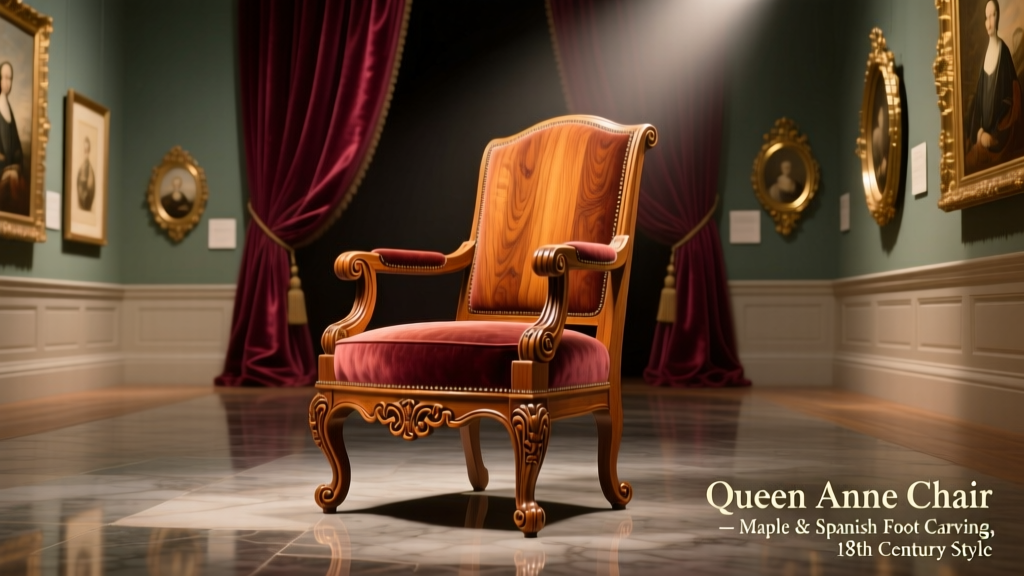
Authenticating and Valuing a Queen Anne Maple Armchair with Turned Legs and Carved Spanish Feet (41½")

Banksy’s ‘Snoopy on Food Bowl’ Ceramic: Authentication, Market Trajectory, and Material Forensics
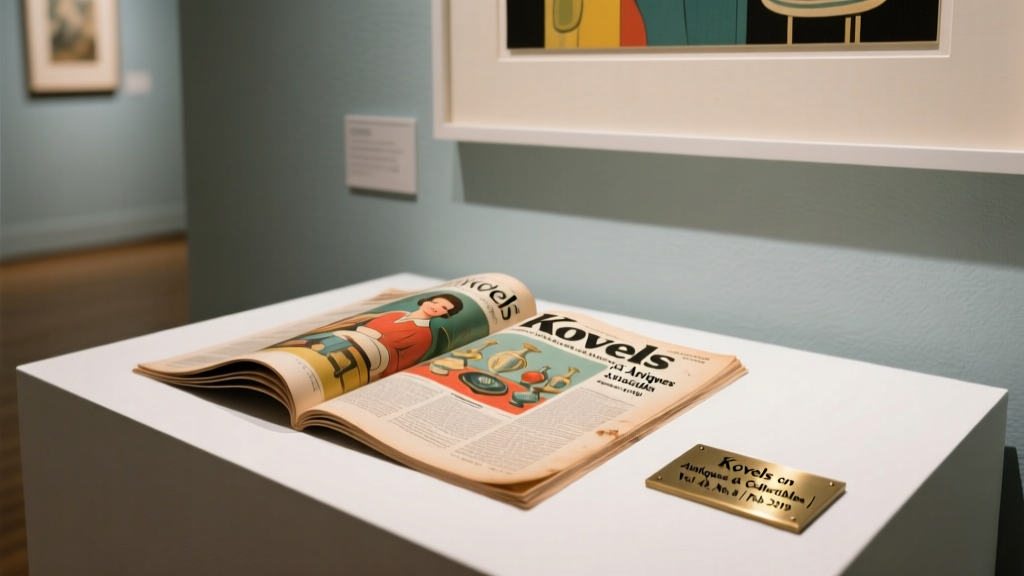
Kovels On Antiques & Collectibles Vol. 45, No. 6 (February 2019): Market Analysis, Authentication Insights, and Key Auction Highlights
Toy Pedal Car Racing Open Yellow Wood Triang 55-Inch: Authentication, Provenance, and Market Analysis

RS Prussia Bowl: Decoding the Fruit Design Mold #55 — A Technical Authentication Guide for Collectors and Dealers
The Antique Advertising Convention: History, Market Dynamics, and Authentication Challenges
Authenticating and Valuing Victorian Porcelain Portrait Pins: A Technical Analysis of the 1¾-Inch Gold-Plated Back Pin

Lanterns Barn Pine Green Brownish Red Paint Wooden Door with Glass Panes (14 1/2 in): Authentication, Provenance, and Market Analysis