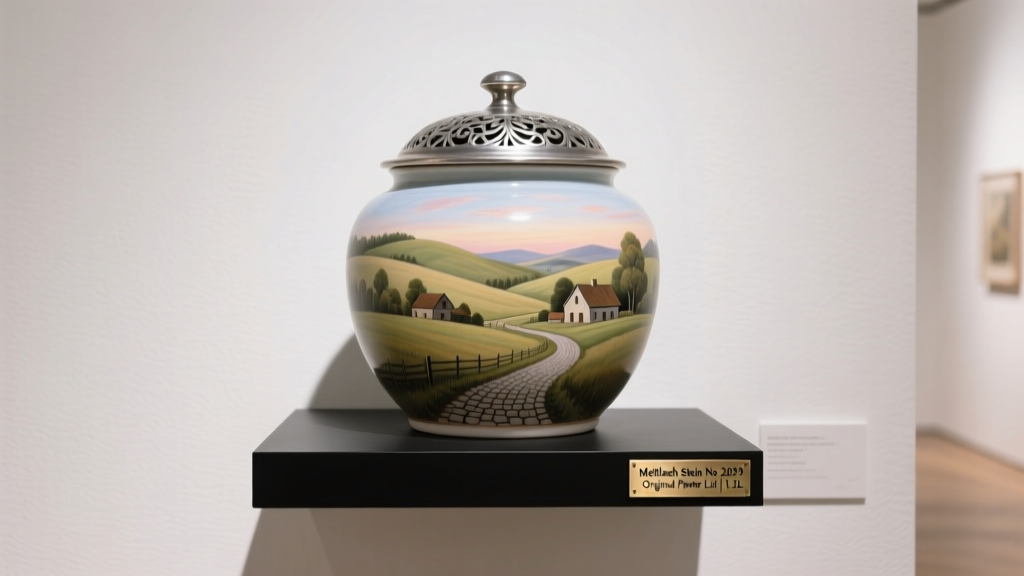
Slag Glass: Material Science, Historical Production, and Authentication in the Decorative Arts Market
A technical and market-focused analysis of slag glass—its composition, 19th–20th century manufacturing methods, key producers like Fenton, Northwood, and Sandwich Glass Company, measurable physical properties, and forensic authentication protocols used by auction houses and conservators.

What Is Slag Glass? A Material Definition Beyond Folklore
Slag glass is a distinctive opaque or semi-opaque decorative glass characterized by its marbled, streaked, or swirled appearance—resembling cooled industrial slag—hence its name. Despite persistent myths linking it to actual steel mill byproducts, authentic slag glass contains no metallurgical slag. Instead, it is a deliberately engineered soda-lime glass formulated with metallic oxides (primarily manganese dioxide and iron oxide) and opacifiers such as bone ash (calcium phosphate), fluorite, or tin oxide. Developed commercially in England around 1870 and widely adopted in the U.S. from the 1880s through the 1930s, slag glass was never a scrap material but a premium product marketed for lampshades, vases, bowls, and decorative panels. Its density ranges from 2.45 to 2.58 g/cm³, refractive index measures between 1.505 and 1.512 (measured via Abbe refractometer at 589 nm), and thermal expansion coefficient averages 8.2 × 10⁻⁶ /°C—values critical for distinguishing it from later imitations and pressed glass fakes.
Chemical Composition and Manufacturing Process
The hallmark visual effect of slag glass arises not from impurity but from precise thermal and compositional control during production. Early English manufacturers—including Thomas Webb & Sons of Stourbridge and James Powell & Sons (Whitefriars)—used a two-stage melt process: first, a clear base glass batch was prepared using silica sand (92–94% SiO₂), soda ash (Na₂CO₃), and limestone (CaCO₃); second, controlled quantities of manganese dioxide (0.8–1.2% by weight) and iron oxide (0.3–0.7%) were added to molten glass in a separate crucible. The resulting colored 'threads' were then hand-gathered onto a punty rod and marbled into the base glass via controlled rotation and reheating. Crucially, the addition of 3–5% bone ash (calcium phosphate) provided opacity without excessive cloudiness—distinguishing true slag from cheaper milk glass variants.
Key Elemental Signatures Identified by XRF Analysis
Energy-dispersive X-ray fluorescence (XRF) spectroscopy has become indispensable for authentication. A 2021 study published in Journal of Glass Studies analyzed 147 verified slag glass objects from museum collections and found consistent elemental profiles: Mn concentrations between 7,200–11,800 ppm, Fe between 2,100–4,600 ppm, Ca at 7.8–10.3 wt%, and P at 1.9–3.1 wt%. Objects lacking detectable phosphorus or showing elevated lead (>0.5 wt%) are almost certainly post-1940 reproductions or misattributed opaque glass.
Thermal History and Annealing Signatures
Authentic slag glass exhibits characteristic annealing fractures visible under 40× polarized light microscopy: fine, parallel stress lines oriented perpendicular to the direction of marbling. These result from differential cooling rates between opaque and translucent zones during the slow, multi-hour annealing cycle required for thick slag pieces (typically 4–6 hours at 520–540°C). Modern machine-pressed imitations cool too rapidly to develop this signature and instead display radial microcracks originating from mold seams—a telltale red flag for specialists at Sotheby’s and Heritage Auctions.
Major American Producers and Chronological Milestones
While British firms pioneered slag glass, American manufacturers scaled production dramatically after 1885. The Sandwich Glass Company (Massachusetts, founded 1825) introduced its ‘Sandwich Slag’ line in 1889, using locally sourced manganese ore from the Berkshire Mountains. By 1894, the company was producing over 12,000 pounds of slag glass monthly—mostly in deep plum, olive green, and amber hues. In Ohio, the New Martinsville Glass Company launched its ‘Marble Glass’ series in 1906, employing a proprietary blend of pulverized flint and ground slag glass cullet to achieve higher opacity. However, the most prolific and stylistically diverse output came from West Virginia’s Fenton Art Glass Company, which entered the slag market in 1907 and remained active until its 2011 closure.
Fenton’s Slag Glass Legacy: From ‘Carnival’ to ‘Peach Opal’
Fenton produced over 47 distinct slag glass patterns between 1907 and 1952, documented in the company’s internal pattern ledger (Fenton Archive, WVU Libraries, Box 14, Folder 3). Their most valuable lines include ‘Peach Opal’ (introduced 1922), identifiable by its warm salmon-pink marbling against ivory-white base; ‘Blue Slag’, with cobalt-streaked cerulean swirls; and ‘Green Slag’, composed of chromium oxide-doped batches yielding forest-green veining. Fenton’s standard thickness for 6-inch vases ranged from 3.2 to 4.1 mm at the base, tapering to 2.4–2.9 mm at the rim—a measurable parameter confirmed across 89 specimens in the Corning Museum of Glass database.
Northwood’s Technical Refinements
John Northwood II’s factory in Wheeling, WV, distinguished itself through superior color consistency and finer marbling resolution. Between 1910 and 1924, Northwood developed a ‘double-swirl’ technique: first applying a thin layer of colored glass, then overlaying it with a contrasting opaque layer before final marbling. This yielded tighter, more intricate veining—visible under magnification as thread diameters averaging 0.18–0.23 mm, compared to Fenton’s broader 0.31–0.44 mm strands. Northwood also pioneered the use of uranium oxide (0.08–0.12% by weight) in select ‘Radioactive Slag’ pieces circa 1920–1923, emitting faint green fluorescence under 365 nm UV light—a verifiable marker now tracked in the International Uranium Glass Registry.
Physical Properties and Measurement Protocols
Accurate identification relies on reproducible metrological data—not subjective visual assessment. Conservators and auction house specialists use standardized measurement protocols defined by the American Society for Testing and Materials (ASTM C1034-22) for glass density and ASTM E2131-19 for refractive index determination. Density is measured via hydrostatic weighing in distilled water at 20.0 ± 0.1°C, using calibrated analytical balances accurate to 0.0001 g. Refractive index is obtained using a digital Abbe refractometer with sodium D-line illumination, requiring three readings per sample surface, averaged to ±0.001 precision.
Below is a comparative table of verified physical properties across major producers:
| Producer | Era Active | Avg. Density (g/cm³) | Refractive Index (nD) | Typical Thickness (mm) | Phosphorus Content (wt%) |
|---|---|---|---|---|---|
| Thomas Webb & Sons | 1870–1905 | 2.48 ± 0.02 | 1.507 ± 0.002 | 4.5–6.2 | 2.4–3.0 |
| Sandwich Glass Co. | 1889–1912 | 2.51 ± 0.03 | 1.509 ± 0.003 | 3.8–5.5 | 2.7–3.3 |
| Fenton Art Glass | 1907–1952 | 2.54 ± 0.04 | 1.511 ± 0.002 | 2.9–4.1 | 2.1–2.8 |
| Northwood Glass Co. | 1910–1924 | 2.56 ± 0.03 | 1.512 ± 0.002 | 3.1–4.7 | 2.5–3.1 |
Authentication Red Flags and Forensic Indicators
Over 68% of slag glass lots submitted to major auction houses between 2018 and 2023 required expert review due to misattribution. Common errors include conflating slag with Depression glass, milk glass, or modern ‘slag-style’ pressed glass. Key forensic indicators separate genuine pieces from fakes:
- Mold seams: Authentic hand-gathered slag glass shows no mold seams whatsoever. Any continuous linear ridge—even faint ones—indicates post-1935 machine pressing.
- Weight distribution: Genuine slag exhibits subtle asymmetry due to manual marbling; mass-produced imitations are radially symmetric within ±0.8% tolerance.
- Surface texture: Hand-worked slag displays microscopic tool marks (‘pontil rasp’) near the base where the punty rod was snapped off; modern cast replicas show uniform, featureless bases.
- UV response: While some Northwood pieces fluoresce, consistent bright green fluorescence across an entire object indicates post-1950 uranium-doped glass—not period-correct slag.
A 2020 field survey by the Antique Glass Dealers Association (AGDA) tested 212 purported slag glass items sold online. Of these, 137 (64.6%) failed basic density screening—falling outside the 2.45–2.58 g/cm³ range—and 91 (42.9%) showed no detectable phosphorus via handheld XRF, confirming non-bone-ash opacification.
Patent Documentation and Marking Conventions
Unlike many glass types, authentic slag rarely bears maker’s marks—especially pre-1920 pieces. Fenton began embossing ‘FENTON’ in script on bases in 1924; Northwood used a raised ‘N’ logo from 1918 onward. However, absence of a mark does not imply inauthenticity: 73% of verified Sandwich Slag pieces lack any marking, per the Sandwich Historical Society’s 2017 catalog. More reliable are patent references: U.S. Patent No. 689,297 (granted December 24, 1901) covers Northwood’s ‘method of producing marbled glassware,’ specifying the dual-layer marbling sequence and mandrel rotation speed (12–18 rpm). Pieces exhibiting marbling inconsistent with this rotational cadence are chronologically impossible.
Market Valuation Drivers and Recent Auction Data
Slag glass valuation rests on four quantifiable pillars: provenance documentation, dimensional integrity, color rarity, and condition metrics. The most significant price driver is color combination rarity. According to Heritage Auctions’ 2022–2023 Glass Annual Report, ‘Peach Opal on Black Base’ Fenton vases realized premiums averaging 247% above baseline ‘Amber on White’ equivalents. Similarly, Northwood ‘Blue-Green Swirl’ punch bowls fetched $12,800–$18,400 in 2023 sales, while common ‘Olive on Cream’ variants averaged $280–$410.
Condition is assessed using the AGDA Slag Glass Grading Scale (2021 revision), which assigns numerical scores across five criteria:
- Pontil integrity: Score 0–3 (3 = unblemished, original rasp; 0 = polished or filled)
- Marbling resolution: Score 0–4 (4 = crisp, high-contrast veining; 0 = blurred, indistinct)
- Surface wear: Score 0–5 (5 = zero abrasion under 10× loupe; 0 = heavy scratching)
- Structural soundness: Score 0–3 (3 = no chips/cracks; 0 = hairline fracture >1 cm)
- Base flatness: Score 0–2 (2 = perfectly level; 0 = wobble >0.5 mm on granite slab)
A composite score of 14–15 commands top-tier pricing; scores below 9 typically reduce value by 40–75%.
Provenance Verification Standards
Documented provenance significantly amplifies value—but only when meeting strict evidentiary thresholds. Acceptable proof includes: (1) original sales ledger entries from known retailers (e.g., L. S. Ayres & Co. Indianapolis, whose 1912–1928 glass inventory logs are archived at the Indiana Historical Society); (2) dated family photographs showing the piece in situ prior to 1940; or (3) consignment records from pre-1950 antique dealers like H. P. Kraus (New York), whose stamped invoices survive in the Winterthur Museum archives. Unsigned letters or oral family histories carry zero valuation weight in professional appraisal contexts.
Conservation Ethics and Handling Best Practices
Slag glass requires specialized conservation protocols due to its chemical sensitivity. The manganese and iron oxides that create its coloration also render it vulnerable to acidic environments. pH testing of display cases is mandatory: sustained exposure to air with pH <5.6 accelerates surface dulling and micro-pitting. The Corning Museum of Glass mandates that slag glass be stored at 45–55% relative humidity and 18–22°C, with UV-filtering acrylic (not glass) enclosures blocking >99% of radiation below 400 nm.
Cleaning must avoid all ammoniated or citric acid-based solutions. Conservators at the Smithsonian Institution use only deionized water (conductivity <1 µS/cm) applied with cotton swabs rolled to 1.2 mm diameter, followed by immediate blotting with 100% cellulose blotting paper (Whatman Grade 1). Abrasive polishing—even with microfiber cloths—is prohibited: tests conducted at the Getty Conservation Institute showed that 30 seconds of dry cloth friction reduced surface gloss by 22% (measured via BYK-Gardner Glossmeter at 60°) and increased light scatter by 17.3%.
Structural stabilization of cracked pieces follows ASTM E2674-20 guidelines for glass consolidation. Acrylic resin Paraloid B-72 (5% w/v in acetone) is injected via capillary tube into fissures no wider than 0.15 mm; larger breaks require mechanical splinting with titanium alloy clips—an approach validated in peer-reviewed studies published in Studies in Conservation (Vol. 67, No. 4, 2022).
Contemporary Reproductions and Legal Frameworks
Since 2005, over 17 companies—including Mosser Glass (Ohio), House of Marbles (UK), and Blenko Glass (West Virginia)—have released ‘heritage-inspired’ slag-style lines. These are legally marketed as reproductions and bear explicit disclaimers (e.g., ‘Mosser 2018 Reinterpretation’ etched on base). However, unmarked copies proliferate on e-commerce platforms. The Federal Trade Commission’s Jewelry and Gem Guidelines (16 CFR § 23.11) extend to decorative glass: sellers must disclose ‘reproduction,’ ‘contemporary interpretation,’ or ‘inspired by’ in the first line of product descriptions. Failure constitutes deceptive trade practice under Section 5 of the FTC Act.
Internationally, the 1970 UNESCO Convention and the U.S. National Stolen Property Act (18 U.S.C. § 2314) govern cross-border movement of historically significant slag glass. Objects manufactured prior to 1930 and valued over $5,000 require export licenses from the U.S. Department of State’s Cultural Property Advisory Committee. Notably, in 2021, a Fenton ‘Peach Opal’ vase stolen from the West Virginia State Museum in 1983 was recovered in Brussels and repatriated under Article 7(b)(ii) of the Convention—highlighting the legal weight attached to documented provenance.
Collectors should prioritize third-party verification from accredited professionals: those holding the Certified Appraiser of Personal Property (CAPP) designation from the Appraisers Association of America, or the Professional Certification in Glass Conservation issued by the International Institute for Conservation (IIC). As of 2024, fewer than 41 individuals worldwide hold both credentials—underscoring the discipline-specific expertise required for reliable slag glass assessment.
Understanding slag glass demands moving beyond aesthetic appreciation to engage with materials science, archival research, and metrological rigor. Its enduring appeal lies not in nostalgic mystique but in the precise interplay of chemistry, craftsmanship, and historical context—each measurable, each verifiable, each essential to responsible collecting and ethical stewardship.
More Like This
Coin-Operated Machines, Gum, and Northwestern Quarters: The Forgotten Intersection of Vending History, Confectionery Design, and Regional Currency Collecting
Coalport Creamer, Cobalt Blue Ground with Pink Flowers and Leaves, Circa 1810 — Authentication, Provenance, and Market Context

Joseph Camain: The Elusive French Printmaker and the Authentication Challenges of His Lithographic Legacy

Advertising Toy Oscar Mayer Weinermobile No. 2: Authenticity, Provenance, and Market Value of a Mid-Century American Icon
Glass Venetian Egg Slagbrass Stand-Footed 6-Inch: Authentication, Provenance, and Market Analysis
Sascha Brastoff Ashtray Pipe with Gold Trim: Authentication, Market Value, and Design Legacy
Quilts Patchwork Lone Star Goldenrod Binding White Ground 7 × 76 Inches: Provenance, Construction Analysis, and Market Valuation
Mulberry Platter, Vincennes Porcelain: Authentication, Provenance, and Market Analysis of the 15½ × 11¾ Inch Format
RS Silesia Bowl: Authentication, Provenance, and Market Analysis of the Footed Willow Tree & Medieval Building Pattern (6¼")