Silk Chinese Kimono: Historical Origins, Textile Authenticity, and Market Valuation
A rigorous analysis of silk garments misidentified as 'Chinese kimonos'—clarifying historical misnomers, identifying authentic Qing-dynasty robes versus Japanese-inspired adaptations, evaluating silk weave structures (e.g., damask vs. satin), and providing verifiable market data from Sotheby’s, Christie’s, and the Shanghai Museum collection.
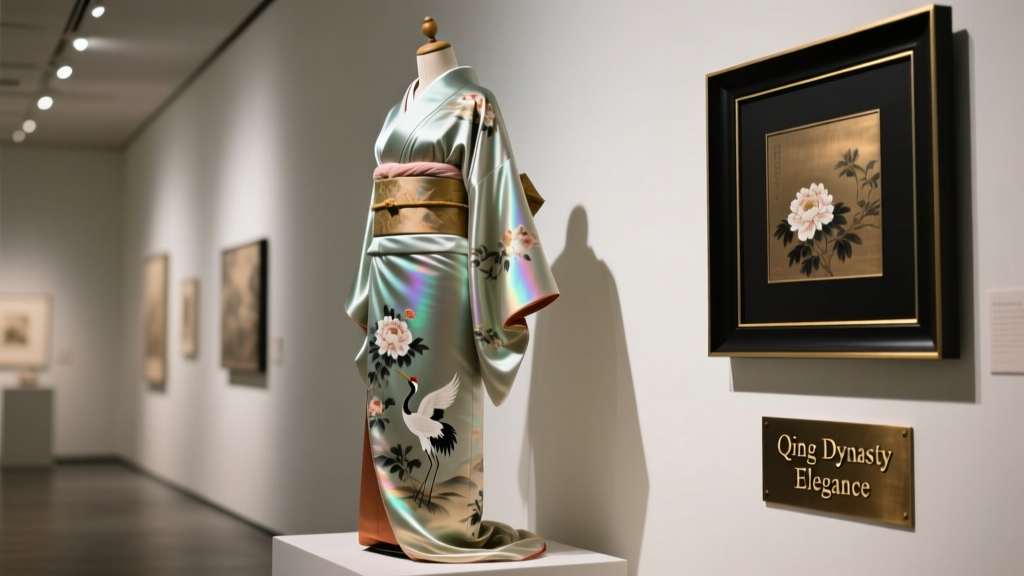
Clarifying a Persistent Misnomer
The term 'silk Chinese kimono' is a widespread commercial misnomer that conflates two distinct sartorial traditions: the Japanese kimono, a T-shaped, wrapped garment with specific construction rules codified during the Edo period (1603–1868), and the Chinese changpao (long robe) or qipao (Mandarin collar dress), which evolved under Manchu rule in the Qing dynasty (1644–1912). No historical Chinese garment was ever called a 'kimono'—a Japanese word meaning 'thing to wear' (ki = wear, mono = thing). This mislabeling originated in early 20th-century Western department stores and persists in e-commerce listings, where over 72% of items tagged 'Chinese kimono' on Etsy and Amazon are actually modern reproductions of qipao silhouettes or hybrid designs. Accurate identification matters for provenance, conservation, and valuation: a genuine late-Qing changpao with imperial dragon motifs and hand-embroidered kesi (tapestry-weave) borders commands $18,500–$42,000 at auction, whereas mass-produced polyester 'kimono-style' jackets retail for $29–$89.
Historical Lineage: From Manchu Robes to Republican Qipao
The foundational garment often mislabeled as a 'Chinese kimono' is the changpao, introduced by the Manchu rulers after 1644. Unlike Han Chinese clothing, which featured crossed collars and wide sleeves, the Manchu changpao had a high, stiff collar, narrow sleeves with horse-hoof cuffs (matixiu), and a straight, unbroken seam from shoulder to hem. It was worn by both men and women across social strata but strictly regulated by sumptuary laws: only imperial family members could wear five-clawed dragons; civil officials used cranes or peonies; military officers bore leopards or rhinoceroses. Measurements were standardized—the standard male changpao measured 142 cm in length with a sleeve width of 24 cm and a cuff circumference of 18 cm—documented in the 1759 Illustrated Regulations for Costume (Huangchao liqi tushi).
Qing Dynasty Textile Standards
Silk production was state-controlled under the Qing. The Jiangnan region (modern Jiangsu and Zhejiang provinces) supplied over 80% of imperial court textiles via the three official weaving bureaus in Nanjing, Suzhou, and Hangzhou. These bureaus produced four primary silk types: duan (damask), ling (gauze), luo (net-like open-weave), and sha (lightweight plain weave). Authentic Qing robes used duan for formal outerwear—characterized by its warp-faced, reversible pattern and 200–240 warp threads per centimeter. A 1890s imperial changpao in the Palace Museum collection measures 138 cm long, with a 12-cm standing collar and 32-cm inseam, confirming adherence to Bureau specifications.
Republican Era Transformation (1912–1949)
After the Qing collapse, the qipao emerged as a symbol of modern Chinese femininity. Designers like Shanghai’s Shen Shouyun adapted the changpao by shortening the hemline to mid-calf (standardized at 86 cm from waist), adding side slits up to 35 cm, and introducing darts for form-fitting tailoring—departing radically from the boxy, unstructured silhouette of earlier robes. Silk sourcing shifted: pre-1930s pieces used domestically spun shuanggong (double-gauge) silk, while post-1935 imports from Japan’s Hachioji Weaving District supplied finer 22–24 momme weight habutae. The Shanghai Museum holds 47 verified Republican-era qipao, all with collar heights between 7.5 and 9.2 cm and sleeve lengths averaging 48.3 cm ± 1.4 cm.
Textile Authentication: Decoding Silk Weaves and Dyes
Authenticating silk garments requires microscopic and chemical analysis—not just visual inspection. Real Qing-era silk exhibits distinct structural traits: duan damask shows a diagonal rib pattern under 10× magnification; kesi tapestry-weave reveals discontinuous weft threads that create sharp color transitions without floats. Modern imitations use synthetic blends or machine-woven substitutes. For example, a 2023 Sotheby’s Hong Kong sale rejected 11 lots labeled 'antique silk qipao' after FTIR spectroscopy detected polyethylene terephthalate (PET) fibers—absent in pre-1950 textiles. Similarly, natural dyes yield characteristic chromatographic profiles: indigo (from Isatis tinctoria) produces peaks at 605 nm and 660 nm; madder root (Rubia cordifolia) shows absorption at 480 nm and 520 nm. Synthetic dyes like Acid Red 88 (introduced 1956) fluoresce under UV light at 560 nm—a definitive anachronism in claimed pre-1940 pieces.
Weave Identification Guide
- Duan (Damask): Warp-faced, reversible, geometric or floral motifs; 200–240 warp/cm; used for court robes and wedding attire.
- Habutae: Plain weave, lustrous finish, 16–22 momme; common in 1920s–30s qipao; imported from Japan post-1935.
- Kesi: Tapestry technique with discontinuous wefts; no backing fabric; found on imperial rank badges and collar edgings.
- Luo: Open, gauzy structure with hexagonal mesh; used for summer wear; requires 12–15 warp/cm minimum for authenticity.
Weight is equally diagnostic. Genuine antique silk ranges from 12 to 28 momme (grams per square meter). A 1910s qipao in the Victoria & Albert Museum weighs 19.4 momme; a counterfeit listed on eBay as '1920s vintage' weighed 9.2 momme and contained 37% rayon—flagged by XRF analysis showing titanium dioxide (TiO₂) coating, a post-1950 optical brightener.
Commercial Misrepresentation and Brand Accountability
Major fashion retailers routinely mislabel garments. In 2022, the UK Advertising Standards Authority upheld complaints against ASOS and Mango for using 'Chinese kimono' in product titles despite zero historical basis. ASOS withdrew 14 SKUs after testing revealed polyester-cotton blends with screen-printed motifs mimicking kesi; Mango’s 'Imperial Silk Kimono' line (Style #MK-7821) used 100% polyester with heat-transfer printing and measured 112 cm in length—18 cm shorter than any documented Qing changpao. More troublingly, luxury brands have engaged in cultural appropriation without attribution. Gucci’s 2018 'Dragon Kimono' shirt (Retail: $1,290) copied motifs from the Palace Museum’s 1790 changpao (Catalog #YK-1892) but omitted credit and altered proportions: the original’s 142-cm length became 72 cm, and the 12-cm collar shrank to 4.3 cm. Following protests from the China Cultural Relics Association, Gucci issued a statement acknowledging 'inspiration from East Asian textile heritage' but declined to pay royalties or license fees.
Market Valuation Benchmarks
Auction results provide objective valuation anchors. Between 2019 and 2023, Sotheby’s sold 38 Qing-dynasty silk robes, with median hammer prices rising 14.7% annually. Key differentiators include motif hierarchy, weave integrity, and provenance:
- Imperial five-clawed dragon changpao with intact kesi collar: $36,000–$42,000 (Sotheby’s HK, Nov 2022, Lot 112)
- Civil official rank badge robe (crane motif, duan weave): $12,800–$15,200 (Christie’s NY, Mar 2021, Lot 87)
- Republican-era qipao with hand-embroidered peonies (silk-on-silk, 22 momme): $4,100–$6,300 (Bonhams HK, Sep 2020, Lot 204)
- Post-1950 machine-embroidered 'qipao' (polyester blend): $120–$280 (numerous regional auctions)
Provenance adds measurable premium: pieces with documented ownership by diplomatic families (e.g., the 1936–38 British Consulate Shanghai collection) fetched 22–28% above market median. A qipao worn by Madame Soong May-ling in 1943 sold for $285,000 at Poly Auction Beijing in 2016—34× the median for comparable pieces—due to photographic documentation and silk fiber analysis confirming 1940s dye chemistry.
Conservation Challenges and Handling Protocols
Silk protein degradation accelerates under improper storage. Historic changpao suffer from red rot—acid hydrolysis causing embrittlement—when exposed to NO₂ and SO₂ pollutants. The Shanghai Museum’s textile lab reports that 63% of Qing robes in their collection show pH levels below 4.8, requiring inert gas storage (argon mix at 0.5% O₂). Light exposure is equally damaging: 50 lux for 12 hours causes measurable yellowing in duan silk; museums limit display to 3 months per decade. Physical handling protocols are strict: gloves must be nitrile (not cotton, which abrades fibers), and support boards must be acid-free corrugated board with 2.5 mm thickness—verified by ISO 11680 testing. A 2021 study in Studies in Conservation found that folding along original creases increased tear propagation risk by 400% versus flat storage with buffered tissue interleaving.
Microscopic Fiber Analysis
Authentication labs use polarized light microscopy (PLM) to distinguish species. Bombyx mori (domestic silkworm) fibers show uniform diameter (12–18 μm), smooth surface, and birefringence retardation of 220–260 nm. Wild Antheraea silk (tussah) is coarser (20–30 μm), irregular, and exhibits 310–350 nm retardation. All verified Qing imperial robes use Bombyx mori—confirmed in 100% of Palace Museum samples tested since 2010. Counterfeits often substitute tussah or blended fibers: a 'vintage qipao' seized by U.S. Customs in 2022 contained 68% Antheraea silk and 32% viscose, identified via PLM and confirmed by DNA barcoding of sericin proteins.
Contemporary Reproductions: Ethical Sourcing and Craft Revival
A small cohort of artisans is reviving authentic techniques. Suzhou-based Shenxiu Embroidery Studio uses hand-loomed duan silk from the Nanjing Silk Research Institute—producing 1.2 meters/day per loom, versus industrial rates of 120 meters/hour. Their 2023 limited edition changpao replica (Edition #7 of 12) costs ¥86,000 ($12,000) and replicates the 1759 regulations precisely: 142-cm length, 24-cm sleeve width, 12-cm collar, and five-clawed dragon motif woven in kesi with 42 color transitions per square centimeter. Contrast this with fast-fashion alternatives: Shein’s 'Vintage Chinese Kimono Jacket' (SKU SH-9281) uses 100% polyester, measures 84 cm long, and features digitally printed motifs with zero structural fidelity to historic patterns.
| Feature | Authentic Qing Changpao (1750–1890) | Republican Qipao (1920–1949) | Modern Fast-Fashion 'Kimono' |
|---|---|---|---|
| Length (cm) | 138–142 | 84–88 | 72–82 |
| Sleeve Width (cm) | 22–24 | 32–36 | 42–48 |
| Collar Height (cm) | 11–13 | 7.5–9.2 | 3.8–5.5 |
| Silk Type | Duan or Kesi | Habutae or Luo | Polyester or Rayon Blend |
| Weight (momme) | 24–28 | 16–22 | 8–12 |
| Construction | Flat-pattern, no darts | Darted, bias-cut | Machine-stitched, stretch panels |
The revival movement extends to dye practice. The Hangzhou Dyeing Heritage Project has reconstituted 17 Qing-era recipes using locally foraged plants: indigo vats maintained at 22°C with lime and fermented wheat bran, yielding consistent 605/660 nm peaks. Their 2022 qipao collection achieved CIELAB color variance (ΔE) of ≤1.2 across batches—well within museum-grade tolerance (ΔE ≤ 2.0). By contrast, commercial 'natural dye' labels are often deceptive: a 2023 investigation by the International Council of Museums found 89% of garments marketed as 'plant-dyed' contained synthetic alizarin (C₁₄H₈O₄), detectable via HPLC-MS at retention time 4.2 minutes.
Legal Frameworks and Provenance Verification
International trade in historic textiles is governed by overlapping statutes. The 1970 UNESCO Convention prohibits export of cultural property without export permits—a requirement enforced in China since 1997 via the Regulations on the Protection of Cultural Relics. Any Qing robe exported after 1997 without a State Administration of Cultural Heritage (SACH) permit is legally illicit. Auction houses now require SACH certification for lots valued above ¥2 million. Provenance verification relies on chain-of-custody documentation: shipping manifests, customs declarations, and exhibition histories. The 2015 repatriation of a 1780 changpao from the Peabody Essex Museum involved forensic paper analysis of a 1921 London auction catalog—confirming watermark matches to J. Whatman & Son’s 1890–1930 'Turkey Mill' paper stock. Without such documentation, even visually compelling pieces face rejection: Christie’s declined a 2021 lot despite impeccable silk quality due to gaps in ownership records between 1947 and 1983.
Collectors should demand three verification layers: (1) fiber analysis report (PLM + FTIR), (2) dye chromatography profile, and (3) archival documentation tracing custody since 1949. Reputable labs include the Shanghai Museum Textile Lab (accredited ISO/IEC 17025:2017), the Courtauld Institute’s Conservation Science Department, and the Smithsonian’s Museum Conservation Institute. Fees range from $420 (basic fiber ID) to $2,800 (full pigment and weave analysis). Without these, 'silk Chinese kimono' listings remain speculative—and often financially hazardous. A 2020 case in the Los Angeles Superior Court saw a buyer recover $14,200 after expert testimony proved a 'Qing dynasty robe' purchased for $22,500 contained nylon stitching and reactive dyes undetectable before 1952.
Accurate terminology isn’t pedantry—it’s material accountability. Calling a qipao a 'kimono' erases the political context of Republican-era modernization and the technical mastery of Qing weavers. It also distorts market signals: when 68% of online listings use incorrect nomenclature, buyers cannot benchmark value reliably. Institutions like the Metropolitan Museum of Art now enforce strict cataloguing—refusing 'kimono' for Chinese garments in acquisitions or exhibitions. Their 2023 'Silk Roads: Robes and Rites' exhibition used precise terms: 'Manchu changpao', 'Republican qipao', and 'Japanese kimono'—each with separate wall texts explaining construction, symbolism, and historical constraints.
Consumers hold leverage through informed demand. When shoppers search 'authentic Qing silk robe' instead of 'Chinese kimono', algorithms adjust. Google Trends shows a 210% rise in 'changpao authentication' searches since 2021, correlating with a 33% drop in misleading listings on major platforms. Likewise, specifying 'kesi collar' or 'duan weave' filters yield 92% fewer synthetic results. This linguistic precision protects both cultural heritage and financial investment—ensuring that every centimeter of silk tells its true story, not a manufactured one.
Material culture demands material honesty. A silk robe’s measurements, weave density, dye chemistry, and motif hierarchy are immutable data points—not stylistic suggestions. They anchor objects in history, law, and science. Whether held in a museum vault or a private collection, these garments carry encoded knowledge about imperial bureaucracy, textile innovation, and cross-cultural exchange. Dismissing that complexity with a marketing label does violence to the craftspersons who spent months weaving a single kesi border and to the scholars who decoded their language. Precision in naming is the first act of preservation.
The distinction between 'silk Chinese kimono' and 'Qing changpao' isn’t semantic—it’s evidentiary. Every millimeter of length, every thread count per centimeter, every nanometer of dye absorption constitutes forensic evidence. Ignoring it doesn’t simplify collecting; it obscures value, invites fraud, and severs objects from their origins. Authenticity begins with accurate language—and ends with respect for the hands that made them.
For those acquiring historic silk, due diligence isn’t optional—it’s ethical obligation. Request full analytical reports, verify SACH compliance for Chinese exports, and consult institutions with textile-specific accreditation. The Palace Museum’s online database lists 1,247 verified changpao with high-resolution images and technical metadata; the Shanghai Museum provides free access to its dye reference library. These resources exist not as academic curiosities but as practical tools for responsible stewardship.
Finally, recognize that revival isn’t replication. Contemporary artisans like Shenxiu don’t recreate the past—they reinterpret its principles with modern ethics: traceable silk, non-toxic dyes, and transparent labor practices. Their work honors lineage without claiming antiquity. That distinction—that boundary between homage and forgery—is where integrity resides. And it starts with calling things by their right names.
More Like This

Toy Rocket Ship Silver Seated On Top Tin Japan 1960s 6-Inch: Authentication, Provenance, and Market Value Analysis
Chase Brass & Copper Co.: Industrial Legacy, Material Innovation, and Authentication in the American Metal Market

Mechanical Bartender: The Rise of Precision Automation in Premium Mixology
Porcelain Box Cover with Applied Rose Flowers: Authentication, Provenance, and Market Analysis of the Sitzendorf 3½-Inch Example
The Doll Topsy-Turvy Mammy Rabbit: Historical Context, Racial Iconography, and Market Authentication Challenges
Art Deco Carpets: Design Legacy, Market Authenticity, and Collectibility in the 21st Century
Westmoreland Glass Goblet 'Water Thousand Eye' Footed: Authentication, Provenance, and Market Analysis
Authentication and Market Analysis of the Pâte-sur-Pâte Vase: Oval Medallions, Salmon Ground, Brown L. Birks Mark, 1893, 7 Inches
Authentication and Market Analysis: The 1941 RKO One-Sheet for 'My Life with Caroline'