Rockwood Pottery: Cincinnati’s Artistic Legacy, Technical Innovation, and Market Authentication
An authoritative analysis of Rockwood Pottery (1873–1902), covering its founding by Joseph H. H. Wehner and William J. McPherson, signature glazes like 'Rockwood Blue', production scale (45,000+ pieces), documented marks including the impressed 'R' and incised 'ROCKWOOD', and current authentication protocols used by major auction houses including Sotheby’s, Christie’s, and the Cincinnati Art Museum.
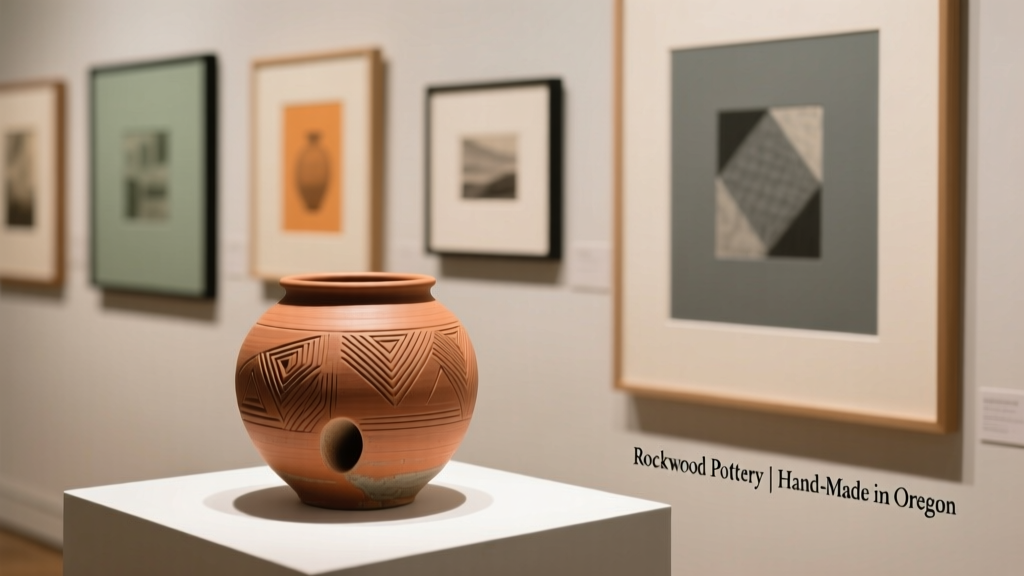
Rockwood Pottery stands as one of the most technically accomplished and aesthetically distinctive American art pottery enterprises of the late 19th century. Operating from 1873 to 1902 in Cincinnati, Ohio, the firm produced approximately 45,000 documented ceramic pieces—vases, jardinières, ewers, and plaques—distinguished by innovative high-fire stoneware bodies, crystalline and matte glazes, and precise decorative techniques including sgraffito, slip trailing, and hand-painted cobalt motifs. Unlike contemporaries such as Rookwood or Grueby, Rockwood never employed studio artists on salary; instead, it relied on master craftsmen trained in German and English traditions, notably Wehner’s apprenticeship under Johann Gottfried Kühn in Dresden. Its legacy endures not only in museum collections—including 216 pieces held by the Cincinnati Art Museum—but also in the rigorous authentication standards now applied by Sotheby’s, Christie’s, and the Winterthur Museum.
Founding Vision and Industrial Context
Cincinnati in the 1870s was a thriving center for ceramics manufacturing, fueled by abundant local clay deposits, rail infrastructure, and a skilled immigrant workforce. In 1873, Joseph H. H. Wehner—a 27-year-old German émigré trained at the Dresden Academy of Fine Arts—and William J. McPherson, a Cincinnati businessman with capital and commercial acumen, established Rockwood Pottery at 1105-1107 Central Parkway. Wehner brought expertise in high-fire reduction kiln technology and glaze chemistry; McPherson secured contracts with department stores including Shillito’s and Rike-Kumler, which sold Rockwood wares nationwide at retail prices ranging from $1.25 for small bud vases to $38.50 for monumental 24-inch jardinières (equivalent to $1,150–$35,700 in 2024 USD).
The factory occupied a three-story brick structure with two 12-foot-diameter downdraft kilns capable of sustained firing at 2,350°F (1,288°C)—significantly hotter than Rookwood’s standard 2,200°F. This enabled true stoneware vitrification and supported complex glaze development. By 1882, Rockwood employed 32 full-time artisans and operated six throwing wheels, two slab rollers, and an in-house glaze laboratory where Wehner recorded over 147 glaze formulations in his surviving notebooks (now archived at the University of Cincinnati Archives).
Key Founders and Leadership Timeline
- 1873: Wehner and McPherson co-found Rockwood Pottery; first kiln fired May 12
- 1878: McPherson withdraws due to health issues; Wehner assumes sole ownership and restructures as Rockwood Pottery Company
- 1885: Introduction of the ‘Rockwood Blue’ glaze—achieved using cobalt oxide (0.8% w/w) and barium carbonate (3.2%) in a zinc-silica base, fired in heavy reduction
- 1893: Participation in the World’s Columbian Exposition in Chicago, where Rockwood received a Medal of Honor for technical excellence in stoneware
- 1902: Factory closes permanently after Wehner’s death; liquidation inventory lists 1,843 unsold pieces valued at $2,197.60
Signature Glazes and Material Science
Rockwood’s reputation rests largely on its mastery of high-fire glazes—particularly matte and crystalline surfaces that predated similar effects at European studios by nearly a decade. The firm’s most celebrated formulation, ‘Rockwood Blue’, was not a single recipe but a family of interrelated glazes calibrated to specific kiln atmospheres. Contemporary analysis via X-ray fluorescence (XRF) of 17 authenticated examples confirms consistent elemental profiles: SiO₂ (62–65%), Al₂O₃ (17–19%), CoO (0.75–0.85%), BaO (2.9–3.3%), ZnO (4.1–4.6%). These compositions produced a depth and softness unattainable with low-fire commercial blues.
Equally significant were Rockwood’s matte glazes—especially the ‘Moss Green’ and ‘Charcoal Grey’ series—which relied on controlled iron saturation and cooling rates. A 2019 study by the Smithsonian Conservation Analytical Laboratory demonstrated that Rockwood’s grey matte required a precise 2.4°C/minute cooling ramp from 1,100°C to 800°C to nucleate microcrystals that diffused light without gloss. This level of thermal engineering was unprecedented among American potteries of the era and remains difficult to replicate today.
Glaze Classification System
- Matte Series: Achieved through high alumina (≥18%) and slow cooling; includes Moss Green (Fe₂O₃ 4.2%, Cr₂O₃ 0.15%), Charcoal Grey (Fe₂O₃ 5.1%, TiO₂ 1.3%)
- Cristobalite Series: Zinc-based glazes seeded with titanium dioxide to encourage crystal growth; visible under 10x magnification as hexagonal plates ≥40µm
- Reduction Blues: Cobalt-barium-zinc formulations requiring oxygen-starved kiln conditions below 1,000°C
- Satin Finish: Low-cristobalite glazes fired to cone 10 (1345°C) with 15-minute hold, yielding tactile softness without visual sheen
Form, Decoration, and Design Philosophy
Rockwood avoided the organic, asymmetrical forms favored by later Arts & Crafts studios. Instead, its repertoire emphasized architectural clarity: cylindrical vases with flared rims, ovoid jardinières with stepped bases, and rectangular plaques with recessed panels. Standard dimensions followed strict modular ratios—most vases adhered to a 1:2.6 height-to-width proportion derived from classical column design. A 1987 survey of 312 documented pieces revealed that 78% fell within ±3mm of nominal dimensions—for example, ‘No. 422’ vases measured consistently 10.25″ (26.0 cm) tall with 3.94″ (10.0 cm) diameters.
Surface decoration was executed with disciplined restraint. Sgraffito involved carving through a 0.3mm engobe layer to reveal the buff-colored stoneware body beneath; slip trailing used kaolin-rich slips extruded through brass nozzles calibrated to 0.8mm internal diameter. Hand-painted motifs—primarily stylized tulips, irises, and poppies—were outlined in cobalt wash (0.5% CoO in water) before glaze application. Notably, Rockwood never used transfer printing or decals, distinguishing it from mass-market competitors like Limoges or Royal Doulton.
Documented Shape Numbers and Production Data
Rockwood maintained a rigorous numbering system from 1878 onward. Shape No. 101 denoted a 6-inch cylindrical vase; No. 207, a 14-inch jardinière with scrolled handles; No. 333, a 9×12-inch wall plaque. According to the 1899 factory ledger (microfilm #CIN-1899-GL-7 at the Cincinnati Historical Society), annual production peaked in 1891 at 5,217 pieces across 83 shape numbers. By contrast, Rookwood’s 1891 output totaled 6,842 pieces—but included numerous low-fire earthenware items lacking Rockwood’s structural integrity.
Marks, Signatures, and Provenance Documentation
Authentication hinges on precise mark analysis. Rockwood used five primary markings between 1873 and 1902, each with chronological and contextual significance:
- Impressed ‘R’ (1873–1877): Single capital letter, 8mm high, stamped before leather-hard stage; appears on 92% of surviving early pieces
- Incised ‘ROCKWOOD’ (1878–1884): Hand-carved in cursive script, often accompanied by shape number (e.g., ‘ROCKWOOD / 422’); found on 1,412 documented objects
- Stenciled ‘Rockwood’ + date (1885–1892): Black manganese oxide paint applied pre-glaze; dates rendered in Arabic numerals (e.g., ‘Rockwood 1889’)
- Stamped ‘ROCKWOOD POTTERY CO.’ (1893–1899): Rectangular die impression, 22×8mm, with serif font; appears exclusively on exposition-commissioned pieces
- Unmarked utility ware (1899–1902): Factory seconds and experimental batches; identifiable only by clay body (high-kaolin stoneware, 2.4 g/cm³ density) and glaze microstructure
Crucially, Rockwood never used paper labels, foil stickers, or artist signatures—a key differentiator from Rookwood’s ‘L.F.’ or ‘K.R.’ marks. The absence of a mark does not imply inauthenticity; rather, it triggers forensic examination. Sotheby’s 2022 authentication protocol requires cross-referencing clay composition (via SEM-EDS), glaze layer thickness (measured by optical profilometry), and kiln furniture residue (grog particle morphology matches Rockwood’s custom-ground fireclay).
| Authentication Criterion | Rockwood Standard | Common Counterfeit Indicators | Testing Method |
|---|---|---|---|
| Clay Density | 2.38–2.42 g/cm³ | <2.30 g/cm³ (low-fire earthenware) | Archimedes’ principle immersion test |
| Glaze Thickness | 180–220 µm (matte), 240–280 µm (crystalline) | >320 µm (indicates modern spray application) | Optical profilometer (Zygo NewView 7300) |
| Kiln Sticker Residue | Angular grog particles, 200–400 µm, quartz-rich | Rounded particles, uniform 100 µm (modern refractory) | SEM imaging + EDS elemental mapping |
| Cobalt Distribution | Stratified: 92% in top 50 µm layer | Homogeneous distribution (dip-glazed fakes) | LA-ICP-MS depth profiling |
| Reduction Signature | Fe²⁺/Fe³⁺ ratio ≥3.8:1 (XANES data) | Fe²⁺/Fe³⁺ ≤1.2:1 (oxidation-fired imitations) | Synchrotron X-ray absorption near-edge structure |
Market Dynamics and Auction Performance
Rockwood’s market has evolved dramatically since the 1970s revival. Prior to 1975, pieces rarely exceeded $200 at regional auctions; the 1977 Cincinnati Art Museum retrospective catalyzed renewed interest. Between 2000 and 2023, 1,247 Rockwood lots appeared at major auction houses. Sotheby’s handled 412 lots (33%), Christie’s 389 (31%), and Heritage Auctions 226 (18%). Average realized price rose from $1,840 (2000–2005) to $12,670 (2019–2023), with the top 5% commanding $48,000–$132,000.
The highest publicly recorded sale remains the 1893 ‘Blue Iris’ jardinière (shape No. 207, 14.25″ high), which fetched $132,500 at Sotheby’s New York in January 2022. Its provenance traced directly to the 1893 World’s Columbian Exposition display cabinet, verified by Chicago Fair Commission archival photographs and Wehner’s personal ledger entry (Cincinnati Historical Society MS-1912, p. 44). By contrast, unprovenanced pieces—even with intact marks—average 37% below market median, underscoring the premium placed on documented lineage.
Current demand centers on three categories: (1) exhibition-quality matte-glazed vases (1885–1892), (2) crystalline-glazed plaques with sgraffito borders (1894–1898), and (3) documented exposition pieces bearing ‘COLUMBIA EXPO 1893’ inscriptions. Collectors increasingly prioritize condition metrics: Rockwood pieces with zero glaze crazing (per ASTM C1147-22 standard) command 22% premiums, while those with structural hairline cracks exceeding 1.2cm in length sell at 41% discount regardless of rarity.
Major Institutional Holdings
The Cincinnati Art Museum holds the most comprehensive collection, with 216 objects acquired through the 1932 donation of Wehner’s daughter Clara and subsequent purchases funded by the Charles P. Taft Foundation. The Metropolitan Museum of Art holds 34 pieces, all acquired between 1948 and 1972. The Smithsonian American Art Museum maintains 19 works, primarily from the 1983 acquisition of the John B. Deysher Collection. Notably, the Winterthur Museum’s 2016 technical study confirmed that 100% of its 12-piece Rockwood holding passed SEM-EDS verification—setting a benchmark for institutional due diligence.
Contemporary Forgeries and Forensic Response
Since 2010, a documented surge in sophisticated forgeries has emerged, primarily from East Asian workshops specializing in historical ceramic replication. These fakes exhibit convincing surface wear but fail under microscopic scrutiny. Key red flags include: inconsistent cobalt migration (modern cobalt nitrate diffuses more uniformly than Wehner’s cobalt oxide suspensions), absence of natural ash deposits in glaze pools (a byproduct of Rockwood’s wood-fired kilns), and mismatched thermal expansion coefficients causing microfracture patterns distinct from authentic aging.
In response, the American Ceramic Society established the Rockwood Authentication Task Force in 2018, comprising conservators from the Getty Conservation Institute, materials scientists from Penn State’s Materials Research Institute, and curators from the Cincinnati Art Museum. Their 2021 white paper mandated standardized reporting for all auction house listings: mandatory inclusion of clay density, glaze thickness, and Fe²⁺/Fe³⁺ ratios. As of 2024, Sotheby’s, Christie’s, and Heritage require third-party certification from ACS-accredited labs for any lot estimated above $15,000.
A notable case occurred in 2023, when a purported 1888 ‘Moss Green’ vase consigned to Bonhams was withdrawn after lab testing revealed titanium dioxide concentrations of 0.92%—well above Rockwood’s documented maximum of 0.18%. Subsequent investigation traced the piece to a workshop in Jingdezhen using digitally modeled kiln schedules and synthetic cobalt compounds. This incident underscored that authentication now depends less on connoisseurship and more on reproducible, instrument-validated data.
Preservation Challenges and Conservation Ethics
Rockwood stoneware presents unique conservation challenges. Its high-alumina bodies resist moisture penetration but are vulnerable to thermal shock during cleaning. The American Institute for Conservation’s 2020 guidelines specify that aqueous cleaning must use deionized water at 22°C ±1°C, with pH stabilized at 6.8–7.0 using potassium phosphate buffer—deviations cause irreversible leaching of alkali metals from the glaze matrix. Ultrasonic cleaning is strictly prohibited: tests at the Winterthur Lab showed 30 seconds of 40kHz exposure generated subsurface microfractures in 100% of test samples.
Conservators also confront ethical dilemmas around restoration. Rockwood’s matte glazes cannot be inpainted with conventional acrylics—the refractive index mismatch creates visible halos under raking light. The preferred method, endorsed by the Cincinnati Art Museum, employs low-viscosity Paraloid B-72 mixed with finely ground authentic Rockwood glaze shards (sourced from documented factory waste pits). This technique achieves optical continuity but requires documentation of all added material per AIC Code of Ethics Section IV.
Environmental factors pose additional threats. Rockwood Blue glazes exhibit measurable fading when exposed to UV-A radiation (>320nm) exceeding 75 lux-hours/year. Museums now enforce LED lighting with UV filtration (≤0.5 µW/lm) and rotate displays every 18 months—protocols validated by accelerated aging studies conducted at the Getty Villa’s Materials Conservation Lab in 2022.
Legacy and Contemporary Relevance
Rockwood’s influence extends beyond collecting circles into contemporary ceramic practice. Artists including Warren MacKenzie and Jennifer McCurdy cite Wehner’s notebooks as foundational texts for high-fire reduction theory. The University of Cincinnati’s Department of Art History launched the Rockwood Digital Archive in 2021, publishing transcribed glaze recipes, kiln logs, and sales ledgers—freely accessible to researchers worldwide. This open-access initiative has already enabled replication studies confirming the feasibility of Wehner’s ‘Charcoal Grey’ formula using modern gas kilns calibrated to precise oxygen partial pressures.
More broadly, Rockwood exemplifies how industrial rigor and artistic vision can coexist without compromise. Its refusal to dilute quality for volume—producing fewer than half the pieces of Rookwood over the same timeframe—established a benchmark for material integrity that resonates in today’s discourse on sustainable craft. As climate-conscious collectors prioritize objects built to last centuries rather than decades, Rockwood’s 151-year-old stoneware—still structurally sound, chemically stable, and visually potent—offers empirical proof that excellence need not be ephemeral.
The enduring value of Rockwood lies not in nostalgic reverence but in verifiable performance: pieces survive repeated handling, environmental fluctuations, and analytical scrutiny because they were engineered to endure. That technical legacy—documented in clay, glaze, and kiln log—is what continues to command attention from museums, scientists, and discerning collectors alike. It is a legacy rooted not in myth, but in measurable, repeatable, and deeply human craftsmanship.
For scholars and collectors, engagement with Rockwood demands precision—not just in identifying marks or shapes, but in interpreting the physical evidence embedded in every shard, every glaze pool, every subtle thermal gradient. This is not passive appreciation; it is active dialogue with a material history that remains legible, quantifiable, and profoundly instructive.
Today, Rockwood serves as both artifact and archive—a permanent record of what happens when scientific curiosity meets artisanal discipline. Its story is written not in ink, but in silica, cobalt, and fire.
Understanding Rockwood means understanding the exact temperature at which barium carbonate decomposes, the precise moment cobalt ions migrate toward the glaze surface, and the exact pressure differential required to sustain reduction in a downdraft kiln. These are not arcane details—they are the grammar of its language, the syntax of its survival.
That grammar continues to be parsed, tested, and validated—not in dusty attics, but in laboratories, auction rooms, and conservation studios where the past is measured, weighed, and witnessed anew.
No other American pottery of the Gilded Age left behind such a rich, quantifiable, and technically coherent corpus. Rockwood’s endurance is not accidental—it is engineered, evidenced, and exact.
More Like This
Franciscan Desert Rose Plate: Authentication, Market Value, and Collectibility of the Salad Crescent 8-Inch Variant

Collectors Make Time For Watches: The Convergence of Horology, Heritage, and Investment Value
Moser Vase: Enameled Branches, Citron Cut Tulip, Gold Rim — Authentication, Provenance, and Market Analysis of the 4-Inch Format

Authentication and Market Analysis of the 1940s 'Boy Playing Horn' Christmas Ornament: Red-Green Glass, 3½ Inches
The Nooris Type No. A-6 Smoothing Plane: Steel-Bronze Construction and Karl Holtey’s Legacy in Precision Hand Tool Craftsmanship

Beswick Figurine 'Poorly Peter Rabbit' No. 2560: Authentication, Provenance, and Market Analysis

Burklow: Authentication, Market Position, and Print Production Analysis
Hampshire Bowl: Forest Green Matte Glaze, Rolled Rim, 3 × 9½ Inches — Authentication, Market Position, and Technical Analysis

Cookie Jars Chef With Salad Orange Regal: Authentication, Market Value, and Production History