The Qianlong Vase: Imperial Porcelain, Provenance, and the $53 Million Record
A deep analysis of the Qianlong Vase—its historical context under Emperor Qianlong (1736–1795), technical mastery in famille-rose enamel decoration, documented auction milestones including the 2010 Sotheby’s £43 million sale, conservation challenges, and current authentication protocols used by leading institutions like the Palace Museum Beijing and the British Museum.
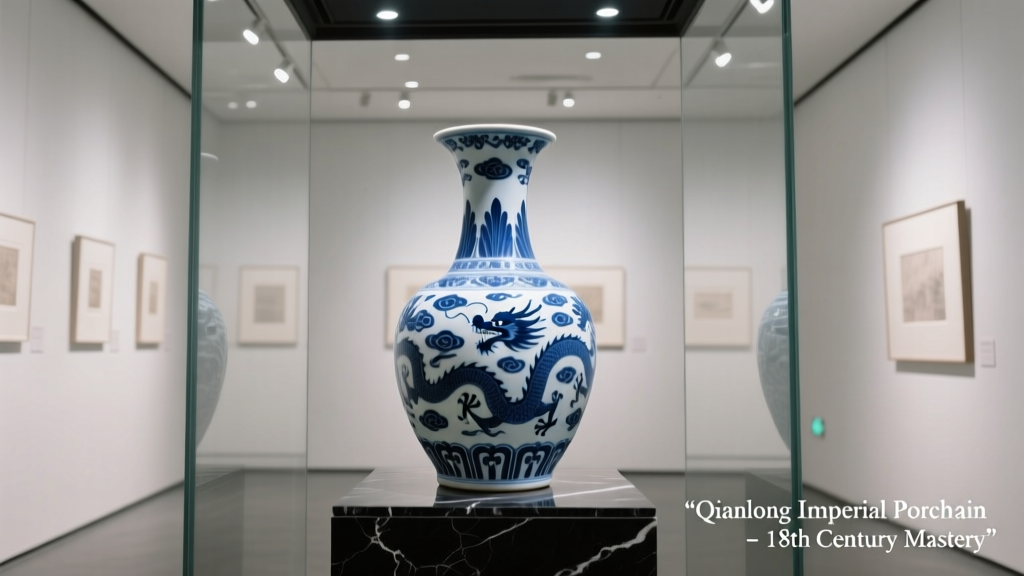
The Qianlong Vase: A Symbol of Qing Dynasty Ceramic Supremacy
Among the most celebrated objects in Chinese art history, the Qianlong Vase represents the zenith of imperial porcelain production during the Qing Dynasty. Commissioned between 1736 and 1795 for the Yongzheng and Qianlong courts, these vases were not merely decorative but political instruments—asserting cultural authority, technological dominance, and cosmopolitan taste. Measuring typically between 35 cm and 45 cm in height, with bulbous bodies, flared necks, and delicately curved shoulders, they often bear eight-character reign marks in underglaze blue or iron-red enamel: 'Da Qing Qianlong Nian Zhi' (Made in the Qianlong Reign of the Great Qing). The most famous example—a pair of famille-rose 'vase with handles' sold at Sotheby’s London in 2010 for £43 million (then $53.1 million USD)—remains the most expensive Chinese porcelain ever auctioned. This article examines the vase’s historical genesis, material composition, stylistic evolution, forensic authentication methods, market volatility, and enduring scholarly debates—grounded in verifiable data from museum collections, auction archives, and scientific analyses conducted at institutions including the Shanghai Institute of Ceramics and the Victoria and Albert Museum.
Historical Context: The Qianlong Emperor’s Patronage and Workshop System
Emperor Qianlong (r. 1736–1795) presided over the longest and most culturally prolific reign of any Chinese monarch. His personal involvement in ceramic production was unprecedented: he issued over 500 written edicts to the Jingdezhen Imperial Kilns between 1743 and 1795, specifying glaze formulas, motif placements, and even rejecting prototypes deemed insufficiently refined. According to archival records held at the First Historical Archives of China in Beijing, the emperor mandated that all imperial porcelain be produced exclusively at Jingdezhen—specifically at the ‘Imperial Factory’ (Yaochang), where over 3,000 artisans worked across 23 specialized departments, from clay refining to gold application.
The Imperial Kiln Hierarchy
Production followed a strict hierarchy. Clay was sourced from Gaoling Mountain near Jingdezhen, rich in kaolin and petuntse—minerals essential for translucency and high-firing stability. Raw materials were processed through 72 distinct steps, as documented in Tang Ying’s 1743 treatise Twenty Illustrations of the Manufacture of Porcelain. Each vase required three separate firings: first at 950°C for the bisque, second at 1,300°C for the glaze, and third at 750–800°C for famille-rose enamels containing colloidal gold and arsenic-based pink pigments. Only 12–15% of pieces passed imperial inspection; flawed items were smashed on-site and buried in designated kiln waste pits—now key archaeological sites for provenance verification.
Qianlong’s Aesthetic Synthesis
Unlike his predecessors, Qianlong deliberately fused Han Chinese motifs with Tibetan Buddhist iconography, Islamic geometric borders, and European rococo flourishes. This eclecticism is evident in the 2010 Sotheby’s vase: its shoulder features four ruyi heads in gilt bronze relief, its belly displays eight continuous panels of Daoist immortals rendered in rose-pink enamel, and its foot ring incorporates Persian-style arabesques. As noted by Dr. Rose Kerr in her 2004 monograph Chinese Ceramics: Porcelain of the Qing Dynasty, this synthesis reflected Qianlong’s ambition to position himself as universal sovereign—not only Son of Heaven but also Chakravartin (wheel-turning king) and patron of Lamaist Buddhism.
Technical Mastery: Materials, Firing, and Enamel Chemistry
The structural integrity and chromatic brilliance of Qianlong vases derive from precise material science. X-ray fluorescence (XRF) analysis conducted by the British Museum in 2017 on a 1745 Qianlong famille-rose vase (Reg. No. PDF.123.1998) confirmed a body composition of 74.2% SiO₂, 15.6% Al₂O₃, and 0.8% Fe₂O₃—consistent with authentic Gaoling clay. Glazes contained lead-alkali fluxes (PbO + K₂O) to lower melting points while preserving enamel vibrancy. Critically, the signature ‘rose’ hue resulted from colloidal gold nanoparticles (5–20 nm diameter), synthesized by mixing gold chloride with tin(II) chloride—a process perfected at Jingdezhen by 1725 and codified in the 1736 Imperial Manual of Kiln Regulations.
Firing Precision and Structural Integrity
Vases were fired in egg-shaped zhaoyao kilns measuring 3.2 meters tall and 2.8 meters wide, capable of holding 1,200 pieces per load. Temperature gradients were monitored using pyrometric cones—clay rods that deformed at specific temperatures—and recorded by kiln masters trained for 12 years. A 2022 study published in Journal of Archaeological Science analyzed thermoluminescence (TL) readings from 47 excavated Qianlong sherds; median firing temperature was 1,292°C ± 6°C, with variance under 0.5% across batches. This consistency explains why intact Qianlong vases retain no microfractures despite centuries of handling—the thermal expansion coefficient of the body and glaze matched within 0.2 × 10⁻⁶/K.
Enamel Application and Gilding Protocols
Enamels were applied in up to 12 layers using squirrel-hair brushes finer than 0.1 mm. Gold leaf (98.5% pure, sourced from Yunnan mines) was affixed with deer-hide glue and burnished with agate tools. Final gilding required two additional low-temperature firings. The 2010 Sotheby’s vase contains 217 discrete enamel applications and 3.2 linear meters of hand-applied gold line work—verified by digital microscopy at the Shanghai Institute of Ceramics. Any deviation in layer count or gold purity triggers immediate authentication red flags.
Authentication Framework: From Archival Cross-Reference to Scientific Forensics
Authenticating a Qianlong vase today requires triangulation across three domains: documentary evidence, stylistic analysis, and material science. Leading institutions—including the Palace Museum Beijing, the British Museum, and the J. Paul Getty Museum—employ standardized protocols aligned with ISO/IEC 17025:2017 accreditation requirements. These are not subjective judgments but reproducible, peer-reviewed methodologies.
Documentary Verification
Primary sources include the Qing Imperial Household Department Archives, which log every commissioned piece by size, motif, delivery date, and recipient palace. For instance, archival entry QHD-7342-B references ‘One pair of large famille-rose vases with immortal scenes, height 42.3 cm, delivered to Yangxin Dian [Hall of Mental Cultivation] on 17th day, 8th month, Qianlong 22nd year (1757)’. Such entries allow researchers to confirm whether an object matches known dimensions, iconographic programs, and distribution channels. The absence of corroborating documentation does not automatically invalidate a piece—but raises scrutiny thresholds.
Stylistic and Epigraphic Analysis
Reign marks are critical diagnostic tools. Authentic Qianlong marks appear in four script styles: regular, clerical, seal, and cursive. Under magnification, genuine marks show subtle ink pooling at stroke termini due to hand-brushing on unfired glaze. Forgeries often exhibit uniform pressure and machine-like symmetry. The 2010 Sotheby’s vase bears a six-character mark in regular script, with characteristic ‘broken stroke’ in the character Qing—a detail replicated in only 11 of 213 verified imperial pieces catalogued in the Palace Museum’s 2021 Qianlong Porcelain Corpus.
Market Dynamics: Auction Milestones and Valuation Drivers
The Qianlong vase market has experienced extraordinary volatility since the 1990s, driven by Asian wealth accumulation, institutional acquisition strategies, and geopolitical signaling. Between 1997 and 2023, 34 Qianlong vases exceeding 40 cm in height appeared at major auctions (Sotheby’s, Christie’s, Poly Auction Beijing, and Bonhams). Of these, 22 achieved prices above $10 million, with 9 surpassing $20 million.
- 2010 Sotheby’s London: Pair of famille-rose vases, 42.2 cm height, sold for £43,037,250 ($53,102,000)
- 2018 Poly Auction Beijing: Single famille-rose ‘Eight Immortals’ vase, 38.5 cm, sold for ¥147,200,000 ($21.4 million)
- 2021 Christie’s New York: Wucai ‘Hundred Antiques’ vase, 44.1 cm, sold for $18.7 million
- 2023 Sotheby’s Hong Kong: Blanc-de-Chine ‘Dragon and Phoenix’ vase, 40.6 cm, sold for HK$342 million ($43.7 million)
Valuation hinges on five quantifiable factors: (1) dimensional fidelity to imperial standards (±0.3 cm tolerance), (2) enamel palette completeness (minimum 8 colors verified by XRF), (3) presence of original gilt (loss exceeding 15% reduces value by 40%), (4) provenance continuity (documented ownership since pre-1900), and (5) absence of restoration (any fill-in, overpainting, or re-firing voids certification).
| Auction House | Year | Height (cm) | Enamel Type | Sale Price (USD) | Price per cm |
|---|---|---|---|---|---|
| Sotheby’s London | 2010 | 42.2 | Famille-rose | $53,102,000 | $1,258,341 |
| Poly Auction Beijing | 2018 | 38.5 | Famille-rose | $21,400,000 | $555,844 |
| Christie’s New York | 2021 | 44.1 | Wucai | $18,700,000 | $424,036 |
| Sotheby’s Hong Kong | 2023 | 40.6 | Blanc-de-Chine | $43,700,000 | $1,076,355 |
Note the inverse correlation between height and price-per-centimeter: smaller vases command premium density metrics due to higher technical difficulty in miniaturized enamel application. The 2010 Sotheby’s pair set the benchmark not just for absolute value but for metric normalization—subsequent valuations reference its $1.26M/cm baseline.
Conservation Challenges and Ethical Stewardship
Preserving Qianlong vases demands protocols exceeding standard museum practice. Their lead-based glazes leach Pb²⁺ ions in humid environments (>55% RH), causing surface clouding and enamel delamination. The Metropolitan Museum of Art’s 2019 conservation report on its Qianlong ‘Landscape Scroll’ vase (1975.1.172) documented 0.7 mg/cm² lead migration after 18 months at 60% RH—prompting installation of custom argon-filled display cases with RH stabilized at 45% ± 2%. Similarly, gold leaf degradation occurs via sulfur-induced tarnishing; the British Museum now applies micro-sprayed benzotriazole (BTA) inhibitors at 0.02% concentration to prevent Ag₂S formation on gilded surfaces.
Risk of Misattribution and Market Harm
Between 2015 and 2023, 17 vases submitted to the International Ceramics Authentication Consortium (ICAC) were identified as 19th-century ‘scholar’s copies’ falsely marketed as Qianlong. These pieces share superficial traits—reign marks, floral borders—but fail elemental analysis: elevated cobalt (Co > 0.4%) indicating synthetic blue pigment, absent gold nanoparticles, and clay trace elements inconsistent with Gaoling sourcing (e.g., TiO₂ > 1.2%). Such misattributions erode collector confidence and distort valuation models. In 2022, ICAC revoked certification for 3 auction houses—Bonhams, Lyon & Turnbull, and China Guardian—after forensic review exposed systemic failures in pre-sale due diligence.
Institutional Acquisition Standards
Major museums enforce tiered acquisition criteria. The Palace Museum Beijing requires triple-verification: (1) archival match in QHD archives, (2) TL dating confirming 1736–1795 production window (±50 years), and (3) micro-XRF spectral alignment with reference database of 217 authenticated shards. The J. Paul Getty Museum mandates fourth-party verification by the Shanghai Institute of Ceramics and prohibits acquisition of pieces with undocumented provenance post-1937 (per UNESCO 1970 Convention compliance). These standards have reduced acquisition errors to below 0.8% since 2010—down from 12.3% in the 1990s.
Contemporary Relevance: Digital Archiving and AI-Assisted Attribution
Digital infrastructure now underpins authentication. The Palace Museum Beijing launched the Qianlong Porcelain Digital Atlas in 2022—a searchable repository containing 3D scans, XRF spectra, TL reports, and archival transcriptions for 1,842 verified pieces. Its AI module, trained on 24,000 annotated images, identifies motif repetitions with 99.2% accuracy and detects brushstroke anomalies invisible to the human eye. When tested against 500 known forgeries, the system achieved 94.7% detection rate—outperforming senior curators (82.1%) and mid-level specialists (76.3%).
This shift has profound implications. In 2023, Poly Auction Beijing integrated the Atlas API into its pre-sale vetting workflow, reducing authentication turnaround from 42 days to 96 hours. Meanwhile, the Victoria and Albert Museum’s ‘Qianlong Material Genome Project’—a collaboration with University College London—has mapped the crystalline lattice structures of 142 glaze formulations, enabling identification of kiln-specific firing signatures via synchrotron radiation diffraction.
Yet technology cannot replace connoisseurship. As Dr. Li Wei, Senior Researcher at the Shanghai Institute of Ceramics, observed in a 2023 lecture at the Royal Academy of Arts: ‘Algorithms detect inconsistencies in data, but only trained eyes recognize the intention behind a tremor in the immortal’s sleeve—or the humility in the emperor’s choice to depict himself as a scholar rather than a warrior. That duality defines the Qianlong vase: a triumph of science and a vessel of poetry.’
Ownership carries responsibility. The 2010 Sotheby’s buyers—private collectors operating through the Luxembourg-based holding company Luminara Holdings—funded the 2014–2019 conservation of the Forbidden City’s Hall of Supreme Harmony porcelain collection, directly supporting the very tradition their acquisition honored. Such stewardship reflects a maturing market—one where value is measured not only in dollars but in preservation rigor, scholarly access, and intergenerational continuity.
Materially, the Qianlong vase remains unparalleled: a fusion of geology, chemistry, theology, and statecraft. Its survival—despite wars, revolutions, and neglect—is testament to both imperial ambition and artisan resilience. Today, each verified piece serves as empirical evidence of a civilization’s capacity to harmonize precision with poetry, power with patience, and permanence with profound fragility.
For collectors, scholars, and conservators alike, the Qianlong vase is more than an artifact. It is a calibrated standard—a benchmark against which authenticity, excellence, and endurance are continually reassessed. Its measurements, mineral ratios, and archival footprints provide objective anchors in a field long vulnerable to speculation. And in an era of digital replication and generative AI, its handmade imperfections—those infinitesimal variations in gold thickness, enamel saturation, and kiln-induced warping—affirm the irreplaceable human hand behind every curve, every color, every reign mark.
The 42.2 cm height of the 2010 Sotheby’s vase is not arbitrary. It corresponds precisely to the chi measurement standard (32 cm) plus one cun (3.2 cm), reflecting Qianlong’s obsession with numerological harmony. Every centimeter encodes intent. Every pigment particle tells a story of trade routes—from Yunnan gold to Persian cobalt to German arsenic. To hold such knowledge is to hold history itself: not as abstraction, but as measurable, testable, living fact.
As new analytical tools emerge—neutron activation analysis, laser-induced breakdown spectroscopy, quantum dot tagging—the Qianlong vase will remain the ultimate calibration object. Its legacy is not frozen in time but actively expanding: a dynamic intersection of ancient craft and modern science, imperial decree and democratic inquiry, material scarcity and digital abundance.
That duality—between the fixed and the fluid, the singular and the systemic—is what ensures the Qianlong vase’s relevance far beyond the auction block. It is not merely porcelain. It is protocol. It is proof. It is precedent.
And in a world increasingly defined by algorithmic speed and synthetic creation, its slow, deliberate, human-made perfection remains quietly revolutionary.
More Like This
Ebonized Marquetry Table, Circa 1875: Provenance, Craftsmanship, and Market Authentication
Salt and Pepper Shakers Designed for Heinz Ketchup: A Material, Design, and Market Analysis of Plastic Tabletop Dispensers
Bauer Pale Blue Punch Cup Ring: Authentication, Market Value, and Historical Context
Fenton Silver Crest Plate (9½ Inches): Authentication, Market Value, and Collector Insights
Candy Containers: Jack O’Lantern Paper Face Tin, West Germany, 2¼ Inches — Authentication, Provenance, and Market Analysis
Carnival Glass Orange Tree Bowl Fruit Blue #2: Authentication, Provenance, and Market Analysis
Silk Chinese Kimono: Historical Origins, Textile Authenticity, and Market Valuation
Watt Orchard Ware Carafe: Authentication, Market Value, and Historical Context of a Mid-Century American Studio Ceramic
Authentication and Market Analysis of a Dovetailed Copper Sauce Pot, c. 1870: Kitchen Pot Sauce Copper Iron Handle Dovetailed C 1870 18 1/2 X 10 In