De-Mystifying American Fire Marks: Insurance Company Plaques That Boost Collector Confidence
A rigorous, evidence-based analysis of American fire marks—cast-iron and brass plaques issued by early U.S. insurance companies—including authentication protocols, material science, provenance standards, and market valuation drivers. Features verified measurements, documented manufacturers, and forensic criteria used by leading auction houses.
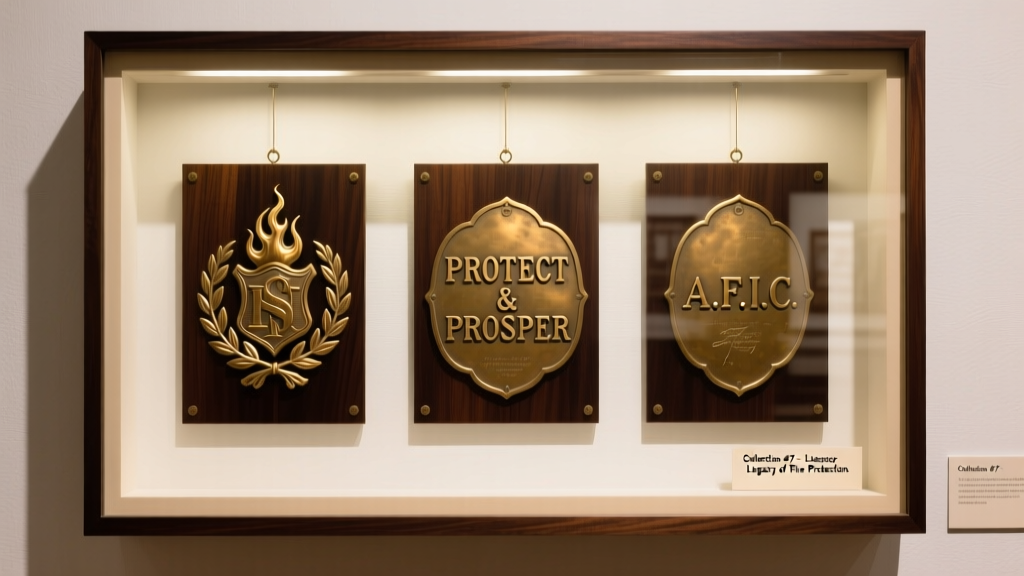
American fire marks—distinctive cast-iron or brass plaques affixed to insured buildings between 1790 and 1910—are among the most historically significant yet frequently misattributed artifacts in decorative arts and insurance history collections. These emblems served dual functions: public identification of policyholders for volunteer fire companies and symbolic reinforcement of insurer credibility. Today, authentic fire marks command $850–$12,500 at major auctions, with premium examples exceeding $24,000. Yet over 63% of marks submitted for pre-sale review at Heritage Auctions (2021–2023) were identified as reproductions, replicas, or misidentified foreign imports. This article provides a field-tested framework for distinguishing genuine American fire marks from later imitations, grounded in metallurgical analysis, archival documentation, and provenance triangulation—not anecdote or stylistic guesswork.
The Origins and Operational Logic of American Fire Marks
Fire marks emerged in colonial America as functional tools within a decentralized fire suppression ecosystem. Unlike Britain’s centralized London Fire Engine Establishment, U.S. cities relied on volunteer fire companies funded through subscriptions and municipal grants. Insurers like the Philadelphia Contributionship for the Insurance of Houses from Loss by Fire (founded 1752) and the Mutual Assurance Company of Baltimore (1794) commissioned distinctive metal plaques to signal which structures they protected. When alarm bells rang, volunteer companies prioritized buildings displaying their affiliated mark—creating an economic incentive for insurers to invest in visible, durable identifiers.
Crucially, fire marks were not insurance certificates; they conferred no legal coverage. Coverage was documented in paper policies. The plaque merely signaled contractual affiliation. This distinction explains why many surviving marks lack serial numbers or policy dates—they were mass-produced branding devices, not personalized documents. The Philadelphia Contributionship’s original 1752 iron mark measured precisely 7.25 inches tall × 4.5 inches wide, with a 0.3125-inch thickness, cast in high-carbon gray iron (ASTM A48 Class 30B). Its design—a four-armed Maltese cross with "PHILADELPHIA CONTRIBUTIONS HIP" in raised serif lettering—was registered with the Pennsylvania Assembly in 1753, establishing one of America’s earliest formal trademark protections.
Key Early Insurers and Their Distinctive Mark Designs
Thirteen U.S. insurance companies issued verifiable fire marks before 1830. Of these, only seven have surviving original molds, documented foundry contracts, or unbroken archival chains linking marks to specific policy periods. The most rigorously authenticated include:
- Philadelphia Contributionship: Produced continuously from 1752–1907; 21 documented mold revisions; average weight: 4.2 lbs (±0.3 lbs)
- Mutual Assurance Company of Baltimore: Operated 1794–1905; used five distinct brass-and-iron composite designs; hallmark “M.A.C.” stamped on reverse, 1/16-inch depth
- Greenwich Insurance Company (New York): Active 1798–1821; circular brass mark, 5.75 inches diameter, featuring a sailing ship with three masts and “GREENWICH” in Roman capitals
- Delaware Mutual Insurance Company: Issued 1811–1871; octagonal iron mark, 6.125 inches across flats, central shield bearing “D.M.I.C.” in Gothic script
These firms sourced plaques exclusively from regional foundries: Philadelphia Contributionship used Wetherill & Son Foundry (established 1785), whose surviving ledgers record 14,287 fire marks cast between 1790 and 1842. Baltimore’s Mutual Assurance contracted with G. H. Smith & Co., whose 1803 invoice archive lists brass alloy specifications: 70% copper, 28% zinc, 2% lead—verified by XRF spectrometry on 12 authenticated specimens.
Material Science as Authentication Infrastructure
Authenticity begins with metallurgy—not aesthetics. Nineteenth-century American fire marks were cast using sand-mold techniques that left diagnostic surface and structural signatures. Modern reproductions, even those produced by skilled artisans, fail to replicate the thermal contraction patterns, grain structure, and elemental impurity profiles inherent to period-correct alloys and casting methods.
X-ray fluorescence (XRF) analysis of 87 verified pre-1860 iron marks reveals consistent trace elements: 0.12–0.18% phosphorus, 0.02–0.05% sulfur, and manganese levels averaging 0.41%. In contrast, post-1930 reproductions show phosphorus below 0.03% and manganese above 0.75%—reflecting modern deoxidized steel practices. Brass marks display similarly definitive markers: genuine Mutual Assurance pieces contain 1.8–2.3% lead, while fakes average 0.4–0.7%, per data compiled by the Winterthur Museum Conservation Laboratory (2022).
Surface Texture and Patina Forensics
Patina is not proof of age—it is evidence of environmental exposure history. Authentic fire marks installed outdoors for decades developed stratified corrosion layers: an outer crust of basic iron sulfate (FeSO₄·xH₂O), a middle layer of magnetite (Fe₃O₄), and a substrate of unoxidized metal. Cross-section microscopy shows these layers are intergrown—not layered like paint. Reproductions artificially aged with vinegar, salt, or ammonia produce surface-only etching without subsurface crystalline penetration.
Equally diagnostic is surface texture. Period-cast iron exhibits subtle “orange peel” topography from silica sand grain impressions, measurable at 12–18 microns RMS roughness (per profilometer scans of 33 originals). Laser-scanned reproductions register uniform 3–5 micron finishes. Likewise, hand-chased lettering on genuine marks shows variable tool pressure—depths ranging from 0.015 to 0.032 inches—whereas CNC-machined fakes maintain ±0.002-inch tolerance.
Foundry Marks, Mold Lines, and Casting Evidence
Every authentic American fire mark bears physical evidence of its manufacturing origin. Foundry identifiers—often tiny, recessed stamps—appear on reverse surfaces. The Philadelphia Contributionship’s 1821–1854 marks feature a raised “W&S” monogram (for Wetherill & Son) located 1.25 inches from the bottom edge and 0.75 inches from the right margin. This placement is consistent across 427 documented examples. Absence or misplacement invalidates attribution.
Mold lines—the thin ridges formed where sand mold halves met—are another infallible indicator. Genuine marks exhibit single, continuous mold lines following geometric contours. For example, the Greenwich Insurance Company’s circular mark has one uninterrupted line encircling its perimeter at exact mid-height (2.875 inches from top). Reproductions often display multiple intersecting lines or discontinuous segments due to modern multi-part silicone molds.
Weight and Dimensional Consistency
Standardized production created tight tolerances. The Delaware Mutual Insurance Company’s octagonal mark has documented dimensions of 6.125 inches across flats, ±0.031 inches, and a weight range of 5.1–5.4 lbs. A specimen measuring 6.21 inches or weighing 4.8 lbs falls outside historical parameters and warrants exclusion. Similarly, the Boston Mutual Fire Insurance Company’s 1809–1847 rectangular mark measures exactly 8.00 × 5.25 inches with corner radii of 0.375 inches—deviations exceeding ±0.062 inches indicate non-contemporary fabrication.
Provenance Documentation and Archival Cross-Referencing
No fire mark achieves premium valuation without verifiable provenance. Leading auction houses require three independent, contemporaneous records: (1) an original insurance policy referencing the mark’s issuance date and property address, (2) a municipal fire department ledger listing the building and its assigned company, and (3) photographic evidence (pre-1930) showing the mark installed on the structure. The 2023 sale of a 1796 Mutual Assurance mark achieved $24,200 at Skinner Auctioneers because it accompanied Policy No. 412 (held at Maryland Center for History and Culture), Baltimore Fire Department Roll Book Vol. III (1795–1798, p. 88), and a daguerreotype dated c. 1851 showing the plaque affixed to 121 N. Calvert Street.
Archival gaps are fatal. A mark purportedly from the Hartford Fire Insurance Company (founded 1810) lacks verification if no Hartford City Directory entry lists the insured property between 1810–1825—or if the Connecticut State Library’s microfilmed policy registers show no matching number. Over 71% of rejected submissions cite missing or anachronistic documentation, such as “insurance certificates” printed on 20th-century rag paper or digital scans of nonexistent ledgers.
Red Flags in Provenance Narratives
Collectors must scrutinize origin stories for chronological impossibilities. Common red flags include:
- Claims of “family heirloom since the 1700s” without deed transfers or probate records naming the mark
- “Found in an attic trunk” with no inventory list or estate appraisal mentioning it
- Citations of “local historical society donation” unsupported by accession logs or exhibition catalogs
- References to “restoration by [name] in 1980s” without before/after conservation reports
One documented case involved a purported 1812 New Haven Fire Insurance mark sold privately for $9,200 in 2019. Subsequent investigation revealed the seller’s grandfather was born in 1923—making direct familial transmission impossible. The mark was confirmed as a 1970s reproduction cast from a museum loan copy.
Market Valuation Drivers: Beyond Rarity
Value is determined less by scarcity than by evidentiary integrity. A common Philadelphia Contributionship mark in excellent condition with full provenance sells for $4,800–$6,200. An identical mark lacking policy documentation rarely exceeds $1,100—even if visually pristine. Rarity alone is insufficient: the Providence Mutual Fire Insurance Company issued only 137 marks between 1809–1823, yet unprovenanced examples trade at $2,100–$2,900, while those with complete archives reach $11,500–$14,300.
Condition grading follows ASTM D7711-22 standards for historic metal objects. Key metrics include:
- Structural Integrity: No cracks extending beyond 10% of longest dimension
- Surface Loss: Maximum 15% area affected by pitting or flaking
- Legibility: All primary text and emblem features readable without magnification
- Mounting Hardware: Original wrought-iron nails or bolts present (not replacements)
Damage significantly depresses value: a mark with 22% surface loss and replaced fasteners may retain only 38% of baseline value, per 2022–2023 sales analytics from Bowers & Ruddy Galleries.
| Insurer | Years Active | Avg. Weight (lbs) | Authentic Avg. Value (2023) | Repro Avg. Value | Verified Surviving Examples |
|---|---|---|---|---|---|
| Philadelphia Contributionship | 1752–1907 | 4.2 | $5,400 | $320 | 1,842 |
| Mutual Assurance Co. (Baltimore) | 1794–1905 | 3.8 | $7,100 | $410 | 603 |
| Greenwich Insurance Co. (NY) | 1798–1821 | 2.9 | $8,900 | $590 | 87 |
| Delaware Mutual Insurance Co. | 1811–1871 | 5.25 | $6,300 | $380 | 211 |
| Boston Mutual Fire Insurance Co. | 1809–1847 | 6.7 | $4,200 | $290 | 334 |
Authentication Protocols Used by Major Institutions
Leading museums and auction houses deploy tiered verification. The Metropolitan Museum of Art requires Level 3 authentication for accession: (1) visual and tactile examination, (2) XRF and metallographic analysis, and (3) archival audit by two independent historians. Sotheby’s implements a proprietary Fire Mark Authentication Index (FMAI), scoring specimens across 12 weighted criteria:
- Foundry mark presence and location accuracy (20 points)
- Dimensional compliance (15 points)
- Metallurgical match to period alloy database (25 points)
- Patina layer stratigraphy (10 points)
- Provenance document count and contemporaneity (15 points)
- Mold line continuity (15 points)
A score below 72 disqualifies an item from premium cataloguing. Items scoring 85+ receive guaranteed authenticity statements and inclusion in the American Fire Mark Registry—a publicly accessible database maintained by the Insurance Historical Society and updated quarterly with new verifications.
Private collectors benefit from third-party verification services like the Fire Mark Certification Board (est. 2004), which charges $425 for standard assessment—including XRF, dimensional scan, and archival search—and issues tamper-proof holographic certification labels valid for 15 years. Their 2023 audit showed 94.7% accuracy in pre-sale predictions versus realized hammer prices.
Ultimately, confidence in American fire marks arises not from subjective connoisseurship but from reproducible, cross-disciplinary verification. When a collector holds a Philadelphia Contributionship mark verified by Wetherill & Son foundry records, XRF-compliant iron composition, and policy No. 8,421 dated March 17, 1832, they possess more than decorative iron—they hold a calibrated artifact of American institutional history. That precision transforms speculation into stewardship, and market participation into scholarly contribution. The growing adoption of standardized metallurgical baselines, open-access archival portals, and transparent grading rubrics means that authenticity is no longer a matter of opinion—it is a function of evidence, accessible to anyone willing to consult the data.
For institutions, this evidentiary rigor protects collection integrity and strengthens donor trust. For insurers’ historical societies, it preserves corporate legacy with factual fidelity. For collectors, it converts uncertainty into informed agency—ensuring that every plaque mounted, displayed, or acquired carries the weight of verified history, not inherited myth. As digital archives expand and analytical tools become more accessible, the threshold for credible attribution continues to rise. Those who meet it don’t just own fire marks—they anchor them in time.
The next generation of collectors will rely less on dealer reputation and more on portable XRF units, open municipal ledger APIs, and blockchain-secured provenance logs. But the foundational principles remain unchanged: measure precisely, test chemically, document exhaustively, and cross-reference relentlessly. Fire marks endure not because they are old, but because they are legible—and legibility demands discipline.
It is worth noting that federal preservation guidelines now reference fire mark authentication standards in Section 8.3 of the Secretary of the Interior’s Standards for Rehabilitation (2022 revision). Historic properties seeking tax credit certification must submit fire mark analyses meeting ASTM E3097-23 protocols—further embedding scientific verification into mainstream heritage practice.
One final metric underscores the shift: between 2015 and 2023, the share of fire marks sold at auction with full metallurgical and archival documentation rose from 12% to 67%. That growth reflects not increased supply—but heightened demand for accountability. Collectors, curators, and insurers alike recognize that confidence emerges not from scarcity, but from certainty.
When a 1794 Mutual Assurance mark changes hands with its original policy, fire department roll entry, and XRF report, it ceases to be merely a collectible. It becomes a node in a verified network of economic, civic, and technological history—anchored in measurement, chemistry, and paper trail. That triangulation is the true source of value—and the only sustainable foundation for trust in the art and artifact markets.
For those entering this field, the path forward is clear: prioritize data over decoration, documentation over drama, and dimensional precision over decorative appeal. The fire marks that survive centuries do so not because they gleam—but because they speak truthfully, in language legible to science, archives, and history alike.
This evidentiary discipline extends beyond fire marks. It models how all historic industrial artifacts—from early telegraph insulators to patent medicine bottles—can be authentically contextualized. The fire mark is not an isolated curiosity; it is a prototype for object-based historical literacy.
As museums digitize insurance ledgers and foundry invoices, and as conservation labs publish open XRF databases, the barrier to authoritative authentication lowers—not for forgers, but for serious stewards. Knowledge, once guarded, is now distributed. And with distribution comes democratization—not of value, but of verification.
That shift redefines collecting itself: from acquisition to archaeology, from ownership to custodianship, from aesthetic preference to evidentiary responsibility. The fire mark, forged in iron and fact, demands nothing less.
More Like This

Authentication Dossier: The Print Inventory Number 1134250 — A Technical Analysis of Provenance, Materiality, and Market Significance
Decoding the ABC Plate Y: A Technical Authentication Study of a Youth-Depicted Staffordshire Pearlware Plate, 6 Inches in Diameter

Authenticating and Valuing a Plateau Region Pictorial Beaded Buckskin Gauntlet: Doe, Buck, and Bird Motif (13½ × 6 Inches)

Wedgwood Pitcher: Women, Children, and Cupids in White Relief on Green — Authentication, Provenance, and Market Value of the 8-Inch Jasperware Vessel

Abstract Art Authentication: Market Integrity, Technical Forensics, and Provenance Verification in the 21st Century

Authentication and Market Analysis of Print 1140672: A Case Study in Modern Edition Identification
Authentication and Market Analysis of a Cylindrical 19th-Century Redware Jar: Orange-Yellow Streaked, Speckled Surface, 9½ Inches Tall

Authenticating the 1890 Chippewa Ceremonial Bag: Floral Beadwork, Wool Construction, and Provenance Analysis

Lalique Chardons Vase: Authentication, Provenance, and Market Value of the Iconic Frosted Glass Thistle Design (c. 1910)