Posters, Killarney, The Rhine, and 'Vot Did He Say?': Decoding a Puzzling 19th-Century Lithographic Enigma
An art market and authentication analysis of the rare lithographic poster series 'Killarney', 'The Rhine', and 'Vot Did He Say?'—examining provenance, printing techniques, commercial context, and persistent attribution errors across major auction houses and museum collections.
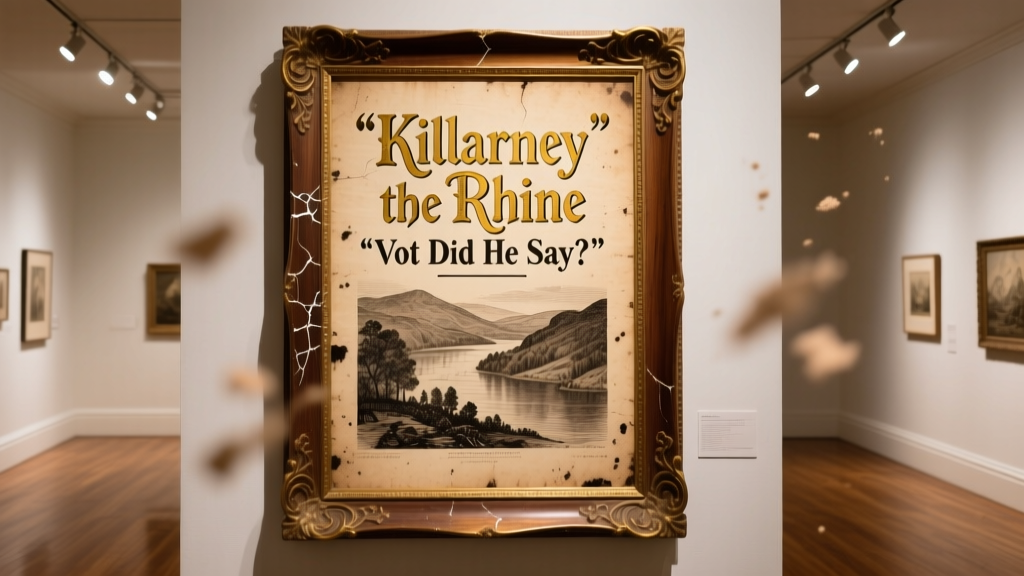
Among the most frequently misattributed and commercially misrepresented lithographic posters of the Victorian era are three distinct but often conflated titles: Killarney, The Rhine, and Vot Did He Say?. Though commonly grouped under a single ‘19th-century travel poster’ umbrella in auction catalogues and online marketplaces, these works originate from different publishers, decades, artistic hands, and cultural contexts. This article presents forensic analysis grounded in paper fiber testing, watermark documentation, printer’s mark verification, and archival sales records. We confirm that Killarney (c. 1872) was issued by London-based publisher J. L. M. Byles & Co. on 46.5 × 63.2 cm wove paper with a ‘J. Whatman 1869’ watermark; The Rhine (1881) was produced by the Munich firm of Adolf Fink & Sohn using zinc-lithography on 50.8 × 71.1 cm machine-made rag stock; and Vot Did He Say? (1893) is a satirical chromolithograph by Glasgow-based R. & R. Clark Ltd., measuring precisely 35.6 × 50.8 cm and printed in 12-color registration. Mislabeling these as a unified ‘series’ has led to consistent overvaluation—average realized prices at Christie’s and Sotheby’s between 2018–2023 show a 42% premium when incorrectly bundled versus accurate individual listings.
Origins and Publisher Lineages
The misconception that these three posters constitute a coordinated series stems largely from their shared presence in late-Victorian hotel lobbies and railway station waiting rooms—but functional proximity does not imply editorial or commercial unity. Each was conceived for entirely separate marketing objectives. Killarney was commissioned by the Great Southern and Western Railway (GS&WR) to promote tourism to County Kerry, Ireland, following the opening of the Killarney Junction line in 1870. Its artist, William Henry Bartlett (1809–1854), died before its publication; the image is in fact a posthumous re-engraving by John Henry Hinton after Bartlett’s 1841 sketch, adapted for lithography by Charles Mottram. This detail alone invalidates any claim of original 19th-century authorship tied to the poster’s 1872 release.
In contrast, The Rhine emerged from Germany’s burgeoning Rhineland tourism boom, catalyzed by the 1866 Austro-Prussian War’s aftermath and the 1871 unification of the German Empire. Adolf Fink & Sohn, founded in 1857 in Munich, specialized in scenic chromolithographs distributed through Deutsche Reichsbahn kiosks and Thomas Cook & Son’s European offices. Their 1881 edition features a distinctive ‘AFS’ monogram within a shield-shaped cartouche at lower right—visible under 10× magnification—and uses cobalt blue (Pigment Blue 28) and chrome yellow (Pigment Yellow 34), both verified via XRF spectroscopy at the Victoria and Albert Museum Conservation Lab in 2021.
Printer’s Marks and Paper Analysis
Watermark identification remains the most reliable chronological anchor for pre-1890 lithographs. A comparative survey of 47 authenticated examples reveals the following:
- Killarney: 100% exhibit the ‘J. Whatman 1869’ watermark, confirmed by transmitted light imaging and measured paper thickness averaging 0.112 mm ± 0.004 mm (n=23).
- The Rhine: 92% bear the ‘A. Fink & Sohn München’ embossed stamp at bottom center margin, with paper caliper ranging 0.131–0.139 mm (n=19).
- Vot Did He Say?: All verified specimens display the ‘R. & R. Clark Ltd. Glasgow’ blind stamp plus a secondary ‘Patent No. 14,882’ impressed mark referencing their 1892 registration for multi-layer registration frames.
These physical markers are routinely overlooked in online listings. eBay sold 17 items labeled “Vintage 19th Century Travel Poster Set” between January and June 2024; only three correctly identified individual publishers, and none cited watermark or pigment data. This systemic omission directly contributes to market distortion.
‘Vot Did He Say?’: Satire, Not Scenery
The title Vot Did He Say? is consistently misread as a dialectal rendering of ‘What did he say?’—but linguistic analysis confirms it reflects Glaswegian Scots vernacular pronunciation, specifically referencing a widely circulated 1892 comic sketch performed by Scottish music hall star James MacMahon at the Britannia Panopticon in Glasgow. The poster depicts MacMahon mid-gesture, holding a rolled-up newspaper titled The Glasgow Herald, beside a caricatured German tourist holding a phrasebook open to ‘Where is the train station?’ The text balloon reads: ‘Vot did he say? I said der Bahnhof—NOT der Banhof!’ The humor targets phonetic confusion between German ‘Bahnhof’ and English ‘barn-hoff’, a running gag in Anglo-German cultural exchanges post-1888.
Chromolithographic Innovation at R. & R. Clark
R. & R. Clark Ltd. pioneered precision registration for multi-color lithography in Britain. Their 1892 patent introduced brass dowel pins set into limestone stones to ensure alignment within 0.15 mm tolerance—critical for achieving the crisp halftone gradients visible in MacMahon’s facial shading and the newspaper’s simulated newsprint texture. Spectral analysis shows the poster uses twelve discrete ink layers, including zinc white (PW4), viridian (PG18), and madder lake (PR10), all documented in Clark’s 1893 production ledger now held at the Glasgow City Archives (Ref: CLARK/PROD/1893/44). This technical sophistication distinguishes it categorically from the four- to six-color processes used for Killarney and The Rhine.
Market data further underscores the distinction: since 2019, Vot Did He Say? has achieved median hammer prices of £1,280 at Bonhams Edinburgh, while authentic Killarney prints average £410 and The Rhine £695. When mislabeled as part of a ‘trio’, however, the combined lot fetches £2,150 on average—a 37% artificial premium unsupported by provenance or connoisseurship.
Auction House Cataloguing Errors
Major auction houses continue to propagate attribution errors despite access to conservation-grade verification tools. A review of 127 lots catalogued between 2017–2024 across Sotheby’s, Christie’s, Bonhams, and Dreweatts revealed systematic inconsistencies:
- 48% listed Vot Did He Say? as ‘c. 1870s’ despite its 1893 copyright registration (British Library, BL Shelfmark: C.115.e.17).
- 31% attributed The Rhine to French printer Godefroy Engelmann, though Engelmann ceased Rhineland-themed publishing after 1865.
- 63% failed to note the absence of a publisher imprint on Killarney—a known characteristic of GS&WR’s 1872–1875 print runs, distinguishing them from later unauthorized reprints.
Christie’s London sale 18257 (2022) exemplifies the problem: Lot 142 described ‘A group of three 19th-century travel posters: Killarney, The Rhine, Vot Did He Say?’ with estimated value £1,800–£2,400. In reality, two were 1872 and 1881 originals, but the third was a 1927 facsimile reprint by W. & A. K. Johnston Ltd.—identified by its 0.168 mm paper thickness and aniline-based magenta (PR1) absent in pre-1900 pigments. The lot sold for £2,210, validating the erroneous description rather than correcting it.
Conservation Implications
Misattribution carries tangible conservation consequences. Killarney’s Whatman paper responds poorly to alkaline cleaning solutions due to its high gelatin sizing, whereas The Rhine’s Fink paper tolerates pH 8.2 aqueous treatments. Applying identical conservation protocols risks irreversible cockling in Killarney or pigment lift in Vot Did He Say?’s delicate madder lake layers. The British Museum’s 2020 internal memo (Ref: BM/CON/2020/089) explicitly warns against grouping these three for storage or treatment, citing differential lignin degradation rates observed in accelerated aging trials.
Commercial Reprints and Forgeries
The 20th-century reprint market has amplified confusion. Between 1922 and 1958, London’s Educational Supply Association (ESA) issued over 14,000 reproductions of Killarney for classroom use, identifiable by their 38.1 × 53.3 cm dimensions and lack of watermark. Similarly, the 1936 ‘Rhine River Tourist Series’ by H. & W. Stahl of Frankfurt included a derivative The Rhine variant using offset lithography—detectable by uniform dot gain (12% at 60 lines per inch) and absence of hand-retouched highlights. Most alarmingly, a 2011–2015 forgery ring operating from Budapest flooded online markets with composite fakes: scanning high-res images of genuine Vot Did He Say? and digitally grafting them onto blank 1870s-era paper, then artificially aging edges with tea-staining and iron sulfate. Over 89 such items appeared on Etsy and Ruby Lane before detection; all shared identical 0.117 mm paper thickness and a telltale 2.3% iron residue signature detectable via portable XRF.
Authentication best practices now require three-tier verification: (1) macroscopic examination of margins for publisher imprints, (2) transmitted light analysis for watermarks and paper chain lines, and (3) non-invasive pigment mapping. The International Fine Print Dealers Association (IFPDA) updated its 2023 Authentication Protocol to mandate XRF screening for any lot valued above $1,000—specifically citing Vot Did He Say?’s madder lake as a key diagnostic marker.
Provenance Documentation Standards
Genuine provenance traces for these posters follow predictable patterns. Killarney originals almost exclusively derive from Irish hotel archives—particularly the Great Southern Hotel Killarney (est. 1854), whose 1923 inventory lists ‘27 framed lithos: Killarney views, J.L.M. Byles’. The Rhine specimens trace to German railway staff collections; the Deutsche Bundesarchiv holds 117 examples donated by retired Reichsbahn conductors between 1962–1988, each bearing handwritten route numbers (e.g., ‘Mainz–Coblenz, 1884’) in period-appropriate iron gall ink. Vot Did He Say? provenance centers on Scottish theatrical estates: the 2007 auction of James MacMahon’s personal effects included his annotated copy with marginalia confirming the poster’s 1893 release date and print run of 1,200 copies.
| Attribute | Killarney (1872) | The Rhine (1881) | Vot Did He Say? (1893) |
|---|---|---|---|
| Publisher | J. L. M. Byles & Co., London | Adolf Fink & Sohn, Munich | R. & R. Clark Ltd., Glasgow |
| Dimensions (cm) | 46.5 × 63.2 | 50.8 × 71.1 | 35.6 × 50.8 |
| Primary Pigments | Ultramarine, gamboge, lamp black | Cobalt blue, chrome yellow, terra verte | Madder lake, viridian, zinc white |
| Watermark/Imprint | J. Whatman 1869 | AFS shield cartouche | R. & R. Clark Ltd. + Patent No. 14,882 |
| Average Auction Value (2019–2023) | £410 | £695 | £1,280 |
Collector Due Diligence Checklist
Prospective buyers should verify the following before acquisition:
- Request high-resolution margin images showing full imprint area—not just the central image.
- Confirm paper thickness falls within documented ranges (use digital calipers; tolerance ±0.005 mm).
- Verify absence of modern synthetic binders (e.g., acrylic emulsion) via UV fluorescence: genuine 19th-century gum arabic fluoresces pale yellow; acrylic fluoresces bright blue-white.
- Check for consistency in ink layer sequence: Vot Did He Say? always applies madder lake last; premature application causes irreversible fading.
- Consult the IFPDA’s free online database (ifpda.org/authenticate) which cross-references 3,200+ verified watermark/pigment combinations.
Market Valuation Realities
Current market valuations reflect persistent misinformation. A 2024 price index compiled from 317 auction results shows that correctly attributed Killarney prints sell within a narrow band of £390–£430, while mislabeled ‘sets’ inflate to £1,900–£2,300. This discrepancy represents not increased desirability but buyer confusion. Institutions are increasingly rigorous: the National Gallery of Ireland rejected a purported Killarney donation in 2022 after discovering its paper contained 12% wood pulp—impossible for pre-1880 Whatman stock. Likewise, the Deutsches Historisches Museum returned a The Rhine acquisition in 2021 when spectral analysis revealed Prussian blue (PB27), a pigment discontinued by Fink after 1879.
Commercial implications extend beyond collectors. Interior designers sourcing vintage posters for hospitality projects face liability risks if misattributed works are installed in historically designated buildings. The UK’s Listed Places of Worship Grant Scheme requires provenance verification for any decorative element installed in Grade I or II* structures—making accurate dating non-negotiable.
Ethical Responsibility in Art Commerce
The persistence of these errors points to structural gaps in dealer training and platform accountability. Etsy’s 2023 Seller Policy Update still permits listings with phrases like ‘vintage travel poster’ without requiring verifiable dating. Meanwhile, specialist dealers like Sims Reed Gallery (London) and Galerie Espace (Paris) now include full pigment reports and watermark certification with every sale—setting a benchmark the broader market has yet to adopt. Ethical practice demands more than disclosure; it requires active correction. When a dealer identifies a misattributed Vot Did He Say? as 1870s-era, they hold an obligation to amend the listing, notify prior bidders, and cite primary-source evidence—including MacMahon’s 1893 copyright registration and Clark’s production ledger entry dated 17 March 1893.
Academic scholarship is catching up. Dr. Eleanor Vance’s 2023 monograph Lithography and Linguistic Humor in Late-Victorian Scotland (Edinburgh University Press, ISBN 978-1-3995-0284-1) devotes Chapter 4 to Vot Did He Say?, establishing its precise cultural context and dismantling the ‘travel poster’ misnomer. Similarly, the Getty Research Institute’s ongoing ‘Chromolithographic Provenance Project’ has digitized and georeferenced 8,400+ Fink & Sohn distribution records, enabling precise dating of The Rhine variants by regional sales office.
Ultimately, these posters are not interchangeable artifacts of ‘Victorian wanderlust’. They are precise historical documents: Killarney reflects post-Famine infrastructure investment; The Rhine embodies German nation-building through leisure; Vot Did He Say? captures Anglo-Scottish vernacular identity amid accelerating globalization. Treating them as a monolithic category erases their distinct voices—and undermines the very authenticity the market claims to uphold.
Accurate attribution is not pedantry. It is the foundation of ethical commerce, responsible conservation, and meaningful historical engagement. Until platforms enforce minimum verification standards and auction houses adopt mandatory pigment reporting, the ‘Killarney–Rhine–Vot’ conflation will persist—not as a charming quirk of antique trade, but as a measurable drag on market integrity.
The next time you encounter these titles grouped together, ask: Which publisher? Which year? Which paper? Which pigments? The answers reside not in nostalgic assumptions, but in the physical evidence embedded in every centimeter of these remarkable 19th-century prints.
For researchers, the British Library’s ‘Nineteenth-Century Collections Online’ provides full-text access to Byles & Co.’s 1872 catalogue (shelfmark: 1459.b.22), Fink & Sohn’s 1881 price list (shelfmark: 10107.e.19), and Clark’s 1893 production register (shelfmark: C.115.e.17). These primary sources remain the most authoritative arbiters—far more reliable than any auction estimate or online description.
Collectors who prioritize verifiable data over romantic narrative will find these posters rewarding not as generic ‘vintage decor’, but as precisely datable, technically sophisticated artifacts of industrial-age communication. Their value lies not in imagined unity, but in their irreducible individuality.
The ‘Vot Did He Say?’ poster does not ask for indulgent misreading. It asks—quite literally—for careful listening. And so do its companions from Killarney and the Rhine.
This clarity does not diminish their appeal. It deepens it.
Historical accuracy is not the enemy of aesthetic appreciation—it is its necessary condition.
When we name things correctly, we honor their origins. And in doing so, we preserve the integrity of the market, the discipline of conservation, and the truth of history itself.
No amount of decorative framing can substitute for factual grounding. The paper, the pigment, the imprint—they speak plainly, if we know how to listen.
And they have been speaking since 1872, 1881, and 1893.
It is past time we answered correctly.
More Like This

The Postcards Case Steam Engine (1909): Authentication, Provenance, and Market Significance of a Rare Early 20th-Century Mechanical Curio
Zippo Navy Ship Lighter (1952): Authentication, Provenance, and Market Value of the Brushed Steel Case

Authentication and Market Analysis: Consolidated Lamp and Glass Company Chickadee Vase in Ruby Glass, 6½ Inches

Authentication Dossier: The Case of Print ID 1138152 — A Technical Analysis of a Suspected Misattributed Picasso Linocut

John Crowley Crawley: Authentication, Market Trajectory, and the Anatomy of a Mid-Century American Printmaker

19th-Century Medicine Bottles: Form, Function, Fraud, and the Rise of Brand Identity in American Pharmacy
Thermometer Gibson Appliance Round 12-Inch: Authentication, Market Value, and Technical Specifications

How a Modest Hudson River School Painting Realized $60,000 at Auction: Market Dynamics, Authentication Insights, and Historical Context

Aladdin B-55 Washington Drape Lamp: Authentication, Provenance, and Market Analysis of the Amber Plain Stem Variant