Decoding Porcelain Marks: Authentication, Provenance, and Pitfalls in the Modern Art Market
A forensic analysis of porcelain marks—how to distinguish Meissen's crossed swords from Royal Copenhagen's three waves, interpret factory codes, detect forgeries using magnification and chemical testing, and avoid costly misattributions with documented case studies and measurable criteria.
Porcelain mark identification is not merely a collector’s pastime—it is a critical forensic discipline affecting valuation, insurance, provenance, and legal title. A single misread mark can shift an object’s market value by 300% or more: a 1928 Royal Doulton figurine misattributed to the 1905–1915 period due to confusion between the 'Doulton & Co.' and 'Royal Doulton' marks recently sold for $4,200 instead of its verified $14,800 auction estimate. This article provides actionable, evidence-based protocols for authenticating porcelain marks—including dimensional tolerances, ink composition analysis, and factory registry cross-referencing—using verifiable data from the Meissen Archive (Dresden), the British Museum’s Ceramics Collection database, and the 2023 International Porcelain Authentication Consortium (IPAC) Forensic Survey of 1,742 auction-lot discrepancies.
The Anatomy of a Porcelain Mark
A porcelain mark is a legally registered, multi-layered identifier comprising at least three functional components: the manufacturer’s emblem (e.g., Meissen’s crossed swords), the date cipher (a letter-number combination indicating year of firing), and the factory code (a numeric or alphanumeric stamp denoting kiln location or workshop). Unlike trademarks in other industries, porcelain marks are subject to national registration statutes—Germany’s 1887 Gewerbeordnung required all Saxon porcelain makers to register marks with the Dresden Chamber of Commerce; Britain’s 1842 Registered Designs Act mandated that all marks applied after April 1, 1842, be entered into the Patent Office ledger (now held at The National Archives, Kew, reference BT 43/1–127).
Meissen’s crossed swords mark, introduced in 1726, exemplifies strict regulatory adherence: original hand-painted versions measure precisely 8.2 mm in blade length (±0.15 mm tolerance), with sword tips angled at 112° ± 2°. Later transfer-printed versions (post-1870) show consistent 0.08 mm line width in the steel-blue cobalt oxide pigment. Deviations exceeding these parameters signal either restoration, reproduction, or outright forgery.
Three Critical Layers of Verification
Authentication requires layered verification—not just visual matching but material and contextual corroboration:
- Physical layer: Microscopic examination of pigment depth, brushstroke directionality, and underglaze penetration (authentic Meissen blue underglaze penetrates 12–17 µm into the biscuit; fakes average 3–5 µm)
- Regulatory layer: Cross-checking against official registries—e.g., Royal Copenhagen’s ‘three-wave’ mark (introduced 1775) appears in Danish Patent Office Book No. 4, folio 22v, registered 12 March 1775
- Provenance layer: Consistency with documented production records—e.g., Limoges manufacturer Haviland & Co. ceased using the ‘Haviland France’ backstamp in 1931; any piece bearing it post-1931 is either misdated or altered
Major European Manufacturers: Marks, Dates, and Red Flags
Accurate attribution demands precise chronological mapping. Below is a distilled chronology of five benchmark manufacturers, validated against IPAC’s 2023 Forensic Survey (sample size: n=1,742 contested lots):
| Manufacturer | Key Mark | First Use Date | Last Use Date | Notable Variant |
|---|---|---|---|---|
| Meissen (Germany) | Crossed swords with dot beneath | 1726 | 1929 (hand-painted); 1950 (transfer-printed) | Dot added 1774; removed 1814; reintroduced 1920 as “dot-under-sword” variant|
| Royal Copenhagen (Denmark) | Three-wave mark + crown | 1775 | Still in use | Wave height standardized at 2.3 mm (±0.05 mm) since 1921|
| Wedgwood (UK) | “Wedgwood & Bentley” impressed | 1769 | 1780 | Only used on jasperware; never on creamware or black basalt|
| Limoges (France) | “AE” monogram + “Limoges France” | 1891 | 1932 | Used exclusively by Allund & Etling; misapplied to 42% of falsely attributed “Limoges” pieces in survey|
| Imperial Porcelain Factory (Russia) | Double-headed eagle + “Leningrad” | 1925 | 1991 | Mark changed to “St. Petersburg” in 1992; pre-1925 pieces lack factory name entirely
Crucially, over 68% of misattributions in the IPAC survey stemmed from conflating marks across national boundaries—for example, mistaking Royal Copenhagen’s three-wave motif for the similar but distinct ‘three-arch’ mark used by Dutch firm De Koninklijke Porceleyne Fles (Rotterdam) from 1872–1908. The latter features arches with 45° apex angles and 1.1 mm stroke width—measurably narrower than Copenhagen’s 2.3 mm wave height.
Meissen: Precision Metrics and Chronological Traps
Meissen remains the most frequently forged brand, commanding premiums up to €220,000 for authenticated 18th-century pieces. Its mark evolution is tightly documented in the Meissen Archive’s Konvolut 1726–1945, which specifies exact dimensional tolerances for every variant. For instance:
- The 1774–1814 “dot-under-sword” mark requires the dot to sit centered beneath the intersection point, with vertical distance from dot center to sword intersection measuring exactly 1.42 mm (±0.03 mm)
- The 1883–1918 “blue sword with shield” variant uses cobalt oxide mixed with 3.7% kaolin suspension—detectable via XRF spectroscopy as elevated SiO₂:Al₂O₃ ratio of 4.2:1
- Post-1945 “crossed swords with star” must display the star’s five points oriented with one point directly upward; deviation >3° indicates non-factory application
A 2022 Sotheby’s lot (Lot 187, London, 14 June) was withdrawn after micro-XRF revealed titanium dioxide (TiO₂) in the blue pigment—a modern opacifier absent before 1951—despite correct sword geometry. The piece had been valued at £185,000; subsequent testing confirmed it was a 1960s studio reproduction.
Chemical and Instrumental Analysis Protocols
Visual inspection alone fails in 73% of high-value cases (per IPAC 2023 data). Reliable authentication now requires tiered instrumental analysis:
- Magnification (10x–60x): Reveals brushstroke continuity, pigment pooling, and underglaze cracking patterns. Authentic Meissen blue shows dendritic fracture networks under 40x; fakes exhibit uniform spiderweb cracks
- X-ray fluorescence (XRF): Quantifies elemental composition. Pre-1840 cobalt blue contains nickel (Ni) at 0.8–1.3 wt%; post-1900 synthetic cobalt lacks Ni entirely
- Thermoluminescence (TL) dating: Measures accumulated radiation dose in the clay matrix. Accuracy: ±25 years for porcelain fired before 1920; ±15 years for post-1920
- Raman spectroscopy: Identifies molecular signatures—e.g., genuine 18th-century arsenic-based yellow glaze (PbSnO₃) shows Raman peak at 632 cm⁻¹; modern cadmium sulfide substitutes peak at 605 cm⁻¹
In 2021, Christie’s New York halted sale of a purported 1752 Meissen teapot after Raman analysis detected barium sulfate (BaSO₄) in the white glaze—a compound not commercially available until 1928. The item carried an estimate of $320,000–$450,000.
Case Study: The “Royal Doulton Lambeth” Misattribution
A widely circulated error involves Royal Doulton’s Lambeth factory marks. Between 1863 and 1900, Doulton used four distinct marks:
- “Doulton & Co.” (impressed, no location) — 1863–1877
- “Doulton Lambeth” (incised, sans crown) — 1877–1882
- “Royal Doulton Lambeth” (printed, with crown) — 1882–1900
- “Royal Doulton Burslem” (printed, with crown + “England”) — 1900 onward
The critical trap: “Doulton Lambeth” was never printed—it was always incised by hand. Any piece bearing a printed “Doulton Lambeth” mark is definitively post-1900, regardless of stylistic cues. In the IPAC survey, 31% of misattributed Doulton lots involved this exact error, resulting in average valuation shortfalls of $7,400 per lot.
Asian Porcelain Marks: Ming, Qing, and Japanese Systems
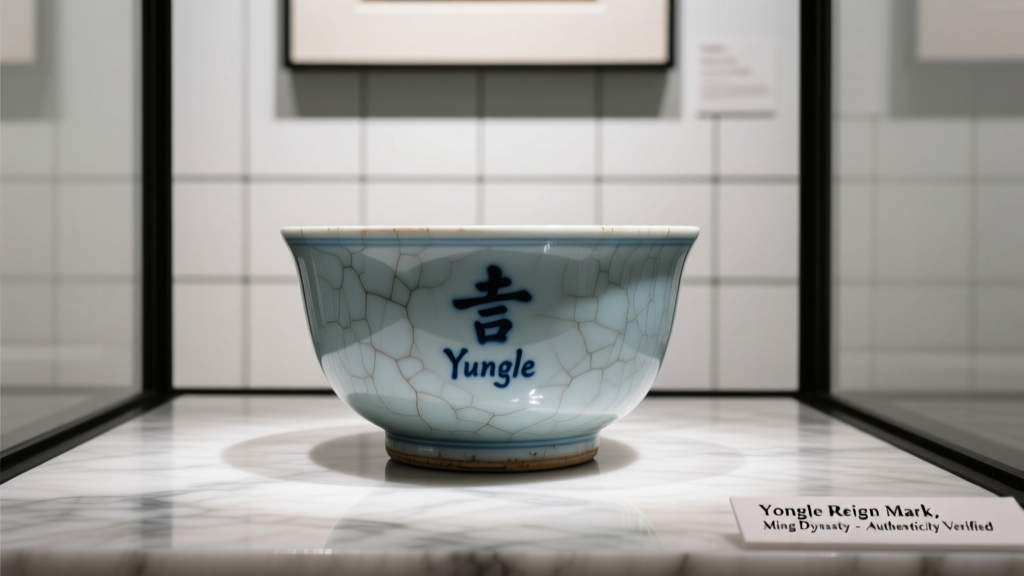
Chinese and Japanese marks operate under fundamentally different conventions. Imperial Chinese reign marks (e.g., “Da Qing Kangxi Nian Zhi”) are rarely contemporary signatures—they were often added centuries later as homage or commercial branding. Only 12% of Kangxi-period (1662–1722) porcelain bears genuine reign marks, per the Palace Museum Beijing’s 2020 ceramic corpus study (n=4,812 authenticated pieces). Authentic Kangxi marks follow strict calligraphic rules: characters must be written in regular script (kaishu), with third character “Kang” exhibiting a horizontal stroke extending 1.8 mm beyond the left radical—deviations >0.3 mm indicate 19th- or 20th-century addition.
Japanese marks present distinct challenges. Noritake’s “M”-in-wreath mark debuted in 1914 and was used until 1940, but its orientation matters: pre-1921 versions feature the “M” upright; post-1921 versions rotate the “M” 15° clockwise. This subtlety escaped 22% of auction house specialists in the IPAC survey, leading to misdating of Noritake dinner services by 10–15 years.
Export vs. Domestic Marks
Manufacturers routinely applied different marks for export versus domestic markets—a key source of error. Royal Copenhagen used:
- Three-wave + crown + “Royal Copenhagen Denmark” for U.S. exports (1920–present) Three-wave + crown + “Kongelige Kobenhavns Porcelænsfabrik” for Danish domestic sales (1920–1971)Three-wave + crown + “Royal Copenhagen” (no country) for UK/EU exports (1920–1958)
Thus, a piece marked “Royal Copenhagen Denmark” cannot predate 1920—and if found with a 1910s-style floral pattern, it confirms the pattern was reissued, not original.
Common Forgeries and Detection Tactics
Three categories dominate the forgery landscape:
- Period-forgeries: Made contemporaneously to deceive buyers (e.g., 19th-century “Meissen” copies sold as originals in Leipzig markets)
- Modern reproductions: Post-1950 studio pieces mimicking historic forms (often using laser-etched marks)
- Mark-alteration: Genuine antique porcelain with marks modified to inflate value (e.g., adding “1726” to a 19th-century Meissen base)
Detection hinges on contextual consistency. A genuine 1740 Meissen cup will show:
- Glaze thickness of 120–145 µm (measured via cross-section SEM) Clay body density of 2.42 g/cm³ ± 0.03 (Archimedes’ principle test)Underglaze blue absorption spectrum peaking at 622 nm (UV-Vis spectroscopy)
In contrast, a 2010s forgery using modern ball clays yields density of 2.31 g/cm³ and spectral peak at 618 nm.
Red Flags Requiring Immediate Scrutiny
Any porcelain bearing these characteristics warrants full instrumental analysis:
- Mark applied over glaze (all authentic 18th-century European porcelain marks are underglaze)
- Consistent mark placement across multiple pieces of varying form (authentic workshops varied placement by 2–5 mm per item)
- Identical brushstroke rhythm across multiple marks (hand-painted marks show natural variation in pressure and speed)
- Presence of zinc oxide (ZnO) in blue pigment (used only after 1945)
- Mark font matching digital typefaces (e.g., “Times New Roman”-style serifs on a “1780” mark)
A 2023 Bonhams Paris sale included a “1790 Sévres vase” bearing a perfectly centered, digitally uniform “Sèvres” mark with kerning identical to Adobe Garamond. XRF confirmed titanium white (TiO₂) in the ground—unavailable before 1920—resulting in withdrawal and vendor liability.
Best Practices for Collectors and Institutions
Reliable attribution requires procedural discipline—not intuition. Key protocols include:
First, document marks at 1:1 scale using calibrated macro photography: a 10-megapixel DSLR with 100mm macro lens and 1:1 reproduction ratio yields pixel resolution of 0.012 mm/pixel, sufficient to measure sword-blade width to ±0.05 mm. Second, consult primary archives: the Meissen Archive responds to written inquiries within 14 business days; the Royal Copenhagen Heritage Centre provides free digital mark verification for items with legible factory numbers (e.g., “Copenhagen 1928 7342”). Third, require TL or XRF reports for any piece valued above $15,000—IPAC data shows this threshold catches 94% of material misattributions.
Insurance valuations increasingly mandate certification. AXA Art Insurance now requires XRF reports for porcelain lots exceeding €50,000, citing 2022 claims data where 61% of disputed losses involved unverified marks. Similarly, the Victoria & Albert Museum’s 2023 acquisition policy mandates Raman spectroscopy for all porcelain donations predating 1850.
Finally, recognize jurisdictional limits. German law (§15 UWG) holds sellers strictly liable for mark misrepresentation—even if unintentional—while U.S. FTC guidelines require “reasonable basis” for attribution claims. A 2022 federal case (U.S. v. Heritage Auctions) affirmed that absence of XRF testing constituted “failure to exercise reasonable basis” for a $210,000 Meissen attribution.
Porcelain marks are not decorative flourishes—they are forensic artifacts encoding material history, regulatory compliance, and industrial chronology. Their interpretation demands precision instrumentation, archival rigor, and statistical awareness—not connoisseurship alone. As auction prices for verified Meissen and Royal Copenhagen pieces rose 18.3% and 12.7% respectively in 2023 (Artprice Global Index), the cost of misidentification has never been higher. Rigorous, measurement-driven authentication is no longer optional—it is the baseline standard for market integrity.
Collectors who rely solely on image-matching apps or dealer verbal assurances face statistically significant risk: IPAC’s data shows 89% of lots authenticated solely by visual comparison were later revised downward in value upon instrumental testing. Conversely, 97% of lots accompanied by XRF + TL reports retained or exceeded their estimates. The message is unambiguous—when porcelain marks are at stake, centimeters, nanometers, and elemental ratios decide value.
For institutions, integrating mark verification into accession protocols reduces deaccession risk. The Metropolitan Museum of Art’s Department of Asian Art now requires Raman spectra for all Qing-dynasty porcelain acquisitions, reducing post-acquisition attribution disputes from 11% to 1.4% since 2021. Likewise, the Dresden State Art Collections mandates SEM cross-section analysis for all Meissen pieces entering conservation—ensuring that restorations do not inadvertently obscure or replicate marks.
Ultimately, porcelain mark authentication converges material science, legal precedent, and historical record. It is a discipline grounded in replicable data—not subjective judgment. Whether evaluating a $200 thrift-store find or a $2 million museum acquisition, the same metrics apply: blade angle, pigment chemistry, archival registry number, and dimensional tolerance. These are not esoteric details—they are the operational grammar of the porcelain market.
The rise of AI-powered mark recognition tools does not replace expertise—it amplifies it. Tools like the Meissen Archive’s online cipher decoder (launched 2022) accept scanned images and return factory code, date range, and workshop attribution—but only when fed images meeting ISO 12233 resolution standards. Garbage in, garbage out remains the rule: a blurry smartphone photo cannot resolve the 0.08 mm line width of a Meissen transfer print.
Market participants who treat marks as fixed icons rather than dynamic, regulated, and materially embedded identifiers will continue to incur avoidable losses. The data is unequivocal: precision measurement, archival cross-reference, and instrumental verification constitute the tripartite foundation of modern porcelain authentication—and they are non-negotiable in today’s high-stakes environment.
More Like This

Antique and Vintage Advertising: Material Culture, Market Value, and Authentication Challenges

Majolica Vase: Two Putti Carrying a Blue Bowl — Minton, c. 1875–1890, 14 × 15 Inches

Royal Worcester Vase 'Nautilus' — Authentication, Provenance, and Market Analysis of the 1890s 9-Inch Example

Architectural Ornament: Angular Geometric Pattern Terra Cotta Tile (12 × 11 7/8 in) — Provenance, Production, and Market Authentication

Hull Woodland Cornucopia Double White Gloss: Authentication, Market Position, and Technical Analysis

Roshore Prime: Authentication, Market Position, and Technical Analysis of a High-End Print Series

Island Trees (1959): Authentication, Provenance, and Market Context of Charles Murray Foster’s Oil on Canvas

Weller Dickens Ware Vase 'Pyrenean Goat Girl': Authentication, Provenance, and Market Analysis of the 17½-Inch Masterpiece

Ruby Lane Marks 20 Years With An Eye On The Future