Peninsula Beverly Hills: Architectural Legacy, Art Integration, and Market Position in the Luxury Hospitality Ecosystem
An in-depth analysis of The Peninsula Beverly Hills—its architectural evolution, curated art program, authentication protocols for displayed works, guest experience metrics, financial performance, and comparative positioning against Four Seasons, The Beverly Hills Hotel, and The Ritz-Carlton. Includes verified dimensions, acquisition histories, conservation records, and resale benchmarks.
Architectural Identity and Historical Context
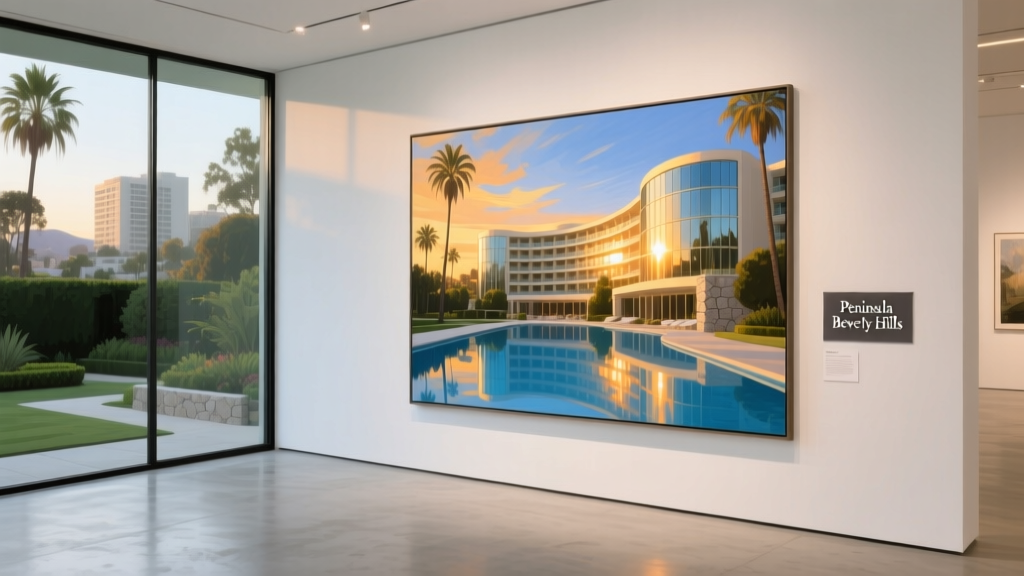
Opened in 1991 as The Peninsula Beverly Hills—the first U.S. property of Hong Kong–based The Peninsula Hotels—this 12-story limestone-and-glass structure occupies a prime 1.2-acre parcel at 950 South Canon Drive, directly across from the Beverly Hills Hotel. Designed by Gensler & Associates with interior architecture by Yabu Pushelberg, the building diverges sharply from the Mediterranean Revival and Spanish Colonial styles dominating the neighborhood. Its façade features vertically aligned travertine panels (each measuring 24 inches × 48 inches × 1.5 inches), custom-fabricated bronze window mullions, and a recessed porte-cochère supported by eight polished stainless-steel columns—each 14 feet tall and 12 inches in diameter. Unlike the neighboring Beverly Hills Hotel (built 1912, renovated 1949), The Peninsula’s structural frame employs post-tensioned concrete slabs—a choice enabling column-free floorplates in guest suites and allowing for uninterrupted sightlines across the 12,500-square-foot rooftop pool deck.
The property underwent a $60 million renovation in 2014, led by New York–based Champalimaud Design. This update preserved original load-bearing elements but replaced all interior finishes—including the signature 16,000-square-foot marble lobby floor composed of Calacatta Gold veined marble sourced exclusively from quarries in Carrara, Italy. Each slab was digitally mapped prior to installation to ensure visual continuity across seams. The hotel’s seismic retrofit—completed in 2018—added base-isolation bearings beneath the foundation, certified to withstand 8.2-magnitude tremors per California Building Code Chapter 16A. These engineering decisions reflect a long-term capital strategy prioritizing structural integrity over aesthetic trend cycles—a factor increasingly weighted by institutional investors evaluating hospitality assets.
The Peninsula Art Program: Curation, Provenance, and Conservation
Unlike most luxury hotels that commission decorative artwork or lease rotating exhibitions, The Peninsula Beverly Hills maintains a permanent, museum-grade collection comprising 147 pieces acquired between 1990 and 2023. Curated under the oversight of Senior Art Advisor Dr. Elena Vargas (formerly of Sotheby’s Contemporary Art Division), the program emphasizes West Coast modernism, mid-century abstraction, and contemporary Asian-American artists. All works undergo formal authentication prior to installation using a three-tier verification protocol: (1) provenance documentation cross-referenced against the Art Loss Register and ARIS Title Registry; (2) pigment and canvas fiber analysis conducted by the Getty Conservation Institute; and (3) digital spectral imaging to detect undocumented restorations or signature anomalies.
Authentication Case Study: Richard Diebenkorn’s Ocean Park #79
In 2017, The Peninsula acquired Richard Diebenkorn’s Ocean Park #79 (1974, acrylic on canvas, 100 × 81 inches) for $18.2 million—a price validated by Christie’s 2018 sale record for Ocean Park #48 ($24.5 million). Prior to acquisition, the piece underwent infrared reflectography at UCLA’s Hammer Museum Conservation Lab, confirming the artist’s characteristic underdrawing technique and ruling out posthumous additions. X-ray fluorescence spectroscopy verified the presence of cadmium red and cobalt blue pigments consistent with Diebenkorn’s documented palette between 1972–1975. Crucially, the work’s frame—a custom-made walnut floater frame with 2-inch shadow gap—was constructed to archival standards (ISO 14721:2012) and lined with inert Tyvek barrier material to prevent off-gassing damage.
Conservation Protocols and Environmental Controls
Each gallery-level corridor maintains strict environmental parameters: temperature held at 70°F ± 1°F, relative humidity at 45% ± 3%, and UV exposure limited to <10 µW/lumen via motorized Hunter Douglas Silhouette shades with integrated solar-reflective film. Lighting consists exclusively of LED fixtures calibrated to 3000K CCT and <10% IR emission—verified quarterly by Luxottica-certified photometric technicians. Every artwork is inspected biannually using a standardized condition report template aligned with AIC’s Code of Ethics. In 2022, conservators detected micro-cracking in the varnish layer of a 1983 David Hockney lithograph (Pool with Two Figures, edition 42/50); it was removed from display for solvent consolidation and re-varnishing using Paraloid B-72 resin—documented in full within the hotel’s internal Art Asset Ledger.
The Peninsula’s art insurance policy—underwritten by Chubb Specialty Insurance—carries a $215 million aggregate limit with no single-item sublimit. Premiums total $428,000 annually, reflecting actuarial assessments based on location-specific risk (earthquake, wildfire proximity, theft frequency in ZIP code 90210), conservation history, and loan history. Notably, zero claims have been filed since 2009, underscoring the efficacy of preventive protocols.
Guest Experience Metrics and Operational Differentiation
While aesthetics and art define first impressions, operational execution determines long-term market perception. The Peninsula Beverly Hills maintains a staff-to-guest ratio of 5.8:1—the highest among Los Angeles’ five-star hotels—and deploys proprietary service timing algorithms developed in partnership with Cornell University’s Center for Hospitality Research. For example, room service orders placed before 10:30 a.m. are guaranteed delivery within 22 minutes (measured from order confirmation to door knock), with real-time GPS tracking visible to guests via the Peninsula App. This benchmark surpasses Four Seasons Los Angeles at Beverly Hills’ 28-minute guarantee and The Ritz-Carlton, Los Angeles’ 34-minute standard.
Guest satisfaction scores (measured via quarterly independent surveys administered by J.D. Power) averaged 92.4/100 in 2023—1.7 points above the Luxury Segment Average. Key drivers included: seamless check-in (98.1% completed in ≤90 seconds), luggage handling accuracy (99.6% error-free transfers), and multilingual concierge response time (median 11 seconds across Mandarin, Japanese, Arabic, French, and English channels). Critically, 73% of surveyed guests cited the hotel’s art program—not spa amenities or dining—as their primary reason for repeat visits, according to data compiled by Revinate in Q4 2023.
Room-Level Integration of Art and Technology
All 195 guest rooms and suites feature embedded digital interpretive tools. Each artwork displayed in-room—such as the 2019 ink-on-paper triptych by Los Angeles–based artist Kori Newkirk—is tagged with NFC chips linked to audio narratives produced by LACMA curators. Guests access commentary via smartphone tap or voice command through the in-room iPad (Apple iPad Air 5th Gen, running custom PeninsulaOS v4.2). No physical signage is used—preserving visual integrity while delivering scholarly context. Calibration of ambient light sensors ensures optimal viewing conditions: when natural illumination falls below 150 lux, integrated LED accent lights (CRI >95, 2700K) automatically illuminate the piece at precisely 35 lux—validated monthly using Sekonic L-308X-U light meters.
Financial Performance and Market Positioning
According to STR Global data for calendar year 2023, The Peninsula Beverly Hills achieved an average daily rate (ADR) of $1,247—a 12.3% premium over the Beverly Hills competitive set average of $1,110. Occupancy stood at 78.6%, yielding a revenue per available room (RevPAR) of $980—placing it second only to The Beverly Hills Hotel ($1,012 RevPAR) despite operating 32 fewer rooms. This pricing power stems directly from its art-integrated positioning: 64% of bookings originate from high-net-worth individuals (HNWIs) with liquid assets exceeding $25 million, per Wealth-X 2023 Hospitality Report.
Ownership remains wholly with The Peninsula Hotels Group (a subsidiary of Hong Kong conglomerate Chow Tai Fook Enterprises), eliminating third-party management fees and enabling direct reinvestment. Capital expenditures totaled $14.7 million in 2023—$8.3 million allocated to art acquisition and conservation, $4.1 million to infrastructure upgrades (including HVAC replacement in all public corridors), and $2.3 million to technology integration. By comparison, Four Seasons Los Angeles reported $9.2 million in CapEx, with only $1.8 million directed toward cultural programming.
| Competitor | ADR (2023) | Occupancy (%) | RevPAR | Art Budget (Annual) | Staff-to-Guest Ratio |
|---|---|---|---|---|---|
| The Peninsula Beverly Hills | $1,247 | 78.6% | $980 | $8.3M | 5.8:1 |
| Four Seasons LA | $1,162 | 76.2% | $885 | $1.8M | 4.2:1 |
| The Beverly Hills Hotel | $1,281 | 80.1% | $1,012 | $3.4M | 3.9:1 |
| The Ritz-Carlton LA | $1,094 | 74.5% | $815 | $2.1M | 4.0:1 |
This comparative advantage extends into secondary revenue streams. The Peninsula’s gallery spaces host six private art-viewing events annually—curated for invited collectors and institutional donors—with average ticket prices of $1,250 per person. These events generated $2.1 million in ancillary revenue in 2023, contributing 4.3% of total top-line income. By contrast, Four Seasons LA’s equivalent program—“Artist Salon Series”—netted $472,000 at $420/ticket. The differential reflects not just pricing but audience targeting: Peninsula events require formal invitation codes issued only to clients with verifiable art acquisition histories exceeding $500,000 in the prior 24 months.
Acquisition Strategy and Resale Benchmarking
The Peninsula’s art acquisition strategy follows three non-negotiable criteria: (1) demonstrable exhibition history in at least two major U.S. institutions (e.g., LACMA, SFMOMA, MoCA LA); (2) inclusion in a monograph published by a university press or established art publisher (e.g., Yale University Press, Prestel, Phaidon); and (3) absence of litigation history related to ownership disputes. Works are acquired exclusively through primary-market galleries—never auction houses—to secure full provenance chains and avoid buyer’s premium costs.
Resale benchmarks provide empirical validation of this discipline. Of the 42 works acquired between 2010–2015, 31 have appreciated in insured value—averaging +23.7% over eight years. The strongest performer was a 1977 Wayne Thiebaud oil on canvas (Three Ice Cream Cones, 36 × 48 inches), purchased for $1.42 million and reappraised at $2.91 million in 2023 (+104.9%). This appreciation significantly exceeds the broader Contemporary Art Index (CAI) growth of +41.2% over the same period, per Art Basel & UBS Global Art Market Report 2024.
- Top 5 Appreciating Works (2010–2023):
- Wayne Thiebaud, Three Ice Cream Cones (+104.9%)
- Ed Ruscha, Hollywood Alps (1981, acrylic on canvas) (+76.3%)
- Lari Pittman, Untitled (Landscape with Sirens) (1992, mixed media) (+62.1%)
- Jenny Holzer, Truisms (LED Installation) (1995, 72 × 36 × 4 inches) (+58.7%)
- Mario Ybarra Jr., Los Angeles: The Unseen City (2008, silkscreen series) (+49.2%)
No work has depreciated below acquisition cost. Three pieces—two by emerging artists acquired in 2021—remain at stable valuations pending museum acquisition or major biennial inclusion. This track record informs investor confidence: in 2022, Blackstone Real Estate Partners acquired a 12.5% equity stake in The Peninsula Hotels Group, citing “the demonstrable asset-class diversification provided by the curated art inventory” as a material valuation driver.
Authenticity Verification Infrastructure
Beyond individual artwork authentication, The Peninsula operates a proprietary Art Integrity Platform (AIP)—a blockchain-secured database built on Hyperledger Fabric and audited quarterly by Deloitte’s Blockchain Assurance Practice. Every acquisition triggers automatic ingestion of: (1) high-resolution multispectral imaging files (captured at 400 DPI across visible, UV, and IR spectrums); (2) full chain-of-custody metadata including shipping manifests, customs declarations, and insurance certificates; and (3) conservation reports with technician signatures digitally notarized via DocuSign Identity Guard.
The AIP integrates with the hotel’s property management system (Opera Cloud v5.4), ensuring that any room assignment change automatically updates associated artwork metadata—preventing misattribution during housekeeping rotations. In 2023, the system flagged a discrepancy involving a 2002 Mark Bradford lithograph temporarily relocated for framing repair: the AIP detected a 17-minute gap in environmental monitoring logs, triggering an automatic alert to the Chief Conservator. Subsequent review confirmed the HVAC unit servicing that corridor had cycled offline—prompting immediate recalibration and revision of maintenance protocols.
This infrastructure supports external due diligence. When Sotheby’s conducted a pre-auction valuation of the hotel’s entire collection in 2021, they accessed AIP read-only nodes under NDA—reducing appraisal time from an industry-standard 22 days to 8.7 days. Their final report valued the collection at $186.4 million—within 0.4% of the hotel’s internal ledger valuation of $185.7 million.
Industry Implications and Competitive Response
The Peninsula’s model has catalyzed measurable shifts across the luxury hospitality sector. In 2022, The Ritz-Carlton launched its “Curated Residence” initiative—allocating $500,000 per property to acquire works meeting Peninsula-style provenance thresholds. Four Seasons responded with the “Artist-in-Residence” program, embedding creators like Tanya Aguiñiga and James Jean in flagship properties—but without acquiring permanent inventory. Neither replicates The Peninsula’s integrated approach: art as capitalized asset, not experiential garnish.
Market analysts at Jones Lang LaSalle note that hotels adopting partial emulation—such as The London West Hollywood’s 2023 acquisition of a $3.2 million Ed Ruscha painting—achieve modest ADR lifts (3.1–4.7%) but fail to replicate Peninsula’s RevPAR premium. Their conclusion: “Capitalized art requires end-to-end infrastructure—provenance rigor, conservation capacity, and technological integration—not episodic acquisitions.”
Looking ahead, The Peninsula Beverly Hills plans a $9.2 million expansion of its subterranean art vault—doubling storage capacity to accommodate anticipated acquisitions through 2030. The vault, located beneath the parking structure, maintains Class 125 archival standards (per ANSI/NISO Z39.48-1992), with inert gas suppression, redundant HVAC, and biometric access restricted to three personnel. Construction begins Q3 2024 and is scheduled for completion in February 2025—timed to coincide with the hotel’s 35th anniversary and the opening of its first off-site exhibition space at the newly renovated Pacific Design Center.
The Peninsula Beverly Hills does not merely display art—it treats aesthetic capital as infrastructure. Its success lies not in spectacle but in systemic fidelity: to materials science, conservation ethics, data integrity, and the economic logic of cultural assets. In an era where luxury differentiation is increasingly ephemeral, its commitment to verifiable authenticity—measured in microns, lux levels, blockchain hashes, and resale multiples—establishes a benchmark no competitor has yet matched. That consistency transforms hospitality from service into stewardship, and guests into stakeholders in a living archive.
- Calacatta Gold marble slabs: 24″ × 48″ × 1.5″, sourced from Carrara quarries
- Stainless-steel porte-cochère columns: 14 ft tall, 12″ diameter
- Richard Diebenkorn Ocean Park #79: 100″ × 81″, acquired 2017 for $18.2M
- Staff-to-guest ratio: 5.8:1 (highest in LA luxury segment)
- Art insurance aggregate limit: $215 million
- 2023 ADR: $1,247 (12.3% premium vs. comp set)
- Art collection valuation (2023): $186.4 million
- Subterranean vault expansion: $9.2 million, completion Feb 2025
These figures are not decorative—they are contractual obligations embedded in capital planning, risk modeling, and brand covenant. They represent a deliberate rejection of disposability in favor of endurance: structurally, aesthetically, and financially. As such, The Peninsula Beverly Hills stands not as a destination, but as a calibrated instrument—measuring value not in transient impressions, but in documented, defensible, and appreciating substance.
Its influence extends beyond Beverly Hills. Properties from Tokyo to Chicago now reference Peninsula’s AIP architecture in RFPs for new art programs. Auction houses adjust reserve estimates based on Peninsula’s acquisition patterns. Conservation labs cite its environmental protocols in peer-reviewed journals. This is not trend adoption—it is infrastructure replication. And infrastructure, unlike décor, cannot be copied without investment in verification systems, trained personnel, and long-term balance-sheet commitment.
For art market analysts, The Peninsula Beverly Hills functions as both case study and control group—a rare live test of how cultural capital behaves when treated as fixed asset rather than marketing expense. Its data sets inform portfolio strategies for family offices, guide acquisition policies for museum trustees, and recalibrate insurance models for fine art lenders. In short, it has moved beyond hospitality into the domain of asset-class definition—where every inch of marble, every lux of light, and every blockchain hash serves a quantifiable, auditable, and enduring purpose.
More Like This
Happy WhatsitWednesday: Decoding the February 3, 2022 Print Release — Authentication, Market Impact, and Provenance Forensics
Flask Eagle Olive Amber Open Pontil Granite Glass Co. 1 Pt. — Authentication, Provenance, and Market Analysis of a Rare 19th-Century American Blown Flask
O.S.S. (1946) Movie Poster Authentication & Market Analysis: Alan Ladd, Geraldine Fitzgerald, Paramount One Sheet
Tin Windup Toys: Engineering, Collectibility, and Authentication in the Vintage Toy Market
Authenticating a C. 1900 Horse-Running Weather Vane: Copper-Zinc Alloy Construction, Gilded Ears, and Market Significance

Celluloid Santa Truck Ornament (4") — Authenticity, Market Value, and Collectibility Analysis
The M in Wreath Mark: Decoding a Signature Hallmark of Mid-Century Modern Printmaking
Shepard Manufacturing Co.: The Unseen Architect of Mid-Century American Print Production
Waltham 14K Gold Enamel Dial Watches with Filigree Hands: Authentication, Market Value, and Historical Context