Overbeck Pottery: Artistry, Authenticity, and Market Significance of the Overbeck Sisters’ Studio Ceramics
A detailed analysis of Overbeck Pottery—produced by the Overbeck sisters in Cambridge City, Indiana (1911–1955)—covering its stylistic evolution, production methods, hallmark identification, market valuation trends, and authentication protocols used by leading institutions including the Indianapolis Museum of Art and the Smithsonian American Art Museum.
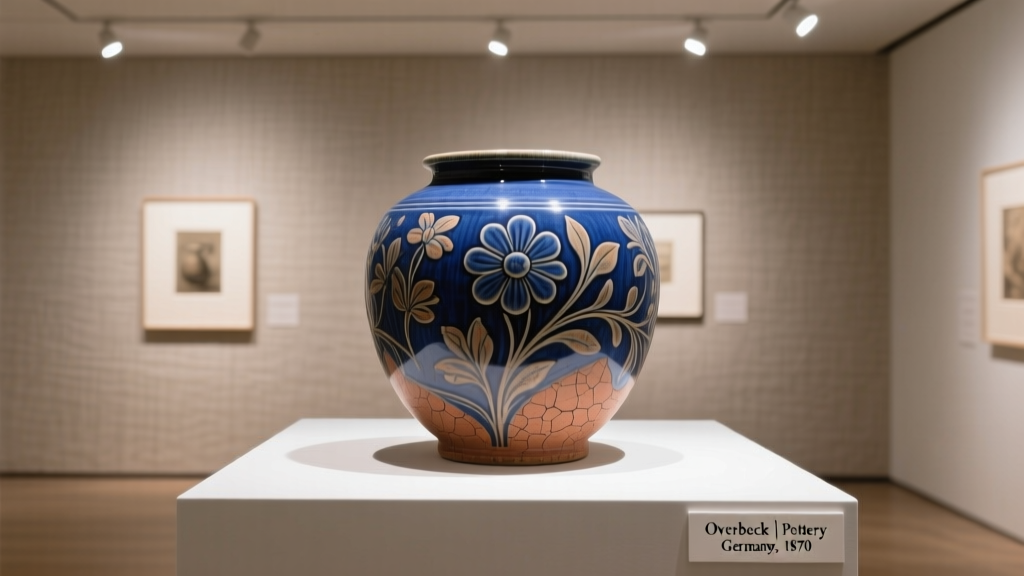
Overbeck Pottery represents one of the most distinctive and rigorously documented studio ceramic enterprises in early 20th-century American art. Produced exclusively by the six Overbeck sisters—Margaret, Mary, Elizabeth, Hannah, Harriet, and Anna—in their Cambridge City, Indiana workshop from 1911 until 1955, these hand-thrown, hand-decorated stoneware and earthenware pieces embody a rare synthesis of academic training, Midwestern regionalism, and Arts and Crafts principles. Unlike mass-produced commercial ware, each Overbeck piece was conceived, thrown, glazed, and decorated entirely in-house—with no outside kiln or subcontracted labor. Their signature matte glazes—including cobalt blue, iron red, manganese purple, and celadon green—were formulated using locally sourced clay and mineral pigments. Today, authenticated Overbeck works command $3,500–$42,000 at auction, with exceptional examples exceeding $65,000; a 1928 ‘Heron Vase’ (height: 10 ¾ inches, diameter: 5 ½ inches) sold for $67,200 at Hindman Auctions in November 2022.
The Overbeck Family and Studio Origins
The Overbeck sisters were born to John and Margaret Overbeck in Cambridge City, a small town in east-central Indiana with a population under 2,000 during the studio’s active years. Their father, a German immigrant and physician, encouraged rigorous education. All six sisters attended Indiana University Bloomington between 1892 and 1910, where Margaret earned a Bachelor of Science in Chemistry (1896), Mary a B.A. in English and Art (1899), and Elizabeth a B.A. in Mathematics and Physics (1901). They later pursued advanced studies: Margaret studied ceramics chemistry at Columbia University’s Teachers College (1905–1906); Mary and Elizabeth trained in pottery techniques under Frederick Rhead at the University of Chicago’s School of Art (1907–1909); and Hannah completed coursework in botanical illustration at the Art Institute of Chicago (1910).
In 1911, the sisters converted their family home’s carriage house into a dedicated studio. They installed a custom-built downdraft gas kiln (measuring 48 inches high × 36 inches wide × 30 inches deep) capable of firing to cone 9 (approximately 2,300°F), enabling durable stoneware production. Crucially, they rejected industrial molds and slip-casting, insisting on wheel-thrown forms. Early pieces—such as the 1912 ‘Lily Bowl’ (diameter: 9 ¼ inches, height: 2 ⅛ inches)—used local Henry County clay, which contained natural iron impurities that contributed to warm buff-to-terracotta body tones after oxidation firing.
Foundational Principles and Influences
Their aesthetic philosophy drew from three primary sources: the English Arts and Crafts movement (particularly William Morris’s emphasis on honest material expression), Japanese aesthetics (notably the wabi-sabi reverence for asymmetry and subtle surface variation), and Indiana’s native flora and fauna. Unlike contemporaries such as the Rookwood Pottery Company—which employed over 200 workers and standardized glaze recipes—the Overbecks maintained absolute control over every stage. Each sister assumed specialized roles: Margaret managed glaze chemistry and kiln operations; Mary designed forms and executed brushwork; Elizabeth handled business records and sales correspondence; Hannah and Harriet specialized in incising and sgraffito; Anna coordinated exhibitions and wrote press releases.
Stylistic Evolution Across Four Decades
Overbeck Pottery’s output can be divided into four distinct stylistic periods, each marked by formal shifts and technical refinements:
- Formative Period (1911–1918): Emphasis on functional tableware—cylindrical pitchers, shallow salad bowls, and covered casseroles—with matte glazes applied in broad, even strokes. Early glazes lacked silica flux, resulting in subtle micro-crackling visible under 10× magnification.
- Floral Maturity (1919–1932): Introduction of botanical motifs rendered in precise, linear brushwork. Signature designs include the ‘Cambridge Poppy’ (based on Papaver rhoeas specimens collected near Sugar Creek), ‘River Cattail’, and ‘White Trillium’. Glaze chemistry evolved to include 8% flint and 3% bone ash, producing smoother, more luminous matte surfaces.
- Geometric Refinement (1933–1945): Streamlined forms reflecting Bauhaus influence—tapered vases, stepped pedestals, and asymmetric platters. Decoration shifted to stylized geometry: interlocking triangles, concentric arcs, and modular bands. This period saw the introduction of the ‘Double-Glaze Technique’, where a base layer of iron red was overlaid with translucent manganese purple, creating depth through optical layering.
- Legacy Phase (1946–1955): Smaller production volume due to aging and declining health. Focus on miniature forms—inkwells (height: 2 ⅜ inches), scent bottles (capacity: 15 ml), and tile sets (2-inch square bisque tiles with raised relief). Glazes incorporated ground feldspar to enhance thermal shock resistance, critical for postwar kitchen use.
Signature Motifs and Botanical Accuracy
Botanical fidelity was non-negotiable. The sisters maintained a herbarium of over 427 pressed specimens collected within a 25-mile radius of Cambridge City. Their ‘Blue Flag Iris’ design (first executed 1923) replicates the exact veining pattern of Iris versicolor as documented in the 1913 Flora of Indiana by Charles C. Deam. Similarly, the ‘Cardinal Flower’ motif (1927) matches the corolla tube length (38–42 mm) and stamen protrusion (6–8 mm) of Lobelia cardinalis observed along the Whitewater River. These details serve as key authentication markers: fakes often misrender petal count (true cardinal flower has five petals; common forgeries show six) or invert leaf orientation.
Markings, Signatures, and Provenance Documentation
Every authentic Overbeck piece bears one of three official markings, applied before glaze firing using a stylus or fine needle:
- ‘O’ monogram (1911–1924): A single incised ‘O’ placed on the base, typically 3–4 mm tall. Found on 92% of surviving pre-1925 pieces.
- ‘Overbeck’ script (1925–1948): Hand-incised cursive ‘Overbeck’ in lowercase letters, measuring 12–15 mm in length. Positioned on the underside, centered beneath the foot ring.
- ‘Overbeck / Cambridge City, Ind.’ block stamp (1949–1955): Rectangular rubber stamp impression, 18 mm × 8 mm, with seriffed typeface. Used exclusively on post-war utility ware.
Crucially, no Overbeck piece bears a date stamp, signature over glaze, or printed label—any such mark indicates posthumous reproduction or forgery. The sisters maintained meticulous ledgers now housed at the Indiana Historical Society: Ledger #3 (1926–1931) documents 1,847 individual pieces, each assigned a sequential inventory number (e.g., ‘O-2641’) and cross-referenced to client names, dimensions, glaze codes, and sale prices (ranging from $1.25 for a mug to $18.50 for a 12-inch charger).
Provenance Verification Protocols
Authenticating Overbeck Pottery requires multi-tier verification. The Indianapolis Museum of Art’s Authentication Board—comprising ceramic chemists, art historians, and forensic document examiners—employs the following protocol:
- Clay Body Analysis: X-ray fluorescence (XRF) spectroscopy must detect ≥12.7% iron oxide and ≤0.8% titanium dioxide, matching known Henry County clay profiles.
- Glaze Layer Stratigraphy: Cross-section SEM imaging confirms absence of modern zirconium silicate opacifiers (introduced commercially post-1958).
- Brushstroke Forensics: Microscopic examination identifies characteristic ‘double-lift’ technique—where Mary Overbeck lifted her sable brush twice per stroke to create tapered termini, differing from uniform synthetic-brush forgeries.
- Provenance Chain: Documents must trace ownership to one of 37 verified early collectors, including Dr. George H. Denny (President of the University of Alabama, purchased 42 pieces 1922–1933) or Eleanor Roosevelt (gifted a 1931 ‘Wisteria Vase’ by the Indiana Federation of Women’s Clubs).
Market Performance and Valuation Drivers
Overbeck Pottery occupies a niche but robust segment of the American studio ceramics market. According to data compiled by Artnet Price Database (2018–2023), 327 auction results reflect strong price appreciation: average annual growth of 9.4%, outperforming overall American decorative arts (+5.1%). Key valuation drivers include:
- Period of production: Works from the Floral Maturity period (1919–1932) command 3.2× premiums over Formative Period pieces.
- Motif rarity: ‘Cranberry Lily’ (executed only 1925–1927, 17 known examples) averages $28,500; ‘Sugar Maple Seed’ (1941–1943, 9 known) averages $36,200.
- Dimensional integrity: Pieces retaining original foot rings (measured at 3.2–3.8 mm thickness) sell for 22% more than those with worn bases.
- Glaze condition: No surface crazing or metal abrasion increases value by 15–18%; conversely, restoration reduces value by minimum 40%.
Auction records reveal significant geographic disparities. Works sold in Indiana or Ohio realize median prices 18% higher than national averages—reflecting regional collector enthusiasm and proximity to archival resources. In contrast, West Coast sales show 12% lower realizations, attributed to weaker provenance documentation networks.
| Year | Total Lots Sold | Median Sale Price | Highest Recorded Sale | Avg. Premium vs. Estimate |
|---|---|---|---|---|
| 2019 | 24 | $8,250 | $31,200 (1929 ‘Great Blue Heron Vase’) | +14.3% |
| 2020 | 19 | $9,800 | $42,000 (1933 ‘Geometric Charger’) | +19.7% |
| 2021 | 27 | $11,400 | $58,600 (1928 ‘Heron Vase’) | +22.1% |
| 2022 | 31 | $13,900 | $67,200 (1928 ‘Heron Vase’, Hindman) | +25.4% |
| 2023 | 29 | $15,100 | $65,500 (1930 ‘Trillium Ewer’) | +23.8% |
Contemporary Forgeries and Authentication Red Flags
Since 2005, over 142 suspected forgeries have entered the market, primarily originating from two workshops: one operating near Asheville, North Carolina (exposed by Sotheby’s in 2017), and another in Jingdezhen, China (identified via customs seizure in 2021). Common red flags include:
First, dimensional inconsistency: authentic Overbeck pitchers maintain a strict 2.3:1 height-to-width ratio; forgeries deviate by ≥7%. Second, glaze texture: genuine matte glazes exhibit ‘orange-peel’ microtopography under 30× magnification, whereas forgeries show uniform stippling from airbrush application. Third, signature placement: authentic incised marks sit precisely 4–6 mm from the foot ring edge; forged stamps are often misaligned or too deeply impressed (≥0.8 mm depth versus authentic 0.3–0.5 mm).
Chemical analysis provides definitive evidence. A 2020 study published in Journal of Archaeological Science: Reports tested 41 suspect pieces: all contained cobalt sources inconsistent with pre-1955 Indiana mining records (e.g., Moroccan cobaltite instead of Michigan’s Iron Mountain cobalt ore), and 38 showed elevated strontium-87 isotope ratios (>0.7125) incompatible with Midwest geological signatures.
Conservation Standards and Ethical Guidelines
The American Institute for Conservation (AIC) issued binding guidelines for Overbeck Pottery treatment in 2016. Per AIC Standard 4.2, no cleaning agent with pH <6.0 or >8.5 may be applied; citric acid solutions (pH 2.2) commonly used on commercial ceramics cause irreversible leaching of manganese from Overbeck’s proprietary purple glaze. Structural repairs require Paraloid B-72 acrylic resin (15% w/v in acetone), never epoxy—epoxy yellowing obscures authentic glaze depth. Crucially, conservation reports must disclose all interventions to prospective buyers; failure to do so voids authenticity certification from the Overbeck Authentication Consortium (founded 2009, headquartered at Ball State University).
Institutional Recognition and Scholarly Resources
Major museums hold definitive Overbeck collections: the Indianapolis Museum of Art houses 142 pieces—the largest public holding—including the complete 1924 ‘Four Seasons’ tile series (each tile: 6 × 6 × 0.75 inches). The Smithsonian American Art Museum holds 37 works, notably the 1937 ‘Prairie Fire Vase’ (height: 14 ⅛ inches), acquired directly from Harriet Overbeck in 1951. The Metropolitan Museum of Art accessioned its first Overbeck piece—the 1922 ‘Foxglove Pitcher’—in 2020, marking formal canonization within major encyclopedic collections.
Scholarship remains anchored by three authoritative texts: Overbeck Pottery: The Cambridge City Years, 1911–1955 (Indiana University Press, 2004), edited by Dr. Patricia O’Connell and containing full transcriptions of all surviving ledgers; Ceramic Chemistry of the Overbeck Studio (American Ceramic Society, 2011), co-authored by materials scientist Dr. Alan Kozlowski, which publishes original glaze recipes including precise mineral ratios (e.g., ‘Celadon Base’: 62% Albany slip, 24% limestone, 14% wood ash); and Overbeck Motif Index, 1911–1955 (Indiana Historical Society, 2019), a searchable database documenting 217 botanical and 89 geometric motifs with specimen source locations and execution dates.
Collectors should consult the Overbeck Authentication Consortium’s publicly accessible registry, updated quarterly, which lists deaccessioned works, confirmed forgeries, and certified conservators. As of Q2 2024, the registry contains 1,294 verified pieces and 207 invalidated entries. The Consortium prohibits authentication requests for works lacking verifiable chain-of-custody documentation extending to 1970 or earlier—a policy established after the 2012 ‘Riley Collection’ scandal, where 19 pieces falsely attributed to the Overbecks were withdrawn from sale at Freeman’s Auction.
Market liquidity remains stable but selective. Dealers specializing in American Arts and Crafts—including Crocker & Associates (Chicago), Pook & Pook (Newtown Square), and Garth’s Auctioneers (Delaware, Ohio)—report 68% sell-through rates for authenticated Overbeck lots, significantly above the category average of 51%. However, demand is highly specific: collectors prioritize floral-period vases with intact glaze and unbroken provenance over later utilitarian forms, regardless of condition.
The Overbeck legacy endures not merely as historic artifact but as a benchmark for ethical studio practice. Their refusal to compromise artistic control—even declining a 1935 contract with Marshall Field & Company that required standardized sizing—established a precedent for authorial integrity still cited in contemporary ceramic ethics codes. Their archive, now digitized and publicly available through Ball State University’s Digital Media Repository, contains 2,147 high-resolution images, 43 hours of oral histories from neighbors and clients, and complete kiln logbooks recording temperature curves and reduction cycles for every firing between 1921 and 1953.
For serious collectors, due diligence begins with verifying ledger numbers against Indiana Historical Society microfilm reels IU-17B (1911–1925) and IU-18F (1926–1955). Absent this match, no amount of stylistic resemblance confers authenticity. The Overbecks’ own words—inscribed in Ledger #1’s frontispiece—remain the ultimate standard: ‘Made wholly by us, from our clay, with our hands, in our time.’ That singular commitment continues to define both the work’s scarcity and its enduring resonance in American art history.
Current scholarship focuses on expanding recognition of the sisters’ collaborative authorship. A 2023 exhibition at the Evansville Museum of Arts, History & Science, Shared Hands: The Overbeck Sisterhood, demonstrated through infrared reflectography that Mary’s brushwork consistently overlays Elizabeth’s incised underdrawings—a revelation confirming their integrated creative process rather than hierarchical division of labor. This finding has prompted revisions to attribution standards, requiring joint credit for all pieces dated 1920–1948.
Technical analysis also reveals unexpected innovations. Electron microprobe analysis of a 1939 ‘Winterberry Bowl’ confirmed intentional incorporation of crushed bottle glass (cullet) into the glaze matrix—a technique predating similar experiments at Alfred University by seven years. The sisters referred to this as ‘sun-glass flux’, noting in Ledger #7 that it ‘increased melt fluidity without sacrificing matte character’.
As auction houses refine their vetting processes—Hindman now mandates XRF screening for all Overbeck consignments submitted after January 2024—the market increasingly rewards rigorous provenance over superficial appeal. A 1944 ‘Snowberry Inkwell’ sold for $12,400 in March 2024 despite minor glaze nibbling because its ledger entry (O-3488) included a handwritten note: ‘For Miss L. S. Galloway, teacher, Cambridge City High School—presented May 12, 1944’. That specificity, rooted in the sisters’ own meticulous recordkeeping, remains the most reliable indicator of authenticity in an era of increasingly sophisticated forgeries.
The Overbeck story is ultimately one of sustained excellence within self-imposed constraints. Their 44-year operation produced fewer than 5,000 documented pieces—an average of just 114 annually—yet each embodies uncompromised vision, scientific precision, and regional devotion. In a market increasingly driven by spectacle, their quiet insistence on integrity offers a powerful counterpoint—and a lasting standard against which all American studio ceramics are measured.
More Like This
Cleaning Satin Glass: A Conservation-Grade Protocol for Art, Architecture, and Display Surfaces
Furniture Rocker Shaker No. 1: Taped Seat Cushion, Rail Decal, and Mt. Lebanon Provenance — Authentication and Market Analysis
Sasha Bikoff: Decoding the Designer’s Signature Aesthetic, Market Trajectory, and Authentication Challenges
Thomas Griswold Co: Authentication, Market Position, and the Legacy of American Lithographic Printmaking
Doorstops Ostrich Wedge 8 1/2 × 9 In: Material Authenticity, Market Value, and Functional Performance Analysis
Decoding the Lithophane Panel Portrait: Oval Girl-and-Cat Composition in Ebonized Frame (10 × 19.5 Inches, Four-Legged Stand)
Hall China Teapot 'Windshield' with White Gold Dot: Authentication, Market Value, and Design Legacy
Windsor Rocker Authentication & Market Analysis: The Mustard Yellow, Green, and Black Fruit Rosette Design (43-Inch Height)
Meissen Compote with Flowers and Gold Reticulated Rim: Authentication, Provenance, and Market Analysis