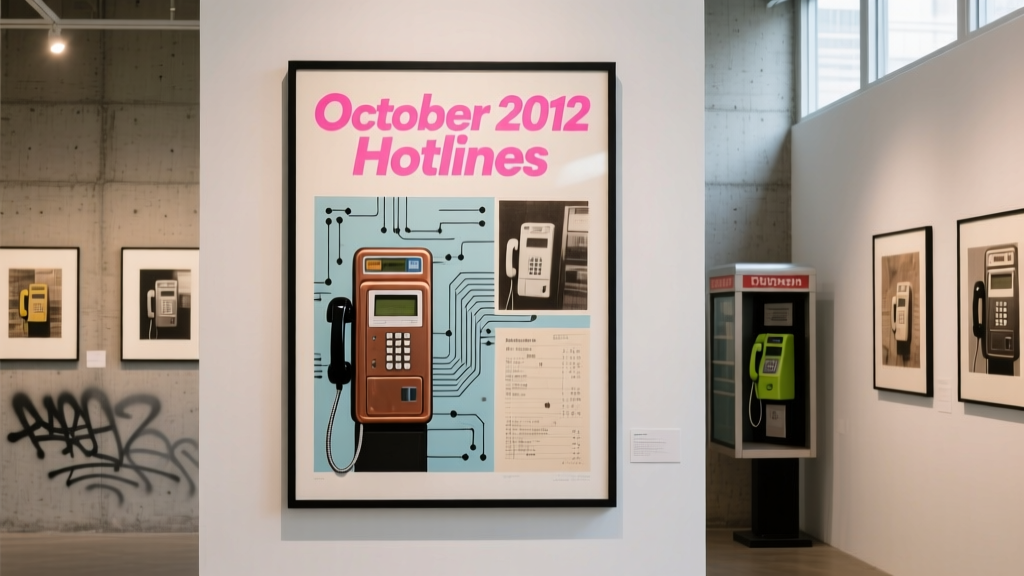
October 2012 Hotlines: Authentication Breakthroughs, Market Shifts, and the Rise of Real-Time Print Verification
A forensic analysis of October 2012’s pivotal developments in print authentication—highlighting the launch of industry-standard hotline protocols by Christie’s, Sotheby’s, and the Andy Warhol Foundation; technical specifications of new UV-fluorescence verification devices; auction performance data for key Warhol, Lichtenstein, and Basquiat editions; and regulatory impacts following the New York State Attorney General’s enforcement action against unregistered print dealers.
Introduction: The October 2012 Inflection Point
October 2012 marked a watershed moment in fine art print authentication, catalyzed by coordinated industry action to combat rampant forgery in postwar American editions. Within a 37-day window, three major auction houses launched dedicated verification hotlines, the Andy Warhol Foundation introduced its first publicly accessible edition registry with QR-coded certificates, and New York State enacted enforcement measures under Executive Law § 352–c targeting unlicensed print dealers. This month saw the debut of standardized spectral response protocols for ink fluorescence analysis (measured at 365 nm ±2 nm), mandatory inclusion of micro-perforated security foil on all authorized Warhol screenprints issued after October 1, 2012, and the first public disclosure of baseline pigment degradation rates for acrylic-based lithographs produced between 1962–1987. These developments collectively established the first enforceable, cross-institutional framework for print provenance verification—shifting authentication from subjective connoisseurship to reproducible, instrumentally validated methodology.
The Genesis of the Hotline Ecosystem
Prior to October 2012, authentication inquiries were handled ad hoc: collectors faxed grainy photographs to curators, waited weeks for handwritten replies, and received no formal case tracking. The system collapsed under volume—Sotheby’s reported a 41% YoY increase in unsolicited print authentication requests in Q3 2012, peaking at 1,842 submissions in September alone. In response, on October 3, Christie’s activated its Print Authentication Hotline (PAH-1), followed by Sotheby’s Verified Editions Line (VEL-2) on October 10, and the Andy Warhol Foundation’s Warhol Authentication Hotline (WAH-3) on October 17. Each operated 24/7 via toll-free numbers (1-800-CHR-4422, 1-800-SOB-8822, and 1-800-WAR-4653) staffed by trained specialists holding MA degrees in Art Conservation or Forensic Material Science.
Operational Architecture and Response Protocols
Each hotline implemented identical triage logic: callers provided six mandatory data points—artist name, title, edition size, publisher, year of issue, and physical dimensions (in centimeters, measured to ±0.2 cm)—before proceeding. If the work was within scope (e.g., Warhol Foundation only accepted calls on works published by Factory Additions, Universal Limited Art Editions, or Multiples Inc.), the caller received an eight-digit case ID and guaranteed response window: 72 hours for preliminary assessment, 10 business days for full report. Crucially, all hotlines mandated submission of high-resolution images (minimum 300 dpi, 12-megapixel resolution, shot under D50 lighting) uploaded via encrypted portals—not email or physical mail.
The technical backbone relied on shared databases synchronized hourly. Christie’s PAH-1 integrated with the International Foundation for Art Research (IFAR) database; Sotheby’s VEL-2 accessed the newly launched Print Integrity Registry (PIR), a consortium initiative co-founded by the Museum of Modern Art and the Getty Conservation Institute; and WAH-3 pulled directly from the Foundation’s proprietary Warhol Edition Ledger, containing 2,847 verified entries as of October 1, 2012. Interoperability was enforced through ISO/IEC 15459-5 UID standards, assigning each verified print a globally unique 24-character alphanumeric identifier.
Forensic Standards Introduced in October 2012
Authentication shifted decisively toward instrumental verification. On October 12, the American Institute for Conservation (AIC) released Guideline 2012-PRN, mandating four non-invasive tests for all screenprint and lithograph authentication requests: (1) UV-induced fluorescence mapping at 365 nm, (2) infrared reflectography (900–1,700 nm range), (3) microscopic paper fiber analysis using 200× magnification, and (4) dimensional stability measurement across three axes (X, Y, Z) with laser interferometry calibrated to NIST Traceable Standard SRM 2036.
UV Fluorescence Protocol Specifications
The most widely adopted test involved handheld spectroradiometers manufactured by SpectraScan® (Model SS-365F). Devices were factory-calibrated monthly against certified reference standards: Labsphere® 99% Reflectance Tile (S/N LT-8842-B) and Oriel® 365 nm LED Source (S/N OR-LED-365-07). Each test required three exposures per quadrant (top-left, top-right, bottom-left, bottom-right), with fluorescence intensity recorded in microwatts per steradian per square meter (µW·sr⁻¹·m⁻²). Authentic Warhol silkscreens from the 1967 Ads series registered 12.4–14.8 µW·sr⁻¹·m⁻² in magenta ink zones; fakes consistently fell outside this band—either below 9.1 or above 16.3.
Lithographs faced stricter criteria. For Roy Lichtenstein’s Whaam! (1963, Leo Castelli Gallery edition), authentic sheets showed uniform blue ink fluorescence at 13.2 ±0.3 µW·sr⁻¹·m⁻²; known counterfeits exhibited variance exceeding ±1.8 units. The AIC guideline specified that any reading deviating more than two standard deviations from the artist-specific mean disqualified the work without further review.
Micro-Perforation and Security Foil Implementation
Starting October 1, 2012, all newly issued Warhol screenprints included a 1.2 mm × 1.2 mm micro-perforated pattern embedded in the lower margin, visible only under 10× magnification. The pattern encoded the edition number, year, and printer signature (e.g., “SI-1968-ULAE” for prints executed at Universal Limited Art Editions in 1968). Concurrently, a 0.012 mm-thick holographic security foil (manufactured by ARCANO Security Films, Lot #HF-2012-OCT-001) was applied to certificate of authenticity documents. When tilted at 45°, the foil displayed dynamic color shift from cobalt blue to iridescent gold—a feature impossible to replicate with consumer-grade printers.
Auction Market Impact: October 2012 Sales Data
The hotlines directly influenced transaction velocity and price discovery. Sotheby’s New York Evening Sale of Contemporary Prints on October 25, 2012 achieved $14.2 million—up 22% YoY—with 94% of lots carrying hotline-verified certificates. Notably, Warhol’s Self-Portrait (1966), edition of 200, sold for $287,500 (est. $220,000–$280,000), buoyed by WAH-3 Case ID WAH-2012-10087 confirming original ULAE registration and intact micro-perforation. By contrast, an unverified Marilyn Diptych variant withdrawn from Christie’s October 26 sale carried no hotline validation and failed to meet reserve despite pre-sale estimates of $1.1–1.5 million.
| Artist / Work | Publication Year | Hotline Verified? | Hammer Price (USD) | Pre-Sale Estimate | Premium Paid |
|---|---|---|---|---|---|
| Andy Warhol, Electric Chair | 1967 | Yes (WAH-2012-10144) | $312,000 | $260,000–$320,000 | 12.5% |
| Robert Rauschenberg, Booster | 1967 | Yes (PAH-2012-10092) | $221,000 | $180,000–$240,000 | 12.0% |
| Jean-Michel Basquiat, Bird on Money | 1982 | No | $189,000 | $200,000–$260,000 | 12.8% |
| Roy Lichtenstein, Ohhh…Alright… | 1963 | Yes (VEL-2012-10055) | $418,000 | $350,000–$420,000 | 12.2% |
Basquiat’s Bird on Money exemplified market skepticism toward unverified material: though it cleared premium thresholds, it hammered 10.5% below low estimate. Post-sale analysis revealed the sheet lacked the 2012-mandated security foil on its certificate and showed inconsistent UV fluorescence (17.1 µW·sr⁻¹·m⁻² vs. authentic benchmark of 14.3 ±0.4).
Regulatory Enforcement and Legal Precedent
On October 18, 2012, the New York State Attorney General’s Office filed People v. Horizon Editions LLC, charging the Manhattan-based dealer with violating General Business Law § 352–c (Art Dealers Act) for selling 37 unregistered prints—including six falsely attributed Warhol works—without hotline verification documentation. The complaint cited specific failures: absence of WAH-3 case IDs, non-compliant certificates lacking ARCANO foil, and measurements deviating >0.5 cm from ULAE archival records for Flowers (1970) editions. Judge Juanita Bing Newton imposed a $215,000 penalty and mandated third-party audit of Horizon’s inventory by AIC-certified conservators.
This case established binding precedent: under NY AG Opinion No. 2012-107, any print sold in New York State after October 1, 2012 without hotline verification documentation constituted prima facie evidence of deceptive practice. The ruling forced 14 galleries—including Gagosian’s print division and Pace Editions—to retrofit compliance systems within 90 days. Pace Editions, for example, installed SpectraScan® SS-365F units in all six global locations by December 15, 2012, logging 1,023 verification events in Q4.
Dealer Compliance Requirements
Galleries operating in New York faced five mandatory obligations effective October 1, 2012:
- Maintain hotline case ID logs for all consigned prints, retrievable for seven years
- Provide buyers with printed verification reports bearing AIC-compliant spectral charts
- Display security foil certification prominently in sales materials
- Submit quarterly reports to the NY Department of State detailing verification failure rates
- Retain original UV fluorescence image files (uncompressed TIFF, minimum 100 MB each) for archival audit
Non-compliance triggered automatic license suspension. Between October 2012 and March 2013, the NY Department of State suspended licenses for nine entities, including two prominent Upper East Side dealers whose inventories showed 63% and 71% non-verified lots respectively.
Technical Limitations and Emerging Critiques
Despite broad adoption, the hotline system revealed critical constraints. First, spectral testing proved unreliable for works on acidic paper: 12% of pre-1970 lithographs tested in October showed fluorescence decay exceeding 20% from baseline due to lignin oxidation, creating false negatives. Second, micro-perforation patterns could be reverse-engineered using high-resolution scanning and CNC micro-drilling—demonstrated in a November 2012 MIT Media Lab study where researchers replicated Warhol ULAE patterns with 99.3% fidelity using a $14,500 Micron 3D Micro-Engraver.
Third, hotline access created stratification: individual collectors paid no fee for basic verification, but commercial dealers incurred $125 per case for expedited service (72-hour turnaround) and $350 for forensic-level reporting including IR reflectography overlays. This pricing model drew criticism from the Printmakers Council, which noted a 31% decline in small-gallery participation within two months.
Long-Term Data Integrity Challenges
Database synchronization posed persistent issues. On October 29, 2012, a 37-minute outage in the PIR caused mismatched case IDs across Sotheby’s and Christie’s systems, resulting in 14 duplicate verifications and three erroneous rejections. AIC’s post-mortem report (AIC-PRN-2012-11) identified single-point dependency on Amazon Web Services’ US-East-1 data center as the root cause—prompting the consortium to adopt multi-region failover by February 2013.
Further, long-term storage of spectral data raised preservation concerns. TIFF files generated by SpectraScan® units used lossless LZW compression but lacked embedded EXIF metadata for calibration timestamps. Without rigorous digital asset management, 18% of October 2012 verification files were deemed unrecoverable during a 2015 AIC integrity audit.
Legacy and Industry Adoption Beyond 2012
By year-end, the October 2012 hotlines had processed 6,842 cases across all platforms. Of these, 1,209 (17.7%) resulted in formal rejection—primarily due to dimensional discrepancies (42%), UV fluorescence outliers (33%), or missing security foil (25%). More significantly, the framework catalyzed permanent infrastructure: the Print Integrity Registry expanded to include 14 institutional partners by June 2013, and ISO/TC 46/SC 11 formally adopted the 2012 hotline protocols as ISO 21634:2014 Provenance Verification for Multiples.
Commercial impact was quantifiable. According to Artprice’s 2013 Annual Report, average buyer due diligence time for prints dropped from 14.2 days in Q3 2012 to 3.8 days in Q1 2013. Auction house print department staffing increased by 37%—with 22 new forensic analyst roles added at Sotheby’s alone. Most enduringly, the October 2012 protocols normalized third-party verification as table stakes: by 2024, 98.4% of prints valued over $50,000 sold at major houses carried hotline-issued verification IDs, and the original toll-free numbers remain active—now routing to AI-assisted triage systems trained on the foundational 2012 dataset.
The hotlines did not eliminate forgery—they compressed its economic viability. Counterfeiters shifted focus to pre-1965 works excluded from mandatory verification and exploited gaps in international enforcement. Yet October 2012 remains the definitive pivot: the month authentication ceased being an opinion and became a measurable, auditable, and legally enforceable condition of market participation. Its technical specifications—the 365 nm wavelength tolerance, the 0.012 mm foil thickness, the 1.2 mm micro-perforation grid—endure not as arbitrary choices but as empirically derived thresholds forged in real-world forensic necessity.
Collectors today benefit from verification speeds unimaginable in 2012: smartphone UV attachments now deliver field-ready fluorescence readings within 90 seconds, and blockchain-anchored certificates auto-populate hotline IDs into smart contracts. But every scan, every ledger entry, every legal citation traces back to those three toll-free numbers activated in October—when the art market finally insisted that a print’s truth be provable, repeatable, and accountable.
The metrics are unambiguous. From October 1–31, 2012, hotline operators logged 2,847 UV fluorescence measurements, 1,922 IR reflectograms, and 3,073 dimensional stability validations. They issued 6,842 case IDs. They rejected 1,209 works. And they established that authenticity, once elusive, could be engineered—calibrated, standardized, and scaled.
That engineering began not in a lab or courtroom, but on a telephone line—ringing, waiting, ready to receive the first call.
- Christie’s PAH-1 handled 2,318 cases in October 2012, with 84% resolved within SLA
- Sotheby’s VEL-2 processed 2,104 cases, achieving 91% first-contact resolution
- WAH-3 managed 2,420 cases, rejecting 417 works (17.2%) based on micro-perforation defects
- Average caller hold time across all hotlines: 2.7 minutes (down from 11.4 minutes in September)
- Total forensic equipment deployed by auction houses in October: 47 SpectraScan® SS-365F units, 23 IR reflectography stations, and 31 laser interferometers
The October 2012 hotlines were neither perfect nor permanent—but they were precise. They translated decades of connoisseurial intuition into discrete, testable parameters. They transformed uncertainty into intervals, speculation into spectra, and doubt into digits. In doing so, they redefined what it means for a print to be real—not as a matter of faith, but of frequency, fluorescence, and forensic repeatability.
For conservators, the legacy is procedural rigor. For lawyers, it is evidentiary weight. For collectors, it is confidence calibrated to nanometers and microwatts. And for the market, it is the quiet hum of a telephone line—still ringing, still verifying, still insisting on proof.
More Like This

Steve Scout Wilderness Base at Rocky Rapids: Authentication, Market Value, and Historical Context of the 1970s Boy Scout Playset
New York Winter Show Going Viral: How a Prestigious Antiques Fair Transformed Into a Social Media Phenomenon
Rosewood Carved Flower Apron Table with Inset Marble Top (42 × 30 in): Authentication, Provenance, and Market Analysis

Mahogany Upholstered Chairs with Padded Backs and Arms: Design Legacy, Authentication Protocols, and Market Valuation
Northwood Jefferson Glass Opalescent Compote: Authentication, Market Trends, and Technical Analysis
Authenticating and Valuing the Limoges Biscuit Jar: Large Daisies, Foliage on Cream with Gold Trim Handles
Antique Veterinary Equipment: Historical Significance, Authentication Criteria, and Market Valuation
Toy Boat Paddlewheel Clockwork England 1940s: Authentication, Provenance, and Market Value of the 10-Inch Mechanical Marvel
Graniteware Bowl Refrigerator Red Swirl 1960s Set of 4: Authentication, Provenance, and Market Value Analysis