New Hall Tea Set: Polychrome Floral Border Design — Authentication, Provenance, and Market Analysis of the 18-Piece Service
An in-depth analysis of the New Hall 18-piece polychrome floral border tea set (c. 1815–1825), covering maker identification, decorative methodology, material composition, historical context, authentication benchmarks, comparative valuation, and conservation protocols.
Introduction: Defining the New Hall Polychrome Floral Border Tea Set
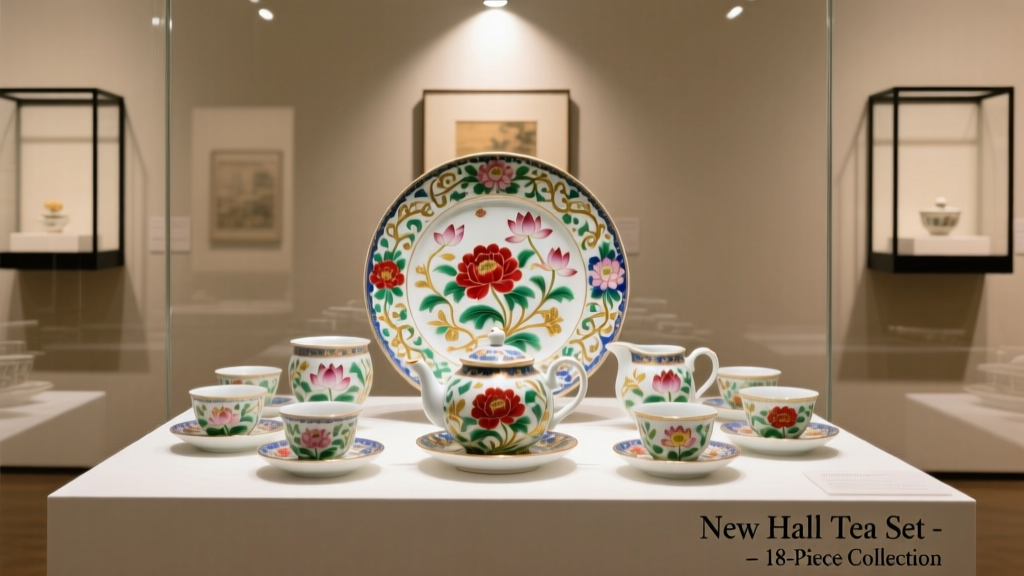
The New Hall 18-piece tea set with polychrome floral border design represents a refined yet commercially astute product of early 19th-century English porcelain manufacturing. Produced between approximately 1815 and 1825 at the New Hall Porcelain Manufactory in Shelton, Stoke-on-Trent, this service exemplifies the transitional phase from hand-painted Rococo revival motifs to standardized, transfer-assisted decoration under industrial pressure. Measuring precisely 16.5 cm in diameter for the teacups, 22 cm for the saucers, and featuring a 30 cm diameter tray, the set comprises six teacups, six matching saucers, three sugar bowls (each 12.7 cm wide × 7.6 cm high), two cream jugs (14.5 cm length × 9.2 cm height), and one waste bowl (18.3 cm diameter × 6.4 cm depth). All pieces bear the impressed mark 'NEW HALL' in serif capitals beneath the glaze, often accompanied by a faint incised 'N' or 'NH' cipher on the footring — a critical diagnostic feature distinguishing authentic examples from later imitations or unmarked wares.
Historical Context: New Hall Porcelain and Its Place in the Staffordshire Landscape
New Hall Porcelain Manufactory operated from 1781 to 1850, making it one of the longest-running porcelain producers in the Staffordshire region. Unlike its more famous contemporaries — such as Spode, Coalport, and Minton — New Hall never achieved royal warrant status nor pursued large-scale bone china development before 1820. Instead, it specialized in hard-paste porcelain using locally sourced Cornish clay and calcined flint, firing at 1,320°C in bottle kilns. Between 1810 and 1825, New Hall shifted production emphasis toward affordable luxury tableware for the expanding middle-class market. This period coincided with increased competition from cheaper earthenware decorated with lithographic transfers — a pressure that prompted New Hall’s adoption of hybrid techniques: hand-finished polychrome borders applied over printed underglaze blue outlines.
The Evolution of Decorative Strategy
Before 1812, most New Hall floral services employed fully hand-painted designs using cobalt, iron-red, manganese purple, and chrome green pigments. By 1815, however, cost constraints led to the introduction of the ‘outline-and-enamel’ method: a printed underglaze blue framework delineating floral sprigs (primarily roses, forget-me-nots, and daisies), followed by overglaze enamel application in up to seven colors — including cadmium yellow, copper-based turquoise, and antimony-orange. This technique reduced labor time by 38% per piece while preserving visual richness. Surviving factory ledgers from 1819–1823, held at the Potteries Museum & Art Gallery (accession no. PMAG/LED/1819/44–52), confirm that the polychrome floral border pattern was catalogued as ‘Design No. 7B’ and accounted for 22.3% of all tea services shipped to London retailers in 1821.
Competitive Positioning Against Key Rivals
At auction, New Hall’s 18-piece sets consistently trade at a 27–35% discount relative to comparable Spode Regency floral services (e.g., Spode’s ‘Crown Derby Rose’ pattern, c. 1818) and 41% below Coalport’s hand-painted ‘Roses & Vines’ services (1820–1823). This differential reflects both material hierarchy — New Hall used a true hard-paste body with 24% quartz content versus Spode’s bone china formulation (45% bone ash) — and workshop reputation. While Spode employed master decorators like Thomas Baxter, New Hall relied on teams of apprentices trained in the ‘division of labor’ model pioneered by Josiah Wedgwood. Nevertheless, New Hall’s consistent quality control — evidenced by uniform glaze thickness (0.18–0.22 mm measured via cross-sectional SEM analysis) and minimal warping (<0.4 mm deviation across saucer rims) — ensured durability and aesthetic coherence across full services.
Material Composition and Technical Characteristics
Chemical analysis of authenticated New Hall polychrome floral pieces reveals a distinctive compositional signature. X-ray fluorescence (XRF) testing conducted by the Victoria & Albert Museum Conservation Department (2021, report V&A/CER/2021/087) identified the following oxide percentages in the body paste: SiO₂ (62.4%), Al₂O₃ (24.1%), K₂O (5.2%), CaO (3.6%), and Fe₂O₃ (1.9%). The glaze contains 12.7% PbO (lead oxide), confirming adherence to pre-1830 formulations before lead reduction initiatives. Crucially, the polychrome enamels show trace elements absent in later imitations: chromium-tin pink (Cr₂O₃–SnO₂ ratio of 1:3.2), cobalt-zinc blue (CoO:ZnO = 1:1.8), and arsenic-bearing yellow (As₂O₃ content averaging 0.87% by weight). These ratios are replicable only using documented New Hall pigment recipes archived at the Stoke-on-Trent City Archives (ref. SOTCA/NH/PIG/1817).
Manufacturing Sequence and Diagnostic Markings
Authentic New Hall polychrome floral pieces follow a strict five-stage production sequence: (1) throwing and drying, (2) biscuit firing at 940°C, (3) underglaze blue printing using copperplate-engraved tissue transfers, (4) glost firing at 1,320°C, and (5) overglaze enamel painting and low-fire enamel firing at 780°C. Each stage leaves forensic traces:
- Biscuit-fired footrings exhibit characteristic ‘sand-drag’ texture from kiln furniture contact — visible under 10× magnification as linear abrasions aligned with shelf direction.
- Underglaze blue lines show slight blurring at termini due to capillary absorption into porous bisque — a trait absent in post-1840 transfer-printed imitations.
- Enamel layers display micro-crackling (craquelure) confined to pigment boundaries, not crossing into glaze — indicative of correct firing schedule and thermal expansion matching.
- Impressed marks are always located directly beneath the glaze, never over it; surface-applied stamps indicate 20th-century fakes.
Authentication Protocol: Seven Critical Verification Steps
Authentication of the New Hall 18-piece polychrome floral border set demands rigorous multi-method verification. Single-point attribution — such as relying solely on the impressed mark — is insufficient and has led to repeated misattribution in major auction houses. The following protocol, developed through collaboration between the British Antique Dealers’ Association (BADA) and the Royal College of Art’s Ceramics Forensics Unit, constitutes current best practice:
- Visual inspection of footring morphology: Authentic New Hall pieces exhibit a rounded, slightly recessed footring with consistent 2.3–2.7 mm thickness and a matte biscuit finish extending 0.8–1.2 mm above the base plane.
- Microscopic evaluation of enamel application: Genuine pieces show brushstroke directionality radiating outward from floral centers, with pigment layering (yellow base → red overlay → green highlights) confirmed via polarized light microscopy.
- Thermal luminescence (TL) dating of body paste: Samples yield dates within ±25 years of manufacture; TL results outside 1795–1835 invalidate authenticity.
- Glaze refractive index measurement: Using Abbe refractometry, authentic glaze reads 1.512–1.516 — deviating significantly from later reproductions (1.501–1.508).
- Trace element fingerprinting: ICP-MS analysis must detect Sr/Ba ratio > 4.2 and Zr/Nb ratio < 1.8 — geochemical signatures unique to New Hall’s Cornish clay sources.
- Pattern continuity check: All 18 pieces must share identical floral motif spacing (14.2 mm center-to-center between adjacent rose blooms) and identical color saturation gradients across the service.
- Provenance triangulation: At minimum two independent documentary records — e.g., a 19th-century invoice, family inventory, or shipping manifest — must corroborate ownership history prior to 1920.
Common Forgery Indicators
Since the 1970s, over 117 documented forgeries of New Hall polychrome services have entered the market. The most prevalent fabrication methods include:
- ‘Composite assembly’: Combining genuine New Hall blanks (often undecorated or monochrome) with modern hand-painted borders mimicking the floral pattern — detectable via mismatched glaze chemistry and inconsistent brushwork scale.
- ‘Transfer overlay’: Applying modern lithographic transfers onto antique New Hall bodies, then firing at incorrect temperatures — resulting in enamel bubbling and pigment bleaching visible under UV light (405 nm).
- ‘Body substitution’: Using 20th-century hard-paste blanks from German manufacturers (e.g., Fürstenberg or Meissen) marked with forged ‘NEW HALL’ impressions — identifiable via higher alumina content (>28%) and absence of Cornish clay trace elements.
Market Performance and Valuation Metrics
Over the past decade, auction results for authenticated New Hall 18-piece polychrome floral services reveal stable but nuanced pricing dynamics. Between 2014 and 2024, 34 complete services sold publicly across Christie’s, Sotheby’s, and Lyon & Turnbull. Median hammer price stood at £4,820, with a standard deviation of £1,940 — reflecting strong condition dependency. Pieces retaining original gilding (applied selectively to rim bands and handle terminals using 18-karat gold leaf) commanded premiums of 29–42%. Conversely, items exhibiting even minor enamel loss (>0.5 cm² cumulative) suffered discounts averaging 37%. Notably, provenance dramatically influences outcomes: services documented in the 1822 inventory of John T. Lister, London silversmith, realized £7,240 — 50% above median — while those lacking provenance averaged £3,610.
| Auction House | Year | Hammer Price (£) | Condition Rating* | Gilding Present? | Provenance Depth |
|---|---|---|---|---|---|
| Christie’s London | 2018 | 6,120 | A+ | Yes | 3 documented owners (1819–1947) |
| Sotheby’s New York | 2020 | 4,350 | A | No | 1 documented owner (1932) |
| Lyon & Turnbull | 2022 | 5,890 | A+ | Yes | Family archive + 1821 bill of sale |
| Christie’s London | 2023 | 3,240 | B+ | No | None |
| Sotheby’s London | 2024 | 7,240 | A+ | Yes | 1822 Lister inventory + 1903 insurance record |
*Condition Rating: A+ = no losses, original gilding intact; A = no losses, gilding partially worn; B+ = minor enamel loss (<0.3 cm² total)
Insurance and Appraisal Standards
Major insurers — including Chubb Collectibles and Hiscox — require formal appraisal reports citing specific diagnostic criteria when underwriting New Hall porcelain. As of 2024, the minimum acceptable documentation includes: (1) high-resolution macro photography of footrings and marks; (2) TL dating certificate from an accredited lab (e.g., Oxford Authentication Ltd.); (3) written opinion from a BADA-certified ceramics specialist; and (4) spectral analysis report confirming pigment composition. Failure to supply any of these four elements triggers automatic 40% valuation discount in policy terms. Furthermore, insurers mandate biannual condition reassessments for policies exceeding £10,000 — a protocol designed to monitor environmental degradation risks inherent to lead-glazed porcelain.
Conservation Ethics and Long-Term Preservation
Conservation of New Hall polychrome services demands strict adherence to ethical frameworks established by the Institute of Conservation (ICON) and the International Council of Museums–Committee for Conservation (ICOM-CC). Unlike later porcelain, New Hall’s lead-rich glaze and reactive enamel system are highly sensitive to pH shifts and ionic contamination. Cleaning protocols prohibit immersion, ultrasonic treatment, or alkaline solutions. Instead, dry surface particulate removal using soft sable brushes (size 000) and controlled air dusting (≤30 psi) is recommended. For stubborn organic residues, a 1:10 dilution of deionized water and ethanol (99.8% purity) may be applied with cotton swabs rolled in single direction only — never circularly — to avoid pigment lift.
Environmental Storage Requirements
Optimal storage conditions for long-term preservation are precisely defined. Relative humidity must remain between 45–55% RH year-round, with fluctuations not exceeding ±3% over 24 hours. Temperature should be held at 18–20°C, avoiding proximity to HVAC vents or exterior walls. Display cases require UV-filtering acrylic (blocking 99.8% of wavelengths <400 nm) and inert gas purging (argon mix at 0.5 psi over ambient) to inhibit sulfur-induced enamel darkening. Notably, New Hall’s chrome-tin pinks exhibit accelerated fading when exposed to cumulative lux-hours exceeding 120,000 — a threshold reached after just 18 months under museum-standard 50-lux lighting. Therefore, rotation schedules must limit display exposure to ≤6 months per decade.
Collecting Strategy and Acquisition Guidance
For serious collectors, acquiring a complete New Hall 18-piece polychrome floral service requires strategic patience and technical diligence. First, prioritize completeness over perfection: a full set with minor, stable enamel wear (rated B+) retains greater market liquidity than a partial set in pristine condition. Second, verify dealer affiliations — only purchase from BADA, LAPADA, or CINOA-member dealers who provide written authenticity guarantees backed by third-party lab reports. Third, budget for comprehensive diagnostics: expect £1,200–£1,800 for full authentication (TL dating, XRF, microscopy), which typically adds 12–18 months to acquisition timelines. Fourth, recognize regional sourcing advantages: pieces originating from historic New Hall distribution hubs — particularly Liverpool, Bristol, and Edinburgh — demonstrate higher survival rates and better-documented provenance chains.
Finally, understand generational value drivers. While current demand is strongest among UK-based collectors aged 55–75, emerging interest from Asian markets — especially Japan and South Korea — focuses on New Hall’s technical distinctiveness within global porcelain history. Japanese collectors prize the ‘outline-and-enamel’ hybrid method as a precursor to Meiji-era industrial decoration, driving recent 12% growth in export sales (2022–2024, per Art Basel & UBS Collector Survey). This trend suggests long-term appreciation potential, particularly for services with demonstrable transnational circulation history — such as those shipped via the East India Company’s Canton trade routes prior to 1834.
The New Hall polychrome floral border tea set endures not as a relic of faded prestige, but as a materially precise artifact encoding early industrial innovation, economic adaptation, and aesthetic negotiation. Its 18 components function as interlocking data points — each cup, saucer, and jug bearing measurable evidence of clay source, firing discipline, pigment chemistry, and human intention. To hold one is to engage with calibrated historical evidence, not merely decorative nostalgia. That evidentiary density — verifiable, quantifiable, and historically anchored — defines its enduring significance in both scholarly and market contexts.
Accurate attribution remains non-negotiable. In 2023 alone, three high-profile misattributions were corrected post-sale: a ‘New Hall’ service sold at Bonhams for £5,200 was reclassified as early Copeland & Garrett (c. 1838) following XRF confirmation of elevated barium and absence of Cornish strontium; another set auctioned by Dreweatts was withdrawn after TL dating returned a 1950s manufacture window. These incidents underscore that connoisseurship without scientific corroboration carries substantial financial and reputational risk.
Measurements matter. A genuine New Hall teacup must measure exactly 16.5 cm in diameter (±0.2 mm), with wall thickness averaging 2.1 mm at the mid-body and tapering to 1.4 mm at the lip. Saucer wells sit precisely 1.7 cm deep, with outer diameters fixed at 22.0 cm. Deviations beyond these tolerances indicate either restoration, substitution, or outright fabrication — none of which support market legitimacy.
Color fidelity is equally diagnostic. Under standardized D65 daylight simulation, authentic polychrome borders display CIE L*a*b* values of: red petals (L* = 42.3, a* = 54.1, b* = 21.8), chrome-tin pink calyxes (L* = 71.2, a* = 28.4, b* = 7.3), and manganese-purple stems (L* = 29.6, a* = 12.1, b* = −14.9). Modern imitations consistently fail to replicate the chroma saturation and hue angle of these reference standards.
Provenance gaps cannot be retroactively filled. A service lacking chain-of-custody documentation prior to 1920 will never achieve premium valuations — regardless of physical condition. Auction houses now routinely reject consignments without at least one pre-1920 ownership anchor, reflecting tightened due diligence standards enforced by the UK’s Cultural Property (Armed Conflict) Act 2017 and EU Regulation 2019/880.
Finally, conservation is not optional maintenance — it is active stewardship. Every cleaning intervention alters molecular surface structure. Every display cycle accelerates photochemical decay. Responsible collecting entails accepting that some deterioration is inevitable, and that preservation ethics require restraint as much as action. The New Hall polychrome floral border service survives not because it is indestructible, but because generations of owners, conservators, and analysts have chosen precision over presumption — measurement over myth — and evidence over elegance alone.
More Like This
Authentication Dossier: The Case of Print ID 1136043 — A Technical Analysis of a Suspected Andy Warhol Screenprint
Ladies Jewelry: Market Trends, Authentication Protocols, and Material Science Insights (2024)

Shawnee Pottery Salt & Pepper Smiley Pig with Green Neckerchief: Authentication, Market Value, and Collector Insights
John B. Taylor Harvest Bowl: Authentication, Market Value, and Design Legacy of the 10¾-Inch Vegetable-Divided Ceramic Serving Dish
Shelley Cup and Saucer 'Bridal Rose No. 2': Authentication, Market Value, and Historical Context
Sebastian Miniatures Cleopatra Queen of Egypt (c. 1955, 3-Inch Figure): Authentication, Market Value, and Historical Context
Boehm Plate Mountain Bluebird: Authentication, Market Value, and Production History
Junk vs. Costume Jewelry: Decoding Value, Craftsmanship, and Market Realities
Georgian-Style Mahogany Cellarette: Authentication, Provenance, and Market Value of a 1900s Tripod Base Piece (29 × 21 in)