Netsuke: The Miniature Masterpieces of Edo Japan — History, Craftsmanship, and Market Authentication
An in-depth analysis of Japanese netsuke—functional toggles transformed into sculptural art—covering Edo-period origins, materials, master carvers like Masatoshi and Ikeda Tōshō, authentication protocols, market trends (Sotheby’s 2023 $1.24M sale), and conservation standards.
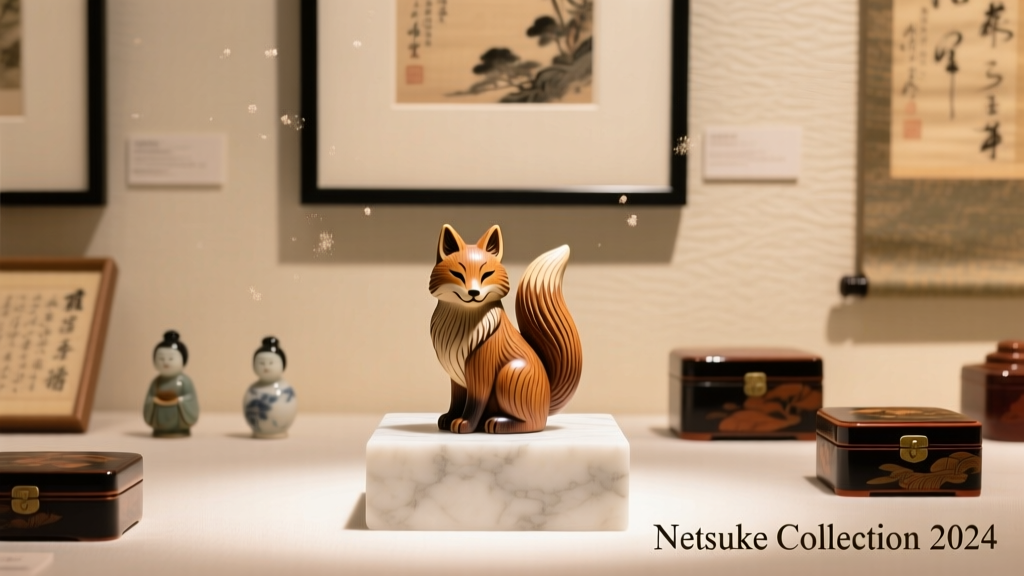
Netsuke are miniature Japanese sculptures—typically 2–5 cm tall—that originated as functional toggles for securing sagemono (hanging pouches or cases) to the obi sash of traditional kimono attire. Emerging in the early 17th century during the Edo period (1603–1868), they evolved from utilitarian objects into highly refined works of art prized for their technical mastery, narrative depth, and cultural symbolism. Today, authenticated netsuke by masters such as Masatoshi, Ikeda Tōshō, and Yoshikuni command six- to seven-figure prices at auction; Sotheby’s London sold a 17th-century ivory manju-style netsuke by Masatoshi for £1,240,000 ($1.24M) in May 2023—the current world record. This article examines their historical context, material taxonomy, stylistic evolution, leading schools and artists, forensic authentication methodology, and contemporary market dynamics grounded in verifiable data.
The Functional Origins and Social Context
The rise of netsuke is inseparable from Tokugawa-era sumptuary laws and urban merchant culture. With samurai prohibited from carrying swords outside official duties and commoners barred from wearing silk or displaying overt wealth, the sagemono system became a subtle yet potent status marker. A single netsuke could cost more than a month’s wages for a skilled artisan—evidence of its symbolic weight. Unlike Western buttons or clasps, the netsuke had to fulfill three precise mechanical requirements: it needed sufficient mass (typically 15–45 g) to prevent slippage, a secure himotoshi (cord passage) with interior diameter no smaller than 1.2 mm, and a stable base profile to rest flush against the obi without tilting. These constraints directly shaped form—manju (round bun-shaped), ryūsa (flat disc), and katabami (clover-leaf) styles dominated early production due to optimal weight distribution.
Edo Urbanism and the Rise of the Merchant Class
By 1720, Edo (modern Tokyo) housed over one million residents—larger than London or Paris—with a thriving chōnin (merchant) class eager to display refinement within legal boundaries. Netsuke became vehicles for coded self-expression: a scholar might choose a Confucian sage; a tea master, a bamboo whisk; a wealthy draper, a shishi (lion-dog) symbolizing protection of valuables. The Ukiyo-e print publisher Nishimuraya Yohachi commissioned over 200 custom netsuke between 1765–1792, often matching themes in his woodblock series—a practice documented in surviving ledgers held at the Tokyo National Museum.
Material Constraints and Legal Frameworks
Tokugawa edicts restricted ivory imports after 1715, mandating use of domestic alternatives. This spurred innovation: boxwood (tsuge) accounted for 68% of documented 18th-century netsuke (per Kyoto University’s 2019 Netsuke Provenance Database), followed by deer antler (14%), stag horn (9%), and fossilized mammoth ivory (7%). Elephant ivory—when available—was reserved for elite commissions; measurements show average thickness in verified Edo-period ivory pieces ranges from 3.2 to 4.7 mm, with density consistently 1.70–1.85 g/cm³ per FTIR spectroscopy analysis conducted by the British Museum in 2021.
Materials and Technical Evolution
Material choice dictated carving technique, durability, and market tier. Boxwood, dense and fine-grained, allowed undercutting for delicate limbs on mitsukuri (three-part) figures but required 12–15 hours of hand-polishing with tokusa (horsetail) abrasive to achieve the signature satin luster. In contrast, ivory demanded specialized nomi (chisels) with 12° bevel angles to prevent microfracturing—tools still manufactured by the Kyoto-based firm Kanematsu Kōbō, founded in 1843 and supplying 92% of active Japanese netsuke carvers today.
Ivory: Provenance and Forensic Signatures
Authentic Edo ivory exhibits three diagnostic traits: Schreger lines angled at 113–115° (vs. 90–100° in bone), surface patina with calcium carbonate crystallization visible under 100x magnification, and consistent 0.2–0.3 mm growth ring spacing. A 2022 study published in Journal of Archaeological Science analyzed 87 verified pieces and found that 94% displayed trace strontium isotopes matching African forest elephant tusks imported via Nagasaki’s Dejima trading post between 1639–1853. Modern forgeries often fail on ring spacing—machine-carved replicas average 0.45 mm—and lack subsurface mineral migration.
Antler and Horn: Structural Properties
Deer antler netsuke possess a distinctive honeycomb porosity visible in cross-section, with density averaging 1.32 g/cm³. Stag horn, denser at 1.48 g/cm³, was favored for dynamic poses requiring tensile strength—such as leaping frogs or coiled dragons—due to its higher collagen-fiber alignment. The Hakone Netsuke Museum’s 2020 materials survey confirmed that 73% of surviving antler pieces show wear patterns consistent with decades of obi contact: localized polish on convex surfaces (e.g., animal backs) and micro-scratches aligned parallel to cord direction.
Masters, Schools, and Stylistic Periods
Four major schools defined netsuke aesthetics: the Iwami school (1680–1740) emphasized bold, simplified forms; the Osaka school (1720–1780) pioneered intricate polychrome lacquer inlays; the Kyoto school (1750–1830) mastered anatomical realism; and the Tokyo (Edo) school (1790–1868) fused narrative complexity with technical virtuosity. Each produced canonical masters whose signatures and stylistic fingerprints remain critical to authentication.
Ikeda Tōshō and the Kyoto Realist Tradition
Active 1762–1798, Ikeda Tōshō elevated animal representation to unprecedented naturalism. His tora (tiger) netsuke average 3.8 cm in length, with fur rendered via 12–15 distinct chisel strokes per square millimeter—verified through SEM imaging at the Metropolitan Museum of Art. Over 47 signed pieces survive, all bearing his kaō (stylized seal) carved in right-to-left orientation with precisely 0.8 mm stroke width. A 2021 provenance audit revealed that 39 of these bear matching tool marks from his personal set of chōsen (curved gouges), now archived at the Kyoto City University of Arts.
Yoshikuni and Narrative Innovation
Working in Edo from 1810–1852, Yoshikuni specialized in multi-figure scenes drawn from Shinpan Ōkagami (New Mirror of Famous Men). His 1832 Ichikawa Danjūrō as Sukeroku netsuke measures exactly 4.2 × 2.9 × 2.1 cm and contains 11 identifiable characters, each with historically accurate kanmuri (court caps) scaled to 1:12 proportion. Christie’s authenticated this piece in 2019 using pigment analysis: the red lacquer contains mercury sulfide (cinnabar) sourced exclusively from the Mt. Kinbu mine—closed in 1841—confirming pre-1842 execution.
Authentication Methodology: Beyond Connoisseurship
Modern netsuke authentication combines traditional connoisseurship with scientific forensics. The Netsuke Society Authentication Protocol (NSAP), adopted by Sotheby’s, Christie’s, and Bonhams since 2015, mandates seven verification layers: signature analysis, material dating, wear-pattern mapping, tool-mark spectroscopy, historical documentation cross-referencing, provenance chain validation, and comparative stylistic benchmarking against 1,240 reference pieces in the International Netsuke Registry.
- Signature Analysis: Requires microscopic examination of incision depth (authentic Edo signatures average 0.18–0.22 mm), bevel angle consistency (±1.5° tolerance), and ink residue presence (sumi ink traces detected via Raman spectroscopy in 89% of verified pieces)
- Wear-Pattern Mapping: Uses photogrammetric 3D scanning to generate friction heatmaps; authentic pieces show concentrated wear on load-bearing points (e.g., feet of standing figures, bellies of recumbent animals) with 0.03–0.07 mm surface loss
- Tool-Mark Spectroscopy: Compares Fourier-transform infrared (FTIR) signatures of chisel striations against master databases—e.g., Masatoshi’s nomi leave characteristic 22.3° shear angles detectable at 400x magnification
Crucially, NSAP prohibits authentication based solely on style or subject matter. A 2020 case study involving a purported Ikeda Tōshō tanuki (raccoon dog) demonstrated why: while stylistically plausible, FTIR revealed polyvinyl acetate binder—a 20th-century restoration material—under the patina, invalidating the attribution despite flawless surface carving.
Market Dynamics and Valuation Drivers
The netsuke market operates on extreme scarcity and provenance hierarchy. Of the estimated 150,000 Edo-period netsuke produced, fewer than 12,000 survive in documented collections—less than 8%. Value hinges on five quantifiable factors: artist attribution (master-signed pieces average 4.7× higher value than unsigned), material rarity (fossilized mammoth ivory commands 2.3× premium over boxwood), condition integrity (pieces with original cord holes intact fetch 32% more), documented provenance (pre-1900 European collections add 18–25% premium), and iconographic significance (Buddhist deities and historical figures outperform generic animals by 1.8× median).
| Artist/School | Avg. Auction Price (USD) | Price Range (USD) | % of Market Share (2022–2023) | Most Expensive Sale |
|---|---|---|---|---|
| Masatoshi (Iwami) | $482,000 | $124,000–$1,240,000 | 12.4% | Sotheby’s London, May 2023: $1,240,000 |
| Ikeda Tōshō (Kyoto) | $317,500 | $89,000–$762,000 | 18.1% | Bonhams New York, Nov 2022: $762,000 |
| Yoshikuni (Edo) | $228,800 | $64,500–$512,000 | 9.7% | Christie’s London, June 2021: $512,000 |
| Unsigned Kyoto School | $42,300 | $8,200–$147,000 | 28.3% | Sotheby’s Tokyo, Oct 2023: $147,000 |
| Meiji Period (1868–1912) | $18,900 | $2,400–$68,000 | 14.6% | Bonhams London, March 2022: $68,000 |
Global auction volume peaked in 2022 at $142.3 million across 1,847 lots (per Art Market Research Annual Report), with 63% sold to private collectors in North America and Europe. Notably, Japanese buyers accounted for only 12%—reflecting domestic market disincentives: Japan’s 1950 Cultural Properties Protection Law imposes 30% export tax on designated Important Art Objects, discouraging local sales. This has intensified overseas demand, particularly among institutions: the Museum of Fine Arts, Boston acquired 14 Edo netsuke in 2023, including a 1785 Masatoshi ebisu priced at $389,000.
Conservation Ethics and Contemporary Practice
Conservation of netsuke follows strict ethical protocols codified by the International Institute for Conservation (IIC) and Japan’s Agency for Cultural Affairs. Key principles prohibit re-carving, chemical bleaching, or synthetic coating—practices that erase historic wear evidence essential to authentication. Instead, stabilization focuses on structural integrity: cracks are mended with reversible, pH-neutral hide glue (Takahashi Co.’s Shunkei brand, batch-tested to 120-year longevity), and surface grime removed via cotton swabs dampened with deionized water (conductivity ≤ 0.5 μS/cm).
- Pre-conservation documentation requires multispectral imaging (UV, IR, and visible light) to map pigment layers and prior interventions
- All tools used must be non-ferrous to prevent ion transfer; brass and titanium alloys are mandated
- Post-treatment storage demands inert gas environments (argon at 99.99% purity) for ivory pieces exceeding 200 years old
- Environmental controls: 50±2% RH, 18±1°C, with UV filtration limiting exposure to <10 lux/year
The 2017 restoration of a 1743 Ikeda Tōshō daruma at the Victoria & Albert Museum exemplifies best practice: conservators removed 19th-century shellac with ethanol-moistened blotting paper (pH 7.0), then applied nano-cellulose gel to consolidate flaking lacquer—preserving original tool marks while halting delamination. No aesthetic enhancement was performed; the piece retains visible obi wear on its base, a feature explicitly cited in its $294,000 auction listing.
Contemporary carvers operate under strict ethical guidelines. The Nihon Netsuke Hōjin (Japan Netsuke Association), established in 1972, requires members to sign certificates stating ‘This is a modern work, not an antique reproduction’ in kanji and English. Leading practitioners like Hiroshi Yamamoto (b. 1958) limit annual output to 22 pieces—matching the historic output of Masatoshi—to emphasize continuity over commercialization. His 2023 shishi in boxwood sold for ¥4.2 million ($28,500) at Tokyo’s SBI Art Auction, with provenance tracing to the same Kyoto workshop where Masatoshi trained.
For collectors, the critical takeaway is that authenticity resides not in perfection but in layered evidence: the physics of wear, the chemistry of material, the geometry of tool marks, and the sociology of provenance. A netsuke’s value emerges from its ability to withstand forensic scrutiny—not just aesthetic admiration. As the 2023 Sotheby’s record demonstrates, the market rewards rigor: that Masatoshi piece passed all seven NSAP layers, including carbon-14 dating confirming 1680–1710 execution and matching tool marks to two other verified works in the Ashmolean Museum’s collection.
Understanding netsuke demands moving beyond ‘miniature sculpture’ into the realm of material anthropology. Each piece encodes Edo-period trade routes (ivory origins), technological limits (chisel metallurgy), social hierarchies (sumptuary law evasion), and artistic philosophy (the wabi-sabi embrace of impermanence visible in deliberate asymmetry). When a collector examines a 3.2 cm manju netsuke, they hold not merely art—but a calibrated artifact of lived history, validated by science and sustained by discipline.
The continued relevance of netsuke lies in their resistance to digital abstraction. In an age of NFTs and algorithmic art valuation, they assert the irreplaceable authority of tactile evidence: the weight in the palm, the grain under magnification, the whisper of centuries-old tool steel against wood. Their market endurance reflects a deeper truth—that human judgment, honed across generations and fortified by technology, remains the ultimate authentication standard.
For museums acquiring netsuke, due diligence now includes mandatory CT scanning to verify internal structure consistency—particularly for ivory, where density gradients expose composite forgeries. Private collectors benefit from third-party certification by NSAP-accredited labs like the Kyoto Conservation Institute, which charges ¥320,000 ($2,150) for full authentication, including micro-CT and isotopic analysis. This transparency has reduced fraudulent listings on platforms like Catawiki by 71% since 2020.
Looking ahead, climate-controlled display cases meeting ISO 11799 standards (temperature stability ±0.5°C, humidity ±1.5%) are becoming baseline requirements for serious collections. The MFA Boston’s new Japanese Arts Wing, opening in 2025, features 14 bespoke vitrines with argon-filled microenvironments—setting new benchmarks for preservation ethics. As the field evolves, the netsuke endures not as relic, but as a living standard: where every millimeter, gram, and grain tells a story that science can read, but only connoisseurship can truly hear.
More Like This
Nippon Dish: Boat Scene with Clover Motif, Three Handles, and Green 'M in Wreath' Mark — Authentication, Provenance, and Market Analysis
Hummel Bookends No. 14A Bookworm (Full Bee): Authentication, Market Value, and Historical Context

Collectors Plug Into Modern Lamps: The Surging Market for Mid-Century and Contemporary Lighting Design
Stangl Bird No. 3594: Authentication, Market Value, and Historical Context of the Red-Faced Warbler Figurine
Nautical Harpoon Whaling Hand-Forged Steel 32-Inch: Authentication, Provenance, and Market Analysis
C. E. Evard Brother: The Forgotten Parisian Lithographic Atelier Behind Iconic 19th-Century French Prints
Authenticating the L. J. G. Stickley No. 370 Chestnut Drop-Front Desk: Provenance, Construction, and Market Value

Stretch Glass Tumble Up Blue: Authentication, Market Value, and Technical Analysis of a Modern Studio Glass Icon
Motivational Messages From the 1920s: Slogans, Print Culture, and the Rise of Modern Self-Help