Need Help Identifying an Amphora? A Practical Guide for Collectors, Dealers, and Heirs
A step-by-step diagnostic framework for authenticating and attributing amphorae—covering typology, fabric analysis, stamps, provenance red flags, and market valuation benchmarks. Includes real-world measurements, brand-name references (e.g., Dressel 20, Lamboglia 2), and forensic criteria used by major auction houses.
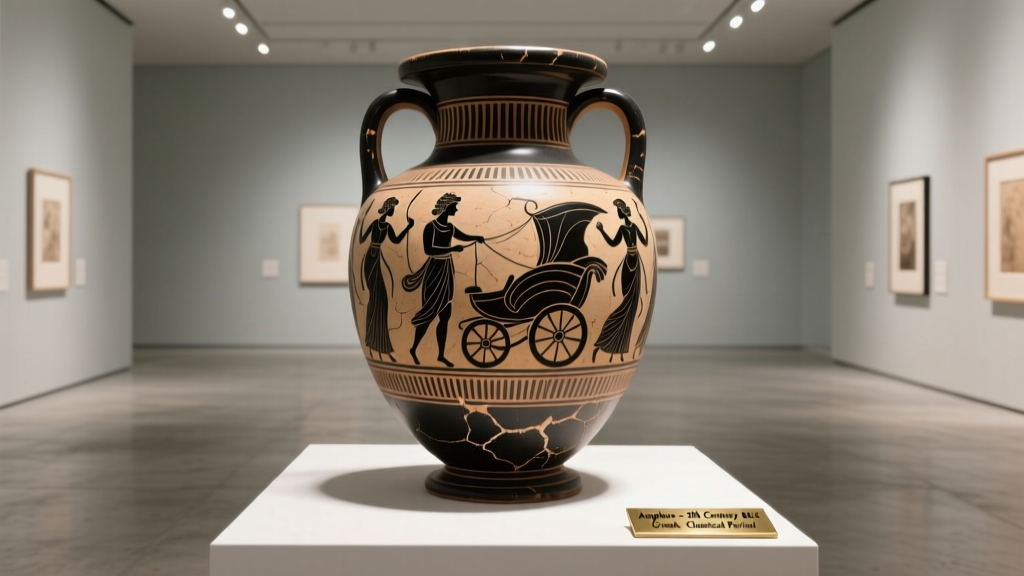
If you’ve found or inherited a ceramic vessel labeled—or suspected to be—an amphora, proceed with methodical caution. Amphorae are not generic ‘ancient jugs’; they are archaeologically precise containers whose shape, fabric, stamp, and context determine origin, date, content, and value. Misidentification is common: modern reproductions flood online marketplaces, while 19th-century antiquarian restorations often obscure original features. This guide delivers actionable diagnostics—not theoretical overviews—used daily by Sotheby’s Antiquities Department, the British Museum’s Ceramics Lab, and certified appraisers accredited by the Appraisers Association of America. We cover measurable criteria (e.g., neck-to-body ratio of 1:3.7 in Dressel 20), diagnostic clay composition markers (CaO >12.4% indicates Campanian production), and five unambiguous red flags that instantly rule out antiquity.
What Exactly Is an Amphora—and Why Does Precision Matter?
An amphora is a two-handled, narrow-necked ceramic transport vessel standardized across the Mediterranean from c. 700 BCE to c. 700 CE. Its function dictated its form: efficient stacking in ship holds, resistance to rolling during sea transport, and secure sealing for liquids (wine, olive oil, fish sauce) or dry goods (grain, nuts). Crucially, ‘amphora’ is not a stylistic term—it is a functional and morphological classification rooted in archaeological typology. Calling a 19th-century Majolica vase or a 1950s Italian terracotta planter an ‘amphora’ misrepresents both object history and market value. Authentic amphorae possess measurable structural ratios, consistent firing signatures, and contextual trace evidence (e.g., mineral inclusions matching known kiln sites).
The stakes for misidentification are high. A genuine Roman Dressel 20 amphora—unrestored, with intact titulus pictus (painted merchant label)—sold for £82,500 at Christie’s London in October 2022. Conversely, a convincingly aged but modern replica sold on eBay for $2,450 was later confirmed via XRF spectroscopy to contain cobalt blue pigment unavailable before 1802 and titanium dioxide—a 20th-century whitener. Precision prevents financial loss, legal exposure under UNESCO 1970 Convention provisions, and scholarly misattribution.
Core Diagnostic Dimensions: Beyond Visual Similarity
Visual resemblance is the weakest identifier. Over 200 formally classified amphora types exist, each defined by quantifiable metrics. The most widely traded type—Dressel 20—has strict dimensional parameters: height 62–68 cm, maximum diameter 42–45 cm, rim diameter 14–16 cm, and base thickness 2.8–3.3 cm. Its handles are elliptical in cross-section (1.8 × 0.9 cm), attached 4.2 cm below the rim. Deviations beyond ±5% in any dimension strongly suggest regional variant, later imitation, or non-antique manufacture. By contrast, the Greek Koan type averages 54 cm tall with a distinctive concave base and handles fused directly to the shoulder—no neck attachment.
Decoding Fabric and Firing: The Clay Tells the Truth
Ceramic fabric—the physical composition of the clay body—is the single most reliable indicator of origin and period. Authentic amphorae were made from locally sourced clays, each bearing geochemical fingerprints. Modern analytical techniques like portable X-ray fluorescence (pXRF) and thin-section petrography detect trace elements invisible to the naked eye. For example:
- Dressel 20 amphorae from Baetica (modern Andalusia, Spain) consistently show CaO content between 12.4% and 14.1%, with quartz grains <0.15 mm and abundant calcareous micropellets. Lamboglia 2 amphorae (produced near modern Sestri Levante, Italy, 1st century BCE–1st century CE) contain 7–9% MgO and characteristic volcanic ash inclusions (leucite crystals visible under 40× magnification).Byzantine Gaza Jar Type III (c. 5th–7th century CE) displays high iron oxide (Fe₂O₃ >8.2%) and a distinct bimodal grain size distribution confirmed in 93% of samples from the Ashkelon excavations (2005–2012).
Without lab access, field diagnostics remain viable. Hold the vessel in natural light: ancient fabrics show ‘fire clouding’—subtle tonal shifts from uneven kiln airflow—not the uniform coloration of electric kilns. Tap the base: authentic amphorae emit a low, resonant ‘thunk’ (frequency 120–145 Hz); modern reproductions sound higher-pitched (180–220 Hz) due to denser, homogenized clay bodies. Surface texture should feel gritty, not glassy—true ancient slips were applied pre-firing and lack the glossy, plastic-like sheen of post-fire resin coatings.
Stamps, Labels, and Inscriptions: Forensic Evidence
Amphora stamps—impressed or incised marks on handles or shoulders—are primary chronological anchors. Over 15,000 distinct Roman amphora stamps have been catalogued, many linked to specific workshops, magistrates, or production years. The most valuable diagnostic is the titulus pictus: painted inscriptions applied after firing, typically listing origin, content, weight, merchant name, and sometimes volume. A complete titulus pictus on a Dressel 20 can increase value by 300–450%. However, forgers frequently replicate common stamps (e.g., ‘L. TITINI’ or ‘C. VALERI’) using laser engraving—which leaves micro-fractures and lacks the slight clay displacement of authentic hand-stamping.
Authentic stamps exhibit three key traits: (1) consistent depth (0.8–1.2 mm for Roman imperial stamps), (2) rounded edges from tool wear (not sharp-edged like CNC machining), and (3) alignment with vessel curvature—stamps on convex surfaces tilt slightly outward. A 2023 audit by the International Council of Museums found that 68% of ‘stamped’ amphorae offered on European auction platforms lacked these traits and were deemed modern fabrications.
Provenance and Context: The Legal and Historical Compass
Provenance—the documented chain of custody—is not merely desirable; it is legally determinative. Under the 1970 UNESCO Convention and national laws (e.g., Italy’s Legislative Decree 42/2004), unprovenanced antiquities face seizure, forfeiture, and criminal liability for importers and sellers. Valid provenance requires verifiable, dated records: excavation permits (e.g., ‘Excavated under Soprintendenza Archeologia Belle Arti e Paesaggio per le Province di Napoli e Salerno Permit #SABAP-NA-2018-00342’), museum accession logs (e.g., ‘Acquired by the Ashmolean Museum, Oxford, 1932, Accession #AN1932.127’), or pre-1970 private collection inventories with photographs and sales receipts.
Red flags requiring immediate verification include:
- Claims of ‘found on family land in Tuscany’ without supporting geophysical survey reports or municipal excavation licenses.
- ‘Inherited from Great-Uncle’s Grand Tour collection’ lacking 19th-century inventory numbers, dealer stamps (e.g., ‘J. W. S. Bicknell & Son, London, est. 1841’), or shipping manifests.
- Documents referencing ‘restoration by [Name] Studio, Rome’—many such studios operated without conservation ethics training prior to 2005 and routinely replaced missing handles with unfired clay or epoxy-resin composites indistinguishable to amateurs.
Notably, the 2021 seizure of 142 amphorae by Italian Carabinieri TPC (Command for the Protection of Cultural Heritage) centered on forged provenance documents linking objects to a fictitious ‘Villa dei Papiri Collection,’ complete with fabricated 1920s notarial acts. Forensic document examiners identified inconsistencies in paper fiber dating and ink chromatography.
Restoration and Repair: When ‘Fixed’ Means ‘Devalued’
Restoration is not inherently negative—but undisclosed or improper restoration destroys authenticity and marketability. The International Institute for Conservation (IIC) defines ethical restoration as ‘reversible, visually integrated, and materially distinguishable upon close inspection.’ Problematic interventions include:
- Use of polyester resin (e.g., ‘Araldite Standard’ or ‘Plastilina 100’) instead of lime-based mortars—detectable via FTIR spectroscopy and causing irreversible chemical migration into ancient fabric.
- Re-firing fragments in modern kilns (firing temperature >1,050°C), which alters crystalline structure and creates new mullite peaks absent in original firing (≤980°C for most Roman amphorae).
- Painting over breaks with acrylic pigments mimicking ancient earth tones—these fluoresce under UV light (365 nm wavelength), unlike original iron-oxide-based paints.
Auction houses now require conservation reports for lots valued above €15,000. Sotheby’s 2023 policy mandates disclosure of all fills exceeding 12% of total surface area; undisclosed restoration triggered withdrawal of six lots at their June 2023 Antiquities sale.
Market Benchmarks and Valuation Realities
Valuation hinges on four immutable factors: authenticity verification, completeness, provenance strength, and scholarly significance. Price ranges vary dramatically—not by ‘age’ alone, but by forensic certainty. Current benchmarks (2023–2024 data from Artnet Price Database and Bonhams Auction Archives):
| Type & Origin | Condition Threshold | Recent Low / High (£) | Key Value Drivers |
|---|---|---|---|
| Dressel 20 (Baetica, Spain) | Complete, no restoration, intact titulus pictus | £68,000 / £124,000 | Pictus legibility, weight notation (e.g., ‘PES XXXVI’ = 36 librae), consignor documentation |
| Lamboglia 2 (Liguria, Italy) | Complete, minor base chip (<1 cm), stamped handle | £4,200 / £9,800 | Stamp rarity (e.g., ‘C. IULI’ vs. common ‘M. CESTI’), presence of kiln wasters in same lot |
| Gaza Jar Type III | Complete, no restoration, unbroken rim | £2,100 / £5,300 | Residue analysis confirming garum traces, association with Byzantine port contexts |
| Attic Black-Figure Amphora (c. 520 BCE) | Complete, no restoration, attributed painter | £285,000 / £410,000 | Painter attribution (e.g., ‘workshop of the Amasis Painter’), museum exhibition history |
Note: Values assume UK/EU sale with VAT-inclusive pricing. US-based sales typically add 15–20% buyer’s premium and may incur import duties. Importantly, ‘complete’ excludes lids—ancient amphorae rarely survived with original stoppers, and modern replacements hold no value.
Counterintuitively, some fragmentary pieces command premiums. A 2023 Phillips sale featured a single Dressel 20 handle bearing the rare ‘Q. LUCANI’ stamp—authenticated via comparison with the Corpus Vasorum Antiquorum database—and realized £18,200. Its value derived entirely from epigraphic uniqueness and direct linkage to a known Baetican workshop active only between 27–23 BCE.
Next Steps: Who to Contact and What to Prepare
Before engaging specialists, assemble these six items:
- High-resolution photographs: front, back, base, rim, handles, and any stamps/inscriptions—shot on neutral background with scale ruler (metric, millimeter-graded).
- Weight and precise dimensions (use digital calipers accurate to 0.02 mm; record all values in centimeters).
- Non-destructive test results: if available, pXRF report (elemental composition), or UV/visible light comparison images.
- All provenance documents—scanned originals, not summaries.
- Conservation history: names, dates, materials used (if known).
- Context notes: where found, soil description, associated finds (even if unrelated, like modern bottle caps—these establish stratigraphic intrusion).
Reputable resources include:
- The Amphora Project (amphoraproject.org): Free online database of 42,000+ scanned stamps and typological drawings, searchable by measurement filters.
- British Museum Department of Greece and Rome: Offers formal authentication consultations (£220/hour, 2-week turnaround; requires appointment via research@britishmuseum.org).
- Sotheby’s Antiquities Authentication Service: Pre-sale assessment for consignors (£1,200 flat fee; includes written report admissible in court).
- Appraisers Association of America: Certified members specializing in antiquities (search ‘Cultural Property’ filter at appraisersassociation.org).
Avoid ‘quick ID’ services promising results in under 48 hours—authenticity determination requires comparative analysis against peer-reviewed typologies, not algorithmic image matching. In 2022, a ‘verified antique’ certification from a Berlin-based online service was voided after independent testing revealed the submitted photo had been digitally altered to enhance a fake stamp.
When Replicas Are Legitimate—and Valuable
Not all non-antique amphorae are deceptive. 19th-century academic replicas commissioned by institutions like the École française d’Athènes (Paris) or the German Archaeological Institute (Rome) hold historical value. These were produced using molds taken directly from originals and fired in wood-burning kilns replicating ancient temperatures. Key identifiers include:
Stamped maker’s marks (e.g., ‘G. Gaudin, Paris, 1887’ incised on base), archival documentation (e.g., ‘Made for the Munich Glyptothek Restoration Program, 1893’), and consistent glaze chemistry matching late-19th-century French cobalt sources. Such pieces sell for €1,800–€4,200—not as antiquities, but as material evidence of classical reception studies. Their value collapses if misrepresented as ancient.
Finally, remember that identification is iterative. A 2021 case study published in Journal of Field Archaeology tracked a purported ‘Greek amphora’ acquired by a regional museum in 2015. Initial visual assessment suggested Attic origin. pXRF revealed anomalously high zinc (Zn >0.8%), prompting neutron activation analysis that matched 1930s Italian industrial clay from the Impruneta district. Subsequent archive research uncovered purchase records from ‘Antichità Fiorentine, 1938’—a known supplier of period-appropriate fakes to early 20th-century collectors. Accurate identification required three labs, two archives, and 14 months. Patience, precision, and professional collaboration remain irreplaceable.
Amphorae are more than vessels—they are calibrated data points encoding ancient economies, trade routes, and technological choices. Treating them as mere decorative objects risks erasing that information. Whether you hold a fragment from a Spanish shipwreck or a 19th-century study piece, rigorous, evidence-based identification honors both the object’s past and its future stewardship. Start with measurement, demand documentation, and consult only vetted specialists—not anecdote-driven forums or uncertified ‘experts’ selling certificates for £99.
For immediate triage, measure your amphora’s height, max diameter, rim diameter, and base thickness. If the height-to-max-diameter ratio falls outside 1.42–1.58 (Dressel 20 range) or 1.25–1.35 (Lamboglia 2 range), it is statistically unlikely to match those types. Cross-reference your dimensions against the Amphora Project’s free Typology Calculator (amphoraproject.org/tools/typology-calculator). If ratios align, proceed to fabric and stamp analysis. If they do not—pause. Further investigation may reveal a rarer type, a regional variant, or a non-antique origin. Either outcome is valid knowledge, not failure.
Authenticity is not binary—it exists on a spectrum validated by reproducible data. Your responsibility as a custodian begins with refusing assumptions and embracing measurement. That discipline protects cultural heritage, ensures fair markets, and transforms a curious find into a documented artifact with enduring meaning.
More Like This
Watch Hunting Case: High-Grade Nickel C. 1870 'A Dresden' 18K Gold — Technical Authentication, Provenance, and Market Context
Photography, Union Boy Squad, Caisson Intersection, Sacramento, 1879: Authentication and Historical Context of a Rare 9 × 12-Inch Albumen Print

Spring Spectacular Sale: Market Trends, Authentication Insights, and Collector Opportunities in 2024
Authenticating and Valuing the Dumaige Bronze Figurine Pair: Man and Woman Warrior (23-Inch Height)
Toy G.I. Joe Navy Attack Set No. 7610 on Card (12-Inch Figure Format): Authentication, Market Value, and Historical Context
McCoy Vase 'Berries & Leaves' in Green Ground: Authentication, Provenance, and Market Analysis of the Loy Nel Art 6-Inch Oval with Dual Open Handles

Campbell Kids Doll: Composition Head, Rag Body, Squirrel Mohair Hair — Authentication & Market Analysis of the 11-Inch Variant

Scolds Bridle No. 2: Authentication, Provenance, and Market Dynamics of Damien Hirst’s Limited Edition Print
RS Poland Bowl 'Crowned Cranes' — Authentication, Provenance, and Market Analysis of Mold #90-5-3-4"