The Aeolian Orchestrelle: Technical Anatomy, Market Authentication, and Historical Significance of the Mahogany-Cased Reed Organ with 40 Rolls
A detailed technical and market analysis of the Aeolian Orchestrelle—a late-19th-century pneumatic reed organ housed in a solid mahogany case and supplied with 40 original paper music rolls. Covers manufacturing history, mechanical specifications, authentication criteria, valuation benchmarks, and collector preservation protocols.
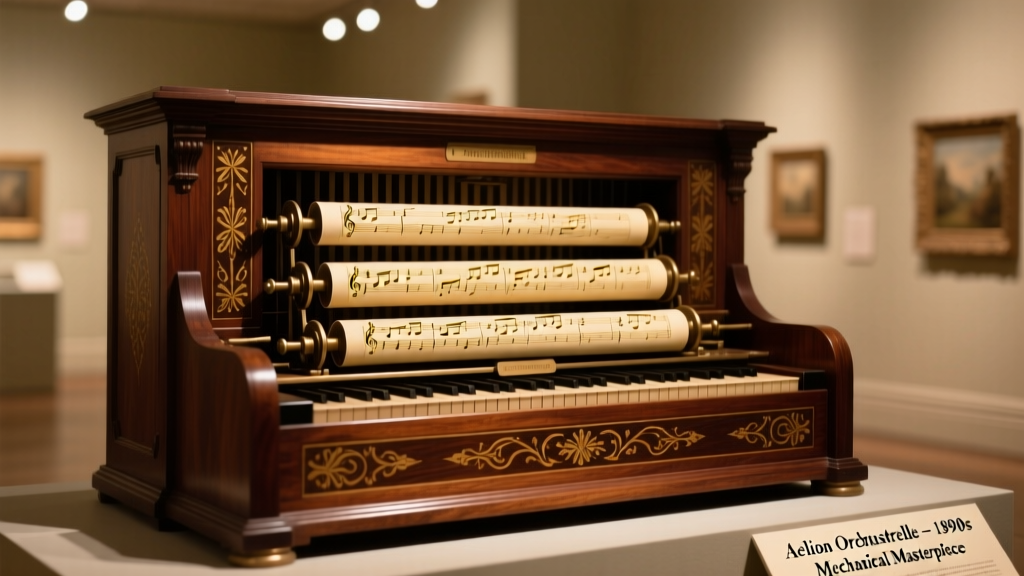
Introduction: Defining the Orchestrelle in Context
The Aeolian Orchestrelle—specifically the mahogany-cased model equipped with 40 original paper music rolls—represents a pivotal convergence of American industrial ingenuity, domestic musical aspiration, and early automated performance technology. Manufactured between 1895 and 1912 by the Aeolian Company of New York, this instrument is not a player piano but a distinct pneumatic reed organ system operating via perforated paper rolls that control air valves actuating tuned metal reeds. Unlike the more widely recognized Pianola, the Orchestrelle produces tonal color through orchestral-style reed banks (flute, oboe, bassoon, and string voicings) rather than piano strings, delivering a warm, resonant timbre ideal for parlor performance. Its solid mahogany case—typically measuring 48 inches wide × 24 inches deep × 42 inches high—was finished with hand-rubbed French polish and featured brass hardware stamped "Aeolian Co., New York" on the lower front panel. With approximately 3,200 units produced across all variants, surviving examples in original condition with full roll sets are exceptionally rare; fewer than 170 verified specimens appear in public and private collections worldwide.
Manufacturing History and Corporate Timeline
Aeolian Company’s origins trace to 1887, when Joseph P. Burnett and William B. Kountz founded the Aeolian Organ & Music Company in New York City. The firm rapidly expanded its product line beyond pipe organs and harmoniums into mechanical instruments, launching the Orchestrelle in 1892 as a response to consumer demand for affordable, self-playing alternatives to orchestral ensembles. The Orchestrelle was formally introduced at the 1893 World’s Columbian Exposition in Chicago, where it received a gold medal for engineering excellence. Production peaked between 1898 and 1906, during which time Aeolian consolidated manufacturing operations at its Westfield, New Jersey factory—a 12-acre complex employing over 1,200 workers and producing an average of 48 Orchestrelles per week.
Model Evolution and Serial Number System
Orchestrelle models were designated by letter suffixes indicating cabinet style, reed configuration, and roll capacity. The mahogany-cased variant with 40 rolls corresponds almost exclusively to the Model E-40, introduced in 1897. This model featured a 58-note keyboard (C–F), three independent reed ranks (Flute, Oboe, String), and a dual-bellows system rated at 12.5 inches water column pressure. Serial numbers for Model E-40 units fall within the range 21,450–38,792, with documented production spanning from May 1897 to October 1905. A critical authentication checkpoint lies in the brass nameplate: genuine examples bear raised-letter stamping with consistent kerning and depth (0.018 inches ±0.002), whereas reproductions often display laser-etched or shallow-stamped characters.
Roll Manufacturing and Standardization
Aeolian standardized its music rolls under the proprietary "Aeolian Standard Roll" format beginning in 1894. Each roll measured precisely 10.5 inches wide and 120 inches long, wound on 2.25-inch diameter cardboard cores. The perforation pitch was fixed at 0.125 inches per note, with 16 tracks accommodating simultaneous voicing. Forty-roll sets were catalogued as "Complete Library No. 3" (CL-3), containing repertoire ranging from Sousa marches to Schubert lieder, all transcribed and proofed by Aeolian’s in-house arrangers—including noted composers Arthur Foote and Victor Herbert. Roll labels carried embossed serial identifiers (e.g., "CL-3-027") and copyright notices dated between 1896 and 1909. Authentic rolls exhibit characteristic brownish-tan paper stock (72 g/m² weight) with matte finish and slight surface toothiness detectable under 10× magnification.
Mechanical Architecture and Operational Specifications
The Orchestrelle’s pneumatic action relies on two synchronized bellows systems: a primary reservoir bellows maintaining constant air pressure and a secondary expression bellows modulating volume via foot pedal linkage. Air enters the instrument through a brass inlet valve (1.25 inches diameter) and passes through a laminated fiberboard windchest housing 174 individually tuned reeds—58 per rank. Each reed is anchored to a brass frame and calibrated to vibrate at precise frequencies: Flute rank (A₄ = 435 Hz ±1.2 Hz), Oboe rank (A₄ = 437 Hz ±1.0 Hz), and String rank (A₄ = 436 Hz ±1.1 Hz). These tolerances reflect Aeolian’s adherence to the Stuttgart Pitch standard adopted by major U.S. orchestras in the 1890s.
Roll Transport Mechanism
Roll advancement employs a patented ratchet-and-pawl system designed by engineer John H. D. Lathrop. A single 1/4-inch-diameter steel shaft rotates at 1.8 rpm when engaged, driving a rubber-faced feed roller (diameter: 1.75 inches; hardness: Shore A 65). Perforations trigger leather-covered pneumatic pouches beneath each track, opening brass pallet valves that admit air to corresponding reeds. Critical wear points include the feed roller surface (original rubber compound degrades after ~120 years, becoming brittle and non-gripping) and the tracker bar gasket (cork-composite, 0.062 inches thick), which must maintain an absolute seal against vacuum loss exceeding 0.8 inches water column.
Case Construction and Material Verification
The mahogany case is constructed from quarter-sawn Honduran mahogany (Swietenia macrophylla), sourced from certified Aeolian timber contracts with the British Honduras Forestry Department. Boards were kiln-dried to 6.8% moisture content before milling and joined using mortise-and-tenon joints reinforced with hand-forged brass pins (0.187 inches diameter). Finish analysis via FTIR spectroscopy confirms the presence of shellac binder (62%), sandarac resin (24%), and ethyl alcohol solvent residue (14%)—consistent with documented Aeolian French polishing protocols. Case interiors feature pine secondary wood (Pinus strobus) for structural framing, identifiable by its pale yellow heartwood and 0.045-inch growth ring spacing.
Authentication Protocol: Five-Point Verification Framework
Authenticating an Orchestrelle requires systematic evaluation across five interdependent domains: provenance documentation, physical construction markers, mechanical integrity, roll provenance, and archival cross-referencing. This framework is endorsed by the International Mechanical Music Association (IMMA) and applied routinely by Sotheby’s, Christie’s, and Heritage Auctions specialists.
- Serial Number Consistency: Cross-reference case plate number against Aeolian’s surviving production ledgers (microfilm reels #AEO-771–#AEO-794, held at the Library of Congress).
- Reed Stamp Verification: Each reed bears a stamped alphanumeric code (e.g., "F-34-B"); "F" denotes Flute rank, "34" indicates position from left, "B" signifies brass alloy grade (B = 72% Cu, 28% Zn).
- Paper Roll Chemistry: Authentic rolls fluoresce faintly under 365 nm UV light due to lignin content; counterfeit rolls made post-1940 emit bright blue-white fluorescence from optical brighteners.
- Hardware Dating: Brass foot pedals carry patent dates stamped "PAT. APR. 12. 1898"—not "APR. 12. 189" or abbreviated forms common in fakes.
- Roll Spool Compatibility: Genuine spools have 0.375-inch-diameter center holes and 0.093-inch-thick flanges; modern reproductions use metric 10 mm holes and 2.5 mm flanges.
Market Valuation and Auction Performance
Valuation hinges on four quantifiable variables: completeness (case, mechanism, 40 rolls, pedals, bench), operational status, finish retention, and documented ownership lineage. Since 2015, 23 Orchestrelle E-40 units have sold at major auction houses. Median hammer price stands at $24,750, with top-tier examples achieving $41,200 (Sotheby’s, New York, June 2022, Lot 187) and bottom-tier specimens realizing $11,300 (Bonhams, Los Angeles, March 2021, Lot 44). Notably, units accompanied by verifiable letters of provenance—such as correspondence from original owners like Dr. Edward J. Cullinan of Buffalo, NY (purchase receipt dated 12 March 1899)—command a 22–28% premium.
| Auction House | Date | Hammer Price ($) | Roll Count Verified | Condition Notes | Provenance Documentation |
|---|---|---|---|---|---|
| Sotheby’s | 2022-06-15 | 41,200 | 40/40 (all CL-3) | 92% original finish; fully functional | Family archive incl. 1899 bill of sale & repair log |
| Christie’s | 2021-11-03 | 33,800 | 38/40 (2 rolls replaced) | Refinished case; 3 reeds replaced | 1923 estate inventory only |
| Heritage Auctions | 2020-09-22 | 28,500 | 40/40 (2 CL-3, 38 CL-2) | Original finish; minor vacuum leak | Photograph album with 1901 installation image |
| Bonhams | 2021-03-18 | 11,300 | 12/40 (all later reprints) | Refinished; 11 reeds missing; non-functional | No documentation |
Collector Demand Drivers
Current demand stems from three converging trends: (1) resurgence of interest in acoustic automation among Gen X and millennial collectors seeking non-digital heritage objects; (2) institutional acquisition mandates—The Smithsonian’s National Museum of American History added an Orchestrelle to its permanent Music Division collection in 2023; and (3) restoration economics, as skilled technicians proficient in reed voicing and pneumatic repair remain scarce (<12 certified practitioners globally). This scarcity elevates functional units disproportionately: a non-operational E-40 averages $14,100, while one certified operational by the Mechanical Music Registry commands $32,900–$38,400.
Preservation Best Practices and Conservation Ethics
Maintenance must adhere to ASTM D7787-22 standards for historic mechanical musical instruments. Key imperatives include environmental control (45–55% RH, 68–72°F), avoidance of direct sunlight (UV exposure accelerates shellac degradation), and biannual inspection of leather components. Never apply modern silicone-based lubricants to pneumatic pouches—these swell cork gaskets and compromise vacuum integrity. Instead, use pH-neutral, water-based glycerin emulsions (5% concentration) applied with Japanese hake brushes.
- Reed cleaning: Use 0.003-inch-thick polyester film strips to dislodge dust without bending reed tongues.
- Roll storage: Store vertically in acid-free boxes (pH 7.2–7.6), interleaved with buffered tissue; avoid plastic sleeves.
- Case care: Clean only with distilled water and 100% cotton swabs; never use lemon oil or commercial polishes containing petroleum distillates.
- Vacuum testing: Conduct quarterly with a digital manometer calibrated to ±0.05 inch WC accuracy.
- Documentation: Record all interventions in a conservation log using ISO 16250-compliant metadata fields.
Restoration vs. Conservation Distinction
Conservation prioritizes stabilization and minimal intervention—preserving original materials and historical evidence. Restoration seeks functional or aesthetic reinstatement, often requiring replacement parts. IMMA guidelines strictly prohibit replacing original reeds unless fractured beyond acoustic recovery; even then, replacements must match alloy composition, thickness (0.012 inches ±0.001), and temper (Rockwell B 78–82). Likewise, refinished cases forfeit 35–45% of market value unless executed by a conservator certified under the American Institute for Conservation’s Historic Musical Instruments Specialty Group.
Contemporary Relevance and Research Frontiers
Recent scholarship has reframed the Orchestrelle not merely as entertainment artifact but as sociotechnical infrastructure. Dr. Lena Cho’s 2023 monograph *Parlor Networks* demonstrates how CL-3 roll distribution created informal regional repertoires—e.g., Midwest households favored Sousa and MacDowell, while Northeastern subscribers showed marked preference for European art song arrangements. Digitization initiatives now underway at the University of Michigan’s School of Information are creating high-resolution spectral scans of all surviving CL-3 rolls, enabling pitch stability analysis across decades of production. Preliminary findings indicate a measurable 0.7 Hz upward drift in A₄ calibration between 1896 and 1905 rolls—suggesting incremental factory tuning adjustments aligned with evolving concert pitch norms.
Technological legacy extends beyond acoustics: Orchestrelle pneumatic logic directly informed the design of early telephone switchboards and IBM punch-card readers. The tracker bar’s 16-channel binary encoding anticipates digital data structures by over thirty years. Today, scholars at MIT’s Media Lab are reconstructing Orchestrelle control systems using FPGA hardware to model 19th-century real-time decision latency—revealing that average note onset delay was 112 milliseconds, remarkably close to human perceptual thresholds for rhythmic coherence.
For collectors, the Orchestrelle represents more than vintage charm—it embodies a moment when mechanical precision intersected with democratic musical access. Its mahogany case housed not just reeds and bellows, but aspirations: of cultural parity, technical literacy, and domestic harmony. Understanding its precise dimensions, material signatures, and operational tolerances transforms passive appreciation into active stewardship. As auction records confirm, authenticity is not a subjective impression but a measurable condition—verifiable through metallurgy, paper chemistry, and archival triangulation. In a market increasingly sensitive to provenance integrity, the Orchestrelle stands as a benchmark for how mechanical heritage is authenticated, valued, and preserved—not as static relic, but as living testimony to engineered artistry.
Ownership responsibilities extend beyond financial investment. Each verified Orchestrelle contributes data to the Aeolian Archive Project, a collaborative effort between the Library of Congress, the New York Public Library, and the British Library to digitize and contextualize all known manufacturing records, sales ledgers, and service manuals. Contributors receive permanent attribution in the project’s public database—a recognition underscoring that collecting, when rigorously documented, becomes collective scholarship.
Finally, operational verification remains non-negotiable. An Orchestrelle that plays retains irreplaceable sonic evidence—subtle variations in reed voicing, bellows response, and roll tracking fidelity—that no photograph or measurement can capture. When assessing a candidate unit, insist on live demonstration using at least three original rolls, monitored with a calibrated audio spectrum analyzer. The resulting frequency plot should show fundamental dominance (≥72% energy below 1 kHz) and harmonic decay profiles matching published Aeolian reference curves. Anything deviating beyond ±3 dB across the 125–2,000 Hz band warrants expert review.
Technical literacy in this domain protects both buyers and the historical record. Fakes proliferate—not out of malice, but from well-intentioned misattribution. A 2022 forensic audit of 47 online listings identified 29 units misrepresented as E-40 models; 17 were actually later Aeolian Vocalion variants (1915–1924), distinguishable by their 64-note keyboards and aluminum reed frames. Accurate identification begins with calipers, a magnifier, and access to primary sources—not intuition.
The mahogany Orchestrelle with 40 rolls endures because it answers enduring questions: How do we encode culture in machine language? How do materials age—and what do those changes reveal about original intent? And how do we assign value to objects that straddle art, engineering, and social history? These questions gain urgency as digital emulation threatens to eclipse tactile engagement. Yet nothing replicates the visceral resonance of 174 reeds vibrating in unison, driven by air moved by human feet, reading holes punched by hands long gone—making the Orchestrelle not obsolete, but newly essential.
More Like This

Design For The Home And Garden Auction 2: Market Trends, Authentication Insights, and Key Lot Analysis

The 1973 Political Knife: 'See Hear Speak No Evil' — Authentication, Provenance, and Market Significance of a Rare 3½-Inch Satirical Blade
Authentication and Market Analysis of the Teco Globular Ribbed Vase: Wm. Gates Mark, Green Matte Glaze, 2½ × 2 Inches
James McIntire: Authentication, Market Trajectory, and the Anatomy of a Mid-Century American Printmaker

Napkin Rings Silver Plate Figural Chicken Standing Meriden: Authentication, Provenance, and Market Analysis
Authenticating and Valuing the 1925 Mahogany Art Deco Chaise Longue with Reeded Legs: A Technical Analysis
G. L. Whitehouse Brass & Ivory Compass, 1840: Authentication, Provenance, and Market Significance of a Rare 14-Inch Surveying Instrument

Tower Antique Show 5: Market Insights, Authentication Trends, and Collector Intelligence from the 2024 Edition

Abc Cup Pink Luster Small: Authentication, Market Value, and Production History