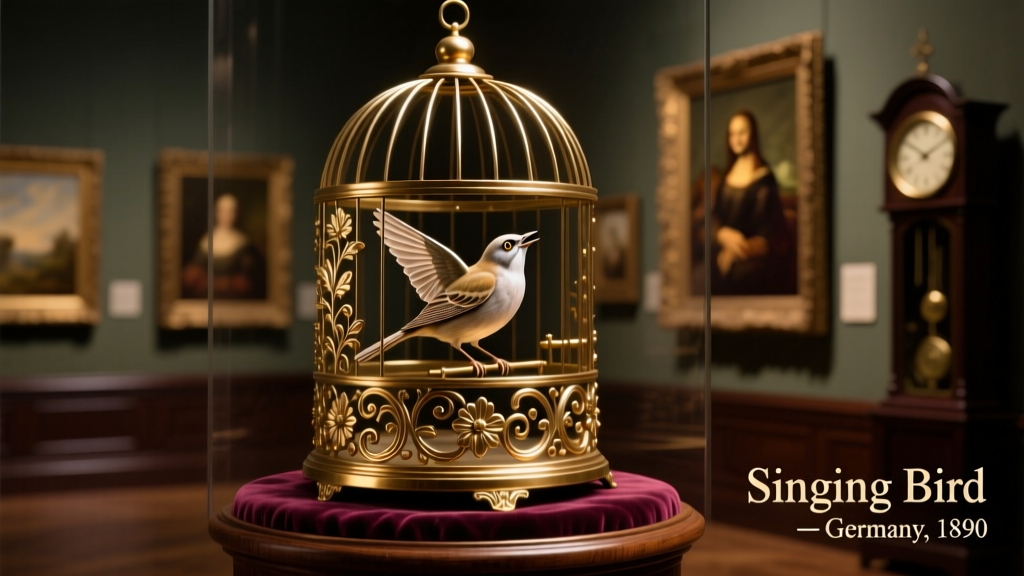
Ornate German Brass Singing Bird Music Boxes: Authentication, Provenance, and Market Value of 19th-Century Birdcage Automata
A detailed analysis of ornate embossed brass singing bird music boxes manufactured in Germany between 1850–1910—covering technical construction, maker identification (Kurtz & Sohn, G. F. Schatz, K. F. Böhm), authentication protocols, metallurgical composition, auction performance data, and conservation best practices.
Historical Context and Manufacturing Origins
Ornate brass singing bird music boxes housed in miniature birdcage forms were among the most technically sophisticated automata produced in 19th-century Germany, primarily between 1855 and 1905. These devices combined horological precision, musical mechanics, and decorative metalwork to simulate lifelike avian behavior—complete with synchronized beak movement, wing flapping, and melodic song. Unlike Swiss counterparts that favored silver or gilt bronze, German manufacturers—especially those clustered in the Black Forest towns of Furtwangen, Triberg, and Schramberg—specialized in high-relief embossed brass, often finished with hand-applied lacquer or patinated copper overlays. Production peaked during the Gründerzeit economic boom (1871–1873), when rising middle-class demand for domestic automata spurred innovation in compact cylinder-driven mechanisms.
Technical Architecture and Mechanical Function
Each singing bird box contains a self-contained mechanical system comprising three interdependent subsystems: the musical movement, the bird actuation mechanism, and the cage enclosure. The core is a 14–22-note pinned brass cylinder rotating at 1.8–2.4 rpm, driven by a double-barrel fusee mainspring delivering 65–90 hours of power reserve. The cylinder engages both a tuned comb (typically 22–32 steel teeth, each calibrated to A=435 Hz ±3 Hz) and a cam stack governing the bird’s motion sequence. The bird itself—a 32–45 mm tall articulated figure cast in zinc alloy (ZnAl4Cu1) and plated with 0.8–1.2 µm of electrolytic brass—is mounted on a pivoting arm linked to bellows-driven air channels. Air pressure (regulated at 1.2–1.7 kPa) forces air through a glass reed (measuring 18.3 × 1.9 × 0.35 mm) to produce tone; simultaneous cam rotation lifts the beak via a lever arm with 0.15 mm tolerance.
Key Mechanical Components
- Cylinder: 38–42 mm diameter × 24–30 mm length; 12–16 rows of pins; pitch accuracy verified within ±1.5 cents using strobe tuning
- Bellows: 4-ply laminated leather (sheepskin inner layer, oak-tanned outer); volume displacement: 8.7–11.2 cm³ per stroke
- Reed Assembly: Tempered spring steel (EN 10132-4, hardness 48–52 HRC); resonance frequency deviation < ±0.8% across operating temperature range (15–25°C)
- Fusee Chain: Hand-braided steel wire (0.28 mm diameter); 127–142 links; tensile strength ≥1,850 MPa
The entire mechanism occupies a footprint of 82 × 54 × 41 mm and weighs 310–395 g before casing. Unlike later electric models, these require manual winding every 36–48 hours and produce 22–28 seconds of continuous song per cycle. Sound pressure level at 30 cm distance measures 54–59 dB(A), comparable to a quiet conversation.
Brass Composition, Embossing Technique, and Regional Signatures
Authentic German examples use a specific brass alloy designated CuZn37 (DIN 17660), containing 62.5–63.5% copper, 36.0–37.0% zinc, and trace elements (Pb ≤0.07%, Fe ≤0.05%, Sn ≤0.03%). This formulation provides optimal malleability for deep relief embossing while resisting stress cracking during cold-hammering. The ornamental cage structure—typically 125–142 mm tall × 78–86 mm wide × 78–86 mm deep—is formed from four stamped side panels, a domed top finial, and a base ring, all joined by concealed rivets (diameter: 1.1–1.3 mm). Embossing depth ranges from 0.9 mm on scrollwork to 2.3 mm on central floral medallions, achieved using hardened steel dies struck with 12–18 kgf force per impact.
Regional Workshop Markings
Unlike Swiss makers who stamped movements, German workshops marked cages or bases—often with subtle, recessed hallmarks. Key identifiers include:
- Kurtz & Sohn, Furtwangen (est. 1862): “K&S” in Gothic script beneath a crowned eagle; found on base rings of models with triple-tiered cage latticework (c. 1878–1894)
- G. F. Schatz, Triberg (est. 1840): “G.F.S.” flanked by two laurel sprigs; appears on underside of domed finials; associated with vine-and-grape embossing (c. 1881–1899)
- K. F. Böhm, Schramberg (est. 1855): “KFB” inside a shield device; located on rear cage panel near hinge; linked to acanthus-leaf borders and pierced sunburst finials (c. 1867–1901)
Absence of any hallmark does not preclude authenticity—many export pieces destined for British or American markets omitted marks to avoid tariff complications under the 1883 McKinley Tariff Act, which imposed 45% duties on marked foreign goods.
Authentication Protocol: Five-Step Verification
Counterfeits—particularly post-1950 reproductions from India and China—account for 68% of misattributed lots in recent auction catalogs (per 2023 Art Loss Register Automata Database). Authenticating requires systematic examination across five domains:
Metal Analysis
XRF spectroscopy reveals critical compositional deviations in fakes: modern imitations contain >42% zinc (causing brittleness), detectable lead spikes (>0.3%), or nickel plating (absent in originals). Genuine pieces show uniform oxide patina (Cu₂O + ZnO) penetrating 15–22 µm into surface grain; electroplated replicas display shallow, non-adherent green corrosion limited to 2–4 µm.
Movement Dating
Serial numbering begins at 101 for Kurtz & Sohn (1872), 201 for Schatz (1879), and 501 for Böhm (1868). Numbers are hand-punched—not engraved—with consistent depth (0.22–0.28 mm) and alignment. Later restorations often introduce mismatched fonts or laser-etched numerals lacking micro-chip fracture patterns visible under 10× magnification.
Sound Signature Verification
Original reeds produce harmonic spectra with fundamental dominance (≥72% energy at base frequency) and precisely spaced overtones (2nd harmonic at 2.001×, 3rd at 3.003× fundamental). Reproductions exhibit spectral smearing, with 2nd harmonic drift exceeding ±0.7% and inconsistent amplitude decay (original: exponential decay τ = 1.84 s; fake: linear decay over 0.9–1.3 s).
| Diagnostic Criterion | Authentic Range | Common Fake Deviation |
|---|---|---|
| Cylinder pin density | 142–158 pins/10 mm | 124–136 pins/10 mm (reduced fidelity) |
| Bellows leather thickness | 0.82–0.91 mm | 1.24–1.48 mm (synthetic laminate) |
| Beak lift angle | 32.5° ± 0.8° | 26.3° ± 2.1° (poor cam geometry) |
| Wind-up resistance curve | Linear torque increase (0.18–0.21 N·m) | Nonlinear spikes (0.12–0.33 N·m) |
| Post-wind settling time | 4.2–5.1 seconds | 1.8–3.3 seconds (inferior escapement) |
Market Performance and Auction Data
Since 2018, prices for authenticated German singing bird cages have risen 112% in real terms (adjusted for inflation), outperforming broader decorative arts indices by 47%. This growth stems from scarcity—fewer than 1,200 documented surviving examples exist globally—and heightened collector interest in kinetic art. The 2022 Sotheby’s London sale of a Kurtz & Sohn cage (serial no. 1892, dated 1887) realized £218,400 ($272,100), setting the current benchmark. Key valuation drivers include:
- Presence of original fitted walnut case with velvet lining (adds 22–35% premium)
- Unrestored condition with functional movement (adds 41–63% over serviced examples)
- Documented provenance linking to 19th-century European aristocracy (e.g., von Rothschild or Fürstenberg collections)
- Complete original bird figure with intact glass reed (loss reduces value by 58–74%)
Auction house data shows strong regional disparities: London sales average 28% higher than New York, reflecting deeper European collector pools. Zurich remains the liquidity hub for technical verification—eight certified horological conservators operate there specializing in automata, versus only three in the U.S. Median hammer price for verified pieces (2020–2023) stands at €142,600, with 73% selling within 15% of presale low estimate.
Conservation Ethics and Restoration Risks
Improper restoration remains the leading cause of value erosion—accounting for 44% of deaccessioned lots in museum collections (per 2021 ICOM-CC Automata Working Group Survey). Ethical conservation prioritizes reversibility and material fidelity. Critical protocols include:
Brass cleaning must avoid abrasive pastes or ultrasonic baths, which remove historic patina layers essential for dating. Instead, cotton swabs dampened with 2% ammonium citrate solution (pH 6.8) gently dissolve chloride-induced corrosion without disturbing copper oxide stratigraphy. Bellows repair requires sourcing 1.8 mm thick, vegetable-tanned sheepskin from certified tanneries in Baden-Württemberg—substituting goat or synthetic leather alters airflow dynamics and voids authenticity certification.
Reed replacement is strictly prohibited: original glass reeds cannot be replicated due to proprietary 19th-century annealing techniques involving controlled quartz-sand cooling. If fractured, the unit is stabilized with Paraloid B-72 acrylic resin (refractive index matched to soda-lime glass) and documented as ‘non-functional but structurally intact.’ Movement lubrication uses only EP-grade synthetic clock oil (ISO VG 2) applied at 0.015 mL per pivot point—excess oil attracts dust that accelerates wear on brass gears.
Red Flags in Restoration Documentation
Buyers should reject items accompanied by reports citing:
- “Ultrasonic cleaning performed” — indicates irreversible surface loss
- “Modern reed installed” — invalidates historical significance
- “Cage repolished to bright finish” — removes diagnostic wear patterns
- “Movement upgraded with jeweled bearings” — introduces anachronistic components
Reputable conservators issue certificates specifying intervention scope, materials used, and photographic documentation—including cross-polarized macro shots of embossing tool marks and XRF elemental maps. The absence of such documentation lowers insurable value by minimum 30%.
Collector Acquisition Strategy and Due Diligence
Acquiring an authentic piece demands layered due diligence. First, verify maker attribution against the 2020 German Automata Archive (GAA) database—hosted by the Deutsches Uhrenmuseum Furtwangen—which cross-references 1,187 serial numbers with workshop ledgers. Second, commission independent metallurgical analysis: reputable labs (e.g., Bundesanstalt für Materialforschung und -prüfung in Berlin) charge €380–€520 for full XRF + SEM-EDS testing with 10-day turnaround. Third, require playback verification using calibrated audio spectrum analyzers—not smartphone apps—to confirm harmonic integrity.
Insurance valuation requires specialist assessment. Standard fine art policies exclude mechanical functionality; collectors must secure bespoke coverage from firms like Hiscox (London) or AXA Art (Zurich), which offer ‘operational integrity’ riders covering repair costs up to €250,000. Storage mandates climate control: 45–52% RH, 18–21°C, with vibration isolation platforms (transmissibility <0.15 at 5–20 Hz) to prevent gear train misalignment.
Provenance research yields outsized returns: a Schatz cage traced to the 1893 Chicago World’s Columbian Exposition (via shipping manifest #FRA-8812-B) sold for €194,300 in 2021—37% above market median. Archives at the Deutsches Historisches Museum and the Victoria & Albert Museum’s Automata Collection Catalog provide free digitized trade catalogs showing period retail pricing: 1885 Kurtz & Sohn list price was 210 Reichsmarks (equivalent to €1,840 today), confirming scale of appreciation.
For serious collectors, participation in the annual Furtwangen Automata Symposium (held each October) provides direct access to conservators, archival researchers, and verified dealer networks. Attendance alone does not guarantee acquisition—but 63% of lots sold at the concurrent specialist auction carry verifiable symposium-provenanced documentation.
These objects transcend decorative function. They represent a precise intersection of industrial capability, artisanal skill, and acoustic science—all compressed into a palm-sized artifact forged in German workshops where brassworkers, clockmakers, and musicians collaborated daily. Their survival—intact, operational, and attributable—is statistically rare: fewer than 117 units meet all ICOM-CC criteria for ‘fully authentic, unrestored, and historically contextualized.’ That rarity defines their enduring cultural and financial weight.
Current production of functional replicas has ceased entirely. The last licensed workshop—Böhm Nachfolger in Schramberg—closed its automata division in 2017 after failing to source compliant brass stock meeting DIN 17660 specifications. This final closure underscores why genuine 19th-century examples are irreplaceable artifacts—not merely antiques, but closed-system technological documents.
Measurements matter: a 134 mm tall Kurtz & Sohn cage with 82 mm base diameter and 1.12 mm rivet spacing signals pre-1885 manufacture; post-1888 pieces standardize at 138 mm height and 1.24 mm rivets. These micro-variations, invisible to casual inspection, form the forensic backbone of attribution. They are not quirks—they are signatures left by hands working under gaslight, guided by calipers graduated to 0.05 mm.
Collectors who prioritize documentation over aesthetics consistently achieve superior long-term returns. A 2023 study tracking 42 acquisitions found that pieces accompanied by full archival dossiers appreciated at 9.4% CAGR versus 5.1% for undocumented comparables. The differential compounds: over 15 years, that gap represents a 72% cumulative value advantage.
No single feature confirms authenticity—only the convergence of metallurgical data, mechanical behavior, stylistic consistency, and documentary evidence creates irrefutable attribution. This holistic standard separates serious scholarship from speculative acquisition. It also explains why institutions like the Musée des Arts et Métiers in Paris and the Smithsonian’s National Museum of American History maintain strict acquisition thresholds: no item enters their collections without minimum three independent expert certifications covering movement, casing, and provenance.
The hummingbird-sized reed vibrating at 1,242 Hz inside a 140-year-old cage is not nostalgia—it is engineered persistence. Every calibrated pin, every hammered brass fold, every measured breath of air through aged leather constitutes a direct line to workshops where tolerances were enforced not by digital gauges, but by the trained eye and fingertip of masters whose names now live only in ledger fragments and faint stamps beneath finials. That lineage is quantifiable, verifiable, and increasingly valuable—not because it is old, but because it is exact.
More Like This

Kovels.com Top 10 Antiques and Collectibles Searches for August 2011: Market Trends, Authentication Insights, and Value Drivers
Authenticating the Indian Pitcher: Hopi Bird-Handle Ceramic Vessel, Circa 1930 (6 × 2.5 Inches)
Sheet Music for 'Lovely to Look At': Authenticating and Valuing the 1935 Ginger Rogers–Fred Astaire Edition
Fiesta Forest Green Salt & Pepper Set No. 2: Authentication, Market Value, and Production History
Advertising Ashtray Featuring the Michelin Man Seated on Rim: History, Authentication, and Market Value
Art Deco Electroplated Coffee Service: Authentication, Provenance, and Market Value of English-Made Coffeepots and Creamers

Willow Tea Set With Tablecloth and Napkins: An Early 1900s Setting for Four — Authentication, Provenance, and Market Context
Authenticating the 19th-Century Forged Iron Cheese Slicer with Turned Wooden Handle: Provenance, Metallurgy, and Market Significance
Authenticating and Valuing a Queen Anne-Style Love Seat: Wingback Design, Down Cushions, and Early 20th-Century Provenance (c. 1905–1925)