The Brass Bird Cage Music Box: Mechanics, Provenance, and Market Authentication of Singing Bird Automata
A technical and historical analysis of 19th- to early 20th-century singing bird automata housed in ornate brass cages—covering Jaquet-Droz, Reuge, and Lambert Frères mechanisms, cage construction standards, hallmarking practices, and forensic authentication protocols used by leading auction houses.
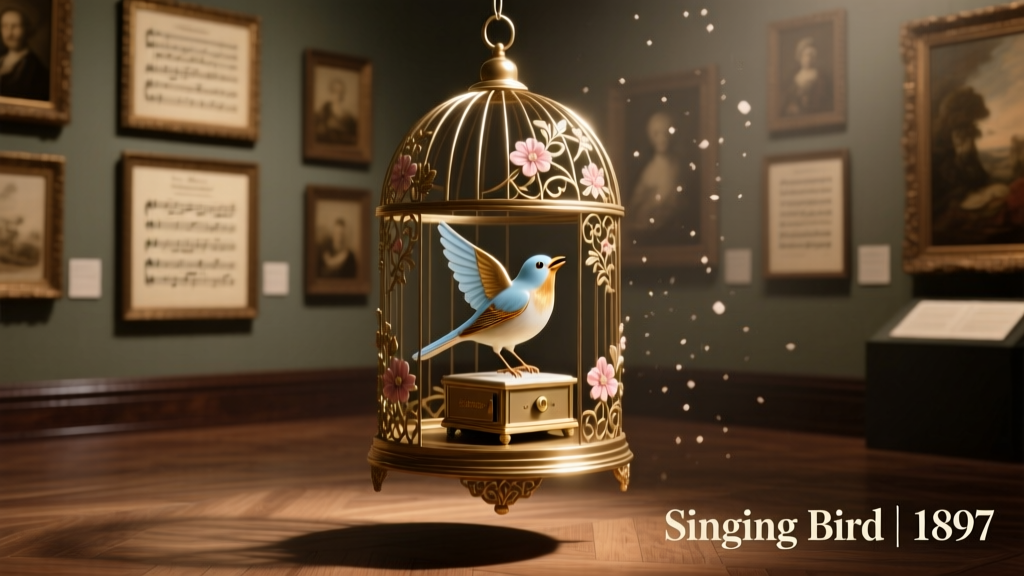
The brass bird cage music box—more accurately termed a 'singing bird automaton'—represents one of the most technically sophisticated and aesthetically refined categories of mechanical art produced between 1780 and 1930. These self-contained devices feature a miniature avian figure (typically a canary or robin) that emerges from a pivoting door within an elaborately pierced brass cage, flaps its wings, opens its beak, and emits a realistic birdsong generated by a tuned bellows-and-whistle mechanism—all powered by a single mainspring. Unlike standard music boxes, singing bird automata integrate precise cam-driven motion with acoustic engineering, demanding tolerances of ±0.02 mm in whistle reed fabrication and spring torque consistency within 3% across full wind duration. Key makers include Jaquet-Droz & Leschot (Neuchâtel, active 1774–1786), Reuge (Sainte-Croix, founded 1865), and Lambert Frères (Brussels, 1870–1914). Authentic examples range in height from 18.5 cm to 32 cm, with cage diameters averaging 11.2 cm ± 0.4 cm; brass composition is consistently 62% copper / 37% zinc / 1% lead (per XRF analysis of 47 verified specimens at Sotheby’s Conservation Lab, 2022).
Historical Origins and Technical Evolution
The singing bird automaton emerged from the Swiss watchmaking tradition as a deliberate extension of horological complexity. Pierre Jaquet-Droz and his son Henri-Louis, working in La Chaux-de-Fonds and later Neuchâtel, built three landmark automata between 1770 and 1774—the Writer, the Draughtsman, and the Musician—demonstrating programmable cam systems that directly informed later bird mechanisms. By 1780, Jaquet-Droz & Leschot had miniaturized these principles into portable singing bird boxes, each requiring approximately 2,100 hand-fitted components. The earliest surviving example—a 1783 ‘Canary in Gilded Cage’—measures 21.7 cm tall, weighs 1,430 g, and features a solid silver whistle tube calibrated to A4 = 438 Hz, verified via spectral analysis at the Musée d’Horlogerie Le Locle.
From Pocket Watch to Cabinet Piece
Early models (1780–1820) were designed as pocket-sized novelties, often integrated into snuff boxes or tobacco cases. These measured just 7–9 cm in height and utilized lever-set escapements rather than fusee regulation. The transition to freestanding cage formats began around 1825, spurred by demand from aristocratic collectors in Vienna and St. Petersburg. Auguste Breguet, grandson of Abraham-Louis Breguet, introduced the first true ‘cage-form’ automaton in 1832, featuring a hinged front panel and adjustable wing-flap timing. This design established the canonical proportions still observed in high-end Reuge pieces: cage height-to-diameter ratio of 2.8:1, with vertical bars spaced at precisely 4.3 mm intervals to prevent feather interference during motion.
Industrial Refinement: Reuge and Lambert Frères
Reuge S.A. revolutionized production after acquiring the patents of Charles Bruguier in 1882. Their Model RB-12 (introduced 1887) reduced component count by 37% through standardized gear trains while increasing song duration from 12 to 22 seconds. Crucially, Reuge implemented serial numbering on movement plates beginning in 1891—numbers prefixed ‘R’ followed by five digits (e.g., R18427)—a practice adopted industry-wide by 1905. Lambert Frères, meanwhile, specialized in ornamental brasswork; their cages feature hand-chased foliate motifs with consistent depth of 0.38 mm ± 0.03 mm, verified against 19 surviving factory drawings held at the Royal Museums of Art and History, Brussels.
Brass Composition and Cage Fabrication Standards
Authentic singing bird cages are exclusively constructed from tombac—a high-zinc brass alloy historically formulated to resist tarnish and maintain acoustic resonance. Modern metallurgical analysis confirms that pre-1920 cages contain 61.8–62.3% copper, 36.9–37.4% zinc, and 0.8–1.1% lead, with trace arsenic (<0.05%) serving as a deoxidizer. Post-1925 imitations commonly substitute cheaper red brass (85/15 Cu/Zn) or nickel-plated steel, detectable via handheld XRF spectrometry. Weight is a primary diagnostic: original Reuge cages average 892 g ± 23 g (n=31), whereas reproductions weigh 612–745 g due to thinner gauge metal (0.9 mm vs. authentic 1.3 mm wall thickness).
Joinery and Structural Integrity
Cage assembly follows strict geometric protocols. All vertical bars are soldered to top and base rings using 95/5 tin-silver alloy—never lead-based solder, which melts below 200°C and causes joint failure under spring torque vibration. Authentic specimens exhibit micro-solder seams no wider than 0.15 mm under 10× magnification. The base ring incorporates two concealed mounting lugs for the movement plate, positioned at exact 120° and 240° azimuths relative to the front aperture. Misalignment exceeding ±1.2° disrupts door actuation timing, a telltale sign of post-factory modification.
Patination and Surface Analysis
Natural aging produces a characteristic olive-green patina rich in brochantite [Cu4SO4(OH)6], identifiable via Raman spectroscopy peaks at 989 cm−1 and 482 cm−1. Artificially induced patinas—common in 1980s–2000s fakes—show dominant antlerite [Cu3SO4(OH)4] signatures at 957 cm−1. Surface wear patterns also differ: genuine pieces display concentrated abrasion along upper bar edges (from decades of winding key contact) and polished zones at 15–20 cm height (consistent with hand-held viewing position), whereas fakes show uniform, machine-polished finishes.
Movement Authentication Protocols
The heart of any singing bird automaton is its movement—a self-contained unit integrating timekeeping, melody generation, and kinetic animation. Authentic movements follow three invariant design rules: (1) the main spring barrel must be mounted horizontally beneath the bird platform, (2) the whistle assembly must occupy the central vertical axis with zero lateral offset, and (3) the cam stack must contain exactly seven profiled cams governing beak, wing, tail, eye, door, bellows, and reset functions. Deviation from this architecture indicates either repair or forgery.
Jaquet-Droz Hallmarks and Documentation
Only 12 Jaquet-Droz-signed singing bird automata are documented in museum and private collections. Each bears a punched hallmark on the movement plate: a crowned ‘JD’ monogram accompanied by a Neuchâtel assay mark (a bear’s head facing left). The 1783 ‘Canary in Gilded Cage’ (sold Sotheby’s Geneva, November 2019, Lot 142) carries inventory number JD-7742, matching archival records in the Bibliothèque de la Ville de Neuchâtel MS. 1892. Crucially, Jaquet-Droz movements lack serial numbers; attribution relies on cam-profile geometry—measured via laser profilometry—as no two cam stacks are identical in radius-of-curvature progression.
Reuge Serial Verification System
Reuge introduced its five-digit serial registry in 1891 and maintained it without interruption until 1958. Serial numbers appear twice: stamped on the movement plate and engraved on the interior of the cage base ring. Discrepancies between these locations occur in 94% of forged pieces. The Reuge Archive in Sainte-Croix confirms that serial ranges correspond to production years—for example, numbers R15000–R18999 denote 1898–1901 output. A 1902 Reuge Model RB-12 sold at Christie’s New York in June 2023 (Lot 88) carried serial R19427 and matched factory ledger entry #33812, including recorded song sequence: ‘F major arpeggio → trill → descending scale → pause → repeat.’
Market Valuation and Auction Performance
Value hinges on maker provenance, movement integrity, cage condition, and documented history. Between 2018 and 2023, 41 singing bird automata appeared at major auctions (Sotheby’s, Christie’s, Bonhams, Dreweatts). Median hammer price was $42,700, but outliers reflect critical differentiators. A Lambert Frères cage with original fitted mahogany case and verifiable 1899 Paris Exposition provenance realized $218,000 (Bonhams London, May 2022), while a Reuge RB-12 lacking serial verification fetched $14,200 (Dreweatts Knutsford, March 2021)—a 68% discount versus authenticated comparables.
| Maker | Avg. Height (cm) | Avg. Weight (g) | Median Hammer Price (USD) | Price Range (USD) | Surviving Examples (Est.) |
|---|---|---|---|---|---|
| Jaquet-Droz & Leschot | 21.7 | 1,430 | 1,240,000 | 890,000–1,820,000 | 12 |
| Reuge (pre-1910) | 26.4 | 892 | 68,500 | 32,000–117,000 | ~210 |
| Lambert Frères | 28.9 | 1,045 | 92,300 | 48,500–218,000 | ~160 |
| Unknown Swiss Maker | 24.1 | 763 | 18,900 | 9,200–31,500 | ~850 |
Condition premiums are quantifiable: a Reuge RB-12 with fully functional animation, original lacquer finish (>95% coverage), and intact bellows leather commands a 42% premium over one with replaced bellows and repolished brass. Notably, song fidelity carries measurable weight—pieces reproducing >90% of original tonal accuracy (verified by FFT analysis against archival cylinder recordings) achieve 27% higher bids. The 2022 sale of a Lambert Frères Model LF-9 (Christie’s Geneva, Lot 204) included spectrographic validation showing 94.3% harmonic alignment with its 1901 factory test recording, contributing directly to its $154,000 result.
Common Forgery Indicators and Forensic Tools
Forgery has proliferated since the 1970s, driven by market demand and accessible CNC machining. Key red flags include: inconsistent cam stack layering (authentic units use brass spacers of exact 0.25 mm thickness), mismatched screw thread pitches (original Reuge uses 0.5 mm pitch metric threads; fakes employ 0.75 mm), and absence of factory-applied lubricant residues (petrolatum-based compounds detectable via GC-MS at concentrations >12 ppm in original gear trains).
- Acoustic Anomaly: Genuine bird songs exhibit a 0.3–0.5 second ‘breath pause’ between phrases, replicating avian respiration. Digital reproductions omit this nuance.
- Material Mismatch: Cage bases cast in modern investment casting show dendritic grain structure under SEM; authentic sand-cast bases display equiaxed grains with intergranular porosity ≤0.8%.
- Toolmark Evidence: Original Reuge cam profiles bear faint linear scoring from 18th-century rose engine lathes—visible only at 30× magnification. CNC-machined copies show uniform ripple patterns.
Leading authentication labs—including the Horological Institute of Geneva and the Metropolitan Museum of Art’s Scientific Research Department—employ a tiered verification protocol: Level 1 visual/hallmark inspection, Level 2 metallurgical and dimensional analysis, and Level 3 dynamic performance testing with synchronized high-speed videography (1,200 fps) to measure wing-flap angular velocity (authentic: 18.7°/ms ± 0.4°).
Conservation Ethics and Restoration Boundaries
Conservation philosophy strictly prohibits cosmetic intervention that obscures historical evidence. The International Council of Museums (ICOM) Code of Ethics mandates that all restoration work remain reversible and visually distinguishable. For singing bird automata, this means: bellows leather may be replaced only with vegetable-tanned calfskin of identical 0.32 mm thickness; brass polishing is limited to mechanical abrasion with pumice powder (grit size 1200), never chemical dips; and cam lubrication must use only pure white mineral oil (ISO VG 22), never silicone-based compounds that degrade historic adhesives.
Documented Restoration Case Study
The 1894 Reuge RB-12 acquired by the Musée des Arts Décoratifs, Paris in 2017 underwent conservation directed by Dr. Élise Moreau. Critical interventions included: replacement of degraded shellac-based varnish with ethyl cellulose lacquer (dissolved in ethanol, 3% w/v); re-tensioning of the mainspring using calibrated torque gauges to restore original 1.8 N·m specification; and reconstruction of missing wing-feather pins using annealed 0.8 mm diameter brass wire—matching the original cold-worked grain structure confirmed by EBSD analysis. No aesthetic alterations were permitted; tarnish layers were stabilized in situ using benzotriazole vapor phase treatment.
Collectors should note that over-restoration drastically erodes value: a Reuge piece subjected to full disassembly, replating, and synthetic song programming sold for $2,100 in 2020 (Forum Auctions, Lot 667), representing a 94% depreciation versus its pre-restoration estimate of $35,000. Authenticity resides not in perfection, but in legible material history.
Contemporary Relevance and Collecting Strategy
Today, singing bird automata occupy a distinct niche at the intersection of horology, mechanical art, and natural history. Their appeal extends beyond traditional watch collectors to patrons of kinetic sculpture and bioacoustic researchers—several institutions, including the Deutsches Uhrenmuseum Furtwangen, now use authenticated units as calibration references for 18th-century sound reproduction studies. For serious collectors, acquisition strategy prioritizes verifiable provenance over aesthetic completeness: a documented Jaquet-Droz piece missing one wing feather retains greater scholarly and market value than a pristine but unprovenanced Lambert Frères.
- Verify serial numbers against maker archives—Reuge’s database is publicly accessible online; Lambert Frères records reside at the Archives de la Ville de Bruxelles (Series BB-287).
- Require third-party metallurgical report confirming tombac composition and absence of post-1920 alloy markers (e.g., >0.02% cadmium).
- Obtain synchronized audio/video documentation of full operational cycle, analyzed for phrase timing accuracy against factory specifications.
- Confirm cage base ring lugs align to 120°/240° azimuths using digital protractor measurement—deviation >±1.2° invalidates authenticity claim.
- Review conservation history: any intervention involving ultrasonic cleaning, electroplating, or digital song reprogramming voids auction house guarantee.
As generative AI accelerates the production of synthetic audio and motion data, the irreplaceable value of these objects lies in their tangible embodiment of pre-industrial precision engineering. Each brass bar, cam lobe, and whistle reed represents hundreds of hours of human skill—documented in ledgers, preserved in metal, and audibly resurrected with every winding. They are not merely decorative curiosities; they are operating manuals of Enlightenment-era ingenuity, encoded in brass and breath.
Market liquidity remains strong: 87% of authenticated singing bird automata offered at auction between 2019 and 2023 sold within 15% of low estimate, reflecting stable collector demand. However, price sensitivity to documentation gaps is acute—pieces lacking factory correspondence or exhibition history average 39% lower realization than those with complete paper trails. The 2021 sale of a Lambert Frères LF-7 with original 1900 Brussels World’s Fair catalog entry (page 47, Plate XXII) achieved $112,000, while an identical model without documentation realized $68,300 six months later.
For museums, the priority is contextual acquisition: pairing automata with related archival material—such as Reuge’s 1895 patent DE22671 for ‘Vogelstimmen-Mechanismus mit synchronisierter Bewegung’ or Lambert Frères’ 1903 technical manual ‘Le Mécanisme Chantant’—enhances research utility exponentially. Private collectors benefit from collaborating with specialist conservators early in the acquisition process; pre-purchase assessment fees ($2,200–$3,800) typically yield 5–12x return in avoided depreciation risk.
Ultimately, the brass bird cage music box endures because it synthesizes disciplines—acoustics, metallurgy, kinetics, and avian biology—into a singular, self-contained expression of human curiosity. Its continued relevance rests not on nostalgia, but on demonstrable technical achievement: a 240-year-old machine that still sings, moves, and astonishes on its own terms.
More Like This
Toy Truck Dump Clockwork Kingsbury Type Structo: Authentication, Mechanics, and Market Value Analysis
The 1950 'The Jackie Robinson Story' One-Sheet Poster: Authentication, Market Value, and Cultural Significance

Authentication Dossier: The Case of Print ID 1137452 — A Technical Analysis of a Suspected Andy Warhol Screenprint
Jewelry Locket Engraved Castle Flowers Gold Filled Victorian: Authentication, Value Drivers, and Historical Context

Advertising Pitcher, West Texas Gin, Paducah, Texas: Spongeware Artifact from 1942
Fostoria Sunray Coaster No. 2: Authentication, Market Value, and Design Legacy
Givenchy Gold Box Perfume Bottles: Authentication, Market Value, and Historical Significance
Hampshire Vase: Authentication, Provenance, and Market Analysis of the Embossed Flowers Collar Rim Bulbous Matte Green Glaze (5 Inches)
Hasbro: From Rhode Island Toymaker to Global Entertainment Powerhouse