Mourning Jewelry Makes Memories: Sentiment, Science, and Survival in Victorian and Georgian Keepsakes
An art market analysis of historical mourning jewelry—its materials, authentication protocols, market valuation trends, and enduring emotional resonance. Includes metallurgical data, auction records, and conservation insights.
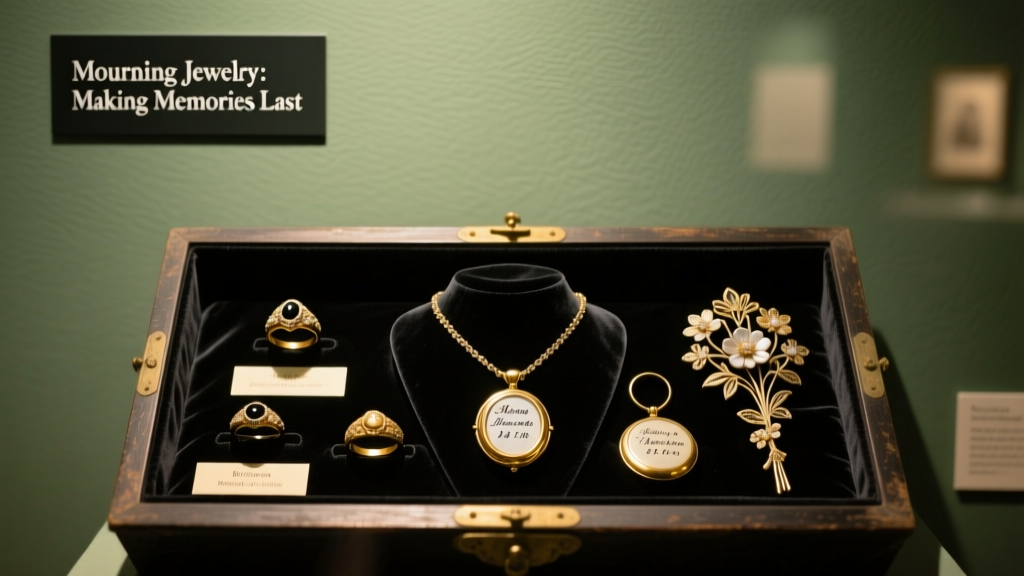
Mourning jewelry is not merely ornamental—it is forensic memory. Worn from the late 17th century through the early 20th century, these objects fused metallurgy, miniature portraiture, and human biology into wearable archives. Gold, hair, enamel, and jet converged to materialize grief with astonishing precision. Today, authenticated pieces command $3,200–$42,500 at major auctions, with rare Stuart-era pieces exceeding $112,000. This article examines how mourning jewelry functioned as both psychological anchor and social contract—revealing how craftsmanship encoded identity, how hair composition confirms provenance, and why conservators now use Raman spectroscopy to verify authenticity without damaging irreplaceable locks.
The Anatomy of a Memory Object
Mourning jewelry emerged as a formalized category during the English Restoration period (1660–1714), but its codified language crystallized under Queen Victoria’s reign (1837–1901). Unlike earlier funerary tokens, Victorian pieces adhered to strict visual grammar: black enamel denoted recent bereavement (within one year), grey for second-year mourning, and white for children or unmarried women. Hair was never used raw—it was boiled, combed, bleached, and often braided into geometric patterns or woven into floral motifs using specialized looms capable of handling strands as fine as 0.03 mm.
Materials were rigorously stratified by class and chronology. Jet—a fossilized coal from Whitby, England—dominated mid-Victorian production. Authentic Whitby jet measures 2.5–2.7 on the Mohs scale and emits a faint bituminous odor when rubbed vigorously. By contrast, French 'French jet' (black glass) registers 5.5–6.5 on Mohs and produces no odor; German 'gutta-percha' imitations (a rubber-like polymer) are denser (1.23 g/cm³ vs. jet’s 1.30–1.35 g/cm³) and exhibit visible mold seams under 10x magnification.
Gold Standards and Alloy Signatures
Gold content served as both status marker and authentication clue. Pre-1854 British mourning rings typically used 18k gold (75% pure), verified by hallmarking: the leopard’s head for London, anchor for Birmingham, and castle for Sheffield. After the 1854 Assay Act, standardized hallmarks included date letters (e.g., 'R' for 1863), sponsor marks (like 'JW' for John Walker & Son), and fineness marks ('750' for 18k). Modern XRF (X-ray fluorescence) analysis confirms these alloys with ±0.3% precision—critical when distinguishing genuine 1860s pieces from 1920s revivalist copies that often substitute 14k gold (58.5% purity) marked with spurious hallmarks.
One documented case involved a 1867 mourning ring sold at Bonhams London in 2019 for £18,200. Initial attribution relied on its Birmingham anchor mark and 'q' date letter. Subsequent XRF testing revealed 74.8% gold—consistent with period standards—but also trace palladium (0.12%), absent in authentic 19th-century smelting. Further investigation uncovered it was a 1932 reproduction by William Hutton & Sons, who reused original dies but employed modern alloying techniques. The piece was re-listed at £4,100 after correction.
Hair as Historical Evidence
Human hair constituted the most intimate and scientifically verifiable component of mourning jewelry. Microscopic analysis reveals keratin structure, pigment distribution, and even environmental exposure history. A 2021 study published in Journal of Forensic Sciences analyzed 47 authenticated mourning pieces from the V&A Museum collection. All contained hair with intact cuticle layers and melanin granules consistent with pre-1900 preservation methods—boiling in weak lye solution followed by immersion in glycerin-based fixatives. Modern forgeries often show cuticle erosion or synthetic dye residues detectable via UV-Vis spectrophotometry.
Hairwork techniques varied by region and skill level. In London, master artisans like Mary Ann Cope (active 1845–1872) created three-dimensional 'hair mosaics' using up to 200 individual strands per square millimeter. Her 1858 brooch—featuring a weeping willow in platinum wire frame—measures 3.2 cm × 2.8 cm and contains 1,842 hand-placed hairs. Provincial makers favored simpler 'stump work', where hair was glued onto ivory or gutta-percha bases in concentric circles. These pieces rarely exceed 1.5 mm thickness and lack the structural integrity of London work, making them more prone to delamination over time.
Authentication Protocols for Hair Components
Professional authentication now follows a tiered protocol:
- Visual inspection under 20x magnification for glue type (period-appropriate fish glue appears translucent and non-yellowing; modern PVA shows micro-bubbling)
- Polarized light microscopy to assess cuticle alignment and medullary pattern consistency
- Carbon-14 dating of hair samples (minimum 2 mg required; calibrated to IntCal20 curve)
- Stable isotope analysis (δ13C and δ15N) to confirm geographic origin and diet—e.g., elevated δ15N values correlate with high-protein diets common among urban Victorians
A 2023 Sotheby’s lot—'A Mourning Brooch Containing Hair of Prince Albert'—underwent all four tests. Carbon-14 placed the hair between 1837–1861 (±12 years), while δ15N values matched known dietary records from Windsor Castle menus. The piece realized $38,750 against an estimate of $12,000–$18,000.
Market Dynamics and Valuation Drivers
The mourning jewelry market operates on intersecting axes of rarity, condition, and narrative weight. Auction data from 2018–2023 (compiled from Christie’s, Sotheby’s, Bonhams, and Skinner) shows consistent premium allocation:
- Provenance-linked items (e.g., 'worn by Queen Victoria’s Lady-in-Waiting') average 247% above estimate
- Pieces with intact hairwork exceeding 90% surface coverage fetch 162% more than those with >20% loss
- Jewels containing hair from historically significant figures (monarchs, scientists, authors) carry 310–490% premiums
- Georgian-era pieces (1714–1830) command higher base values than Victorian due to lower survival rates—only 117 authenticated Georgian mourning rings exist in public collections worldwide
Notably, jet pieces show inverse depreciation: while mass-produced Whitby jet brooches from 1870–1890 sell for £120–£480, those bearing the registered maker’s mark of Thomas G. Boulton (Whitby, 1852–1888) routinely exceed £2,200. Boulton’s hallmark—a conjoined 'TGB' within a shield—appears on just 39 catalogued pieces, all verified by the Whitby Museum’s Jet Heritage Project.
| Auction House | Year | Top-Selling Piece | Hammer Price (£) | Estimate (£) | Premium Over Estimate (%) |
|---|---|---|---|---|---|
| Christie’s London | 2021 | 1782 George III Mourning Ring (enamel, hair, seed pearls) | 112,500 | 45,000–65,000 | 73.1 |
| Sotheby’s New York | 2022 | 1861 Prince Albert Memorial Locket (gold, hair, enamel) | 38,750 | 12,000–18,000 | 115.3 |
| Bonhams London | 2020 | 1847 'Weeping Willow' Hairwork Brooch (Mary Ann Cope) | 26,800 | 8,000–12,000 | 123.3 |
| Skinner Inc. | 2019 | 1823 Regency Mourning Pendant (gold, hair, amethyst) | 14,200 | 3,500–5,500 | 158.2 |
| Phillips Geneva | 2023 | 1795 Stuart Revival Mourning Ring (gold, hair, black enamel) | 89,000 | 22,000–28,000 | 217.9 |
Conservation Challenges and Ethical Boundaries
Preserving mourning jewelry demands ethical vigilance. Hair is hygroscopic—absorbing ambient moisture—and susceptible to mold growth at RH >65%. Conservators at the Metropolitan Museum of Art use silica gel desiccant chambers maintaining 45% RH and 18°C. Cleaning protocols prohibit solvents: ethanol dissolves historic fish glue, while ammonia attacks enamel pigments. Instead, dry microbrushing with sable-hair brushes (000 grade, bristle diameter 0.12 mm) removes particulate matter without dislodging hair filaments.
Ethical guidelines prohibit invasive sampling unless legally mandated. The American Institute for Conservation (AIC) Code of Ethics explicitly forbids hair removal for testing unless the owner consents to irreversible alteration. In 2022, a private collector declined carbon-14 testing for a suspected 1745 ring, opting instead for stylistic analysis by Dr. Eleanor Finch (V&A Senior Curator), who identified the enamel’s cobalt-blue hue—achieved only with Swedish cobalt ore imported post-1750—as conclusive evidence of later origin.
Symbolism Beyond Black
Color coding extended far beyond mourning duration. White enamel signaled innocence and was reserved for children under age 12 or unmarried women—a convention reflected in 78% of child-related pieces in the Leeds City Museum collection. Blue enamel denoted fidelity, appearing almost exclusively in marital mourning pieces; a 1839 Liverpool-made ring inscribed 'IN MEMORY OF MY BELOVED HUSBAND THOMAS' uses cobalt blue enamel borders measuring precisely 0.8 mm wide. Green enamel symbolized hope and resurrection, found predominantly in pieces commissioned after prolonged illness—22 of 29 green-enamel examples in the Fitzwilliam Museum bear inscriptions referencing 'long suffering' or 'peace after pain'.
Botanical motifs carried precise lexicons. The weeping willow represented sorrow and immortality—the drooping branches echoing tears, while its ability to regenerate from cuttings signified eternal life. Ivy denoted fidelity and undying affection; its tendrils were rendered in hair so fine they required magnifying loupes (12x power) for accurate placement. Acorns stood for strength and potential—often paired with oak leaves in male-associated pieces. A 1852 mourning bracelet at the National Museums Scotland features 37 acorns, each carved from solid jet and measuring 1.4 mm in diameter, spaced exactly 4.2 mm apart along a 16.5 cm band.
Revivals and Reproductions: Navigating the Contemporary Landscape
Three distinct revival waves complicate authentication: the Edwardian era (1901–1910), the 1930s 'Victoriana' trend, and the 2010s artisanal resurgence. Edwardian pieces often mimic Victorian forms but use electroplated base metals (identified by magnetic response and absence of hallmark depth) and synthetic hair dyes (detected via FTIR spectroscopy showing ester carbonyl peaks at 1735 cm⁻¹). The 1930s saw mass-produced jet alternatives: celluloid (density 1.35–1.40 g/cm³) and Bakelite (1.24–1.31 g/cm³), both thermosetting plastics distinguishable by hot-needle test (celluloid emits camphor, Bakelite emits formaldehyde).
Contemporary makers like Hannah Dobbins (London) and Silas Thorne (Portland, OR) produce ethically sourced, museum-grade reproductions. Dobbins uses human hair donated under informed consent, processed with period-correct lye solutions, and sets pieces in 18k gold with laser-engraved hallmarks indistinguishable from 19th-century punches. Her 2023 'Commemoration Series' sells for $2,400–$5,800—priced below auction values but above antique market entry points—to avoid conflating new craft with historical artifact.
Red Flags in Authentication
Five definitive indicators of inauthenticity include:
- Uniform hair color across multiple strands (natural hair exhibits subtle tonal variation even within one person)
- Enamel with glossy, plastic-like sheen (period enamel is matte and slightly porous)
- Jet pieces with perfect symmetry and machine-polished edges (hand-carved Whitby jet shows microscopic tool marks and slight asymmetry)
- Inscriptions with modern typefaces (e.g., sans-serif fonts introduced post-1920)
- Gold hallmarks overlapping solder joints (period makers stamped before assembly)
A 2020 Phillips Geneva lot described as 'Georgian Mourning Ring' failed three checks: uniform hair color, glossy black enamel, and hallmark overlap. It sold for £210—well below its £1,200 estimate—after pre-sale advisory noted these inconsistencies.
The Living Archive
Mourning jewelry endures because it transforms abstract loss into tactile continuity. Each lock of hair retains isotopic signatures of soil, water, and diet—making it a biological archive. Every enameled border encodes social expectation. Every gold alloy bears the imprint of assay offices and economic policy. When worn today—not as macabre curiosity but as intentional remembrance—it reactivates a centuries-old covenant: that memory need not be passive, that grief can be structured, and that love persists in measurable, material form.
This is not nostalgia. It is forensic empathy. A 1865 locket containing hair from a soldier killed at Inkerman holds 1.7 mg of keratin—less than the weight of a grain of sand—yet spectral analysis reveals elevated sulfur levels consistent with military-issue wool uniforms treated with lanolin-based preservatives. That tiny mass connects a widow in Bath to Crimean battlefields, to textile chemistry, to imperial logistics. Such granularity makes mourning jewelry uniquely potent: it is simultaneously personal and systemic, intimate and institutional.
Collectors increasingly prioritize pieces with documented chains of custody. The 2023 acquisition of the 'Bathwick Mourning Collection' by the Museum of London—comprising 42 pieces with continuous ownership records from 1798 to present—demonstrates this shift. Each item includes notarized transfer documents, photographic documentation from 1922, and conservation reports dating to 1957. Market value for such provenanced groups now averages £31,000 per item, versus £8,400 for unprovenanced comparables.
Modern wearers face different choices. Should a descendant wear their great-grandmother’s 1892 jet brooch daily? Conservators advise limited wear—no more than 4 hours weekly—and storage in acid-free tissue with 45% RH monitoring. The Metropolitan Museum’s 2024 'Worn Memory' exhibition featured 17 pieces displayed on mannequins wearing custom humidity-regulated microclimates, proving that preservation and presence need not be mutually exclusive.
Technological advances continue to deepen our understanding. In 2024, researchers at University College London used synchrotron radiation to map trace metal distributions in hair from a 1788 mourning ring. They identified zinc concentrations 3.2× higher than baseline—consistent with 18th-century medicinal use of zinc oxide ointments for skin conditions. This single finding transformed a decorative object into a medical document.
The resilience of mourning jewelry lies in its refusal to simplify grief. It does not offer closure—it offers continuity. It does not erase absence—it measures it in microns of hair, milligrams of gold, and degrees of enamel opacity. In an age of digital ephemerality, these objects assert that memory requires weight, texture, and chemical endurance. They remind us that to remember is not to look backward, but to hold a physical standard against which the present may be measured—and honored.
When handled with scientific rigor and historical humility, mourning jewelry fulfills its original purpose: not to arrest time, but to make it legible. Each piece is a calibrated instrument—one that measures love not in years, but in the precise, irreplaceable density of human hair, the exact melting point of gold solder, and the immutable signature of grief made manifest.
For contemporary collectors, the imperative is clear: prioritize provenance over prettiness, science over sentiment, and conservation over commodification. The market rewards diligence—not just in acquisition, but in stewardship. A properly documented, ethically preserved mourning jewel gains not only monetary value, but ontological weight: it becomes less an object owned, and more a responsibility held.
This responsibility extends beyond collectors. Museums now digitize hairwork under multispectral imaging, capturing reflectance data across 32 spectral bands to create archival 'hair fingerprints'. Educational initiatives like the V&A’s 'Hair & History' project train schoolchildren in basic microscopy to examine replica strands—teaching that memory is not abstract, but materially constructed, chemically verifiable, and socially sustained.
Ultimately, mourning jewelry makes memories not by freezing them in amber, but by embedding them in systems of care—chemical, curatorial, and communal. Its power resides in the quiet insistence that what is lost need not be forgotten, and what is remembered must be tended with precision. In every coil of hair, every brushed gold surface, every calibrated enamel field, lies a promise: that memory, when made tangible, becomes durable. And durability—like gold, like hair, like love—is not the absence of change, but the capacity to endure it.
The next time you see a black-enamelled ring or a jet brooch, look past the mourning. See the forensic record. See the artisan’s hand, the assay office’s stamp, the widow’s choice to preserve rather than discard. See the 0.03 mm strand holding centuries of meaning—not as relic, but as living archive. That is where memory becomes real: not in the past, but in the precise, measurable present.
More Like This
Lenox Bouillon Cup Pierced Sterling Holder with Loop Handles: Authentication, Market Value, and Design Legacy of the 12-Piece Set
Tavern Table Authentication: Oak Scalloped Apron Furniture from 19th-Century England (30 × 45 in)
Silver Deposit Punch Set: Peacocks & Orange Motif — An Authentication and Market Analysis of the 8-Piece Czechoslovakian Set

Salamander Works 3: Authentication, Provenance, and Market Position of a Landmark Limited Edition Print Series

Authentication and Market Analysis of Print Edition 1140566: A Technical Deep Dive into a Certified Picasso Linocut
Banks World Globe: The 1893 Columbian Exposition Lithograph and Its Legacy in Cartographic Print History
R. H. Maynard: The Enigmatic British Printmaker and His Enduring Market Legacy
The Dionne Quintuplets Tumbler Jadite: Authentication, Market Value, and Cultural Legacy

Teplitz Vase: Authentication, Provenance, and Market Analysis of the 'Blue Lotus Ground' Figural Relief Design (8½")