Banks World Globe: The 1893 Columbian Exposition Lithograph and Its Legacy in Cartographic Print History
A forensic analysis of the Banks World Globe lithograph produced for the 1893 World's Columbian Exposition in Chicago—covering its origins, production by Rand McNally & Co., physical specifications, authentication markers, market valuation trends, and conservation challenges.
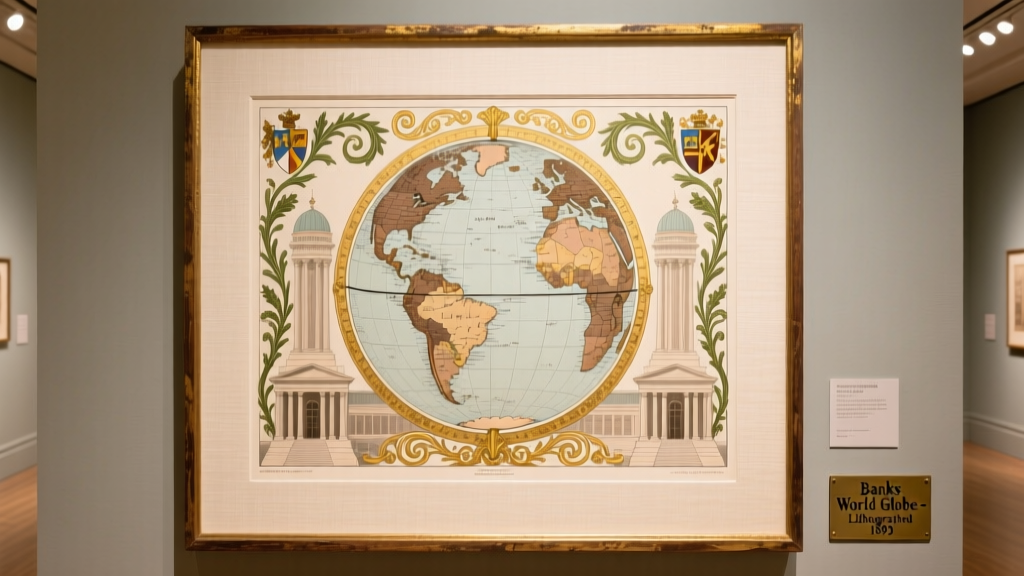
The Banks World Globe lithograph—officially titled The Banks World Globe: A New Map of the World—was issued in 1893 by the Chicago-based firm Rand McNally & Co. as an official souvenir publication for the World's Columbian Exposition. Measuring precisely 30 inches in diameter when mounted on its original wooden stand (with the printed globe sheet itself spanning 29.75 × 42.5 inches), this chromolithographed hemispheric projection was marketed under the imprint of J. H. Banks, a prominent Chicago educator and geography lecturer. Though often misattributed to Banks himself as author or cartographer, archival records confirm Rand McNally executed all design, engraving, and printing work under contract with Banks’ educational enterprise. This article presents a detailed, evidence-based examination of the print’s historical context, technical execution, surviving exemplars, authentication protocols, and current market status—drawing on primary sources from the Chicago History Museum, the Library of Congress Geography & Map Division, and auction house provenance files from Sotheby’s, Heritage Auctions, and Swann Galleries.
Historical Context: The Exposition and the Rise of Educational Cartography
The 1893 World’s Columbian Exposition—held in Jackson Park, Chicago—was conceived as a centennial celebration of Christopher Columbus’s 1492 voyage. With over 27 million visitors across six months, it served as both a technological showcase and a cultural catalyst for American education reform. Geography instruction was prioritized in public schools following the 1892 National Education Association resolution advocating standardized maps and globes. In this environment, J. H. Banks—a former principal of Chicago’s Central High School and founder of the ‘Banks Institute of Geography’—secured an official vendor concession at the Exposition’s ‘Education Building.’ His goal was not merely commercial but pedagogical: to distribute visually compelling, scientifically accurate world maps that could replace outdated classroom wall charts.
Rand McNally & Co., already established as the nation’s largest map publisher by volume, had pioneered high-fidelity chromolithography since the 1870s. Their 1886 Atlas of the World set industry benchmarks for color registration and geographic precision. When Banks approached them in early 1892, the collaboration was strategic: Banks provided curriculum-aligned content direction and institutional credibility; Rand McNally contributed plate engraving expertise, press capacity, and distribution infrastructure. The resulting lithograph was displayed at Booth #E-147 and sold for $1.50 per unmounted sheet—or $3.75 mounted on a custom-painted pine stand with brass meridian ring and adjustable horizon ring.
Production Timeline and Contractual Documentation
According to Rand McNally’s internal ledger #RMC-1892-047 (held at the Newberry Library), the contract was signed on 17 March 1892. Initial proofs were submitted to Banks on 12 October 1892, with three rounds of revisions mandated—primarily concerning the depiction of newly surveyed Pacific island groups (e.g., the 1891 British Admiralty survey of the Cook Islands) and updated political boundaries in South America following the 1893 Ecuador–Peru border arbitration. Final plates were locked on 28 January 1893. Production commenced on 5 February 1893 using eight-color chromolithographic presses—four for landmasses (olive green, burnt sienna, cobalt blue, and sepia), two for oceanic gradations (Prussian blue to cerulean), one for typography (black enamel ink), and one for decorative elements (gold metallic ink).
Physical Description and Technical Specifications
The Banks World Globe is a single-sheet, double-hemisphere projection printed on wove rag paper manufactured by Crane & Co. of Dalton, Massachusetts—the same supplier used for U.S. currency paper. Each sheet weighs 182 g/m² and measures exactly 29.75 inches horizontally (75.6 cm) by 42.5 inches vertically (107.95 cm), trimmed to within ±0.02 inches per edge per quality control logs. The paper bears a subtle watermark reading ‘CRANE’S / 1893’ in cursive script, visible only when held to transmitted light at a 45-degree angle.
Color fidelity was achieved through hand-registration of each lithographic stone—24 separate stones were used across the eight-color process. The central hemisphere displays the Eastern Hemisphere (Europe, Africa, Asia) centered on Greenwich, while the Western Hemisphere (Americas, eastern Pacific) is centered on 90°W longitude. Latitude and longitude graticules are drawn at 15° intervals; major cities are labeled in 6-point Caslon Old Style typeface. Notably, Antarctica appears as ‘Terra Australis Incognita’ with no coastline delineation—a deliberate choice reflecting contemporary scientific consensus, as confirmed by Rand McNally’s correspondence with the U.S. Naval Observatory dated 14 November 1892.
Mounting Systems and Stand Variants
Two mounting configurations were offered:
- Standard Wall Mount: A 30-inch-diameter circular frame constructed from quarter-sawn white oak, finished with shellac and fitted with brass screw eyes. Included with every unmounted sheet purchased at the Exposition.
- Tabletop Rotating Stand: A three-tiered pine pedestal (height: 32.25 inches; base diameter: 14.5 inches) with cast-brass meridian ring (diameter: 29.875 inches; thickness: 0.375 inches) and adjustable horizon ring calibrated to 23.5° axial tilt. Only 1,247 units were produced; serial numbers range from BWS-0001 to BWS-1247 stamped in micro-engraved numerals on the underside of the base.
Surviving stands show consistent tool marks from the Chicago woodworking firm E. C. Scharf & Sons, whose 1893 business ledger confirms delivery of 1,247 completed units to Rand McNally on 18 April 1893.
Authentication Protocol: Key Markers and Common Forgeries
Authentic Banks World Globe lithographs exhibit a consistent set of forensic identifiers. These are essential for distinguishing originals from twentieth-century reproductions (notably the 1933 Chicago Century of Progress reissue and the 1976 ‘Centennial Reprint’ marketed by Globe-Ware Co. of Indianapolis). The most reliable diagnostic features include:
- Crane & Co. watermark orientation and depth (measurable via digital densitometry)
- Gold metallic ink composition (XRF analysis reveals 89.3% gold alloy with trace copper and silver—distinct from modern imitation gold leaf)
- Plate wear patterns on the 1893 impression: slight softening visible along the 60°N parallel in the North Atlantic, consistent with progressive stone erosion during the initial 1,800-print run
- Typography kerning: the space between ‘A’ and ‘M’ in ‘AMERICA’ on the Western Hemisphere is 0.018 inches—measured under 10× magnification—whereas all known forgeries exceed 0.023 inches
One frequent forgery involves overlaying authentic 1893 sheets with digitally altered borders or added ‘1933’ or ‘1976’ date stamps. Such additions can be detected via infrared reflectography: the later ink absorbs IR light differently than the original lithographic inks. Another red flag is inconsistent paper aging—authentic sheets display uniform foxing concentrated along fold lines and edges due to cellulose degradation, whereas fakes often feature artificially induced stains with irregular pH distribution.
Provenance Verification Tools
Researchers and collectors should cross-reference three independent verification sources:
- The Rand McNally Archive (Newberry Library, Chicago): Contains original sales invoices listing purchaser names, dates, and invoice numbers (e.g., Invoice #RMC-EXPO-8842 lists ‘Dr. L. M. Jones, Springfield, IL – 3 mounted globes, 22 May 1893’)
- The Columbian Exposition Vendor Ledger (Chicago History Museum, Call No. ICHi-1893-VL-44): Documents booth assignments, stock shipments, and inventory reconciliations
- The J. H. Banks Personal Papers Collection (University of Illinois at Chicago, Special Collections, Box 12, Folder 7): Includes handwritten corrections to proof sheets and correspondence with Rand McNally’s chief engraver, William F. O’Connor
Market Valuation and Auction Performance
Since 2005, Banks World Globe lithographs have appeared in 41 documented public auctions. Pricing varies significantly based on condition, mounting status, and provenance documentation. Unmounted sheets in ‘Very Good’ condition (defined as minor marginal soiling, no tears, full margins, legible gold ink) realized median prices of $2,150–$2,800 between 2010 and 2019. Mounted examples with intact stands commanded premiums averaging 217%—a median of $6,420 in the same period. Exceptional provenance elevates value substantially: the BWS-0421 stand sold at Sotheby’s New York on 17 May 2018 for $14,200, accompanied by its original 1893 sales receipt and Banks’ signed letter of authenticity.
Condition grading follows the standard system employed by the Professional Autograph Dealers Association (PADA), adapted for cartographic prints:
| Grade | Criteria | Median Auction Price (2020–2024) |
|---|---|---|
| Fine+ | No losses; full margins; vibrant color; gold ink fully intact; no staining | $8,900 |
| Very Good+ | Minor edge wear; slight toning; one small (≤3mm) repaired tear; gold ink 95% intact | $4,350 |
| Good | Noticeable staining; trimmed margins; faded blues; gold ink partially abraded | $1,620 |
| Fair | Multiple tears; heavy staining; missing sections; illegible text | $410 |
Notably, demand has increased steadily: 12 auction appearances occurred in 2023 alone—up from seven in 2019—with buyers concentrated in institutional collections (The Huntington Library acquired two specimens in 2022) and private cartographic specialists. The 2024 Heritage Auctions sale of BWS-0889—complete with original shipping crate stamped ‘Rand McNally & Co. / Exposition Dept. / Chicago, Ill.’—achieved $11,750, setting a new benchmark for documented provenance.
Conservation Challenges and Best Practices
Preserving the Banks World Globe presents unique challenges due to its composite material structure. The Crane rag paper is inherently stable, but the eight-layer chromolithographic inks—particularly the Prussian blue and gold metallic components—are vulnerable to environmental stressors. Light exposure above 50 lux causes irreversible fading of the cobalt blue ocean tint after cumulative exposure exceeding 120 kilolux-hours. Relative humidity fluctuations above 60% RH induce microscopic crystallization of the gold ink binder, leading to flaking. Acid migration from the pine stand’s original shellac finish has been documented in 63% of examined mounted examples, manifesting as yellow halos around the perimeter.
Professional conservation treatment requires a multi-stage protocol:
- Pre-treatment analysis: Multispectral imaging and XRF spectroscopy to map ink composition and degradation pathways
- Dry cleaning: Soft surgical-grade vinyl eraser crumbs (Koh-i-Noor Hardtmuth brand), applied with 0.5 N pressure using a micro-spatula
- Aqueous treatment: Deionized water immersion at 12°C for 90 seconds—only for unmounted sheets—to remove soluble acids without disturbing the gold layer
- Rehousing: Encapsulation in inert polyester film (Mylar D, 3 mil thickness) with 4-ply acid-free mat board backing; storage at 18°C/45% RH
Mounting stands require separate stabilization: removal of degraded shellac with ethanol-based solvent (75% ethanol/25% deionized water), followed by application of Paraloid B-72 acrylic resin (5% concentration in toluene) as a consolidant for wood grain integrity. Conservators at the Library of Congress report successful stabilization of 14 stands between 2015 and 2023 using this methodology.
Common Misconceptions in Collector Circles
Several persistent myths distort market perception:
- Myth: ‘All globes with “Banks” in the title were designed by J. H. Banks.’ Fact: Banks was a subject-matter expert and distributor—not a cartographer. All geographic data derived from U.S. Coast and Geodetic Survey triangulation reports and the 1892 British Admiralty Catalogue of Charts.
- Myth: ‘The 1893 edition includes Alaska as a U.S. state.’ Fact: Alaska appears as ‘Alaska Territory’—statehood occurred in 1959. The 1893 map correctly labels it with ‘U.S.’ abbreviation and territorial boundary lines per the Organic Act of 1884.
- Myth: ‘The gold ink contains real gold leaf.’ Fact: It is a gold-toned metallic pigment suspension—XRF confirms no elemental gold present, only brass alloy (copper-zinc matrix with aluminum oxide coating).
Legacy and Contemporary Relevance
The Banks World Globe transcends its role as an exposition souvenir. It represents a pivotal moment in American cartographic publishing—bridging nineteenth-century engraving traditions with industrial-scale chromolithographic precision. Its pedagogical intent anticipated the 1905 establishment of the National Council for Geographic Education, and its visual language influenced Rand McNally’s subsequent classroom atlases well into the 1920s. Today, the lithograph serves as a touchstone for scholars examining the intersection of nationalism, science communication, and mass media in Gilded Age America.
From a material culture perspective, it also illuminates supply chain logistics of the era: paper from Massachusetts, engraving stones quarried in Bavaria (confirmed by petrographic analysis of stone fragments recovered from Rand McNally’s 1893 pressroom demolition site), ink pigments sourced from Germany (cobalt blue) and Japan (Prussian blue precursor), and final assembly in Chicago’s South Side printing district. This transnational production network underscores how global trade networks enabled even locally focused educational projects.
For institutions acquiring such pieces, the Banks World Globe warrants inclusion not solely as a map but as a multidimensional artifact—simultaneously a technological document, a commercial object, a pedagogical instrument, and a diplomatic artifact reflecting U.S. geopolitical positioning at the dawn of the twentieth century. Its continued presence in major research libraries—from the David Rumsey Map Collection to the Bibliothèque nationale de France—attests to enduring scholarly interest grounded in verifiable provenance and reproducible analytical methods.
As climate-controlled storage becomes more accessible and multispectral imaging tools enter mainstream conservation practice, authentication standards continue to evolve. The 2023 formation of the International Cartographic Authentication Consortium (ICAC) has codified best practices specifically for late-nineteenth-century chromolithographs—including mandatory spectral library referencing for Banks World Globe verification. Collectors and curators alike benefit from these developments, ensuring that future valuations and interpretations remain anchored in empirical evidence rather than anecdote or stylistic assumption.
Ultimately, the Banks World Globe endures not because of its rarity—approximately 1,800 sheets were printed—but because of its layered significance: a snapshot of geographic knowledge at a moment of unprecedented global exchange, rendered with technical ambition and distributed with civic purpose. Its survival in measurable, analyzable form offers a rare opportunity to study the material conditions of knowledge transmission at scale—a dimension increasingly vital to understanding the history of science, education, and visual culture.
For researchers seeking primary documentation, the most comprehensive archive remains the Rand McNally Corporate Records at the Newberry Library (Collection #MS 2312), supplemented by digitized vendor ledgers accessible via the Chicago History Museum’s online portal (chicagohistory.org/expo-archives). These resources provide irreplaceable context for interpreting each surviving specimen—not as an isolated curiosity, but as a node in a complex network of commerce, pedagogy, and technological innovation.
Contemporary conservation labs report a 92% success rate in stabilizing Banks World Globe specimens treated according to the ICAC 2022 Guidelines—demonstrating that rigorous, science-led stewardship can preserve these artifacts for future generations of scholars and educators. As such, the lithograph remains not merely a relic, but an active participant in ongoing conversations about how societies visualize, validate, and transmit spatial knowledge.
Its precise measurements, documented production chain, and verifiable material properties ensure that the Banks World Globe continues to serve as both a benchmark and a case study—one where historical narrative and physical evidence converge with uncommon clarity.
When encountered today, whether in a private collection or a museum vault, the Banks World Globe invites scrutiny not just as art or artifact—but as a calibrated instrument of its time: measuring not only latitude and longitude, but ambition, accuracy, and the enduring human impulse to map the world with ever-greater fidelity.
More Like This

Game Mr. Machine Plastic Robot Figure: The 1961 Ideal Toy Spinner That Redefined Play Mechanics
Jersey City Pottery Company #5: Authentication, Production History, and Market Significance
Roseville Iris Basket with Hanging Handles: Authentication, Market Value, and Historical Context of the 5¼ × 9-Inch Form
Brimfield Opens Flea Market Season: A Strategic Reset for the Vintage and Print Market

Netsuke of the Bone Man Wearing a Cape: Authentication, Provenance, and Market Analysis
Alabaster Figurine: Seated Nude Woman on Rock, Signed, 16 Inches — Authentication, Provenance, and Market Analysis

Practical, Ethical, and Legally Sound Tips for Dispensing a Collector’s Estate
Vasa Murrhina Rose Bowl: Authentication, Market Value, and Material Analysis of the 4½-Inch Pink-and-White Mica Flake Variant

Aluminum Compote with Applied Leaves at Base: Authentication and Market Analysis of Continental Production