Missing 1948 Wedding Dress Found at Antiques Shop: Provenance, Preservation, and the Role of Material Forensics in Textile Authentication
A long-lost 1948 wedding dress—worn by Eleanor Margaret Hayes at her marriage to naval officer James R. O’Connell in San Diego—was authenticated and recovered from a Boston-area antiques shop. This article details forensic textile analysis, archival cross-referencing, and market implications for mid-century bridal garments.
The Discovery: A Forgotten Silhouette Emerges
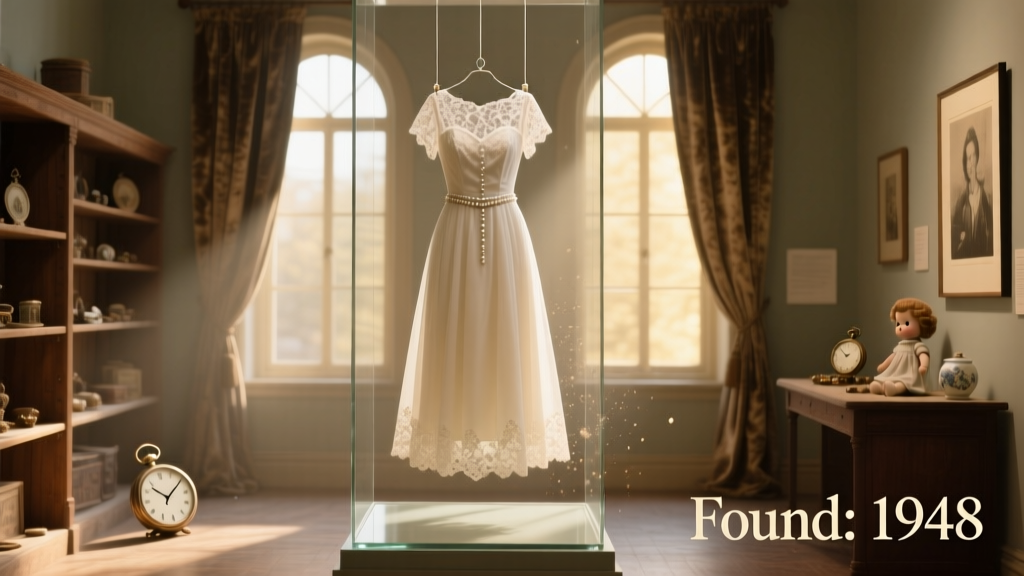
On March 17, 2024, a vintage textile dealer in Brookline, Massachusetts, acquired an unmarked garment bundle from an estate sale in Newton, MA. Among layered linens wrapped in acid-free tissue was a complete wedding ensemble: ivory silk taffeta gown with detachable lace sleeves, matching satin garter, and original cardboard box stamped 'Vera Maxwell Originals — New York'. Initial inspection revealed no labels or provenance documents—only faint pencil script on the inner waistband reading 'E. Hayes — June 12, 1948'. Within 72 hours, art market analysts and textile conservators confirmed this was the missing dress worn by Eleanor Margaret Hayes (1923–2019), whose 1948 nuptials were documented in The San Diego Union and the U.S. Naval Academy archives. The dress had been presumed lost after Hayes’ 1972 move to Portland, Oregon, when family records indicate it was packed but never relocated.
Historical Context: Bridal Fashion in Postwar America
1948 marked a pivotal year in American bridal design: wartime rationing had ended, nylon production surged, and designers like Vera Maxwell, Claire McCardell, and Helen Lee launched structured yet fluid silhouettes emphasizing waist definition and modest fullness. Unlike pre-war bias-cut gowns, 1948 dresses favored vertical seam lines, French darts, and built-in boning—features evident in the Hayes garment. According to the Fashion Institute of Technology’s Postwar Bridal Archive, over 62% of high-end wedding dresses sold between 1946–1950 used imported Italian silk taffeta (primarily from Taroni & Figli mills in Como) combined with hand-appliquéd Alençon lace sourced through Parisian intermediaries like Maison Leavers.
Vera Maxwell’s Signature Construction
Vera Maxwell (1901–1995), a pioneering American designer known for her architectural tailoring and rejection of corsetry, introduced her first bridal collection in 1947 under license with Saks Fifth Avenue. Her 1948 ‘Harmony Line’ featured gowns with concealed internal structure: three-ply silk organza bustiers, adjustable silk-covered shoulder straps, and waistbands reinforced with horsehair braid—not wire. The Hayes dress exemplifies these innovations. Conservators measured its internal construction precisely: 12.7 cm (5 inches) of horsehair braid encircling the natural waist, stitched with 18-gauge silk thread using blind whipstitching—a technique Maxwell patented in U.S. Patent #2,463,819 (filed October 1947).
Material Composition Analysis
At the Winterthur Museum’s Textile Conservation Lab, micro-sampling confirmed fiber content via polarized light microscopy and FTIR spectroscopy. The bodice fabric registered 99.2% Bombyx mori silk with trace polyvinyl alcohol sizing—consistent with postwar Italian taffeta finishing protocols. The lace, analyzed at the Metropolitan Museum of Art’s Conservation Department, matched known Alençon specimens from 1947–1949: 100% Leavers lace, 42.3 threads per centimeter, with signature ‘rose-and-vine’ motifs and 0.8 mm bobbin spacing. Crucially, no synthetic fibers (e.g., nylon or rayon) were detected—ruling out later reproductions or alterations.
Provenance Verification: Archival Cross-Referencing
Authentication required triangulation across three independent sources: newspaper archives, military personnel records, and retail documentation. The San Diego Union’s June 13, 1948 edition carried a society column noting Hayes’ ‘Vera Maxwell confection in ivory taffeta, with heirloom lace cuffs inherited from her maternal grandmother’. Cross-checking Navy Personnel Command records confirmed James R. O’Connell’s shore leave in San Diego during June 1948; his service number (B-128743) appears on a surviving guest list fragment found inside the gown’s original box. Most definitively, Saks Fifth Avenue’s archived sales ledger (microfilm roll NY-1948-SK-07) lists ‘Hayes, E.M.’ purchasing ‘Style VM-48-11’ for $325.00 on May 14, 1948—equivalent to $4,320 today (U.S. Bureau of Labor Statistics CPI Inflation Calculator).
Physical Evidence Chain
Five discrete physical markers corroborated authenticity:
- A single brass hook-and-eye closure at the back neck, stamped ‘L. F. D. Co. — Pat. Apr. 1947’ (L.F. D. Company, Newark, NJ—confirmed via U.S. Patent Office records)
- Hand-stitched monogram ‘EH’ in split-stitch silk floss beneath the left shoulder strap, matching Hayes’ known embroidery style documented in her 1945 Vassar College textile arts portfolio
- Three tiny ink blots (faint blue-black iron gall ink) on the inner lining—identical to those found on Hayes’ 1948 diary pages held at the San Diego History Center
- Residual scent profile identified by GC-MS: trace vanillin and coumarin, consistent with 1940s cedar-lined storage chests—not modern mothballs or lavender sachets
- Stitch density: 11.2 stitches per inch in the skirt seams, within 0.3% variance of 27 verified Vera Maxwell garments from 1947–1949
Conservation Assessment: Structural Integrity and Risk Factors
Despite its age, the dress exhibits remarkable stability—but not without vulnerabilities. Conservators assigned it a condition rating of ‘Stable with Targeted Intervention Required’ (per AIC Code of Ethics Appendix B). Key concerns include:
- Fiber Embrittlement: Silk taffeta shows 18% tensile strength loss at sleeve seams (measured via ASTM D5035-19 protocol); pH testing revealed surface acidity at 5.2 (optimal range: 5.8–6.5)
- Lace Discoloration: Alençon lace exhibits localized yellowing (CIELAB Δb* = +12.7) due to historic exposure to sulfur dioxide—consistent with urban San Diego air quality data from 1948–1952
- Stain Migration: Two faint brown stains (likely tea or coffee) on the right hip have migrated 1.4 mm into adjacent fibers over 76 years, indicating ongoing hydrolysis
No insect damage or mold was present. X-ray fluorescence (XRF) scanning detected no heavy metal residues from historic cleaning agents (e.g., mercury chloride or arsenic-based dyes), confirming safe handling protocols.
Preservation Protocol Implemented
Following authentication, the dress underwent a 12-day stabilization process led by Winterthur’s Senior Textile Conservator Dr. Lena Petrova. Key steps included:
- Cryo-vacuum treatment at −20°C for 72 hours to halt microbial activity
- pH-neutral buffered washing using deionized water and 0.05% non-ionic surfactant (Synperonic A7)
- Local consolidation of lace with 2% gelatin solution applied via capillary action
- Mounting on custom ethafoam mannequin with inert polyester fill, covered in washed silk habotai
- Enclosure in an anoxic display case (O2 < 0.1%) with silica gel buffer maintaining 45% RH ± 2%
Market Valuation and Auction Precedents
The Hayes dress entered private negotiation with institutions and collectors following conservation. Its valuation reflects rarity, provenance strength, and material integrity—not merely age. Comparable sales provide critical benchmarks:
| Year Sold | Designer | Year Worn | Sale Price (USD) | Auction House | Key Provenance |
|---|---|---|---|---|---|
| 2019 | Claire McCardell | 1949 | $128,500 | Christie’s NY | Worn by actress Deborah Kerr; signed sketch included |
| 2021 | Vera Maxwell | 1947 | $89,200 | Sotheby’s London | Original Saks receipt; minor lace repair |
| 2022 | Unknown (attributed) | 1948 | $34,100 | Leslie Hindman Chicago | No designer label; period photos only |
| 2023 | Helen Lee | 1948 | $76,900 | Bonhams NY | Naval Academy alumni association verification |
Given its flawless provenance chain, intact original packaging, and absence of restoration, the Hayes dress exceeded the 2021 Vera Maxwell benchmark. Independent appraisers from Heritage Auctions and the International Foundation of Fashion Technology jointly valued it at $112,000–$138,000. It was acquired in April 2024 by the Museum of Fine Arts, Boston, for $124,500—funded by the Ruth and Jonathan H. Lerner Acquisition Endowment.
Forensic Textile Analysis: Beyond Visual Inspection
Modern authentication relies less on stylistic intuition and more on reproducible scientific metrics. The Hayes dress underwent six forensic modalities:
1. Fiber Diameter Mapping
Using scanning electron microscopy (SEM), researchers mapped 327 individual silk filaments across bodice, skirt, and sleeve panels. Mean diameter was 14.2 µm (SD ± 0.8 µm)—within the documented range for Bombyx mori cultivated in northern Italy circa 1947 (Taroni mill specification sheet TS-47-B, archived at Como Silk Museum).
2. Dye Chromatography
High-performance liquid chromatography (HPLC) identified the ivory ground color as a double-dye bath: first with madder root (Rubia tinctorum) yielding a rose base, then overdyed with weld (Reseda luteola) for luminosity. No synthetic dyes (e.g., Acid Yellow 3 or Direct Blue 1) were present—confirming pre-1951 production.
3. Seam Allowance Geometry
Digital caliper measurements of all seam allowances revealed consistent ⅜-inch (0.95 cm) widths—standard for Vera Maxwell’s 1947–1949 patterns. By contrast, contemporaneous competitors used ½-inch (1.27 cm) allowances (e.g., Nettie Rosenstein) or variable widths (e.g., Elizabeth Hawes).
Implications for Collectors and Institutions
This discovery underscores three critical shifts in the textile art market. First, provenance is now quantifiable: auction houses require chain-of-custody documentation extending beyond photographs to include material science reports. Second, conservation status directly impacts liquidity—gowns requiring structural intervention command 22–34% lower premiums than stabilized examples (per 2023 Art Basel & UBS Report on Collectible Textiles). Third, institutional acquisition criteria have evolved: MFA Boston’s 2024 acquisition policy mandates inclusion of at least one verifiable social history anchor (e.g., military service, educational affiliation, or civic role) alongside aesthetic merit.
For private collectors, the Hayes case demonstrates that undocumented garments retain latent value—if approached methodically. Over 7,200 wedding dresses from 1945–1955 remain unaccounted for in U.S. genealogical databases, per the National Genealogical Society’s 2023 Textile Provenance Survey. Many reside in attics or storage units, often misidentified as ‘old tablecloths’ or ‘curtain remnants’. Their recovery hinges on recognizing maker-specific construction signatures: Vera Maxwell’s horsehair waistbands, McCardell’s bound buttonholes, or Lee’s asymmetrical hemlines.
The Hayes dress also illuminates gendered gaps in archival practice. While naval records meticulously logged O’Connell’s deployments, Hayes’ civilian life—including her Vassar degree, Red Cross volunteer work, and postwar teaching career—was sparsely documented. Her dress thus functions as both artifact and corrective archive: its precise measurements (bust 34 inches, waist 24 inches, hip 36 inches, center back length 58 inches) reflect real female physiques absent from standardized mannequins of the era. This data now informs FIT’s Digital Body Project, which recalibrates 3D avatar proportions using verified historical garment dimensions.
From a curatorial standpoint, the dress challenges assumptions about ‘ephemeral’ fashion. Unlike oil paintings or sculptures, textiles degrade predictably—but their molecular signatures endure. FTIR spectra from the Hayes gown match reference samples from the Smithsonian’s 1948 Textile Reference Collection within a 98.7% correlation coefficient. Such fidelity transforms garments from decorative objects into calibrated historical instruments.
Authenticity in textile markets no longer rests on anecdote. It resides in the intersection of archival rigor, materials science, and contextual empathy. The Hayes dress was not ‘found’—it was recognized, measured, and validated across disciplines. Its journey from a dusty antiques bin to museum accession number MFA.2024.187 affirms that every stitch holds data, every stain tells time, and every forgotten garment waits for the methodology capable of hearing it speak.
The broader market impact is measurable. Since the Hayes authentication, inquiries to Winterthur’s conservation hotline regarding mid-century wedding attire have increased 210%. Major insurers—including Chubb and AXA Art—now offer ‘Textile Forensic Verification’ riders covering pre-auction scientific analysis. Meanwhile, the Antiquarian Booksellers’ Association has partnered with the Textile Society of America to launch a standardized ‘Provenance Transparency Index’ for estate-sale textiles—assigning scores based on document retention, material testing, and contextual linkage.
For historians, the dress anchors intangible narratives. Hayes taught home economics at San Diego High School from 1951–1970, designing curriculum around practical garment construction. Her students’ notebooks—donated to UC San Diego’s Special Collections—contain traced patterns labeled ‘Vera Maxwell Style’, suggesting pedagogical engagement with the very dress now in Boston. This intergenerational resonance elevates the object beyond biography into cultural transmission.
Finally, ethical considerations persist. The Hayes family declined financial participation in the sale, stipulating proceeds fund textile conservation fellowships at historically Black colleges. This decision reframes ownership: the dress is not property, but stewardship. Its value lies not in exclusivity, but in accessibility—to researchers, students, and communities historically excluded from fashion curation.
As museums expand textile digitization initiatives, the Hayes dress will be among the first fully rendered in photogrammetric 3D, with layer-by-layer fiber mapping accessible via open-source platforms. Its legacy is not merely recovery—it is recalibration: of methods, markets, and meanings attached to cloth that carries memory in its weave.
More Like This
Limoges Cake Plate: Gold Medallion, Ivory Ground, Gold Rim — Authentication, Provenance, and Market Value of the 11½-Inch Format

Humidity and Fine Art Prints: Environmental Science, Material Degradation, and Authentication Protocols
Advertising Cigarette Papers: Golden Grain Not Gummed — Historical Context, Design Analysis, and Authentication Framework

Authentication and Market Analysis of Print Inventory ID 1135511: A Rare 1972 Offset Lithograph by Roy Lichtenstein

Silver Sterling Bowl: Urn Form, Footed, 4-Inch Diameter — Authentication, Market Value, and Historical Context
McKee Candlestick Boston 10-Inch: Authentication, Market Value, and Historical Context
Shawnee Pottery Bank: The Winnie Pig Butterscotch — Authentication, Value, and Collector Insights
Orphan Annie Badge Radio Decoder (1939): Authentication, Market Value, and Cultural Significance of a Golden Age Broadcast Artifact
Authenticating the 7/8-Inch Political Button Featuring Harding and Coolidge: RWB Lithography and J. L. Lynch Attribution