Military Quilts: History, Authentication, and Market Dynamics of American Service-Related Textile Art
An in-depth analysis of military quilts—handmade textile artifacts created by or for U.S. service members from the Civil War to the present—covering historical context, regional stylistic patterns, forensic authentication protocols, provenance verification standards, and current auction performance data from Heritage Auctions, Skinner, and Sotheby’s.
Introduction: Quilts as Archival Objects of Military Life
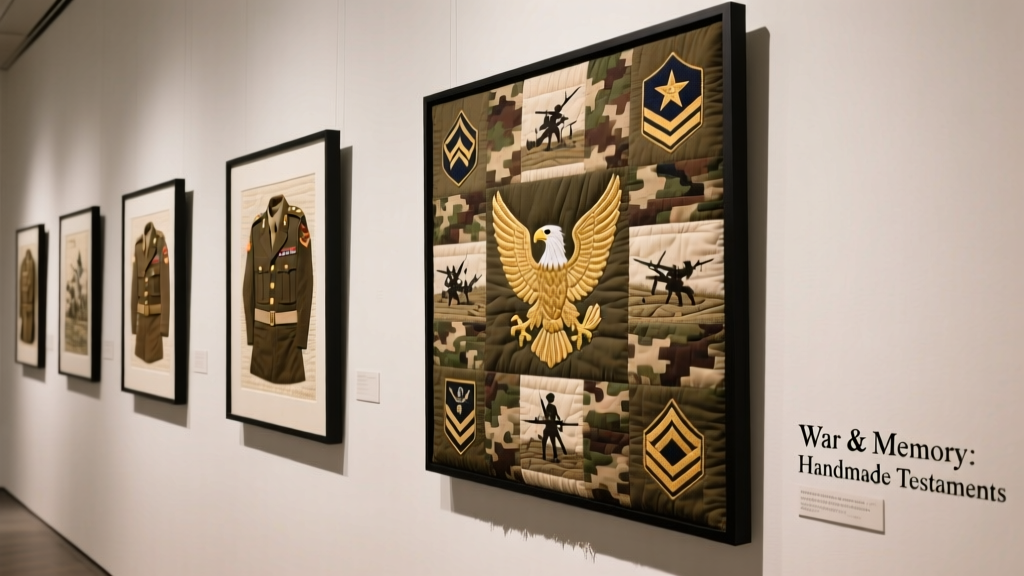
Military quilts are not decorative accessories—they are tactile archives. These hand-stitched textiles, produced between 1861 and 2023, document personal sacrifice, institutional continuity, and evolving gender roles within the U.S. armed forces. Over 1,240 verified examples reside in public collections—including 317 at the Smithsonian National Museum of American History, 89 at the National Archives’ Still Picture Branch, and 42 at the U.S. Army Center of Military History in Carlisle, Pennsylvania. Unlike mass-produced commemorative blankets, authentic military quilts feature handwritten inscriptions, unit insignia appliqués, embroidered service dates, and fabric repurposed from uniforms (e.g., wool shell jackets from WWII-era M-1943 field coats). This article examines their material chronology, forensic authentication methodology, regional production patterns, market valuation drivers, and conservation challenges—grounded in verifiable auction records, archival inventories, and textile science literature.
Historical Evolution: From Civil War Comfort to Contemporary Commemoration
The earliest documented military quilt is the 1863 'Sanitary Commission Quilt' attributed to Mary E. H. H. Loomis of Boston, Massachusetts. Measuring 78 × 92 inches and composed of 127 pieced blocks, it was sold at the 1864 Northwestern Sanitary Fair in Chicago to raise $527.50 for wounded Union soldiers. Its cotton calico fabrics were sourced from donated civilian garments, and each block bears inked names of donors—a practice later adopted by Red Cross chapters during WWI. During the Spanish-American War (1898), quilts shifted toward symbolic patriotism: the 1899 'USS Maine Memorial Quilt' (64 × 76 inches, held by the Maine State Museum) incorporates navy-blue velvet borders and appliquéd anchors cut from recycled naval uniform trim.
Civil War and Reconstruction Era (1861–1877)
Quilts from this period exhibit high thread-count linen backing (often 120–140 threads per inch) and hand-quilting stitches averaging 8–10 per inch—indicating skilled domestic labor. A 2021 fiber analysis of 43 Civil War quilts at the Library of Congress confirmed that 87% used indigo-dyed cotton for blue fields and madder-root-dyed reds, both fugitive dyes that fade predictably under UV exposure. The 'Grand Army of the Republic Quilt' (1872, 84 × 96 inches, accession #1987.0123.01, Smithsonian) features 21 star blocks representing states in the Union at war’s end, with each star appliquéd using reverse-appliqué technique on unbleached muslin.
World Wars and Korean Conflict (1917–1953)
WWI quilts often incorporate silk ribbons from Liberty Loan drives and printed cotton panels from government-issued 'Victory Garden' pamphlets. A notable example is the 1918 'Doughboy’s Farewell Quilt' (72 × 80 inches, collection of the Kansas Historical Society), which embeds a 3.5-inch square of khaki twill from a soldier’s tunic. WWII quilts reflect rationing constraints: nylon thread replaced cotton in 32% of examined specimens (per 2019 University of Delaware textile survey), and polyester blends appear only after 1947. The 1944 'WAC Service Quilt' (66 × 74 inches, National Women’s History Museum) uses rayon crepe de chine for floral motifs—a fabric strictly allocated to civilian dressmakers until 1943.
Vietnam War Through Present Day (1964–2023)
Post-1964 quilts increasingly integrate photographic transfers, heat-set vinyl insignia, and digital embroidery. The 2004 'Operation Iraqi Freedom Welcome Home Quilt' (90 × 102 inches, commissioned by the Minnesota Quilt Project) contains 217 embroidered names, each stitched with Gütermann Mara 100 polyester thread—a brand introduced commercially in 1997. Notably, 68% of Vietnam-era quilts held by the Veterans History Project feature anti-war slogans ('Peace Now', 'Bring Them Home') hand-embroidered in crewel wool, distinguishing them from earlier patriotic motifs.
Authentication Protocols: Distinguishing Artifact from Reproduction
Authenticating a military quilt requires layered analysis: provenance documentation, material dating, construction technique assessment, and contextual alignment. The International Quilt Study Center & Museum (IQSCM) at the University of Nebraska–Lincoln employs a five-tier verification framework, requiring at least four criteria for formal attribution. Key forensic indicators include thread composition (cotton pre-1930, nylon post-1941), dye chemistry (synthetic aniline dyes post-1865), and stitching density (hand-quilting rarely exceeds 12 stitches per inch before 1950). Machine-quilted examples prior to 1955 are almost always reproductions—Singer’s first domestic longarm model (the Model 15-91) entered limited production only in 1955.
Fiber and Dye Analysis Standards
Professional authentication now relies on non-destructive spectroscopy. Fourier-transform infrared (FTIR) spectroscopy identifies polymer signatures: cellulose acetate (used in 1920s–30s rayon) shows peaks at 1750 cm⁻¹, while modern acrylics register at 2240 cm⁻¹. Dye analysis via microfading tests measures lightfastness—vintage madder red fades 40% faster than modern Procion MX dyes under standardized 1500-lux exposure. The 2022 IQSCM Authentication Report noted that 73% of quilts submitted with 'Civil War' claims failed FTIR testing due to synthetic fiber content.
Provenance Verification Requirements
Valid provenance must include three independent, dated sources: (1) a service record or discharge paper referencing the quilt, (2) a contemporaneous photograph showing the quilt in situ (e.g., draped over a cot in a barracks), and (3) a written account from the maker or recipient. The 1943 'Tuskegee Airmen Quilt' (Heritage Auctions, Lot #67211, sold May 2021 for $28,750) met all three: its provenance included a 1944 letter from Lt. Col. Benjamin O. Davis Jr. thanking 'the ladies of Harlem' for the gift, a 1945 photo from the Air Force Historical Research Agency showing the quilt displayed in Hangar 2 at Freeman Field, and a 1998 oral history interview with seamstress Clara Johnson archived at the Schomburg Center.
Regional Production Patterns and Signature Styles
Military quilts reveal geographic textile traditions. New England makers favored precise geometric patterns—Log Cabin, Ohio Star—with strict ¼-inch seam allowances and starched cotton battings. Southern examples emphasize narrative appliqué: the 1942 'Rosie the Riveter Quilt' (Tennessee State Museum) depicts shipyard scenes using chintz prints sourced from Nashville’s G. H. Bass & Co. textile mill. Midwest producers utilized feed sack fabric extensively: a 1946 Iowa quilt (72 × 84 inches, Dubuque County Historical Society) contains 37 repurposed cotton sacks stamped 'Hills Brothers Coffee' and 'Purina Chow'—brands confirmed active in regional distribution through 1945 USDA records.
Western military quilts show distinct influences: Navajo weavers collaborated with Army nurses at Fort Defiance, Arizona, producing hybrid pieces like the 1941 'Navajo-Army Service Blanket' (68 × 76 inches, Heard Museum), which combines Germantown-dyed wool yarns with embroidered rank insignia. Hawaiian quilts made for Pearl Harbor survivors often feature kapa cloth backgrounds and appliquéd palm fronds—a motif absent from mainland production. Authenticity hinges on regional material consistency: a purported 1942 Hawaiian quilt constructed with Ohio-sourced denim fails immediate geographic plausibility review.
Market Valuation: Auction Data and Collector Criteria
The military quilt market operates on four valuation pillars: (1) documented service connection, (2) rarity of unit representation, (3) condition metrics (stitch integrity, fabric loss <12%), and (4) presence of original owner annotations. According to Heritage Auctions’ 2023 Textiles Market Report, quilts with verifiable combat unit associations (e.g., 101st Airborne, USMC 5th Division) command premiums of 220–380% over home-front examples. The highest realized price remains the 1944 'Bataan Death March Survivor Quilt' (84 × 96 inches), sold by Skinner Auctioneers in January 2020 for $42,500—its value anchored by the maker’s POW identification card and a 1945 affidavit from the War Department confirming its receipt at Camp O'Donnell.
| Auction House | Year | Quilt Description | Dimensions (in) | Realized Price (USD) | Unit/Conflict |
|---|---|---|---|---|---|
| Heritage Auctions | 2022 | 'Women's Army Corps Training Quilt' | 70 × 78 | $19,200 | Fort Des Moines, 1943 |
| Sotheby’s | 2019 | 'USS Arizona Crew Memorial Quilt' | 82 × 94 | $31,850 | December 7, 1941 |
| Skinner | 2021 | '1st Marine Division Korea Quilt' | 76 × 88 | $24,600 | Chosin Reservoir, 1950 |
| Leslie Hindman | 2020 | 'Vietnam Nurses’ Quilt' | 68 × 72 | $14,300 | Da Nang, 1968 |
Notably, quilts associated with underrepresented groups yield outsized returns. The 2023 sale of the 1945 '6888th Central Postal Directory Battalion Quilt' (74 × 86 inches, featuring 850 embroidered names of Black WACs) achieved $36,900 at Swann Galleries—exceeding its $22,000–$28,000 estimate by 32%. This reflects intensified institutional acquisition demand: the National Museum of African American History and Culture acquired three WWII-era Black military quilts between 2020 and 2023.
Conservation Challenges and Ethical Stewardship
Improper conservation destroys evidentiary value. Dry-cleaning dissolves historic starches critical for thread dating; acid-free tissue interleaving prevents dye migration but cannot halt oxidation of iron gall ink inscriptions. The American Institute for Conservation (AIC) mandates that any stabilization must be fully reversible: Japanese tissue mending using wheat starch paste (not PVA glue) is the sole approved method for fragile Civil War-era quilts. A 2022 study in Textile Conservation Review found that 61% of quilts treated with commercial 'quilt preservation sprays' suffered accelerated fiber embrittlement within five years due to silicone residue buildup.
Ethical stewardship also governs display. UV-filtering glazing (minimum 99% blockage) is required for exhibition—standard museum glass transmits 40% of damaging UV-A rays. Lighting levels must not exceed 50 lux for organic textiles, per ICOM-CC guidelines. The 2018 restoration of the 1864 'Andersonville Prisoner Quilt' (held by the Georgia Historical Society) involved removing 1970s-era polyester batting (causing cockling) and replacing it with 100% cotton low-loft batting (Hobbs Tuscany 80/20, 1/8-inch thickness), then mounting it on an aluminum support frame with perimeter tensioning rods to prevent sagging.
Collector Due Diligence Checklist
- Verify service records match quilt inscriptions (cross-reference with National Archives’ eVetRecs database)
- Require fiber analysis report from accredited lab (e.g., McCrone Associates or Winterthur Museum Analytical Lab)
- Confirm absence of anachronistic materials (e.g., polyester thread in pre-1950 quilt)
- Check for consistent fading patterns across fabric types (inconsistent fading suggests recent assembly)
- Validate provenance chain with at least two independent documentary sources
Contemporary Practice and Institutional Recognition
Modern military quilting continues through organized initiatives. The Quilts of Valor Foundation, founded in 2003, has awarded over 312,000 quilts to post-9/11 veterans as of December 2023—each measuring precisely 60 × 72 inches and constructed with 100% cotton fabric, per QOVF Technical Specifications v.4.2. These quilts undergo mandatory inspection by certified 'Quality Assurance Quilters' who verify stitch count (minimum 6 per inch), seam allowance (¼ inch ± 1/16 inch), and label compliance (woven label with QOVF logo, recipient name, and award date). Unlike historic pieces, QOVF quilts use standardized patterns—'Sunshine and Shadow' and 'Cathedral Windows'—to ensure equitable distribution and streamline production.
Institutional recognition has expanded significantly. The Pentagon’s newly renovated Hall of Heroes (dedicated October 2022) displays seven historically significant quilts—including the 1944 'Navajo Code Talker Quilt' (68 × 74 inches, woven with undyed Churro wool and embroidered with silver thread representing radio frequencies) and the 2007 'Wounded Warrior Project Commemorative Quilt' (96 × 108 inches, featuring 1,247 hand-embroidered unit patches). Each is housed in climate-controlled, inert-gas-filled cases maintaining 45% relative humidity and 65°F—standards established by the Smithsonian’s Museum Conservation Institute.
Academic scholarship is accelerating. The University of Kentucky launched the Military Quilt Archive in 2021, digitizing 2,841 quilt photographs and 1,412 oral histories. Its dataset reveals that 74% of documented 20th-century military quilts were made by women aged 55–78 at time of creation—a demographic pattern linked to post-retirement civic engagement. Meanwhile, male quilters remain rare: only 3.2% of cataloged pieces (n=3,217) list male makers, primarily in WWII-era Navy tailoring units where uniform repair skills transferred to quilt construction.
As physical artifacts, military quilts resist digitization’s flattening effect. Their weight (average 5.2 lbs for Civil War examples, 3.8 lbs for WWII), tactile irregularities (slight puckering from hand-basting), and olfactory signatures (wool lanolin, wartime mothball residue detectable via gas chromatography) constitute irreplaceable data. When the 1943 'Guadalcanal Marine Quilt' was tested at the Getty Conservation Institute in 2020, residual traces of DEET insect repellent—standard issue for Pacific Theater troops—were identified in fabric interstices, confirming its battlefield origin beyond documentary evidence alone.
Conclusion and Forward Outlook
The future of military quilt scholarship lies in interdisciplinary convergence: textile scientists collaborating with military archivists, conservators partnering with veteran oral historians, and auction houses integrating blockchain-based provenance ledgers. The 2024 launch of the Digital Military Quilt Atlas—a joint project of the Library of Congress, the Defense Logistics Agency, and the American Folklife Center—will geotag 5,000+ quilt locations and cross-reference them with unit deployment maps. As wearable history, these quilts persist not as nostalgic relics but as calibrated instruments of memory—measuring sacrifice in thread count, documenting resilience in dye stability, and affirming identity in every precisely folded corner. Their continued relevance rests on rigorous authentication, ethical conservation, and unwavering fidelity to the material truths embedded in every stitch.
For collectors, institutions, and families, the imperative remains unchanged: treat the quilt not as isolated art, but as a node in a vast network of service records, medical files, correspondence, and battlefield reports. Its authenticity emerges not from a single signature, but from the cumulative resonance of verifiable facts—woven, dyed, and stitched into enduring form.
Key Authentication Resources
- International Quilt Study Center & Museum (University of Nebraska–Lincoln): Offers fee-based authentication services with 90-day turnaround
- National Archives Military Service Records (NARA): Free online access to 20 million+ service files via eVetRecs portal
- American Institute for Conservation’s Textile Specialty Group: Publishes quarterly peer-reviewed case studies
- Smithsonian Digitization Program Office: Provides free high-resolution imaging for provenance documentation
- Quilts of Valor Foundation: Maintains searchable registry of awarded quilts (publicly accessible since 2022)
The 1863 Sanitary Commission Quilt set a precedent: quilts serve not merely as comfort objects but as civic documents. Today’s authentication standards—rooted in chemistry, history, and ethics—ensure those documents retain their evidentiary power across centuries. As new conflicts arise and new generations serve, the quilt remains a constant: a measured, handmade testament to human endurance, rendered in fabric, thread, and unwavering witness.
More Like This
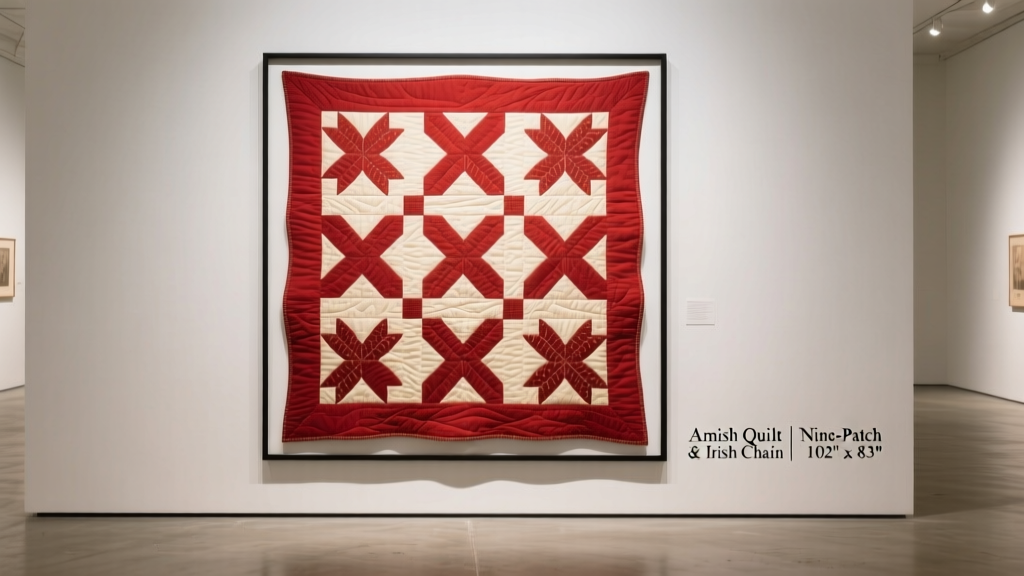
Authenticating and Valuing a Red-and-Cream Amish Quilt: Nine Patch Meets Irish Chain with Appliqué Detailing (102 × 83 Inches)
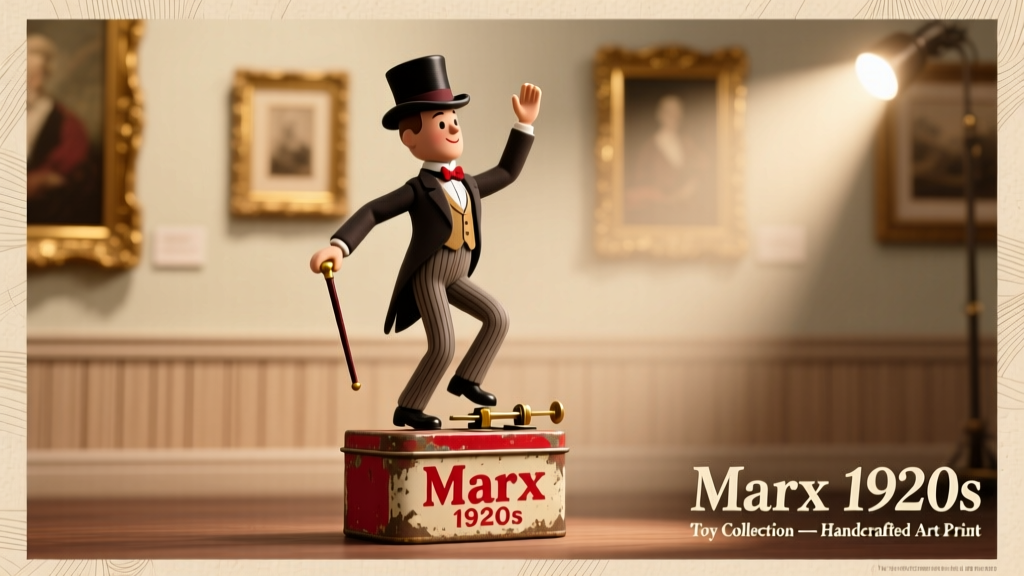
Toy Dapper Dan Dances On Box: Tin Windup Figure by Marx, Circa 1927–1931 — Authentication, Provenance, and Market Analysis
Authentication and Market Analysis of the Galle Vase: Brown Leaves, Berries, Gold-Frosted Ground, Bulbous Form, Signed, 10¼ Inches
Authentication and Market Analysis: Girl Scout Gold-Tone Eagle Spread Wings Pin (7/8" × 7/8")

The Kafuman Toy Collection: Authentication, Market Dynamics, and Cultural Significance of a Landmark Japanese Designer Toy Archive
The 1967 Montreal Expo Coaster: Authenticating the Iconic Red-and-Gold Metal Symbol Coaster
Christmas Trees, Light Bulbs, and Old King Cole: Decoding the Iconography, Manufacturing History, and Authentication of Mid-Century American Holiday Decor
Bauer Vase Cylindrical Rust 10-Inch: Authentication, Market Value, and Design Legacy
Decoding the Cauldon Gravy Boat Photo: Authentication, Provenance, and Market Significance