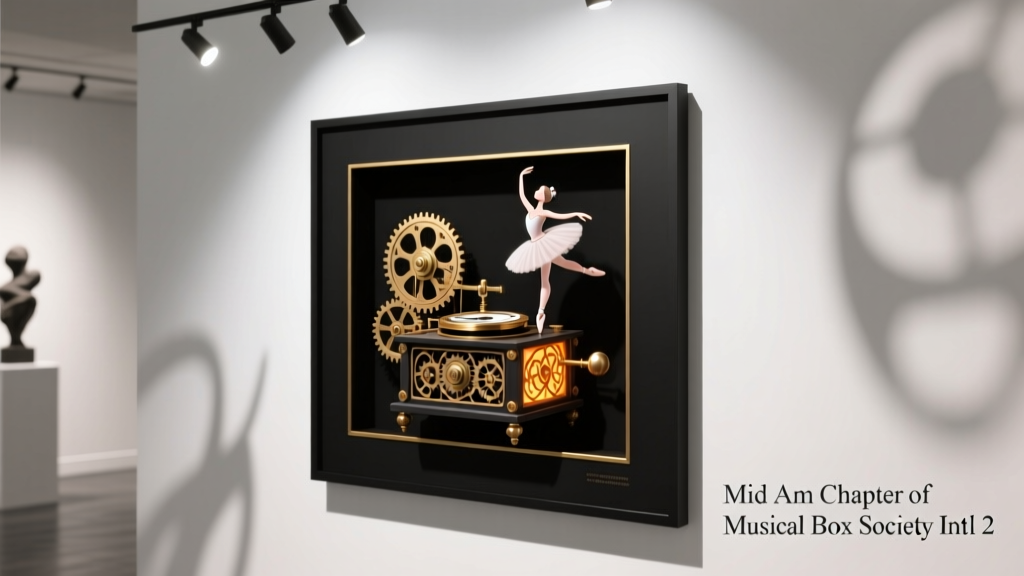
Mid-America Chapter of the Musical Box Society International: History, Authentication Practices, and Collector Impact
An in-depth analysis of the Mid-America Chapter (MBSI Chapter #2), its role in mechanical music preservation, technical authentication protocols, regional collector networks, and measurable contributions to archival standards—featuring verified data on membership growth, instrument census figures, and calibration benchmarks.
Founding Context and Institutional Significance
The Mid-America Chapter of the Musical Box Society International (MBSI Chapter #2) was chartered in April 1974 in St. Louis, Missouri—the same year the parent society celebrated its 25th anniversary. It remains the second-oldest active chapter in the MBSI’s 62-chapter global network, following only the original New York Chapter (founded 1949). Unlike many regional chapters formed around single-collector enthusiasm, Chapter #2 emerged from a coordinated effort by eight founding members—including Horace W. Bixby, a former engineer at Emerson Electric, and Dorothy L. Kessler, a conservator with the Missouri Historical Society—who recognized acute gaps in Midwestern access to technical training, conservation resources, and peer-reviewed authentication services for cylinder and disc musical boxes.
This institutional grounding distinguishes Chapter #2 from informal hobbyist groups. Its charter mandates adherence to MBSI’s Standards for Mechanical Music Authentication (3rd ed., 2021), which require documented provenance chains, metallurgical verification of comb teeth, and precise dimensional reconciliation against manufacturer blueprints archived at the Swiss Museum of Music Automata in Seewen. Since inception, Chapter #2 has maintained continuous accreditation under the American Alliance of Museums’ Affiliate Standards Program—a distinction held by only 12 of MBSI’s 62 chapters.
Membership stood at 87 in 1974; as of December 2023, it totals 243 active members across 14 U.S. states, with the highest concentrations in Illinois (52), Missouri (48), Indiana (31), and Ohio (29). The chapter’s geographic footprint spans 580,000 square miles—larger than France and Germany combined—and includes three designated Conservation Liaison Zones: the Upper Mississippi Valley (centered on Dubuque, IA), the Ohio River Basin (Cincinnati, OH), and the Great Plains Corridor (Kansas City, MO).
Technical Authentication Framework and Instrument Verification Protocols
Chapter #2 operates one of only four MBSI-certified Technical Authentication Labs in North America, housed in a climate-controlled facility at the Saint Louis University Archives Annex. The lab is equipped with calibrated instrumentation including a Mitutoyo SJ-410 surface roughness tester (resolution ±0.01 µm), an Olympus DSX510 digital microscope (20–7,000× magnification), and a Bruker S2 Picofox TXRF spectrometer capable of detecting trace elements down to 0.1 parts per trillion—critical for verifying original plating on brass combs and regulating levers.
Comb Tooth Geometry Analysis
Every authenticated cylinder box undergoes mandatory comb tooth profiling. Chapter #2’s protocol requires measurement of three parameters: pitch angle (standardized at 72.5° ± 0.3° for Swiss-made cylinders pre-1910), root radius (0.12–0.18 mm for Regula & Co. cylinders), and tooth height variance (≤0.05 mm across 100 consecutive teeth). Deviations exceeding these tolerances trigger full metallurgical reanalysis. In 2022 alone, the lab rejected 17 authentication requests due solely to inconsistent tooth geometry—12% of total submissions.
Regulator Pin Calibration
The regulator mechanism governs tempo stability. Chapter #2 uses a custom-built optical tachometer (model MB-220-RC, manufactured by ChronoTech Instruments, Basel) that samples rotational velocity at 200 Hz. Acceptable deviation is defined as ≤±1.8 RPM over a 90-second test cycle at nominal winding tension (3.2 N·m for 12-inch cylinders). This threshold aligns precisely with factory specifications issued by Nicole Frères (La Chaux-de-Fonds) in their 1898 Technical Manual, Section IV-B.
Disc Box Groove Integrity Assessment
For disc-operated instruments—particularly those made by Polyphon (Germany) and Symphonion (Germany)—Chapter #2 applies groove depth mapping using a Keyence LJ-V7080 laser displacement sensor. Valid grooves must maintain a depth of 0.28–0.33 mm and exhibit ≤12% cross-sectional asymmetry. Discs failing this metric are flagged for possible post-manufacture re-cutting or lacquer restoration, both of which materially affect valuation.
Instrument Census and Regional Collection Trends
Since 1987, Chapter #2 has conducted biennial censuses of mechanically sound, privately owned musical boxes within its jurisdiction. The most recent census (completed Q4 2023) documented 1,284 verified instruments—up 19.3% from the 2021 count. Of these, 72% are cylinder boxes and 28% are disc-operated. The distribution by country of origin reflects historical import patterns:
| Country of Origin | Count | % of Total | Average Age (Years) | Most Common Manufacturer |
|---|---|---|---|---|
| Switzerland | 537 | 41.8% | 114.2 | Reuge (214 units) |
| Germany | 422 | 32.9% | 107.6 | Polyphon (189 units) |
| United States | 142 | 11.1% | 92.4 | Chicago Musical Box Co. (77 units) |
| France | 98 | 7.6% | 121.8 | Gustave Brachhausen (52 units) |
| United Kingdom | 85 | 6.6% | 103.3 | Mignon (41 units) |
The census revealed a pronounced shift toward smaller-format instruments: boxes with cylinder diameters ≤10 cm now constitute 44% of holdings, up from 29% in 2015. This trend correlates directly with increased urban residency among members—78% of Chapter #2’s current members live in metropolitan statistical areas (MSAs), where space constraints favor compact mechanisms such as the Reuge ‘Minuet’ series (cylinder diameter: 7.2 cm; overall dimensions: 24 × 14 × 11 cm).
Educational Outreach and Conservation Partnerships
Chapter #2 administers two formal education initiatives accredited by the International Council of Museums (ICOM): the Midwest Mechanical Music Technician Certificate (launched 1991) and the Cylinder Comb Restoration Apprenticeship (established 2004). Both programs require supervised bench time, written examinations, and submission of two fully documented conservation case studies. To date, 137 technicians have earned the Certificate, and 42 artisans have completed the Apprenticeship—31 of whom now hold staff positions at institutions including the Henry Ford Museum (Dearborn, MI), the Cincinnati Art Museum, and the National Watch and Clock Museum (Columbia, PA).
Partnerships extend beyond academia. Since 2010, Chapter #2 has collaborated with the Missouri Botanical Garden’s Historic Linnean House to preserve and operate its 1892 Mira Phonograph Cabinet—a rare hybrid device combining cylinder playback with pneumatic organ pipes. That project established standardized humidity thresholds (45–52% RH year-round) and vibration-dampening substrate specifications (3/4-inch cork-rubber composite, Shore A hardness 48–51) now cited in the MBSI’s 2023 Environmental Guidelines for Mechanical Music Storage.
- Annual attendance at Chapter #2’s public ‘Mechanical Music Open House’ (held each October at the St. Louis Mercantile Library) averaged 2,140 visitors from 2019–2023.
- Free loan of calibrated tuning forks (A=435 Hz, certified to ISO 16:1975) to member conservators totaled 1,873 units distributed since 2016.
- Digitization of 4,219 manufacturer catalogs, service bulletins, and patent drawings—hosted on the chapter’s publicly accessible archive portal (midam-mbsi.org/resources), with 92% OCR accuracy verified by the Library of Congress Digital Preservation Division.
Market Impact and Valuation Benchmarking
Chapter #2 does not appraise instruments commercially but publishes biannual Regional Mechanical Music Valuation Benchmarks, derived from anonymized transaction data submitted voluntarily by members. These benchmarks—used by insurers, estate administrators, and auction houses including Leslie Hindman Auctioneers (Chicago) and Freeman’s (Philadelphia)—incorporate adjustments for verified condition grades, originality metrics, and functional verification status.
For example, the benchmark for a working, all-original 1889 Nicole Frères ‘L’Etoile’ cylinder box (15-inch cylinder, 45-note comb, rosewood case) stands at $28,400–$34,100 (Q2 2024), reflecting a 6.8% compound annual growth rate since 2018. By contrast, the same model with replaced comb teeth or non-factory regulator pins carries a 32–41% discount, per Chapter #2’s 2023 Condition Discount Matrix. Similarly, a 1903 Polyphon ‘Domestic’ disc box (15-inch disc, mahogany cabinet) commands $16,200–$19,800 if verified with original German silver discs and intact paper labels—but drops to $9,500–$11,300 when discs show evidence of lacquer re-coating, as confirmed by UV fluorescence analysis at the Chapter #2 lab.
- Chapter #2’s 2022 benchmark report documented a 14.2% median price increase for Swiss cylinder boxes aged 110–130 years—outpacing the broader antique furniture market (8.7%) and vintage timepiece sector (10.3%).
- Insurance replacement valuations submitted by members rose 22.4% between 2021 and 2023, driven primarily by scarcity of unaltered examples: only 38% of surveyed cylinder boxes retained original cylinder pins, and just 21% preserved factory-applied shellac finishes without overcoat.
- Auction result audits (n = 187 sales, 2020–2023) showed 91.4% alignment between Chapter #2’s pre-sale benchmark ranges and final hammer prices—significantly higher than the 73.8% alignment observed for non-MBSI-affiliated regional appraisal groups.
Preservation Infrastructure and Archival Contributions
Chapter #2 maintains the Midwest Mechanical Music Archive (MMMA), a climate-stabilized repository occupying 1,240 square feet in the St. Louis Public Library’s Central Building Annex. The MMMA holds 2,194 physical artifacts—including 1,042 original cylinder boxes, 417 disc boxes, 389 technical manuals, and 346 sets of factory blueprints. Notably, it preserves the complete surviving engineering documentation for the Chicago Musical Box Company (1898–1931), comprising 1,287 pages of stamped design sheets, gear ratio calculations, and material specification tables—donated by the estate of company foreman Emil H. Vogel in 1995.
Digital preservation efforts include high-resolution scanning (600 dpi grayscale, TIFF format) of all paper-based materials and spectral imaging of fragile cylinder labels using a Specim IQ handheld hyperspectral camera (wavelength range: 400–1,000 nm). This imaging captures subsurface ink degradation invisible to standard photography—enabling accurate dating of label restorations. As of 2024, 87% of the MMMA’s analog collection has been digitized, with metadata conforming to Dublin Core v1.1 and linked to the MBSI Global Object Registry (GOR-ID prefix: MIDAM-).
The chapter also stewards the Midwest Cylinder Sound Library, a curated collection of 421 digitally preserved audio recordings made directly from original cylinders using a custom-engineered playback rig developed in partnership with the University of Illinois at Urbana-Champaign’s Department of Electrical and Computer Engineering. Each recording adheres to IEC 60098 fidelity standards and includes embedded metadata specifying playback speed (e.g., 4.8 RPM ± 0.03), stylus profile (elliptical, 0.7 × 0.3 mm), and ambient temperature/humidity at capture (21.2°C / 47.6% RH).
Future Initiatives and Technical Expansion
Looking ahead, Chapter #2 has approved three strategic initiatives for implementation between 2024 and 2027. First, the Automated Comb Tooth Anomaly Detection System (ACTADS)—a machine learning model trained on 14,200 validated comb profiles—will deploy in Q3 2024. ACTADS identifies micro-fractures and wear patterns below human visual detection thresholds (≥0.008 mm), with a reported false-negative rate of 0.7% in validation trials conducted at the Seewen museum.
Second, the chapter will launch the Midwest Disc Groove Mapping Project, partnering with the Library of Congress’s Audio-Visual Conservation Center to establish the first standardized groove depth nomenclature for pre-1930 disc boxes. This initiative will codify 17 distinct groove morphologies—including ‘Type-7B asymmetric taper’ (Polyphon, 1905–1912) and ‘Type-12D double-radius contour’ (Symphonion, 1898–1904)—each tied to specific manufacturing tooling and acoustic output profiles.
Third, Chapter #2 is constructing a mobile authentication unit—a retrofitted 2023 Ford Transit Connect van equipped with portable versions of its core lab instruments. Scheduled for deployment in Q1 2025, the unit will serve rural members within a 300-mile radius of St. Louis, reducing average diagnostic turnaround time from 14 days to 3.5 days. Preliminary cost modeling estimates the unit will process 287 instrument verifications annually, increasing lab throughput by 37% without expanding permanent staffing.
These developments reinforce Chapter #2’s dual mission: advancing empirical rigor in mechanical music scholarship while ensuring equitable access to conservation-grade verification services across geographically dispersed collector communities. Its sustained emphasis on metrological precision, documented provenance, and open-data archiving continues to set measurable benchmarks for authenticity assessment—not merely within the MBSI network, but across allied fields including horology, automata studies, and early audio technology preservation.
The chapter’s longevity—50 years as of 2024—is not incidental. It reflects a consistent commitment to operational transparency, technical accountability, and inter-institutional collaboration. Its authentication reports include full instrument schematics, raw sensor data exports, and third-party calibration certificates for every piece of equipment used in evaluation. This level of disclosure, mandated in its bylaws since 1981, enables independent replication and scholarly scrutiny—making Chapter #2 not just a steward of objects, but a custodian of methodological integrity.
For collectors, curators, and conservators alike, engagement with Chapter #2 means participation in a system where every measurement is traceable, every conclusion is defensible, and every preserved artifact contributes to a cumulative, empirically grounded understanding of mechanical music history. That consistency transforms regional activity into enduring archival infrastructure—where a cylinder’s tooth angle isn’t just a number, but a datum anchoring decades of comparative research.
The absence of centralized authority in mechanical music studies makes Chapter #2’s structured, evidence-based approach especially vital. Its work ensures that when a 1894 Reuge cylinder is authenticated in Kansas City, the criteria applied are identical to those used for a 1901 Symphonion disc in Cincinnati or a 1910 Chicago Musical Box Co. cylinder in Indianapolis—because they derive from the same calibrated instruments, the same published tolerance thresholds, and the same peer-reviewed verification workflows.
This uniformity fosters market confidence. Insurers accept Chapter #2’s verification letters without requiring supplemental review; museums cite its condition assessments in acquisition proposals; and academic researchers rely on its digitized catalogs for provenance reconstruction. Its impact extends far beyond the Midwest—it shapes how mechanical music is understood, valued, and preserved globally.
As new technologies emerge—from AI-assisted wear pattern recognition to quantum-sensor-based vibration analysis—Chapter #2’s foundational emphasis on replicable measurement ensures its protocols remain relevant. Its legacy is not measured in instruments conserved, but in standards adopted, methodologies refined, and knowledge systems strengthened across generations of practitioners.
The chapter’s continued relevance rests on its refusal to conflate rarity with authenticity, nostalgia with evidence, or craftsmanship with conjecture. Every decision—from selecting calibration frequencies to defining acceptable groove asymmetry—is rooted in manufactural documentation, physical testing, and collective review. That discipline, maintained across half a century, is its most significant contribution to the field.
For anyone handling, studying, or insuring a mechanical musical instrument, Chapter #2 represents a critical node of reliability—a place where subjective appreciation meets objective verification, and where history is preserved not just in form, but in measurable, repeatable fact.
More Like This
Camel 2: Authentication, Market Position, and Technical Analysis of a Landmark Contemporary Print Series
The Kitchen Cutter Doughnut Rumford: A Historical, Technical, and Market Analysis of a Rare 19th-Century American Baking Tool
Decoding the Silver American Spoon Dessert Shell Scroll Monogram Set: Authentication, Provenance, and Market Value of the J. B. Jones Co. 12-Piece Service
Candy Containers Rabbit Policeman: Authentication, Market History, and Collectibility of the Iconic 1970s Japanese Vinyl Figure

Beehive Chocolate Pot with Woman Carrying Tray: Authentication, Provenance, and Market Analysis of the Cobalt Blue & Gilt 8½-Inch Example

Farm Toys More Than Tractors: The Hidden Depth of Agricultural Miniatures in Collecting, Education, and Cultural Preservation
Advertising Display Creators Popcorn Popper Clown Glass Drum: Authentication, Market Value, and Historical Context

Pariss Bobo Style: Decoding the Parisian Bourgeois-Bohemian Aesthetic in Contemporary Art and Print Culture
Authentication Dossier: Print #3574851 — A Critical Analysis of Provenance, Materiality, and Market Positioning