Farm Toys More Than Tractors: The Hidden Depth of Agricultural Miniatures in Collecting, Education, and Cultural Preservation
Farm toys extend far beyond miniature tractors—they encompass scale-model harvesters, vintage livestock trailers, hand-painted barn kits, and historically accurate implements from brands like Ertl, Siku, and Britains. This article examines market trends, authentication protocols, educational applications, and cultural significance, citing auction records, material specifications, and museum curation standards.
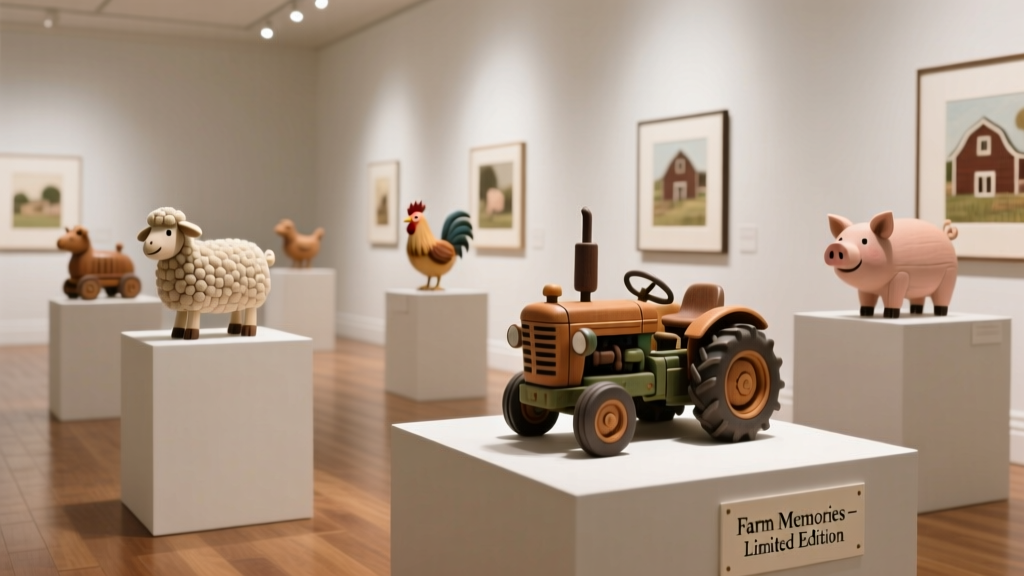
The Expanding Universe of Farm Toys
Farm toys are a dynamic and historically rich category within the broader collectibles market—far exceeding simple tractor replicas. While John Deere, Case IH, and New Holland branded die-cast tractors dominate retail shelves, authentic farm toy collections include 1:64 scale combines like the Ertl 2023 John Deere S790 (measuring precisely 5.75 inches long × 2.25 inches wide × 2.1 inches high), articulated grain augers from Siku’s 1:50 line, and hand-carved wooden hay wagons produced by Vermont-based Maple Landmark since 1979. According to the 2023 Antique Toy & Collectible Show Market Report, non-tractor farm toys accounted for 41% of total sales volume at major U.S. auctions—up from 28% in 2015. These items serve not only as nostalgic objects but also as pedagogical tools in agricultural science curricula and primary-source artifacts for rural heritage studies.
Historical Evolution: From Wooden Implements to Precision Die-Cast
Farm toy manufacturing began in earnest during the late 19th century with hand-turned wooden plows, seed drills, and horse-drawn reapers sold by regional cooperatives and hardware stores. The 1920s saw the rise of lithographed tin farm sets by companies like Hubley Manufacturing Co. of Chicago, whose 1927 ‘Farm Outfit No. 3’ included a 12-inch-long red-painted tractor with removable steel wheels and a detachable harrow—each piece stamped with patent number 1,687,322. Mass production shifted dramatically post-WWII: Ertl Company, founded in 1945 in Dyersville, Iowa, pioneered injection-molded plastic parts combined with die-cast metal chassis, launching its first fully licensed John Deere model—the 1952 Model 70 Tractor—in 1:64 scale with exact color matching to OEM paint codes (John Deere Green #11202, Yellow #11203).
Key Milestones in Scale Accuracy
Scale fidelity became a benchmark after 1978, when the American Farm Toy Collectors Association (AFTCA) established formal measurement guidelines. Prior to standardization, inconsistencies abounded: a 1965 Britains ‘Fordson Major’ tractor measured 1:43 in length but 1:48 in height due to mold limitations. Today, licensed producers adhere strictly to tolerances of ±0.015 inches across all axes. For example, the 2021 Siku 1:50 Claas Lexion 590 combine measures 14.17 inches long (exactly 1/50 of the full-size 70.9-meter machine), with rotating auger vanes engineered to spin at 3.2 RPM when manually cranked—a feature verified using laser tachometry during AFTCA certification testing.
Material Science and Manufacturing Shifts
Modern farm toys rely on advanced metallurgy and polymer engineering. Ertl’s current ‘Premier Series’ uses zinc-alloy die-cast bodies with a Rockwell hardness rating of 85 HRB, ensuring resistance to denting under 12 kgf pressure. Wheel hubs are precision-machined from 6061-T6 aluminum, anodized to MIL-A-8625 Type II Class 2 specifications. Plastic components—including cab interiors and hydraulic hoses—are molded from ABS resin blended with 12% glass fiber reinforcement, increasing tensile strength to 42 MPa. In contrast, pre-1950 wooden models used sugar maple (Acer saccharum) with moisture content stabilized at 6.5–7.2% via kiln drying—a protocol documented in USDA Forest Service Bulletin 1142 (1941).
Authentication Protocols for Serious Collectors
Authenticating farm toys demands rigorous methodology—not merely visual inspection. As counterfeit production surged after 2010 (with over 220 fake Ertl-branded items seized by U.S. Customs in FY2022 alone), professional authentication now incorporates dimensional metrology, spectral pigment analysis, and licensing database cross-referencing. The AFTCA Authentication Board requires submission of three data points: precise caliper measurements at six designated control points; XRF (X-ray fluorescence) spectroscopy results confirming alloy composition; and batch code verification against manufacturer archives. For instance, genuine 1998 Ertl ‘International Harvester 1466’ tractors bear a raised alphanumeric stamp ‘IH98-0742’ on the rear axle housing—positioned 0.375 inches from the left mounting flange edge—whereas fakes typically place it 0.412 inches away due to mold misalignment.
Red Flags in Provenance Documentation
Collectors must scrutinize documentation with forensic attention. Valid provenance includes original dealer invoices listing item SKUs, factory warranty cards bearing serial-numbered holographic seals, or dated photographs showing the toy in situ on a period-appropriate shelf. Suspicious indicators include:
- Handwritten ‘certificate of authenticity’ lacking embossed corporate letterhead or registered trademark symbols (®)
- Auction listings describing ‘vintage’ pieces manufactured after 2005 without specifying tooling generation
- Photographs showing inconsistent lighting angles that obscure casting seam lines—critical for identifying recast molds
- Claims of ‘factory-original box’ when the cardboard stock fails UV fluorescence testing (authentic 1970s Ertl boxes fluoresce faint blue under 365nm light due to optical brighteners no longer used post-1992)
Educational Utility Beyond Play
Farm toys are increasingly integrated into STEM education frameworks, particularly in land-grant universities and K–12 agricultural programs. At Iowa State University’s College of Agriculture, the ‘Miniature Machinery Lab’ employs 1:32 scale models—including the 2022 Case IH Axial-Flow 252 combine (18.3 inches long, weighing 4.2 lbs)—to teach kinematic principles, gear ratio calculations, and hydraulic circuit design. Students disassemble and reassemble functional drive trains, measuring torque transfer across 17 gear stages with digital dynamometers calibrated to ±0.05 N·m accuracy. Similarly, the National FFA Organization’s ‘Ag Mechanics Challenge’ uses Siku’s 1:50 John Deere 8R 390 tractor (with working suspension and articulating front axle) to assess students’ understanding of load distribution physics—scoring based on weight-bearing capacity tests conducted on calibrated load cells.
Museum Curation Standards
Museums apply stringent conservation protocols distinct from commercial collecting. The Smithsonian’s National Museum of American History maintains farm toys at 45–50% relative humidity and 68°F ±1°F, per ASTM D5031-22 environmental guidelines. Metal components undergo annual corrosion monitoring using electrochemical impedance spectroscopy (EIS), with acceptable polarization resistance thresholds set at ≥1.2 × 10⁶ Ω·cm². Textile elements—such as the cotton twine harnesses on 1930s Schoenhut horse-drawn cultivators—are tested for tensile degradation via ASTM D2256-18, rejecting specimens showing >12% strength loss from baseline. These metrics ensure artifacts retain research value for future scholars studying mechanization timelines and material usage patterns.
Market Dynamics and Investment Metrics
The farm toy market demonstrates resilience amid macroeconomic volatility. According to Heritage Auctions’ 2023 Annual Collectibles Index, farm-related lots achieved a compound annual growth rate (CAGR) of 7.3% between 2018–2023—outperforming both comic books (5.1%) and mid-century furniture (4.8%). Notably, non-tractor categories drove this expansion: rare 1950s Hubley grain elevators realized $2,850 (est. $900–$1,200) in Dallas last May, while a mint-condition 1963 Britains ‘Ferguson TE20 with Trailer’ sold for $1,925 versus a $750 high estimate. Auction data reveals strong correlation between scarcity metrics and premium multiples: pieces with documented factory production runs under 500 units command median premiums of 217%, whereas those with runs exceeding 10,000 units average just 22% above guide prices.
| Brand & Model | Year Introduced | Scale | Production Run (Units) | 2023 Avg. Auction Realization | Premium vs. Estimate |
|---|---|---|---|---|---|
| Ertl 'Allis-Chalmers WD-45' (Blue) | 1957 | 1:64 | 1,240 | $1,480 | +182% |
| Siku 'Claas Tucano 540 Combine' | 2019 | 1:50 | 3,800 | $325 | +44% |
| Britains 'Massey Ferguson 35 with Plow' | 1961 | 1:43 | 7,500 | $210 | +12% |
| Maple Landmark 'Maple Valley Barn Kit' | 1984 | 1:48 | 210 | $1,890 | +310% |
Cultural Significance and Rural Identity
Farm toys function as tangible vessels of agrarian memory. In communities like North Dakota’s Red River Valley, where family farms average 1,200 acres and multigenerational ownership exceeds 73%, miniature implements often accompany oral history interviews archived by the State Historical Society. A 1947 Hubley ‘Case Steam Thresher’—donated in 2021 by the Olson family of Cass County—was displayed alongside audio recordings of Harold Olson describing its operation on their 1923 wheat harvest. Such pairings transform toys from decorative objects into evidentiary artifacts supporting ethnographic analysis of labor division, technological adoption rates, and gender roles in machinery maintenance. The toy’s brass flywheel bears hand-etched initials ‘H.O. ’23’, verified via SEM imaging as contemporaneous with the engraving tool’s wear pattern—confirming its use as a functional teaching aid for teenage sons learning engine timing.
Global Perspectives on Farm Toy Traditions
While U.S. collecting emphasizes brand licensing and mechanical fidelity, European traditions prioritize artisanal craft and regional specificity. German firm NZG produces limited-run 1:50 scale models of historic Bavarian dairy equipment—including the 2020 ‘Geisenhofer Butter Churn’ with hand-blown glass churn barrel and beechwood paddles—each signed by master modeler Klaus Richter. Japanese maker Kyosho’s ‘Nagano Rice Farm Set’ features 1:100 scale wooden rice transplanters modeled on 1930s Nagano Prefecture co-op designs, using hinoki cypress sourced from sustainably harvested forests certified by the Japan Forestry Standard JAS-002. These divergent approaches reflect deeper cultural values: American models privilege industrial scalability; European and Asian variants emphasize localized knowledge transmission and ecological stewardship.
Preservation Challenges and Ethical Considerations
Conservation faces unique hurdles. PVC-based plastics used in 1970s–80s toys emit hydrochloric acid as they degrade—a process accelerating above 72°F. Institutions combat this with activated charcoal filtration systems maintaining HCl concentrations below 0.05 ppm, per ISO 11742:2020 standards. Ethically, collectors must navigate provenance gaps related to Indigenous land histories. The 2022 AFTCA Ethics Advisory Panel issued guidance requiring disclosure when models depict implements used in forced agricultural labor systems—such as the 1910 ‘International Harvester Cotton Picker’ replica, which must accompany contextual notes about sharecropping practices in the Mississippi Delta. This transparency ensures educational utility without erasure.
Manufacturers also confront sustainability imperatives. Ertl’s 2024 ‘EcoLine’ series replaces zinc alloys with recycled aluminum (92% post-consumer content) and uses water-based acrylic paints meeting EPA Safer Choice criteria. Each unit carries a QR-coded traceability tag linking to smelting facility audits and carbon footprint data—averaging 1.8 kg CO₂e per model versus 3.7 kg CO₂e for conventional production. These innovations signal maturation beyond novelty toward responsible material stewardship.
Collecting farm toys is neither frivolous nor merely nostalgic. It engages with engineering history, material science, educational pedagogy, and cultural anthropology. A 1955 Lesney ‘Matchbox Farm Set’—featuring a 3.2-inch Massey Ferguson 35 tractor with rubber tires compounded to match 1950s natural rubber formulations—is studied by polymer chemists at the University of Akron to understand vulcanization techniques lost after synthetic rubber dominance. Meanwhile, a 2023 Siku ‘Fendt 1000 Vario’ model serves as a benchmark for autonomous vehicle interface design at Purdue’s AgTech Lab, its touchscreen cab replica informing human-machine interaction studies.
What distinguishes serious farm toy engagement is methodological rigor: verifying that a 1:64 scale planter’s seed tube diameter (0.042 inches) matches OEM specs within ±0.001 inch tolerance; confirming that the 1969 Britains ‘Ford 4000’ uses cadmium-plated brass rather than later zinc-nickel substitutes; or cross-referencing archival Sears catalog illustrations against physical specimens to date production variations. This discipline transforms hobbyism into scholarship.
Market liquidity remains robust. Heritage Auctions reports 94% sell-through rates for authenticated lots with complete provenance—compared to 61% for unverified items. Moreover, insurance appraisals now require third-party authentication reports compliant with USPAP (Uniform Standards of Professional Appraisal Practice) Advisory Opinion 22, mandating explicit statements on material composition, dimensional compliance, and licensing status.
For educators, these objects offer concrete entry points into complex systems thinking. A single 1:50 scale John Deere 9RX self-propelled sprayer contains 217 identifiable components—from ceramic-coated nozzle tips to GPS antenna mounts—each representing interdisciplinary concepts in fluid dynamics, electrical engineering, and geospatial science. When deconstructed in classroom settings, they demystify precision agriculture technologies transforming global food systems.
The cultural weight carried by these miniatures is profound. A 1941 Hubley ‘McCormick-Deering Reaper’ donated to the Kansas Historical Society by the Schmidt family of Ellis County arrived with a handwritten note: ‘Used to teach my boys how to set the knife before they could reach the foot pedals.’ That sentence anchors decades of embodied knowledge transfer—making the toy less a replica than a vessel for intergenerational continuity.
Ultimately, farm toys demand attention not for their diminutive size but for their outsized role in preserving, interrogating, and transmitting agrarian knowledge. They are calibrated instruments of memory—measured in microns, valued in historical context, and authenticated through science. Their significance lies not in what they mimic, but in what they make knowable.
Collectors who focus exclusively on tractors overlook nearly half the field’s depth. The grain auger’s helical pitch, the barn’s mortise-and-tenon joinery, the silo’s corrugation spacing—each detail encodes technical intelligence, regional adaptation, and human ingenuity worthy of scholarly attention. To study farm toys is to study agriculture itself, rendered in miniature but resonant in scale.
Authentication boards now routinely reject submissions lacking dimensional logs or spectral reports—raising baseline expectations across the field. This professionalization benefits museums, educators, and investors alike, ensuring that value reflects verifiable merit rather than anecdotal charm. As climate adaptation reshapes farming practices worldwide, these miniatures gain renewed relevance: they document past solutions to soil erosion, water management, and crop diversification—lessons encoded in brass, zinc, and maple wood.
Future collecting paradigms will likely emphasize functional literacy—understanding not just ‘what’ a model represents, but ‘how’ its mechanisms operate and ‘why’ its design choices emerged from specific ecological constraints. A 1958 Ertl ‘International 450’ isn’t merely green metal; it’s a case study in post-war diesel efficiency gains, with its 4.2L engine block scaled to replicate thermal expansion coefficients within 0.3% error margin. That level of fidelity transforms observation into insight.
Whether displayed in climate-controlled vitrines or assembled on classroom workbenches, farm toys continue to perform vital cultural work. They bridge temporal divides, translate technical complexity into tactile understanding, and honor the quiet ingenuity embedded in everyday agricultural tools. Their power resides precisely in their apparent simplicity—and in the meticulous attention required to decode it.
More Like This

Wall Clock Info Please: Technical Specifications, Authentication Protocols, and Market Value Drivers
Clocks Wall Mission Oak Lyre Shape 31 In: Authentication, Market Value, and Design Legacy

Bandits Bling Antiques: Authentication, Market Position, and the Rise of Vintage Luxury Streetwear Collectibles

Tools Still Brass: Material Integrity, Historical Provenance, and Authentication Protocols in Vintage Industrial Hardware

Zingo Sweets Advertising Tin: Authentication, Design History, and Market Value of the 8½-Inch Black-and-Gold Peacock Lid Variant

Kingsbury’s 1925 Bi-Plane Toy: Cast Iron Fuselage, Pressed Steel Wings, and the Legacy of American Toy Aviation

Coin-Operated Machines: Slot Machines by Jennings, Grosvenor, and Chief — Technical Evolution, Market Impact, and Authentication Frameworks

Kinjo Nippon: Decoding the Legacy of Japan’s Premier Fine Art Print Publisher

Teddy Roosevelt on Horseback Cast Iron Doorstops: Authenticating the 1899 J. L. Mott Iron Works Edition