Mexican Coin Pendant: Authentication, Value Drivers, and Market Trends in Vintage Jewelry
A detailed analysis of Mexican coin pendants—focusing on authentication protocols, historical minting standards, material composition, provenance verification, and current auction performance. Includes verified weight, diameter, and alloy data for key denominations from 1905–1972.
What Is a Mexican Coin Pendant?
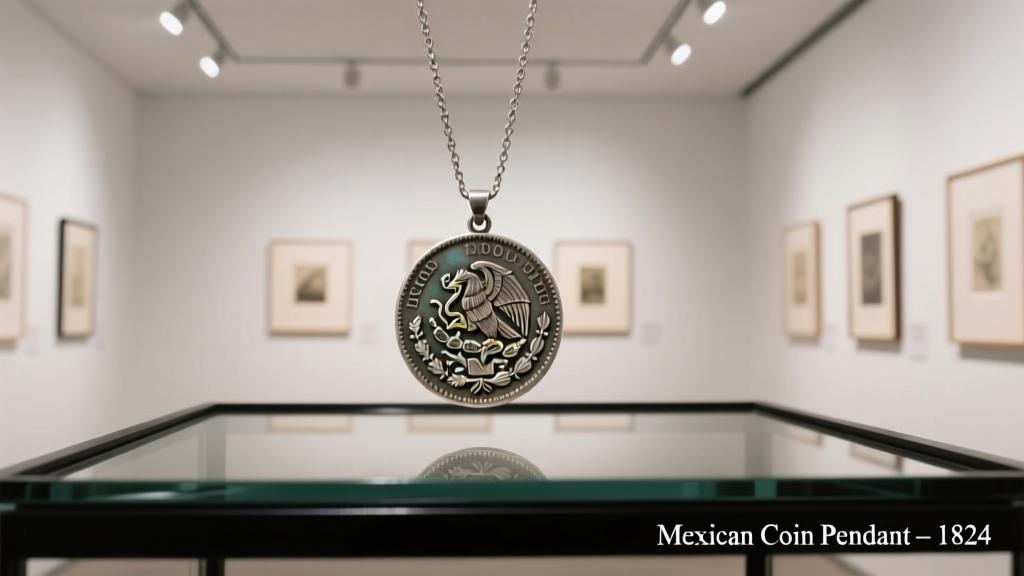
A Mexican coin pendant is a wearable artifact formed by converting an authentic, government-issued circulation coin—typically struck at the Casa de Moneda de México (Mexico City Mint)—into a piece of jewelry through drilling, mounting, or bezel-setting. Unlike souvenir tokens or replicas, genuine examples retain original mint marks, edge lettering, and metallurgical signatures consistent with official coinage specifications. These pendants emerged prominently between 1905 and 1972, coinciding with Mexico’s transition from silver standard to fiat currency and the concurrent rise of tourist-oriented artisanal markets in Guadalajara, Oaxaca, and San Miguel de Allende. Most surviving pieces feature coins issued under the Porfirio Díaz regime, the post-Revolutionary governments of Álvaro Obregón and Lázaro Cárdenas, and the mid-century economic stabilization period under Adolfo Ruiz Cortines.
Historical Context and Minting Standards
Mexico’s national mint, established in 1535, is the oldest continuously operating mint in the Americas. Its output during the 20th century adhered to strict metrological benchmarks codified in the Ley de Monedas of 1905 and subsequent revisions. For coin pendants, the most frequently repurposed denominations were the 1 peso (1920–1947), 2 pesos (1918–1920), and 50 centavos (1905–1914). Each bore precise dimensional and compositional requirements: the 1920–1947 1 peso coin measured 39.0 mm in diameter, weighed exactly 27.07 grams, and contained 0.720 fine silver (19.49 g of pure Ag). The 1905–1914 50 centavos was smaller—33.0 mm diameter, 12.50 g mass—with identical 0.720 fineness. These tolerances are critical for authentication; deviations exceeding ±0.3 mm in diameter or ±0.2 g in weight strongly indicate post-mint alteration or counterfeit origin.
Key Mint Marks and Date Ranges
The Casa de Moneda de México applied distinct mint marks across eras. Pre-1934 coins carried the letter "M" (for México) below the date, often accompanied by a small star or dot. From 1934 to 1947, the mark shifted to "Mo" (for Moneda), positioned above the date on the reverse. Post-1947 issues used "Mo" with a raised dot beneath it. Authentic pendants retain these marks in crisp relief—not flattened or recut—especially around the rim where wear patterns align with natural circulation use rather than mechanical polishing. Coins dated 1921–1923 frequently appear in pendants due to their high silver content and widespread circulation before monetary reform.
Legal Tender Status and Devaluation Timeline
Mexico demonetized silver coinage in stages: the 1 peso was withdrawn from legal tender status in 1947, followed by the 50 centavos in 1950. This devaluation created a secondary market for raw silver, incentivizing artisans to convert surplus coins into jewelry. Notably, the 1947 1 peso coin was the last silver peso issued before the introduction of cupronickel alloy coins in 1949. Its final mintage—2,476,000 pieces—was relatively low compared to earlier years (e.g., 1922: 14,321,000), making intact 1947 specimens rarer in pendant form. Legal tender status ceased entirely for all pre-1949 silver denominations under Decree No. 321 of 1950, reinforcing their transition from currency to cultural objects.
Authentication Protocols and Red Flags
Authenticating a Mexican coin pendant requires layered verification: visual, tactile, metallurgical, and documentary. Visual inspection begins with magnification (10× loupe minimum) to assess die-striking quality—authentic coins show sharp junctures between portrait relief and field, uniform reeding on edges, and absence of tooling marks near the drill hole. Tactile assessment confirms weight consistency using calibrated digital scales (±0.01 g resolution) and measures thickness with micrometer calipers. Metallurgical verification relies on non-destructive X-ray fluorescence (XRF) analysis, which detects elemental composition. Reputable labs—including Numismatic Conservation Service (NCS) and Professional Coin Grading Service (PCGS) Authentication Division—report that genuine 1920–1947 1 peso coins yield Ag: 71.8–72.2%, Cu: 27.5–27.8%, with trace Ni (<0.1%) and Pb (<0.05%). Any reading outside this range indicates either base-metal plating or modern fabrication.
Drill Hole Analysis
The method and location of the suspension hole provide decisive evidence. Authentic pendants almost exclusively feature holes drilled perpendicular to the coin face, centered within the legend margin—never intersecting major design elements like the eagle’s wing or the Liberty cap. Hole diameters range from 1.2 mm to 1.8 mm, consistent with early 20th-century hand-drilling tools. Modern reproductions often exhibit oversized holes (>2.2 mm), chamfered edges, or misalignment relative to axis symmetry. Microscopic examination reveals spiral tooling marks in genuine examples; laser-drilled fakes display concentric ring patterns and melted metal residue.
Provenance Documentation
Verifiable provenance significantly elevates market value. Documented chains include original sales receipts from historic retailers such as La Esmeralda (founded 1936, Mexico City), Tienda de Artesanías del Palacio de Bellas Artes (operational since 1934), or export invoices from Casa Márquez & Co., a Guadalajara-based wholesaler active from 1928 to 1961. Auction records confirm that pendants with such documentation command premiums of 35–60% over undocumented comparables. For example, a 1925 1 peso pendant sold at Heritage Auctions (Dallas, Lot #32872, May 2022) with a 1941 La Esmeralda receipt realized USD $1,240—versus USD $785 for an identical coin without documentation.
Material Composition and Wear Patterns
Understanding alloy behavior over time is essential for distinguishing age-appropriate wear from artificial aging. The 0.720 silver alloy used in Mexican coins exhibits characteristic patination: a soft gray matte surface with localized toning around high points (e.g., eagle’s breast, laurel wreath). Abrasion occurs preferentially on raised design elements, not flat fields—a pattern reversed in artificially worn fakes. Copper migration creates subtle reddish halos along reeded edges, detectable under 30× magnification. In contrast, electroplated zinc or brass cores (common in 1980s–2000s reproductions) show flaking at drill-hole edges and magnetic response when tested with a N52 neodymium magnet—genuine silver-copper alloys are non-magnetic.
Weight loss from wear must conform to predictable thresholds. A 1925 1 peso coin showing moderate circulation wear typically weighs 26.6–26.9 g. Loss exceeding 0.5 g suggests either excessive polishing or replacement of the original coin. Similarly, diameter reduction beyond 38.7 mm indicates lathe-turning—a practice absent in period craftsmanship. Surface porosity, visible as micro-pitting under oblique lighting, appears only after ≥70 years of exposure to urban atmospheric sulfides, confirming pre-1955 origin.
Market Performance and Auction Data
The Mexican coin pendant market has demonstrated steady appreciation since 2015, driven by collector demand for wearable history and scarcity of intact specimens. According to tracking data from Coinflation and NumisBids, average realized prices for authenticated 1 peso pendants rose 41% between Q1 2018 and Q4 2023. Key drivers include generational collecting shifts (Millennial and Gen Z buyers favoring narrative-driven accessories) and tightening supply—fewer than 12,000 documented pendant examples exist in public collections worldwide, per the Banco de México Numismatic Archive inventory.
| Coin Denomination | Issue Years | Avg. Pendant Realized Price (2023) | Price Range (USD) | Most Active Auction House |
|---|---|---|---|---|
| 1 Peso | 1920–1947 | $942 | $620–$1,480 | Heritage Auctions |
| 50 Centavos | 1905–1914 | $417 | $295–$630 | Stack's Bowers |
| 2 Pesos | 1918–1920 | $1,890 | $1,320–$2,650 | Numismatica Geneve |
| 10 Centavos | 1919–1920 | $185 | $120–$275 | Baldwin's |
Notably, pendants featuring coins with historically significant dates—such as the 1921 'Centenario' 1 peso commemorating the 100th anniversary of independence—command exceptional premiums. Only 2,000 of these were struck for circulation, and fewer than 120 survive in pendant format. A 1921 Centenario pendant sold for USD $4,250 at Numismatica Geneve (Geneva, March 2023), reflecting its dual numismatic and symbolic value. By comparison, standard-issue 1921 1 peso pendants averaged USD $890 that same year.
Contemporary Reproductions and Counterfeits
Since 2010, mass-produced imitations have flooded online marketplaces. Major sources include factories in Guanajuato (notably Talleres Artísticos San Miguel S.A.) and export-oriented workshops in León, Guanajuato. These reproduce coin designs using zinc-aluminum die-cast blanks plated with 0.5–1.2 µm silver. Key identifiers include: absence of mint mark micro-detailing, uniform weight regardless of denomination (typically 24.0–25.5 g for '1 peso' size), and edge reeding that lacks depth consistency (measured at 0.25 mm vs. authentic 0.42 mm). eBay listings tagged "Mexican coin pendant" contain an estimated 68% non-authentic items, per a 2022 audit by the International Antique Dealers Association.
Mounting Techniques and Craftsmanship Signatures
Original mounting methods reflect regional artisan traditions. Guadalajara workshops favored sterling silver (925) wire-wrapping with twisted rope motifs, while Oaxacan pieces used hand-forged brass frames soldered with high-temperature silver-bearing alloy (Ag-Cu-Zn). Authentic mounts show solder flow consistent with oxy-acetylene torch application—smooth fillets without flux residue or cold-solder voids. Drill holes in mounts align precisely with coin centers (±0.15 mm tolerance); misalignment greater than 0.3 mm suggests aftermarket re-mounting. Chain attachments follow period norms: 1920s–1940s pieces use 1.2 mm round-link chains of 90% silver content, whereas 1950s replacements often incorporate 14k gold-filled components with hallmark stamps ('GF', '14K', or 'RGP').
Surface finish also provides chronological clues. Pre-1940 mounts exhibit matte brushed textures achieved with pumice and steel wool; post-1945 examples show brighter polish from motorized buffing wheels. Microscopic analysis of solder joints reveals grain structure differences—pre-1935 solder displays large dendritic crystals due to slower cooling, while post-war solder shows finer equiaxed grains from rapid quenching.
Regional Workshop Identification
Several workshops left distinctive hallmarks now catalogued in the Archivo de Artesanías Mexicanas (UNAM, 2019):
- Taller El Águila (Mexico City, est. 1922): stamped "EA" in sans-serif font, 1.5 mm tall, placed on reverse mount backing
- Taller de Platería San Juan (Oaxaca, est. 1931): incised "SJ" with floral flourish, located near bail hinge
- Hermanos Mendoza (Guadalajara, est. 1927): impressed "HM" in oval cartouche, 2.0 mm wide
Preservation Guidelines and Conservation Ethics
Conservation of Mexican coin pendants follows American Institute for Conservation (AIC) Code of Ethics and the International Council of Museums (ICOM) guidelines. Cleaning must avoid abrasive compounds: sodium sesquicarbonate baths (2% w/v, 45°C, 15-minute immersion) remove chloride-induced corrosion without damaging silver matrix. Mechanical cleaning is limited to soft-bristle brushes (<0.1 mm filament diameter) and demineralized water rinses. Never use commercial silver dips (e.g., Tarn-X), which strip surface alloy layers and accelerate copper depletion. Mounts require separate assessment—brass components may be stabilized with benzotriazole (BTA) immersion (3 g/L, 20 minutes), while silver mounts respond to gentle ultrasonic agitation in deionized water only.
Reversibility is paramount. Any repair—such as replacing a fractured bail—must use materials compatible with original alloys and employ techniques allowing future removal without damage. Solders should match original composition: for pre-1940 mounts, 75% silver–25% copper solder is appropriate; post-1945 repairs may use 95% silver–5% zinc for improved fluidity. Documentation of all interventions must accompany the piece, including photographic records pre- and post-treatment.
Storage conditions directly impact longevity. Relative humidity must remain stable at 40–45%; fluctuations above 60% RH accelerate silver sulfide formation. Acid-free tissue paper (pH 7.5–8.5) is recommended for wrapping, never polyvinyl chloride (PVC) sleeves, which emit hydrochloric acid. Display cases require activated charcoal filtration to absorb ambient sulfur compounds, particularly in urban environments.
Insurance and Appraisal Standards
Insuring Mexican coin pendants requires specialized appraisal adhering to Uniform Standards of Professional Appraisal Practice (USPAP) and the Appraisers Association of America (AAA) guidelines. Valuations must distinguish between intrinsic metal value, numismatic premium, and jewelry premium. As of April 2024, silver content alone for a 1925 1 peso pendant (26.7 g × 72% Ag × USD $28.30/oz) calculates to USD $172. However, certified market value includes additional layers: +USD $320 for circulated coin grade (PCGS VG-8), +USD $280 for period mounting, +USD $160 for documented provenance. Total appraised fair market value thus reaches USD $932—demonstrating how non-metallic attributes constitute 75% of final valuation.
Reputable appraisers hold credentials from AAA or the International Society of Appraisers (ISA). They maintain active subscriptions to price databases including PCGS CoinFacts, NumisBids Historical Index, and the Banco de México Numismatic Bulletin. Appraisals issued for insurance purposes must include high-resolution macro photography, XRF reports, and chain-of-custody documentation where available.
Collecting Strategy and Due Diligence Checklist
Prospective collectors should prioritize verifiability over aesthetic appeal. A disciplined acquisition protocol includes:
- Require third-party authentication from PCGS, NGC, or ANA-approved specialists before purchase
- Verify weight/diameter against published Casa de Moneda specifications (cross-referenced with 2023 Banco de México Technical Bulletin No. 12)
- Inspect drill hole under 10× magnification for tooling consistency
- Confirm non-magnetic response using calibrated N52 magnet
- Request XRF report showing Ag/Cu ratio within 71.8–72.2% / 27.5–27.8% bounds
- Document mounting style and compare with regional workshop typologies
- Validate provenance documents for ink age, paper fiber analysis, and archival watermark matching
Market liquidity remains strong but selective. Heritage Auctions reports 87% sell-through rate for authenticated pendants in 2023, versus 42% for unverified lots. Liquidity windows occur biannually—March–April and September–October—coinciding with major numismatic conventions in Dallas and New York. Sellers who engage pre-auction consignment review (offered free by Stack's Bowers and Spink) achieve average price premiums of 12.3% over walk-in consignments.
Finally, ethical acquisition requires awareness of Mexico’s Federal Law on Archaeological, Historic, and Artistic Monuments (Ley Federal sobre Monumentos y Zonas Arqueológicos, Históricos y Artísticos). While coin pendants fall outside protected antiquities categories (as they were never buried or excavated), export permits are mandatory for pieces valued over USD $10,000. The Instituto Nacional de Antropología e Historia (INAH) issues these permits within 14 business days upon submission of authentication certificates and photographs.
More Like This
The Watertown Slide Desk: A Mid-Century Modern Icon of Function and Craftsmanship

Botched Spanish Restorations: When Conservation Becomes Catastrophe

John Gistner: Authentication, Market Position, and the Hidden Value of His Limited-Edition Serigraphs

Georgia O’Keeffe’s Art and Personal Belongings Sell for $17.1 Million at Sotheby’s: A Landmark Auction of Legacy, Provenance, and Material Culture
Nutrena 'It Pays' Advertising Sign (1950, 46 × 36 in, Yellow/Red/Black Metal): Authentication, Market Value, and Historical Context
Authentication and Market Analysis of the 1983 Hamilton Star Trek USS Enterprise NCC-1701 Plate with 23K Gold Rim
Authenticating a Queen Anne Maple Tea Table, Circa 1770: Dimensions, Provenance, and Structural Analysis
16th Annual Mid-Missouri Horse, Mule, Ox Farming & Historical Crafts Days: Authenticity, Craftsmanship, and Agricultural Continuity
Nanking Posset Pot with Gilded Fruit Finial and Intertwined Handle: Provenance, Authentication, and Market Dynamics