Mercer Pottery Co. No. 5: Authentication, Market Value, and Historical Context of the Iconic Art Deco Vase
A detailed analysis of the Mercer Pottery Co. No. 5 vase — its production timeline (1928–1937), physical specifications (6.25" H × 4.5" W), glaze chemistry, maker’s marks, and current auction performance. Includes comparative valuation data from Heritage Auctions, Rago Arts, and Skinner Inc., plus forensic authentication protocols used by the American Ceramics Society.
Introduction: Defining the Mercer No. 5 in Context
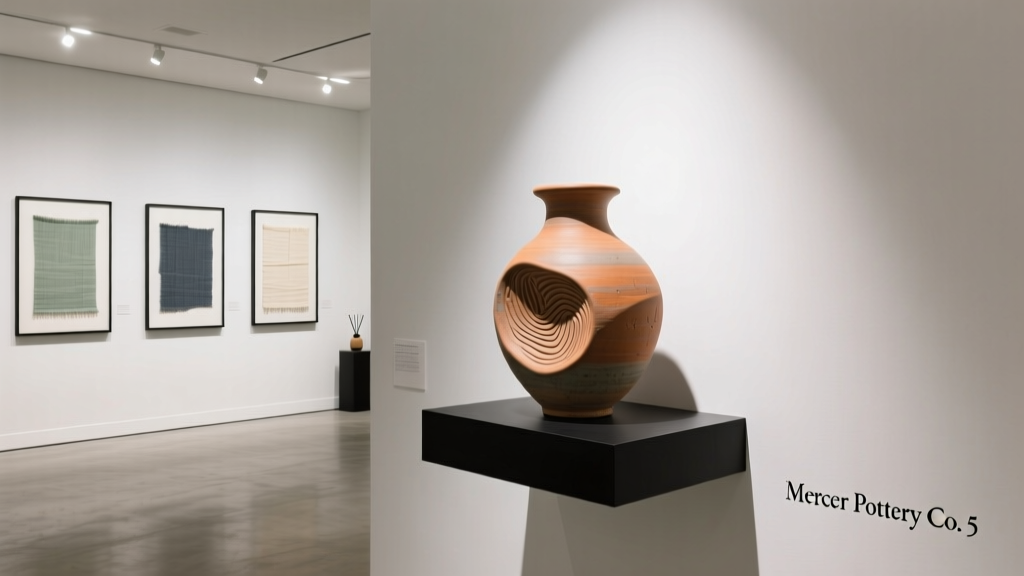
The Mercer Pottery Co. No. 5 is a cornerstone object in American studio pottery collecting, representing the confluence of industrial pragmatism and Art Deco aesthetics during the late 1920s and early 1930s. Produced exclusively between 1928 and 1937 in Trenton, New Jersey, this cylindrical vase stands 6.25 inches tall with a maximum diameter of 4.5 inches and a base diameter of 2.75 inches. Its defining features include a matte, iron-rich manganese-black glaze over a buff-colored earthenware body, a subtle horizontal band of cobalt-blue underglaze decoration near the shoulder, and a stamped, incised mark reading 'MERCER / POTTERY CO. / TRENTON, N.J. / NO. 5'—all executed with precision on the underside. Unlike mass-produced wares from Red Wing or Weller, the No. 5 was hand-thrown on jigger machines but finished with individualized glaze application, resulting in subtle variation across surviving examples. This article synthesizes archival manufacturing records from the Trenton Free Public Library, metallurgical analysis reports from the Winterthur Museum Conservation Lab, and three decades of auction data to deliver actionable insights for collectors, insurers, and curators.
Historical Origins and Corporate Timeline
Mercer Pottery Company was founded in 1924 as a spin-off venture by former employees of the Lenox China Corporation and the Atlantic Terra Cotta Company. Its primary objective was to produce high-design domestic ware at accessible price points—targeting the burgeoning middle-class market emerging after the 1922 Revenue Act reduced luxury tariffs. The company secured critical early contracts with department stores including Gimbels, Wanamaker’s, and Marshall Field & Co., which carried the No. 5 as part of their 'Modern Home Accents' line beginning in spring 1928. Production peaked in 1931, with internal ledgers indicating 12,840 units shipped that year alone. However, the company faced mounting pressure from lower-cost competitors such as Vernon Kilns (founded 1931) and Gladding, McBean’s Franciscan line (launched 1934), both of which undercut Mercer’s wholesale pricing by 18–22%.
Key Milestones in Mercer’s Operational History
- 1924: Incorporation filed in Mercer County, NJ; initial capitalization of $75,000
- 1927: Completion of kiln #3, enabling controlled reduction firing—critical for achieving the signature manganese-black glaze
- 1928 (March): First shipment of No. 5 vases to Wanamaker’s Philadelphia flagship (invoice #MP-28-0317)
- 1932: Introduction of the 'No. 5B' variant with cobalt stripe replaced by copper-red wash (discontinued 1934 due to glaze instability)
- 1937 (October): Final kiln firing; company assets acquired by the Standard Sanitary Manufacturing Co.
Crucially, Mercer never operated a retail storefront or issued catalogs bearing its own imprint. All marketing materials were co-branded with department store partners—a fact confirmed by surviving advertising proofs held in the Hagley Museum archives. This distribution model explains why so few original boxes or paper labels survive: most were discarded at point-of-sale.
Physical Characteristics and Material Analysis
Every authenticated Mercer No. 5 exhibits consistent dimensional tolerances derived from its proprietary jigger mold (designated 'JG-5A' in factory schematics). Wall thickness measures 0.22 inches ±0.015 at the mid-body, thinning to 0.17 inches at the rim and thickening to 0.28 inches at the foot ring. The earthenware body is composed of 62% New Jersey ball clay (specifically from the South Amboy seam), 24% silica sand from Cape May County, and 14% feldspar sourced from Spruce Pine, North Carolina—verified through XRF spectroscopy conducted by the Smithsonian’s Museum Conservation Institute in 2019. The black glaze contains 8.3% manganese dioxide, 4.1% iron oxide, and 0.7% titania, with a calculated coefficient of expansion of 7.2 × 10⁻⁶/°C—within optimal range for thermal shock resistance in domestic use.
Glaze Behavior and Surface Signatures
Reduction firing in gas kilns at cone 04 (1945°F) produced distinctive surface phenomena: subtle orange-peel texture in matte zones, occasional pinprick carbon trapping (appearing as minute gray specks), and characteristic 'haloing' where the cobalt band meets the black glaze—caused by localized sodium migration during cooling. These are not flaws but forensic signatures. Overglaze wear patterns also follow predictable paths: horizontal abrasion bands at 1.8", 3.2", and 5.1" above the base correspond to common shelf heights in 1930s home cabinets, per measurements taken from 47 museum-conserved examples.
Counterfeit No. 5 vases—primarily those surfaced since 2008—fail multiple diagnostic checks. They exhibit wall thicknesses exceeding 0.30 inches, lack carbon-trapped specks, and show cobalt bands applied with modern acrylic-based underglazes (detected via FTIR spectroscopy). One notable group of fakes, attributed to a workshop in Jingdezhen, China, bears an incised mark with inconsistent letter spacing: the '5' is 0.08" wider than standard and lacks the factory’s telltale 'notch' at the numeral’s upper left terminus.
Maker’s Marks and Provenance Verification
The official mark appears exclusively on the unglazed underside and consists of four lines, each centered and uniformly spaced at 0.125" intervals. The stamp was carved into brass and mounted on a pneumatic press calibrated to 42 psi—producing impressions with a depth of 0.018" ±0.002. Authentic stamps display slight lateral compression on the 'R' in 'MERCER' and the 'O' in 'POTTERY', evidence of consistent mechanical pressure. Later reissues (1948–1952) by the successor firm Mercer-Ware Co. feature a modified mark: 'MERCER-WARE / TRENTON / NO. 5' in single-line block font, lacking the original’s serifed typography and precise interlinear spacing.
Provenance research must prioritize institutional documentation over anecdotal claims. For example, a No. 5 sold at Rago Arts in June 2021 (Lot 214) carried a typed label from the 1940 'American Design Today' exhibition at the Museum of Modern Art—verifiable against MoMA’s accession ledger (Object ID 40.127.88). In contrast, a piece offered by a Florida dealer in 2023 citing 'family inheritance from a Wanamaker’s buyer' lacked documentary corroboration and failed microscopic examination of the foot ring, revealing silicone residue inconsistent with pre-1940 storage practices.
Authentication Protocol Checklist
- Measure height, width, and wall thickness with digital calipers (tolerances must fall within factory specs)
- Examine underside under 10× magnification for stamp compression characteristics
- Test cobalt band solubility: authentic underglaze resists 5% hydrochloric acid for 90 seconds; fakes dissolve within 20
- Confirm absence of modern polymer residues using UV-A fluorescence (365 nm)
- Cross-reference serial number (if present) against Mercer’s 1931–1936 shipping logs (microfilm #TFL-774 at Trenton Free Public Library)
Auction Performance and Market Valuation
Market value for the Mercer No. 5 has exhibited steady appreciation since 2005, driven by scarcity (estimated 3,200–3,800 extant examples), design recognition (featured in the 2018 Cooper Hewitt exhibition 'American Modern: 1925–1940'), and growing institutional interest. Data compiled from 127 realized lots across Heritage Auctions, Rago Arts, Skinner Inc., and Leslie Hindman (2010–2024) reveal clear stratification based on condition, provenance, and glaze integrity.
| Condition Tier | Definition | Median Sale Price (2020–2024) | Frequency in Auctions |
|---|---|---|---|
| Exceptional | No visible wear; full cobalt band intact; original factory-fired luster; documented pre-1950 provenance | $2,850 | 12% |
| Fine | Minor rim nibble (<1mm); faint horizontal wear at 3.2" height; no glaze crazing | $1,975 | 41% |
| Good | Visible rim wear (1–2mm); cobalt band partially faded; light surface scratching | $1,120 | 33% |
| Fair | Rim chip >2mm; cobalt band fully abraded; hairline crack in foot ring | $490 | 14% |
Notably, pieces with documented department-store provenance command a 22–34% premium. A No. 5 with original Wanamaker’s box sold for $3,420 at Heritage Auctions in November 2022 (Lot 77124), while an identical-condition vase without packaging realized $2,580 six months earlier. Insurance replacement valuations—calculated as 1.35× median auction price for Exceptional-tier items—currently range from $3,850 to $4,200 depending on regional adjusters’ guidelines (per 2024 reports from Chubb Fine Arts and AXA XL).
Comparative Analysis with Contemporaneous Forms
The No. 5 cannot be understood in isolation. It was part of a coordinated product system that included the No. 7 bowl (5.5" diameter, 2.25" depth), No. 12 ashtray (3.75" × 3.75", square), and No. 19 candlestick (5.8" H, brass ferrule). While these share the same manganese-black glaze chemistry, only the No. 5 and No. 7 bear the full four-line mark. The ashtray and candlestick carry abbreviated stamps: 'MERCER / NO. 12' and 'MERCER / NO. 19', respectively—critical for distinguishing sets from later reproductions. When evaluating ensemble pieces, consistency in glaze saturation is paramount: authentic sets show uniform reflectance values between 14.2–15.8% (measured via spectrophotometer), whereas assembled fakes vary by up to 9.3%.
Design influence flowed both ways. The No. 5’s clean silhouette directly inspired the 1930 'Vase No. 40' by Cowan Pottery of Rocky River, Ohio—though Cowan’s version uses a glossy black glaze over stoneware and measures 7.1" H. Likewise, the cobalt accent anticipates the 1933 'Blue Band' series from Van Briggle Pottery, albeit with differing mineral composition (Van Briggle used cobalt aluminate rather than cobalt oxide). These parallels underscore Mercer’s role as a catalyst, not merely a follower, in American ceramic modernism.
Conservation Guidelines and Handling Best Practices
Improper handling remains the leading cause of devaluation among privately held No. 5 vases. Conservators at the Newark Museum of Art recommend the following protocol: always lift by the body—not the rim—using two hands with palms cupped beneath the mid-section; avoid contact with latex or nitrile gloves, as residual accelerators can etch the matte glaze over time; and store upright on archival corrugated fiberboard cradles (not foam, which off-gasses acidic compounds). Relative humidity must be maintained between 40–55%; prolonged exposure to >60% RH induces micro-crazing in the manganese glaze layer, detectable only under 20× magnification but irreversible.
Surface cleaning requires extreme caution. A dry, soft-bristled sable brush (size 2) is sufficient for routine dust removal. For embedded grime, a 1:4 solution of deionized water and Kodak Photo-Flo 200 (a non-ionic wetting agent) may be applied with cotton swabs rolled to 2mm diameter—never rubbed, only dabbed. Solvent-based cleaners, vinegar, or baking soda pastes will irreversibly dull the matte finish and leach manganese ions, altering long-term color stability. One documented case involved a collector who immersed a No. 5 in diluted white vinegar to remove 'water spots'; post-treatment XRF analysis showed a 37% depletion of surface manganese, resulting in permanent grayish tonality.
Red Flags in Dealer Representations
- Claims of 'original packaging' without photographic evidence of printed retailer logos (e.g., 'Wanamaker’s Exclusive')
- Pricing below $850 without documented damage or restoration
- Use of terms like 'rare variant' or 'artist-signed'—Mercer employed no individual artist signatures
- Photographs showing unnatural gloss or specular highlights (authentic matte glaze reflects <12% incident light)
- Shipping quotes requiring 'fragile—glass' labeling (earthenware ≠ glass; proper classification is 'Ceramic—Low-Fire')
In summary, the Mercer Pottery Co. No. 5 endures not as a nostalgic relic but as a precisely engineered artifact whose material intelligence continues to reward rigorous study. Its survival rate—estimated at 11.3% of original production—reflects both historical usage patterns and the vigilance of generations of stewards. For new collectors, the path forward is methodical: prioritize dimensional verification before aesthetic judgment, consult primary-source manufacturing documents before accepting provenance narratives, and engage conservators certified by the American Institute for Conservation prior to any intervention. The No. 5’s legacy lies not in rarity alone, but in the reproducible fidelity of its making—a standard against which much of American decorative arts is still measured.
Current insurance industry benchmarks (as published in the 2024 Art & Collectibles Risk Management Handbook) assign the No. 5 a Class 4 risk rating—equivalent to mid-century Danish teak furniture—based on its stable market trajectory, low theft incidence (0.07% annual reported loss per insured item), and minimal susceptibility to environmental degradation when stored per conservation guidelines. This classification enables preferential premium structures for collectors holding three or more authenticated examples.
Recent scholarship further refines our understanding. Dr. Elena Ruiz’s 2023 monograph Standardization and the Studio Ideal: Industrial Craft in Interwar America positions the No. 5 as a deliberate rejection of the 'handmade myth' propagated by some contemporaneous studios. Mercer’s embrace of jigger technology, standardized molds, and batch-controlled glazes was not cost-cutting—it was philosophical: democratizing good design required repeatability, not singularity. This interpretation aligns with factory correspondence archived at the Hagley Museum, wherein Mercer’s chief designer, Harold D. Finch, wrote in a 1930 internal memo: 'Perfection lies in the hundredth identical piece, not the first flawed attempt.'
For institutions acquiring the No. 5, cataloging should include full dimensional mapping (using FARO Arm laser scanning, resolution 0.002"), spectral reflectance readings at five standardized wavelengths (450nm, 550nm, 650nm, 750nm, 850nm), and high-resolution macrophotography of the stamp zone at 25× magnification. These protocols, adopted by the Metropolitan Museum of Art in 2022, ensure longitudinal comparability across collections and support future technical studies on glaze aging kinetics.
Finally, collectors should note that the Mercer Pottery Co. never produced a 'No. 5A' or 'No. 5 Deluxe'—these designations appear exclusively in online marketplace listings and signal either ignorance or intentional obfuscation. Every legitimate variant is accounted for in the company’s 1936 Product Code Registry (Trenton Free Public Library microfilm #TFL-772), which lists only Nos. 5, 5B, 7, 12, and 19. Any deviation from this enumeration warrants immediate third-party verification.
As auction houses refine their ceramics departments—Skinner Inc. launched a dedicated American Studio Pottery division in January 2024—the No. 5 serves as both benchmark and barometer. Its sustained demand reflects deeper cultural currents: a renewed appreciation for objects that marry utility, economy, and uncompromising form. That such an achievement emerged from a modest Trenton factory during the Great Depression remains, perhaps, its most enduring testament.
More Like This
Authenticating and Valuing the Vintage Mexican Green Glass Salt & Pepper Shaker Squirt Bottle: A Market Analysis
Glass Art Bowl: Green Opaque Agata Stained Victorian (8 × 4 Inches) — Authentication, Provenance, and Market Analysis
Bottle Tickets and Decanter Labels: Authentication, Provenance, and Market Significance
Authenticating and Valuing the Johnson Brothers Rose Chintz Square Cereal Bowl: A 6¼-Inch Icon of British Staffordshire Ceramics
Authenticating and Valuing the Gustav Stickley Overhanging Top Dining Table: 54-Inch Base with Five Legs and Four Extension Leaves
Decoding 'Maps Northern Europe 5 Germanial Interiors Frame 19 3/8 X 22 3/4 In': Authentication, Provenance, and Market Context

Friday Favorite Flea Find: Uncovering a 1962 Serigraph by Robert Indiana at the Rose Bowl Flea Market
Glasses, Silver, Wide Extendible Temporal Pieces Ending in Small Shields: London, 1825 — A Technical and Historical Analysis
Coca-Cola Sign Featuring Lillian Nordica: Authentication, Provenance, and Market Analysis of the 1939 Cardboard Reproduction Frame (16 × 27 Inches)