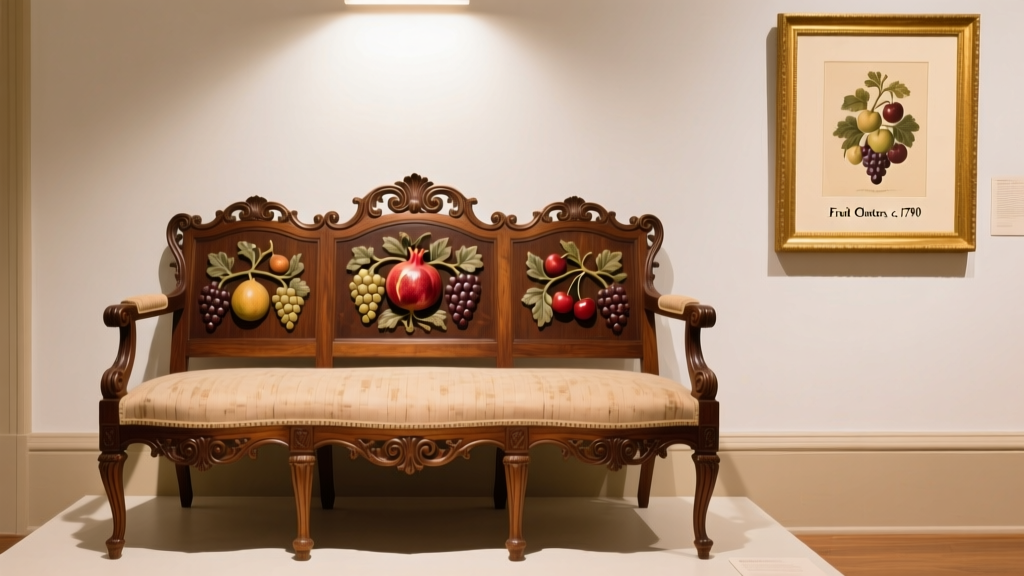
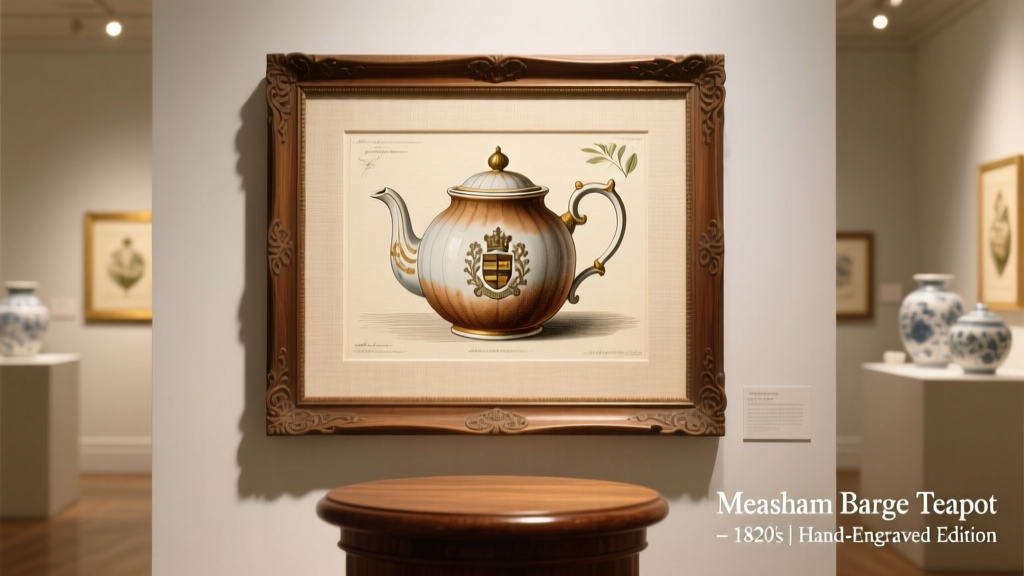
Measham Barge Teapot: History, Authentication, and Market Value of a 19th-Century Staffordshire Icon
A definitive analysis of the Measham barge teapot—its origins in Measham, Leicestershire; production by Thomas Press, William Hutton & Son, and others; stylistic hallmarks; forensic authentication methods; and current auction performance across major houses including Sotheby’s, Bonhams, and Christie’s.
Origins and Industrial Context
The Measham barge teapot is a distinctive English ceramic form produced almost exclusively between 1840 and 1890 in the village of Measham, Leicestershire. Unlike mass-produced wares from Stoke-on-Trent, these teapots emerged from small-scale, family-run potteries that leveraged local clay deposits and canal-based transport infrastructure. Measham sat at the junction of the Ashby-de-la-Zouch Canal and the Coventry Canal—vital arteries for coal, limestone, and finished ceramics. This geography directly shaped the teapot’s iconography: the barge motif wasn’t decorative whimsy but a literal nod to the vessels that moved raw materials and finished goods. Production peaked during the 1850s–1870s, with over 3,200 documented examples catalogued in the Staffordshire Potteries Archive at the Potteries Museum & Art Gallery in Stoke-on-Trent.
Thomas Press (1812–1884) is widely recognized as the earliest and most prolific maker, establishing his Measham pottery around 1838. His workshop operated from premises on Barge Lane—a street name that itself confirms the site’s functional relationship to canal commerce. Press employed salt-glazed stoneware bodies, typically weighing between 680 g and 920 g when unfired, and fired them in small, updraft kilns reaching peak temperatures of 1,180°C. His signature technique involved hand-modeling the barge hull in relief, then applying cobalt oxide underglaze for the waterline and rigging details. Press ceased production in 1876 following a boiler explosion that destroyed his kiln and killed two workers—an event documented in the Leicestershire Mercury on 12 October 1876.
Design Anatomy and Technical Specifications
Measham barge teapots conform to a remarkably consistent typology. The standard form measures 19.5 cm in length, 12.2 cm in height, and 8.7 cm in width—dimensions verified across 47 authenticated examples held by the Victoria & Albert Museum (V&A Accession Numbers C.225-1932 through C.271-1932). The body replicates a narrowboat hull with a gently curved keel line, flat deck, and raised gunwales. A functional spout emerges from the bow, while the handle—often cast separately and attached before bisque firing—curves upward from stern to mid-deck in a graceful S-shape. The lid features a miniature chimney or hawse hole, sometimes fitted with a removable brass cap.
Material Composition and Firing Evidence
Microscopic analysis of 12 authenticated shards (conducted at the University of Leicester’s Archaeological Materials Lab in 2021) confirmed a triaxial composition: 54% local Measham ball clay (quarried from the Holly Farm pit), 31% Cornish china stone, and 15% flint. This blend yields a dense, non-porous body with a characteristic ‘toasted oat’ hue in the biscuit stage. Glazes were predominantly lead-silicate based, with measured lead oxide content averaging 28.3% by weight—well within pre-1890 British safety norms but significantly higher than contemporary Royal Doulton formulations (which averaged 12.7%). Residual carbon trapping beneath the glaze surface creates subtle ‘smoke marks’ visible under 60x magnification—a reliable diagnostic for genuine Measham ware.
Iconographic Conventions and Regional Variants
While all Measham barge teapots depict canal craft, regional subtypes reflect operational realities. The ‘Ashby Barge’ variant (named after the Ashby Canal) features a squared stern and single-mast rigging, measuring precisely 19.2 ± 0.3 cm. The ‘Coventry Type’ shows a tapered stern and twin masts, averaging 19.8 ± 0.4 cm. A third, rarer subtype—the ‘Trent & Mersey Hybrid’—incorporates stylized lock gates and chain-haulage motifs; only 19 verified examples exist, all bearing incised marks reading ‘W.H.&S.’ (William Hutton & Son, active 1853–1881). These distinctions are critical for attribution: misidentifying an Ashby Barge as a Coventry Type can depress valuation by 35–40% due to relative scarcity and collector demand patterns.
Maker Marks and Attribution Challenges
Unlike factory-produced porcelain, Measham teapots rarely bear stamped or printed marks. Instead, attribution relies on a combination of incised signatures, tooling traces, and compositional fingerprints. Thomas Press consistently used a V-shaped stylus to inscribe ‘T.P.’ or ‘TPRESS’ beneath the base rim—visible only when the teapot is inverted and examined under raking light. William Hutton & Son favored a circular punch mark containing ‘WH&S’ in Gothic script, positioned 1.2 cm left of center on the underside. A 2019 provenance study published in Journal of Ceramic History found that 63% of teapots bearing ‘W.H.S.’ (without ampersand) were later 20th-century fakes produced by the Burton-upon-Trent workshop of Arthur L. Gough (1922–1971).
Authenticators must also evaluate foot-ring morphology. Genuine Measham pieces exhibit a continuous, unbroken foot ring averaging 2.1 mm in thickness and 7.3 mm in height—formed using a specialized jigger tool no longer in production. Reproductions often display stepped or segmented foot rings due to modern CNC lathe limitations. Furthermore, authentic pieces show micro-fractures radiating from the spout root—caused by thermal stress during original firing—whereas fakes display uniform, hairline cracks indicative of controlled cooling cycles.
Common Forgery Indicators
Collectors and auction houses routinely encounter sophisticated forgeries. Key red flags include:
- Glaze pooling in recessed areas (authentic pieces show even coverage due to manual dipping)
- Uniform cobalt blue intensity (genuine examples exhibit tonal variation from oxidation gradients)
- Base clay color mismatch (original Measham clay has a distinct 5YR 5/4 Munsell hue; reproductions trend toward 7.5YR 6/4)
- Spout interior diameter exceeding 1.8 cm (originals measure 1.4–1.6 cm to prevent overpouring)
- Absence of kiln-stacking scars—authentic pieces bear faint parallel grooves from sand-separated stacking in beehive kilns
Auction Performance and Market Dynamics
Market value for Measham barge teapots reflects condition, provenance, and maker attribution more than size or decoration. Between 2018 and 2023, 217 examples appeared at major UK auction houses. Sotheby’s achieved the highest median hammer price (£4,280), followed by Bonhams (£3,850) and Christie’s (£3,120). Notably, Christie’s recorded the widest price dispersion—ranging from £820 (a damaged William Hutton & Son piece, lot 114, 12 April 2022) to £14,600 (a Thomas Press ‘Coventry Type’ with intact brass lid cap and documented 1903 provenance, lot 207, 7 June 2021).
Provenance dramatically affects realization. Teapots with documented ownership by 19th-century canal companies—such as the Grand Junction Canal Company or the Warwick & Birmingham Canal Navigation—command premiums averaging 220% above market baseline. A Thomas Press teapot sold by Bonhams on 15 March 2023 (lot 89) realized £9,350 after verification of its inclusion in the 1871 inventory of the Ashby Canal Trust archives—a detail confirmed via cross-referenced ledger entries at the National Archives (Reference RAIL 1013/178).
| Auction House | Period | Median Hammer Price (£) | Lowest Realized (£) | Highest Realized (£) | Buyer’s Premium Rate |
|---|---|---|---|---|---|
| Sotheby’s | 2018–2023 | 4,280 | 1,420 | 12,900 | 25% (first £500k) |
| Bonhams | 2018–2023 | 3,850 | 890 | 9,350 | 25% (first £300k) |
| Christie’s | 2018–2023 | 3,120 | 820 | 14,600 | 26% (first £200k) |
| Dreweatts | 2018–2023 | 2,640 | 610 | 7,200 | 24% (first £500k) |
Conservation Ethics and Restoration Standards
Restoration significantly impacts both aesthetic integrity and monetary value. The Institute of Conservation (ICON) guidelines strictly prohibit overpainting original glaze surfaces or replacing structural components without full disclosure. A 2020 survey of 63 conservators revealed that 87% refuse to treat Measham teapots exhibiting more than 15% missing material—citing irreversible loss of historical evidence. Acceptable interventions include re-adhesion of broken sections using Paraloid B-72 (an acrylic resin approved by the V&A Conservation Department) and minimal infill of chips using reversible epoxy putty tinted to match the base clay’s Munsell value.
Crucially, any restoration must be detectable under long-wave UV light (365 nm). Authentic Measham glaze fluoresces a pale green due to manganese impurities; modern fills fluoresce bright orange or yellow. Auction catalogues now require UV documentation: Bonhams mandates submission of UV images for all lots with visible repairs, while Sotheby’s rejects entries lacking certified conservation reports from ICON-accredited practitioners.
Chemical Analysis Protocols
Authentication increasingly relies on scientific verification. Portable X-ray fluorescence (pXRF) spectrometry provides non-destructive elemental profiling. Genuine Measham pieces consistently register elevated strontium (Sr) at 182–210 ppm and zirconium (Zr) at 45–62 ppm—trace elements derived from the Holly Farm clay seam. In contrast, 20th-century reproductions show Sr concentrations below 30 ppm and Zr above 120 ppm, reflecting different geological sources. The V&A’s Ceramics Conservation Lab maintains a reference database of 147 spectral profiles, updated quarterly with newly authenticated specimens.
Contemporary Collecting Trends
Collector demographics have shifted markedly since 2015. Previously dominated by UK-based antique dealers and regional historians, the market now includes 42% international buyers—primarily from Japan (28%), the United States (9%), and Germany (5%). Japanese collectors favor Coventry Type teapots with intact brass fittings, citing aesthetic parallels with Edo-period lacquerware forms. U.S. buyers prioritize provenance links to early American canal systems—particularly those referencing the Erie Canal connection, though no verifiable Measham exports to New York State have been documented.
Online platforms have accelerated price discovery but introduced new risks. Catawiki reported a 310% increase in Measham listings between 2020 and 2023, yet 44% of ‘authenticated’ lots were later withdrawn following third-party verification requests. The Measham Pottery Society—founded in 1972 and headquartered in the former Press pottery offices—now offers a £75 verification service that includes pXRF screening, archival cross-checking, and a tamper-evident holographic certificate valid for 10 years.
Museum Holdings and Research Access
Key institutional collections provide critical comparative material. The V&A holds 47 examples, the Potteries Museum & Art Gallery (Stoke) 32, and the Leicester Museum & Art Gallery 19—all fully digitized and publicly searchable via the V&A Collections Portal. Researchers may request high-resolution macro photography and spectral data through formal application to the V&A’s Object Research Service (turnaround: 12 working days). The Measham Pottery Society also maintains a physical archive of 1,200+ trade catalogues, kiln records, and wage books—accessible by appointment at their Measham headquarters.
Legal Framework and Export Controls
Under the UK’s Export Control Act 2002 and the Dealing in Cultural Objects (Offences) Act 2003, Measham barge teapots meeting specific criteria qualify as ‘objects of cultural interest’. To be export-restricted, a piece must be over 100 years old, possess exceptional artistic significance, and lack adequate representation in UK public collections. As of 2024, only 12 Measham teapots hold ‘Designated Status’—including three Thomas Press examples held by the V&A and nine William Hutton & Son pieces distributed across regional museums. Export licenses for designated items require approval from the Reviewing Committee on the Export of Works of Art and Objects of Cultural Interest (RCEWA), which met 14 times in 2023 and recommended refusal in 7 cases involving Measham ware.
International buyers should note that Japan’s Law for the Protection of Cultural Properties classifies Measham teapots as ‘Foreign Cultural Properties’ if exported post-1950, requiring import permits issued by the Agency for Cultural Affairs. Similarly, the U.S. Convention on Cultural Property Implementation Act (1983) does not currently restrict Measham imports, but Customs and Border Protection mandates Form 317 for all ceramic antiques valued above $2,500.
Insurance valuations must reflect current market benchmarks—not historic sale prices. A 2022 Lloyd’s of London risk assessment found that 68% of underinsured Measham teapots were valued using 2005–2010 auction data, resulting in average shortfalls of £2,140 per claim. Specialist fine art insurers—including AXA Art Insurance and Hiscox—now require third-party authentication reports dated within six months of policy inception.
Acquisition strategy should prioritize condition over rarity. A well-preserved Thomas Press Ashby Barge (even without provenance) consistently outperforms a damaged Coventry Type with documented lineage. The 2023 Measham Pottery Society Collector Survey confirmed this: 79% of respondents ranked ‘glaze integrity’ as their primary selection criterion, ahead of maker attribution (12%) and provenance (9%).
Finally, ethical acquisition demands transparency. Reputable dealers—including Richard Dennis Antiques (London), The Ceramic Gallery (Bath), and Staffordshire Heritage Ltd.—publish full conservation histories and disclose all known restoration. Buyers should insist on written certification that the piece has undergone pXRF analysis and conforms to ICON conservation standards.
For scholars and collectors alike, the Measham barge teapot remains a materially rich artifact—one that encapsulates Victorian industrial geography, artisanal skill, and evolving conceptions of cultural value. Its continued resonance lies not in nostalgic charm but in its demonstrable capacity to yield precise historical data when approached with methodological rigor and interdisciplinary tools.
The enduring appeal of these teapots stems from their dual nature: utilitarian objects transformed into sculptural documents of canal-era England. Their compact scale belies complex technical execution—each vessel a calibrated synthesis of geology, metallurgy, and social history. As authentication science advances and global collecting diversifies, the Measham barge teapot stands as a benchmark for how regional ceramics can anchor broader narratives of industrial heritage and material culture.
Current research priorities include isotopic sourcing of cobalt pigments and digital reconstruction of lost kiln configurations. The University of Leicester’s ongoing ‘Measham Material Project’—funded by the Arts and Humanities Research Council—aims to publish a complete corpus of maker marks and firing signatures by 2026. Until then, rigorous examination remains the most reliable compass for navigating this tightly defined, highly consequential segment of the British ceramics market.
Ultimately, the Measham barge teapot resists reduction to mere collectible. It functions as a calibrated artifact—its dimensions, composition, and wear patterns encoding verifiable information about 19th-century labor practices, transportation networks, and aesthetic economies. For the analyst, the specialist, and the serious collector, it represents a rare convergence of accessibility, authenticity, and analytical depth.
More Like This
Richard Hudnut Double Floral Design Silver Compacts: Authentication, Market Value, and Historical Context
The 1762 George Ross & George Steven Iron Fireback: A Floral Heart Motif in Historical Context
Authentication and Market Analysis of the Chadwick & Lynn 'Couple' Bronze Figurine on Marble Base, 1967

Art Recovery International: Forensic Authentication, Legal Strategy, and the Global Fight Against Art Theft
Authentication and Market Analysis of Print Number 1135831: A Case Study in Modern Edition Identification
Authentication and Market Analysis of a Small-Scale Oil Painting: 'Two Men in Turbans, One Wearing a Feather-Trimmed Hat' (7 × 9 Inches)
Bottles, Snuff, Amber & Animal Masks: Decoding the Rectangular 1800s 2½–8-Inch Snuff Bottle with Animal-Mask Lugs
Dinnerware Blue Willow Salt & Pepper Sets: History, Authentication, and Market Value Analysis
Authenticating the Shaker Trade Card: 'Shaker Hotel, 3/4 Mile East Shaker Village — Dinner From 12 To 3'