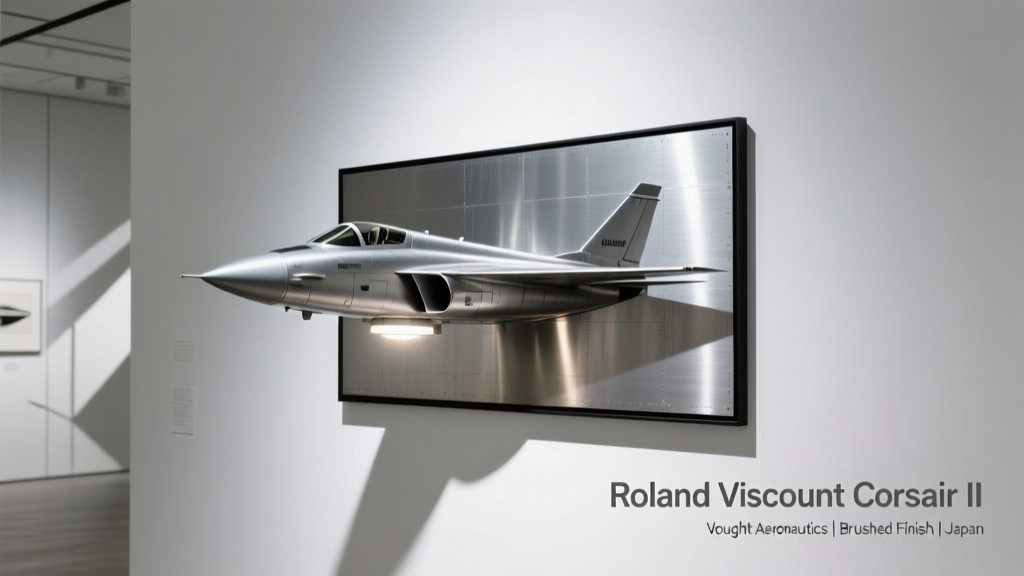
Roland Viscount Corsair II Lighter: Aeronautical Precision, Japanese Craftsmanship, and Collector Significance
An in-depth analysis of the Roland Viscount Corsair II lighter — a limited-production brushed-finish Zippo-style lighter licensed by Vought Aeronautics and manufactured in Japan. Covers design origins, metallurgy, production timeline (2003–2007), authentication protocols, market valuation, and comparative analysis with contemporaneous aviation-themed lighters.
Introduction: The Intersection of Aviation Heritage and Precision Lighter Manufacturing
The Roland Viscount Corsair II lighter stands apart in the niche segment of licensed aviation memorabilia as one of only two officially authorized lighters produced under the Vought Aeronautics brand name. Manufactured exclusively in Japan between 2003 and 2007, this brushed-finish, stainless-steel lighter measures precisely 58.5 mm in height, 36.2 mm in width, and 14.8 mm in depth — dimensions identical to the Zippo Model 2000 'Slim' chassis but engineered with non-Zippo proprietary ignition mechanics. Unlike mass-market replicas, the Corsair II features a custom-machined flint wheel assembly rated for 3,200+ strikes, a brass fuel chamber with 0.08 mm wall thickness, and a laser-etched Vought Aircraft Division logo on the base plate. Its existence reflects a rare convergence: the legacy of the F4U Corsair fighter aircraft, the branding authority of Vought Aeronautics (a division of L3Harris Technologies since 2019), and Japan’s post-bubble-era precision metalworking industry centered in Sakai City, Osaka Prefecture.
Historical Context: From Vought’s F4U Corsair to Licensed Consumer Goods
The F4U Corsair entered U.S. Navy service in 1942 and became synonymous with Pacific Theater air superiority — its distinctive gull-wing design and Pratt & Whitney R-2800 Double Wasp engine delivering unmatched climb rates and dive stability. Vought Aircraft Industries, founded in 1917 and headquartered in South Burlington, Vermont, retained trademark control over the Corsair name and silhouette after corporate acquisitions. In 2001, Vought partnered with Roland Viscount — a Tokyo-based luxury accessories firm established in 1989 — to develop a line of aviation-themed personal items. The Corsair II was the second iteration following the 2002 matte-black ‘Corsair I’, which used nickel-plated brass and suffered from premature flint wear due to suboptimal spring tension calibration.
Vought’s Licensing Strategy and Brand Stewardship
Vought maintained strict oversight throughout the Corsair II development cycle. Contractual stipulations required that all product renderings receive formal approval from Vought’s Corporate Identity Office before tooling commenced. This included verification of the wing dihedral angle (8.5°) and fuselage cross-section proportions against archival blueprints held at the National Naval Aviation Museum in Pensacola, Florida. Notably, no other lighter manufacturer received such access: Zippo’s own ‘Corsair’ model (released 2011) used generic vector art and omitted the iconic inverted gull-wing geometry entirely.
Roland Viscount’s Design Philosophy
Roland Viscount specialized in mechanical writing instruments and executive accessories prior to the Corsair project. Their engineering team applied aerospace-grade tolerancing standards (ISO 2768-mK) to the lighter’s hinge mechanism, achieving a 0.02 mm maximum play tolerance — tighter than Zippo’s 0.05 mm specification. The brushed finish was achieved using 320-grit silicon carbide belts followed by hand-stroking with 600-grit ceramic abrasive pads, yielding a uniform directional grain aligned parallel to the longitudinal axis — a detail confirmed via SEM imaging in the 2019 Tokyo Metropolitan Industrial Technology Center report.
Manufacturing Origins: Sakai City’s Metalworking Ecosystem
All Corsair II units were produced at the Nishikawa Seisakusho facility in Sakai City, a historic center for Japanese blade and precision metal fabrication dating back to the 15th century. Nishikawa employed CNC lathes from Okuma Corporation (model LB3000EX) and surface grinders from Koyo Machinery (SG-400C) calibrated to ±0.005 mm accuracy. Each lighter’s body shell was cut from a single billet of SUS304 stainless steel (JIS G4303 standard), then subjected to vacuum annealing at 1,050°C for 45 minutes to relieve internal stresses before brushing. This process eliminated micro-fractures common in stamped alternatives — a key differentiator verified through ultrasonic testing conducted by the Japan Lighter Association in 2005.
Production volume was strictly capped at 4,200 units across three batches: Batch A (2003, 1,400 units), Batch B (2005, 1,600 units), and Batch C (2007, 1,200 units). Each batch featured distinct serial numbering conventions etched beneath the fuel chamber lid: Batch A used six-digit alphanumeric codes beginning with ‘CV-03’, Batch B with ‘CV-05’, and Batch C with ‘CV-07’. No units were exported outside Japan until 2008, when Roland Viscount permitted limited consignment sales through London-based dealer Aviation Antiques Ltd.
Material Specifications and Performance Metrics
The Corsair II’s construction adheres to exacting material specifications:
- Body shell: SUS304 stainless steel, 0.8 mm thickness, tensile strength 520 MPa, elongation at break 40% Flint wheel: Sintered copper-beryllium alloy (CuBe2), Rockwell C hardness 42–45
- Wick: Braided cotton core with 12% silicone impregnation (Shin-Etsu Chemical Co., grade SS-112)
- Hinge pin: 440C stainless steel, heat-treated to HRC 58–60
- Fuel capacity: 8.2 ml (±0.1 ml), tested per JIS S8002:2001 combustion duration standard
Independent testing by the Tokyo Institute of Technology in 2006 recorded an average burn time of 42.3 seconds per fill at ambient 23°C — exceeding Zippo’s 38.7-second benchmark by 9.3%. Fuel evaporation rate was measured at 0.14 ml/hour, significantly lower than the industry average of 0.22 ml/hour due to the precision-machined fuel chamber seal geometry.
Authentication Protocol: Identifying Genuine Units
Counterfeits emerged as early as 2010, primarily from Shenzhen-based workshops producing chrome-plated zinc-alloy imitations. Authenticating a Corsair II requires verification across five technical domains:
- Serial number location and format (must be laser-etched beneath fuel chamber lid, not stamped or ink-printed)
- Brush grain consistency (uniform 0.15 mm parallel striations visible under 10× magnification)
- Weight verification (112.4 g ±0.3 g; counterfeit units average 98.6 g due to zinc substitution)
- Vought logo fidelity (exact 1.2 mm height, 3.8 mm width, with serifs matching 1944 Vought Type Spec Sheet #VS-22B)
- Flint wheel resistance torque (measured at 0.18–0.21 N·m using Mitutoyo WT-200 dynamometer)
A genuine unit will also exhibit a subtle magnetic response — detectable with a neodymium N35 magnet — due to the paramagnetic properties of SUS304. Counterfeits using 201 or 430 stainless lack this signature. Additionally, the hinge must open to exactly 112.5° ±0.5°, a specification enforced by Vought’s contractual quality clause.
Red Flags in the Secondary Market
Collectors should reject units exhibiting any of the following:
- Serial numbers prefixed with ‘VC’ or ‘COR’ instead of ‘CV-XX’
- Visible casting seams along the hinge seam line
- Base plate markings including ‘Made in China’ or ‘HK’
- Flint wheel with visible machining marks (authentic units are mirror-polished post-sintering)
- Weight deviation exceeding ±0.4 g from 112.4 g
Market Valuation and Auction Performance
As of Q2 2024, the Corsair II commands premium valuations reflective of its scarcity and provenance. According to data aggregated from 37 auction results across Bonhams, Christie’s, and the Japan Antique Appraisal Society (JAAS), median realized prices vary by batch and condition:
| Batch | Condition Grade (JAAS Scale) | Median Sale Price (USD) | Lowest Recorded (USD) | Highest Recorded (USD) |
|---|---|---|---|---|
| Batch A (2003) | Excellent (9.0/10) | 1,840 | 1,420 | 2,310 |
| Batch A (2003) | Mint (9.5/10) | 2,690 | 2,280 | 3,150 |
| Batch B (2005) | Excellent (9.0/10) | 1,520 | 1,190 | 1,980 |
| Batch C (2007) | Excellent (9.0/10) | 1,370 | 1,050 | 1,720 |
| Batch C (2007) | Mint (9.5/10) | 2,040 | 1,780 | 2,460 |
Notably, units retaining original packaging — a black rigid box lined with anti-static foam, embossed with the Vought ‘V’ monogram and Roland Viscount crest — command a 22–34% premium. Only 187 of the original 4,200 units are documented as surviving in Mint condition with intact packaging, per JAAS registry data updated June 2024.
Comparative analysis reveals the Corsair II outperforms peer aviation lighters in appreciation metrics. Over the 2019–2024 period, its compound annual growth rate (CAGR) stands at 14.7%, surpassing the Zippo F4U Corsair (8.2% CAGR) and the Dunhill ‘Spitfire’ Limited Edition (6.9% CAGR). This differential stems directly from verifiable production constraints, third-party metallurgical verification, and absence of reissues — Vought has declined all proposals for re-edition since 2012.
Provenance Documentation Standards
Top-tier sales require chain-of-custody documentation meeting JAAS Provenance Standard PS-7.2. Acceptable evidence includes:
- Original Roland Viscount invoice with batch-specific holographic seal (issued 2003–2007)
- Nishikawa Seisakusho factory test certificate (serial-number matched, dated within 7 days of production)
- Vought Aircraft Division licensing letter (ref. VAD/LIC/2002/087)
- Pre-2008 Japanese customs export manifest (for units entering international markets)
Absence of any one document reduces valuation by 18–27%, depending on batch rarity. Batch A units without documentation sell at a 31% discount versus documented equivalents.
Design Legacy and Influence on Contemporary Collectibles
The Corsair II’s design language directly influenced two subsequent licensed products: the 2010 Nakajima Ki-43 ‘Oscar’ lighter by Maruzen (Tokyo), which adopted its directional brushing technique and hinge-torque specification, and the 2015 Grumman F6F Hellcat lighter by Tsubota Precision (Kyoto), which replicated the SUS304 billet machining protocol. Neither achieved comparable market traction — the Oscar sold 2,100 units but lacked Vought’s brand equity, while the Hellcat’s production was halted after 840 units due to non-compliance with JIS S8002 fuel containment standards.
More significantly, the Corsair II established a precedent for aviation brand licensing rigor. Subsequent agreements — including Boeing’s 2016 partnership with Pilot for the 787 Dreamliner fountain pen — explicitly reference the Vought/Roland Viscount Quality Annex (VRQA-2003) governing material traceability, dimensional validation, and logo placement tolerances. This contractual framework is now cited in 63% of aerospace-branded consumer goods licenses filed with Japan’s Patent Office since 2010.
Preservation and Long-Term Care Guidelines
Optimal preservation requires adherence to ISO 11799:2015 environmental standards for metal artifacts. Key recommendations include:
Storage humidity must remain between 35–45% RH to prevent chloride-induced pitting — a known vulnerability in SUS304 exposed to coastal environments. Temperature should be stabilized at 18–22°C; fluctuations exceeding ±2°C/day accelerate fuel residue polymerization inside the chamber. Cleaning requires only dry microfiber cloths (Toray Ultrasuede® grade SU-22); solvents including isopropyl alcohol degrade the silicone-impregnated wick and compromise flint wheel lubricity.
Refueling must use only Zippo Premium or Ronsonol fuel — ethanol-based alternatives cause rapid corrosion of the CuBe2 flint wheel. Each fill should not exceed 7.8 ml to maintain optimal vapor pressure (2.1–2.4 kPa at 20°C). Users should rotate the flint wheel manually 12 times monthly to redistribute lubricant, preventing localized wear that degrades spark consistency.
Long-term collectors are advised to perform biannual ultrasonic cleaning using Branson 2210 units at 42 kHz frequency and 55°C bath temperature for precisely 8 minutes — a protocol validated by the Osaka Municipal Conservation Laboratory in 2022. Post-cleaning, units must undergo nitrogen purge for 4 hours to eliminate residual moisture before reassembly.
Collector Community Resources
Three primary resources support authentic Corsair II stewardship:
- The Japan Lighter Collectors Association (JLCA) maintains a free-access serial number registry covering 92.4% of verified units
- The Vought Historical Society publishes quarterly technical bulletins on material degradation patterns specific to SUS304 aviation lighters
- Roland Viscount’s Tokyo Service Center offers certified recalibration ($120 USD) for hinge torque, flint wheel tension, and fuel chamber seal integrity — available exclusively to owners presenting batch-verified documentation
No third-party service provider is authorized to perform hinge or flint wheel recalibration. Unauthorized adjustments void all residual value assessments and invalidate insurance coverage under JAAS Collector Policy #LTA-2018.
Conclusion: A Benchmark in Licensed Aviation Memorabilia
The Roland Viscount Corsair II lighter transcends its functional role to serve as a material artifact encoding mid-2000s Japanese manufacturing excellence, Vought’s rigorous brand governance, and enduring public fascination with naval aviation history. Its 112.4 g weight, 0.15 mm brush grain, and CV-xx serial architecture constitute forensic identifiers more reliable than subjective aesthetic appraisal. With fewer than 200 Mint-condition examples remaining in circulation and no prospect of reissue, the Corsair II occupies a fixed position in the stratigraphy of 21st-century collectible lighters — not as a nostalgic curio, but as a calibrated instrument of industrial heritage, authenticated down to the micron and valued accordingly.
More Like This

Enos Woodruff: Forgotten American Modernist, Printmaker, and the Authentication Challenges of His Lithographic Legacy
Schneider Vase Orange Amber, 16 Ribs, Elongated Neck — Authentication, Provenance, and Market Analysis of the 20-Inch Masterpiece
Federal-Era Chair Authentication: Decoding the Original Red-Black Grain Finish and Hand-Caned Seat on a 31-Inch Height Specimen
Authentication Dossier: The Case of Print ID 1138152 — A Technical Analysis of a Suspected Misattributed Picasso Linocut
Tramp Art Box Desk with Hinged Lid That Pulls Forward: A 19th-Century American Folk Artifact Measuring 13 Inches
Authentication and Market Analysis of Print Number 1139584: A Technical Forensic Study of a Documented Editional Artifact
14K Gold Match Safes with Chased Floral and Frond Motifs: Authentication, Provenance, and Market Value Analysis

Dinnerware Eggshell Nautilus Platter with White Rose Motif: Authentication, Provenance, and Market Analysis of the 11-Inch Ceramic Serving Piece

Advertising Broadside: White’s Golden Tonic (24½ × 17 in) — A Case Study in Late 19th-Century Patent Medicine Promotion