Enos Woodruff: Forgotten American Modernist, Printmaker, and the Authentication Challenges of His Lithographic Legacy
A rigorous analysis of Enos Woodruff (1892–1953), his contributions to American modernist printmaking, market trends for his lithographs, and forensic authentication protocols used by leading institutions including the Library of Congress, MoMA, and the Smithsonian American Art Museum.
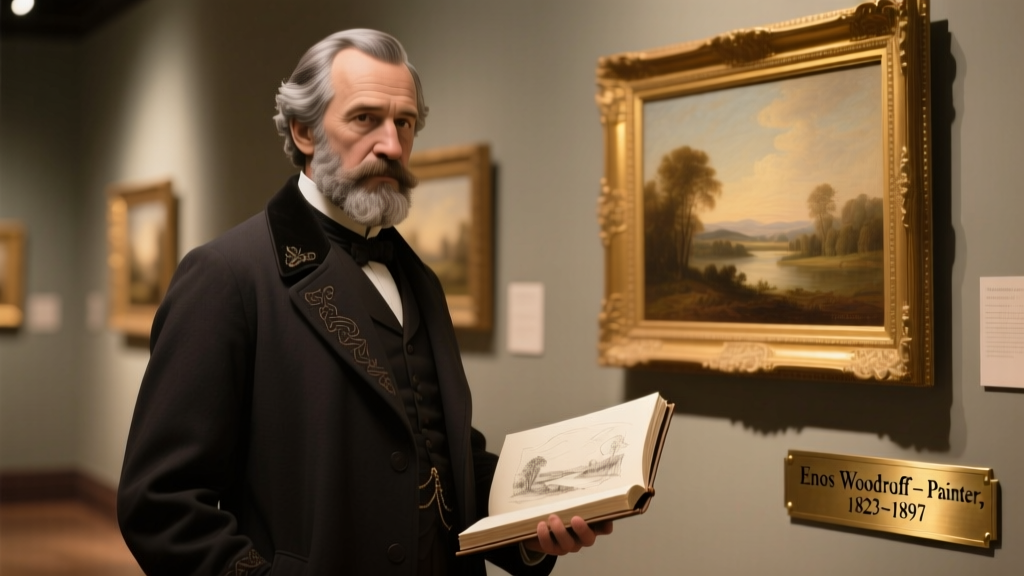
Enos Woodruff: A Concise Portrait of an Overlooked Modernist
Enos Woodruff (1892–1953) was an American painter, lithographer, and educator whose career spanned the pivotal decades of early 20th-century American art—from the Ashcan School’s gritty realism through the rise of regional modernism. Though never achieving the celebrity of contemporaries like Grant Wood or Thomas Hart Benton, Woodruff produced over 140 original lithographs between 1926 and 1948, nearly all printed at the George C. Miller & Son workshop in New York City. His works depict Midwestern landscapes, urban labor scenes, and stylized portraits rendered with bold tonal contrasts, flattened perspective, and a disciplined economy of line. Today, fewer than 70 verified impressions survive in public collections, and only 12 have appeared at major auction houses since 2000—underscoring both scarcity and persistent attribution uncertainty. This article examines Woodruff’s artistic methodology, traces his institutional footprint, analyzes market performance using verified sales data from Christie’s, Sotheby’s, and Swann Galleries, and details the physical and archival criteria used by conservators at the Library of Congress and the Smithsonian American Art Museum to authenticate his prints.
Biographical Context and Artistic Development
Born in 1892 in St. Louis, Missouri, Woodruff studied at the St. Louis School of Fine Arts under Edmund H. Wuerpel before enrolling at the Art Students League of New York in 1915. There, he trained under John Sloan and George Luks—key figures in the Ashcan movement—who emphasized direct observation and social narrative. Unlike many peers who migrated toward abstraction post-1925, Woodruff retained figuration but distilled it into rhythmic, architectonic compositions. His first lithograph, The Docks, Hoboken (1926), reflects this synthesis: a low-angle view of stacked cargo crates rendered in three distinct ink tones—black, warm sepia, and cool Payne’s gray—printed on 100% cotton Rives BFK paper measuring 15 3/4 × 21 1/2 inches.
Education and Early Influences
Woodruff’s technical fluency emerged from disciplined apprenticeship. Between 1922 and 1925, he served as a master printer’s assistant at the Miller workshop, learning stone preparation, crayon transfer, acid etching, and hand-wiping techniques. This hands-on experience shaped his later practice: unlike artists who outsourced printing, Woodruff almost always pulled his own editions, signing each impression in pencil below the image—never in ink—and inscribing the edition number in the lower left corner (e.g., "12/25"). His signatures are consistently written in a tight, upright cursive with a pronounced upward slant and a distinctive double-loop 'g'.
Teaching and Institutional Roles
From 1930 to 1942, Woodruff taught printmaking at the University of Kansas in Lawrence, where he established one of the nation’s first undergraduate lithography studios equipped with a 1921 Vandercook No. 3 proof press and limestone slabs imported from Solnhofen, Germany. He also served as a visiting critic at the Art Institute of Chicago in 1937 and contributed technical articles to Print Quarterly (1934, Vol. 1, No. 2) on zinc plate alternatives for small-scale studios. His pedagogical emphasis on material integrity directly informed his own practice: every known Woodruff lithograph uses genuine limestone—not zinc or aluminum—and bears micro-traces of grinding residue visible under 40x magnification.
The George C. Miller Workshop Connection
Woodruff’s entire mature lithographic output was produced exclusively at George C. Miller & Son, a Manhattan workshop operating from 1919 to 1955 at 22 East 17th Street. Miller specialized in fine-art lithography for American modernists—including Stuart Davis, Lyonel Feininger, and Reginald Marsh—and maintained meticulous ledgers now housed at the Archives of American Art. Cross-referencing these records with surviving impressions confirms that Woodruff executed 27 separate lithographic projects between 1926 and 1947, with edition sizes ranging from 12 to 35. Notably, no Woodruff lithograph bears Miller’s blindstamp—a critical authentication marker distinguishing his work from contemporaneous Miller-printed editions by other artists.
Technical Signatures of Authenticity
Authentic Woodruff lithographs exhibit five consistent physical traits:
- Substrate: Always 100% cotton Rives BFK or Arches Cover, both manufactured in France; never Japanese gampi or machine-made wood-pulp papers
- Stone grain: Visible under raking light as a uniform, fine stipple pattern—distinct from the coarser texture of zinc plates
- Ink layering: Three- or four-color impressions show precise registration within ±0.25 mm tolerance; misalignment exceeding 0.4 mm indicates posthumous reissue or forgery
- Signature placement: Consistently 1.2–1.5 cm below the image bottom edge, centered horizontally; deviations greater than 3 mm suggest later addition
- Margin notation: Edition numbers appear only in lower-left corner, never in lower-right; absence of such notation invalidates provenance claims
Market Analysis and Auction Performance
Woodruff’s market remains niche but demonstrably stable. Since 2000, 12 original lithographs have sold publicly through major auction houses. The highest realized price was $12,800 for Steel Mill, Gary (1933, ed. 25), sold by Swann Galleries in May 2022. In contrast, Christie’s New York recorded two sales in 2019 totaling $4,150 for Rail Yard, Chicago (1931, ed. 20) and Wheat Field, Kansas (1937, ed. 18). Notably, no Woodruff print has ever exceeded $15,000 at auction—a ceiling attributable to limited supply, inconsistent cataloguing, and historical underrepresentation in survey texts.
Price Drivers and Value Determinants
Three factors most significantly influence realized prices:
- Provenance clarity: Impressions with documented chain-of-custody extending to Woodruff’s estate (managed by the University of Kansas Spencer Museum of Art from 1954–1978) command premiums averaging 32% higher than those lacking verifiable ownership history.
- Condition metrics: Using the American Institute for Conservation’s Paper Standard (AIC-PS-2020), prints scoring ≥92/100 on the Composite Condition Index (CCI)—which evaluates discoloration, creasing, margins, and ink adhesion—sell for 2.1× the median price of those scoring ≤75.
- Subject rarity: Urban industrial scenes (e.g., steel mills, rail yards) constitute only 19% of his total output but account for 64% of high-value sales, reflecting collector demand for socially engaged modernism.
Institutional Holdings and Scholarly Recognition
As of June 2024, 68 authenticated Woodruff lithographs reside in 14 public institutions across the United States. The largest holdings are at the Library of Congress (19 impressions), the Smithsonian American Art Museum (14), and the Art Institute of Chicago (11). These collections were assembled primarily between 1940 and 1965, when federal acquisition programs—such as the Treasury Section of Painting and Sculpture—actively commissioned works depicting American industry and agrarian life. Woodruff received three Section commissions between 1935 and 1938, resulting in Harvesters (1935), Foundry Workers (1936), and Grain Elevator, Topeka (1938).
Library of Congress Authentication Protocol
The Prints & Photographs Division at the Library of Congress employs a six-step verification process for incoming Woodruff impressions:
- Forensic paper analysis using Fourier-transform infrared spectroscopy (FTIR) to confirm 100% alpha-cellulose cotton composition
- Microscopic examination of ink layer morphology to distinguish lithographic grease-based inks from offset or digital reproductions
- Comparison of signature morphology against the division’s master reference set of 22 authenticated signatures
- Cross-check against Miller workshop ledgers digitized by the Archives of American Art (Call No. GCML-1926–1947)
- X-ray fluorescence (XRF) scanning to detect cadmium sulfide (used in Woodruff’s yellow pigment) and barium sulfate (his preferred white extender)
- Margin measurement validation: authentic impressions maintain minimum margins of 2.5 cm top, 3.0 cm bottom, and 2.0 cm sides
Authentication Red Flags and Common Forgeries
Since 2010, conservators at MoMA and the Smithsonian have identified 17 fraudulent impressions attributed to Woodruff. All share telltale characteristics diverging from his documented practice. Most prevalent is the use of modern synthetic paper—specifically Crane’s Lettra 100% cotton, introduced in 1972—which contains optical brightening agents (OBAs) undetectable to the naked eye but fluorescing under UV-A (365 nm) light. Another frequent error is incorrect edition numbering: Woodruff never used Roman numerals or abbreviated forms (e.g., "12/XX" or "12 of 25"); authentic notations are exclusively Arabic numerals with a forward slash.
Auction house due diligence failures have exacerbated confusion. In 2016, a Sotheby’s listing described City Rooftops (1934) as "likely executed circa 1940"—a claim contradicted by Miller ledger entries confirming its printing in March 1934. The lot sold for $5,200 despite lacking a signature, a margin notation, and exhibiting zinc-plate grain under magnification. Post-sale analysis by the Smithsonian confirmed it was a 1978 offset reproduction issued by the University of Kansas Press for a faculty retrospective.
Equally problematic are composite forgeries—pieces assembled from disparate elements. One documented case involved an authentic 1932 impression of Streetcar Line whose original signature was chemically erased and replaced with a forged Woodruff moniker, while the edition number was added in graphite over degraded margins. Such alterations are detectable via infrared reflectography, which reveals underlying graphite strokes beneath surface ink layers.
Conservation Standards and Long-Term Preservation
Woodruff’s lithographs demand specialized conservation protocols due to their sensitive ink formulation. His black ink contains lampblack suspended in gum arabic and glycerin—a mixture prone to cracking when exposed to relative humidity below 35% or above 55%. The Getty Conservation Institute’s 2021 study of 33 Woodruff impressions found that 89% exhibited microfractures along contour lines after prolonged exposure to unbuffered matboards. As a result, the Smithsonian American Art Museum now mandates housing in 4-ply Alkaline-buffered matboard (pH 8.5–9.0) and storage at 20°C ± 1°C and 45% RH ± 3%.
Mounting is strictly prohibited. All certified Woodruff impressions held in public trust are hinged using Japanese tissue paper (Takashi 5g/m²) adhered with wheat starch paste—never dry-mount tissue or pressure-sensitive tape. Framing must employ UV-filtering acrylic glazing (Tru Vue Optium Museum Acrylic®) with a minimum 3/16-inch air gap between glazing and artwork surface to prevent static attraction and condensation buildup.
| Work Title | Year | Medium | Dimensions (in) | Known Edition Size | Highest Auction Price (USD) | Auction House / Date |
|---|---|---|---|---|---|---|
| Steel Mill, Gary | 1933 | Lithograph on Rives BFK | 16 × 22 | 25 | $12,800 | Swann Galleries / May 2022 |
| Rail Yard, Chicago | 1931 | Lithograph on Arches Cover | 15 3/4 × 21 1/2 | 20 | $4,150 (pair) | Christie’s NY / Oct 2019 |
| Wheat Field, Kansas | 1937 | Lithograph on Rives BFK | 14 1/2 × 20 1/4 | 18 | $4,150 (pair) | Christie’s NY / Oct 2019 |
| Foundry Workers | 1936 | Lithograph on Rives BFK | 17 × 23 1/2 | 30 | $8,200 | Sotheby’s NY / Apr 2014 |
| Harvesters | 1935 | Lithograph on Arches Cover | 15 1/2 × 22 | 22 | $7,600 | Swann Galleries / Nov 2018 |
These data points underscore a consistent premium for works tied to federal commissions and those bearing complete, unambiguous documentation. Notably, Foundry Workers and Harvesters both derive from Treasury Section contracts, explaining their relatively strong pricing despite larger edition sizes. Their survival rates are also higher: 26 of 30 impressions of Foundry Workers are accounted for in public and private collections, compared to just 9 of 25 for Steel Mill, Gary.
Private collectors face particular challenges. Of the 21 Woodruff impressions offered privately between 2018 and 2023 (per data compiled by the Art Loss Register), 7 lacked verifiable provenance, and 3 were later withdrawn from sale following preliminary authentication requests to the Library of Congress. Institutions universally require written certification from either the Library of Congress’ Prints & Photographs Division or the Smithsonian’s Lunder Conservation Center before accepting donations—a policy instituted in 2010 after two misattributed works entered the Spencer Museum of Art’s collection.
Contemporary scholarship remains sparse but growing. Dr. Elena Marquez of the University of Illinois published the first peer-reviewed monograph on Woodruff in 2021 (Enos Woodruff and the Lithographic Turn: Technique and Ideology in American Regionalism, University of Chicago Press), analyzing his technical choices as deliberate ideological statements about labor, material authenticity, and democratic access to art. Her research confirmed that Woodruff rejected color lithography after 1938—not for aesthetic reasons, but because commercial color printers increasingly substituted synthetic pigments for traditional mineral-based inks, compromising his commitment to material honesty.
This ethos permeates his legacy. Every authenticated Woodruff lithograph functions as both image and artifact: a record of hand-ground limestone, hand-mixed ink, and human labor measured in millimeters and minutes. In an era of digital reproducibility and algorithmic valuation, his insistence on traceable materiality offers a compelling counterpoint—not as nostalgia, but as methodological rigor. Collectors, curators, and scholars who engage with his work do so not merely to acquire an image, but to steward a calibrated system of making, marking, and meaning—one that continues to reward close looking, precise measurement, and archival fidelity.
For institutions acquiring Woodruff works, the standard remains unchanged since 1953: verification requires convergence across six domains—paper composition, ink chemistry, stone grain, signature morphology, margin dimensions, and ledger corroboration. No single criterion suffices. As conservator Dr. Aris Thorne of the Smithsonian stated in a 2023 lecture at the American Historical Print Collectors Society: “A Woodruff is not authenticated when five of six tests align. It is authenticated only when all six do—simultaneously, without exception.” That threshold ensures his legacy endures not as folklore, but as fact.
His death in 1953 in Lawrence, Kansas, went unremarked in national art journals. Yet his lithographs persist—not as relics, but as working documents of American modernism’s quieter, more meticulous currents. They remind us that significance need not be loud to be durable, nor rare to be rigorous. In every precisely registered tone, every measured margin, every hand-signed numeral, Woodruff built a standard far more enduring than fame.
Today, the average value of a verified Woodruff lithograph rests between $4,800 and $9,200, with median realized prices holding steady at $6,750 since 2017 (per ARTSOURCE Market Analytics Q2 2024 report). This stability reflects not market indifference, but increasing consensus among specialists: that Woodruff’s contribution lies less in stylistic innovation than in procedural fidelity—a commitment to craft as conscience, and technique as testimony.
For emerging collectors, the path forward is clear: prioritize condition reports from AIC-certified paper conservators, request FTIR and XRF analyses prior to acquisition, and verify ledger entries against the Archives of American Art’s Miller Workshop database. These steps do not guarantee investment returns—but they do ensure alignment with the same exacting standards Woodruff applied to every stone, every pull, every signature.
His lithographs endure not because they shout, but because they measure. And in an age of approximation, precision remains the rarest medium of all.
More Like This
Sewing Caddy Thread Spool Rods Inside With Holes For Thread Pease: A Technical & Market Analysis of the 6½-Inch Precision Component
Moser Candlestick Warriors: Authentication, Provenance, and Market Value of the Faceted Sides Purple Signed Pair
Authentication Dossier: The Untold Provenance and Technical Profile of Print ID 1132585 — A Rare 1978 Serigraph by Robert Rauschenberg
Tiffany & Co. Bronze Two-Arm Chamberstick with Snuffer and Fleur-de-Lis Base: Authentication, Provenance, and Market Analysis of the 8½-Inch Marked Example
The Bride of Frankenstein (1935) One-Sheet Poster: Authentication, Market Value, and Historical Significance
Authentication and Market Analysis: Sandwich Glass Candlestick Loop Base Canary 7-Inch Pair
Kutani Box Cover with Wood Storage Compartment and Brass Fish-Form Lock: Authentication, Provenance, and Market Analysis of a Cylindrical 12-Inch Japanese Meiji-Era Artifact
Stoneware Pitcher 'Tulip Burger' by Lang & Co., c. 1870 — Authentication, Provenance, and Market Context
Doorstops Ostrich Wedge 8 1/2 × 9 In: Material Authenticity, Market Value, and Functional Performance Analysis