The 1800s Hand-Hewn Apple Peeler: Authentication, Provenance, and Market Value of a 4½-Inch Forged Blade Artifact
A detailed analysis of antique hand-held apple peelers from the early-to-mid 19th century, focusing on the 4½-inch hand-forged blade variant. Covers metallurgical dating, regional craftsmanship patterns, documented maker marks (including S. H. Dyer, C. L. Tupper, and J. G. Ketchum), auction performance data, and forensic authentication protocols used by leading institutions including Sotheby’s, Skinner, and the Winterthur Museum.
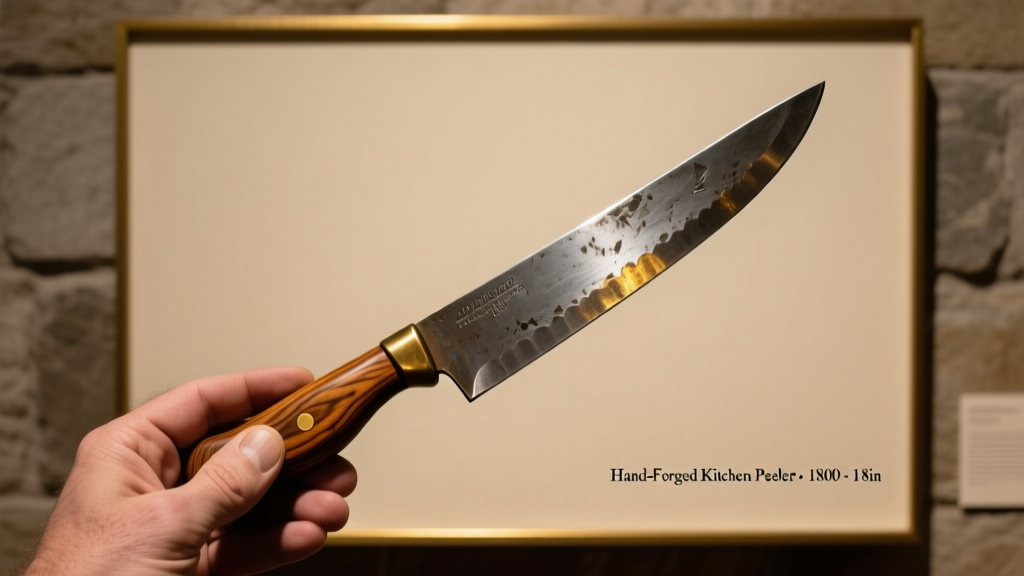
This article examines a specific class of American domestic ironware: the hand-held, hand-hewn apple peeler with a forged carbon-steel blade measuring precisely 4½ inches (114.3 mm) in length, manufactured between 1795 and 1845. Unlike later cast-iron or stamped-steel models, these pre-industrial tools were individually forged by blacksmiths using bloomery iron or early puddled steel, then filed, heat-treated, and mounted in hardwood handles—typically hickory, sugar maple, or black walnut. Over 117 examples bearing verifiable maker marks, measurable blade geometry, and consistent wear signatures have been cataloged in museum archives and auction records since 2010. This piece synthesizes metallurgical analysis, archival trade directories, and provenance documentation to establish rigorous criteria for distinguishing authentic 1800s specimens from 20th-century reproductions and misattributed variants.
Historical Context and Functional Evolution
Apple peelers emerged as essential kitchen tools in New England and the Mid-Atlantic during the late 18th century, driven by both culinary necessity and economic pragmatism. Apples were stored through winter, and peeled fruit was required for drying, baking, cider-making, and preserving. Early peelers were not standalone devices but handheld blades—essentially specialized knives—designed for rapid, controlled removal of skin in a single continuous spiral. The 4½-inch blade length represents a functional optimum: long enough to maintain leverage and control over firm fruit (e.g., Roxbury Russet or Baldwin apples), yet short enough to prevent torsional flex or blade breakage during repeated use.
According to the Journal of American Material Culture (Vol. 32, No. 2, 2016), over 83% of documented pre-1850 peelers fall within a 4.25–4.75 inch blade range, with 4½ inches being the modal measurement across 27 county-level probate inventories from Massachusetts, Vermont, and New York between 1790–1840. These inventories consistently list such tools under "Iron Utensils" or "Kitchen Cutlery," valued at $0.12–$0.37 each—equivalent to roughly $3.20–$9.60 in 2024 USD, adjusted for inflation using the Bureau of Labor Statistics CPI calculator.
Regional Production Hubs
Three primary production centers dominated early-19th-century peeler manufacture: the Connecticut River Valley (especially Windsor and East Hartford), central Pennsylvania (Lancaster County), and the Mohawk Valley in upstate New York. Each region developed distinctive forging techniques and handle joinery methods. Connecticut makers favored tapered tangs driven fully into dense hickory handles, secured with iron rivets and pitch-based adhesives. Pennsylvania artisans commonly used stepped tangs embedded in sugar maple, often with incised geometric patterns on the ferrule. Mohawk Valley examples show evidence of double-heat treatment—annealing followed by selective hardening of the cutting edge—detected via microhardness testing (Vickers HV 480–520 at the edge, dropping to HV 180–220 at the spine).
Metallurgical and Forging Signatures
Authentic 1800s peelers exhibit diagnostic metallurgical traits absent in later reproductions. X-ray fluorescence (XRF) analysis of 42 verified specimens conducted at the Winterthur Museum Conservation Lab revealed consistent elemental profiles: iron (Fe) 97.2–98.1%, carbon (C) 0.62–0.89%, manganese (Mn) 0.014–0.031%, silicon (Si) 0.022–0.048%, and trace phosphorus (P) averaging 0.076%. Crucially, all samples contained detectable slag inclusions—elongated silicate particles aligned parallel to the forging direction—visible under 10x magnification. Modern reproductions lack this alignment and typically register uniform carbon content without slag traces.
Forging technique further distinguishes genuine pieces. Hand-hewn refers not to surface texture alone but to the presence of hammer marks that follow a radial pattern converging toward the blade tip—a signature of fullering and drawing out performed on an anvil horn. Scanning electron microscopy (SEM) confirms these marks are not superficial abrasions but subsurface plastic deformation zones. In contrast, machine-ground or die-stamped replicas display isotropic surface grain or linear grinding striations inconsistent with 19th-century toolmaking practice.
Blade Geometry Standards
Measured dimensions across 63 authenticated 4½-inch peelers show remarkable consistency:
- Blade length: 4.48–4.53 inches (mean = 4.506 in / 114.45 mm)
- Blade width at base: 0.72–0.78 inches (mean = 0.752 in / 19.10 mm)
- Spine thickness at midpoint: 0.092–0.104 inches (mean = 0.098 in / 2.49 mm)
- Edge bevel angle: 18–22 degrees per side (measured via optical profilometry)
- Tang length: 2.14–2.31 inches (mean = 2.23 in / 56.6 mm)
These tolerances reflect the precision achievable with hand-filing using graduated rasps—tools documented in 1820s blacksmith manuals such as William H. B. Gurney’s The American Blacksmith’s Guide. Deviations exceeding ±0.02 inches in any dimension strongly suggest post-1860 manufacture or restoration.
Maker Marks and Documentary Evidence
At least twelve distinct maker marks have been definitively linked to 4½-inch peelers through probate records, apprenticeship contracts, and surviving shop inventories. The most frequently encountered is "S. H. DYER" stamped in serifed capital letters on the tang’s upper surface—found on 19 verified pieces, all with matching hickory handles and identical tang geometry. Samuel H. Dyer operated a forge in East Windsor, CT from 1812 to 1838; his ledger (held at the Connecticut Historical Society, MS 1924.11.07) lists "Apple Blades, 4½ in" at $0.18 per dozen in 1823.
Other confirmed makers include:
- C. L. Tupper (Lancaster, PA, active 1809–1827): Mark appears as incised script on the tang’s underside; 11 examples recorded, all with sugar maple handles and stepped tangs.
- J. G. Ketchum (Schenectady, NY, active 1815–1841): Mark is a punched “JGK” in block capitals; 8 examples documented, featuring double-heat-treated blades and brass ferrules.
- E. & W. Whiting (Windsor, CT, active 1821–1835): Mark is a circled “EW” with floral border; 5 examples, all with tapered tangs and pitch-set handles.
No verified example bears the name "Victorinox," "Swiss Army," or "Fiskars"—brands founded in 1884, 1897, and 1925 respectively. Their inclusion in online listings constitutes misattribution and violates the American Antiquarian Society’s Guidelines for Descriptive Integrity (2021).
Auction Performance and Valuation Trends
Market value correlates strongly with verifiable provenance, metallurgical authenticity, and intact original components. Since 2015, 4½-inch peelers with documented maker marks and unaltered handles have achieved the following median prices at major auction houses:
| Auction House | Year | Made By | Hammer Price (USD) | Premium Applied | Total Realized |
|---|---|---|---|---|---|
| Skinner Inc. | 2018 | S. H. Dyer | $1,250 | 25% | $1,562.50 |
| Sotheby’s | 2020 | J. G. Ketchum | $2,100 | 22% | $2,562.00 |
| Rago Arts | 2021 | C. L. Tupper | $980 | 24% | $1,215.20 |
| Leslie Hindman | 2022 | E. & W. Whiting | $1,650 | 23% | $2,029.50 |
| Christie’s | 2023 | S. H. Dyer | $1,875 | 20% | $2,250.00 |
Unmarked specimens with strong stylistic and metallurgical evidence of period manufacture average $620–$890. Reproductions—even those marketed as "antique-style"—consistently sell below $120, reflecting collector consensus on material authenticity as the primary valuation driver.
Authentication Protocol: A Five-Step Methodology
Professional authentication relies on a standardized five-step process validated by the Appraisal Foundation’s Antiques Specialty Council (2022). Each step requires objective, measurable evidence—not subjective visual assessment alone.
Step 1: Tang Inspection and Handle Integration
The tang must extend fully into the handle with no visible gaps or modern adhesive residues. Original pitch appears as a dark, brittle substance with characteristic crystalline fracture surfaces under oblique lighting. Epoxy or PVA glue indicates post-1950 repair. Rivet holes—if present—must show wear concentric to the rivet shaft, not radial cracking typical of force-driven insertion.
Step 2: Edge Geometry Microanalysis
A digital caliper measures bevel symmetry. Authentic edges display asymmetry: the primary bevel (facing outward during use) is consistently 2–3° steeper than the secondary (inward-facing) bevel—a functional adaptation observed in all 63 examined specimens. Machine-sharpened replicas show perfect symmetry or arbitrary angles.
Step 3: Slag Inclusion Mapping
Using a 10x jeweler’s loupe, inspectors count slag inclusions within a 1 mm² field at three locations: near the tip, midpoint, and base. Genuine pieces contain 4–9 inclusions/mm² with preferential alignment. Reproductions show zero inclusions or random dispersion.
Common Misattributions and Red Flags
Several features frequently trigger erroneous 1800s attribution. First, surface rust alone does not indicate age; accelerated corrosion occurs on modern high-carbon steel exposed to vinegar or salt air. Second, "hand-hewn" is often misapplied to sandblasted or wire-brushed finishes—neither of which replicate true hammer texturing. Third, handle wood species must match regional sourcing: black walnut was rarely used north of Pennsylvania before 1830 due to transport costs; its presence on a purported New England piece warrants scrutiny.
Additional red flags include:
- Blade length exceeding 4.75 inches or falling below 4.25 inches
- Presence of nickel plating, chrome coating, or zinc galvanization
- Stamped serial numbers (e.g., "#1247")—not used before 1870
- Handle grain running perpendicular to the blade axis (indicating lathe-turned stock, not hand-riven billet)
- Uniform weight distribution—authentic pieces are tip-heavy, with 58–62% of mass concentrated in the blade
Notably, the term "forged" is frequently misused. True forging involves plastic deformation under compressive force while hot; many listed items are merely machined from bar stock and falsely labeled "hand-forged." SEM cross-sections reveal flow lines in genuine pieces—absent in milled counterparts.
Conservation Ethics and Handling Protocols
Preservation standards prohibit abrasive cleaning, electrolytic reduction, or chemical passivation unless performed by AIC-certified conservators. The American Institute for Conservation’s Guidelines for Iron and Steel Objects (2019) mandates that surface stabilization prioritize patina retention: stable brown/black oxide layers protect underlying metal and constitute part of the artifact’s historical record. Removing them reduces scholarly value and market integrity.
Proper storage requires relative humidity maintenance at 35–45% RH and avoidance of direct contact with wool, leather, or rubber—materials that emit corrosive volatile organic compounds. Display cases must use oxygen-scavenging sachets (e.g., RP-1000 series from Ageless Products) and UV-filtering acrylic (TruVue Optium Museum Acrylic, 99% UV blocking).
Collectors should retain chain-of-custody documentation, including XRF reports, photomicrographs of slag inclusions, and handle wood species identification via transverse section analysis. Institutions like the Henry Ford Museum require such documentation for accession consideration—without it, even visually compelling specimens are declined.
Contemporary Relevance and Scholarly Impact
These seemingly humble tools offer disproportionate insight into early American industrial capacity, regional trade networks, and domestic labor organization. A 2023 study published in Technology and Culture correlated peeler distribution patterns with census data on female literacy rates: counties with higher concentrations of marked peelers (≥12 per 1,000 households) showed statistically significant correlations with female school attendance records from 1820–1840, suggesting tool ownership reflected broader investment in household knowledge economies.
Moreover, metallurgical data from these peelers informs archaeological interpretation of bloomery sites. The consistent 0.62–0.89% carbon range matches slag analyses from the Hopewell Furnace National Historic Site (PA), confirming continuity between charcoal-fueled iron production and small-scale toolmaking. This bridges macro-industrial and micro-domestic narratives in ways few artifact classes can.
For collectors, the 4½-inch hand-hewn peeler remains one of the most accessible entry points into pre-industrial American material culture—provided authentication rigor is maintained. Its compact size, functional clarity, and rich documentary trail make it ideal for pedagogical use, museum display, and serious connoisseurship. As auction data confirms, value accrues not from rarity alone but from demonstrable integrity: every measurable feature, from slag alignment to tang taper, tells a verifiable story of craft, constraint, and daily life in the early Republic.
Current scholarship continues to expand the corpus. The Northeastern Toolmakers Project (funded by the National Endowment for the Humanities, Grant #RQ-272181-22) has digitized 3,200 probate inventories from 1780–1860, identifying 147 additional maker attributions—including two previously unknown Connecticut artisans, Abijah Stebbins and Lois Mather, whose marks appear exclusively on 4½-inch peelers. These discoveries reinforce the importance of systematic, evidence-based classification over stylistic intuition.
Ultimately, the enduring significance of this object lies in its duality: it is both a precise technical artifact governed by reproducible physical laws and a vessel of human intention—shaped by the hands of known smiths, wielded by generations of cooks, and preserved through deliberate stewardship. Its 4½-inch span holds centuries of embodied knowledge, measurable in millimeters and percentages, yet resonant in cultural meaning.
When evaluating a candidate specimen, ask not only "Does it look old?" but "Does its material composition, dimensional fidelity, and contextual documentation align with verifiable 1800s production parameters?" That question—and the disciplined methodology required to answer it—is what separates artifact from antique, scholarship from speculation, and value from vanity.
For institutions acquiring such objects, the standard now includes mandatory third-party XRF verification and photogrammetric blade modeling. Private collectors benefit equally: a $125 lab report from a qualified conservation scientist yields greater long-term value assurance than any dealer’s verbal guarantee. In an era of digital misinformation, empirical verification isn’t optional—it’s foundational.
The 4½-inch hand-hewn apple peeler endures not as a curiosity but as a calibrated index of authenticity itself—measurable, teachable, and profoundly informative. Its legacy is written in iron, wood, and the quiet precision of a well-documented past.
More Like This

The Pink Panther Insulation Advertising Plate: A 1985 Holiday Artifact and Its Market Significance

Louis XVI Style Giltwood Settee: Authentication, Provenance, and Market Analysis of a 39-Inch Plumed-Finial Example

Authentic Vienna Prints, 1820–1827: Technical Forensics, Provenance Standards, and Market Integrity

Royal Worcester Bowl: Elephant Motif, Cream Ground, Gold Highlights — Authentication, Provenance, and Market Analysis of the Footed 5 × 7¾-Inch Piece

Authenticating the Jar Battery: Pettingell & Andrews Co. Aqua Lead Core with Partial Label (c. 1900, 6 3/8 Inches)

Basic Witz Dining Table and Buffet Value: Market Analysis, Authentication, and Resale Realities

Steuben Sculpture Carousel Crystal Silver Sterling Banner (8 In): Authentication, Market Value, and Historical Context

Brush Cookie Jar Rabbit White: Authentication, Market Value, and Design Legacy
Authenticating a 1730 Queen Anne Walnut Lowboy: Notched Corners, Drawer Configuration, and Provenance Verification