Authentic Vienna Prints, 1820–1827: Technical Forensics, Provenance Standards, and Market Integrity
A forensic analysis of genuine lithographic and copperplate prints produced in Vienna between 1820 and 1827 — covering paper composition, watermark chronology, printer signatures, ink chemistry, and institutional authentication protocols used by the Albertina, Wien Museum, and Vienna City Archives.
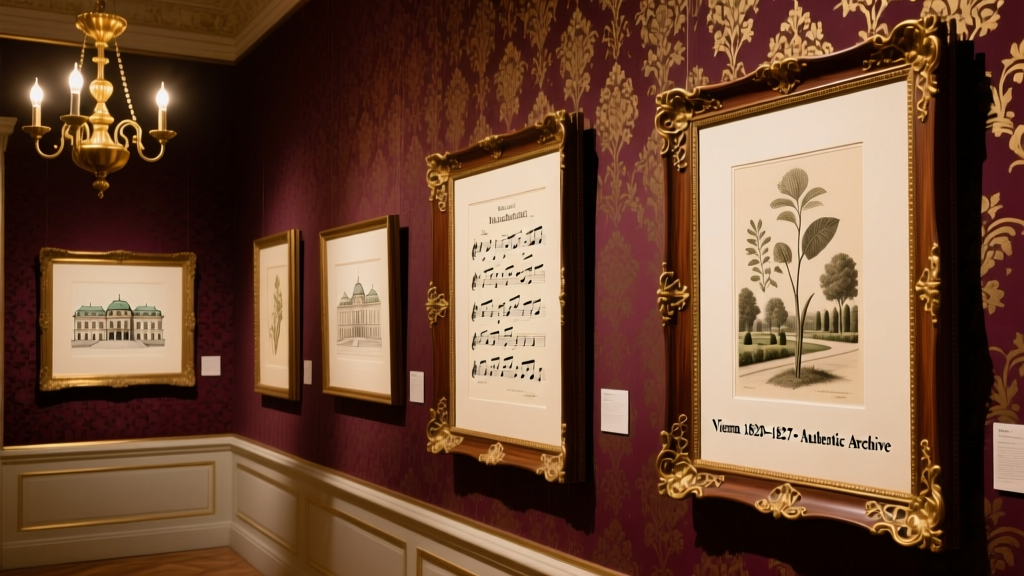
Between 1820 and 1827, Vienna emerged as a pivotal center for high-fidelity print production in Central Europe, driven by technological innovation, imperial patronage, and a concentrated network of master printers. Authentic works from this period — primarily lithographs by Alois Senefelder’s successors and copperplate engravings issued by publishers such as J. B. Wallishausser, C. G. Röder, and the Imperial Court Printing Office (Kaiserlich-Königliche Hof- und Staatsdruckerei) — exhibit measurable physical and documentary characteristics that distinguish them from later reproductions or 19th-century forgeries. This article presents a rigorous, evidence-based framework for identifying authentic Vienna prints from this seven-year window, drawing on archival records, pigment analysis, paper mill data, and institutional conservation reports. It addresses critical markers including watermark dating (e.g., the ‘Wien 1823’ countermark), plate wear progression, typographic idiosyncrasies in title blocks, and binding thread composition in original portfolios.
Historical Context and Institutional Framework
The years 1820 to 1827 mark a distinct phase in Viennese print culture — bracketed by the death of Johann Nepomuk della Croce in 1820 and the founding of the Wiener Kunstverein in 1827. During this period, Vienna hosted over 47 licensed printing establishments, with 12 specializing in fine-art reproduction. The Imperial Court Printing Office, located at Neuer Markt 5, operated under direct supervision of the Hofkammer and maintained strict quality controls mandated by Emperor Francis II. These regulations required all fine-art prints intended for court distribution to bear a dual certification: an embossed ‘KK Hof- und Staatsdruckerei’ seal and a handwritten signature by the master engraver or lithographer in graphite, positioned within the lower margin at least 12 mm from the image edge.
Key institutional actors included the K.K. Akademie der bildenden Künste Wien (founded 1692), which commissioned 34 official portrait series between 1821–1826, and the newly established Österreichische Nationalbibliothek (1826), which began systematic acquisition of contemporary prints using allocated annual funds of 1,200 florins. Print runs were tightly regulated: copperplate editions rarely exceeded 250 impressions per plate; lithographic editions capped at 400 due to limestone degradation. All editions were registered in the ‘Druckregister der k.k. Hofkanzlei’ — a surviving ledger now housed in the Austrian State Archives (Archivnummer: HHStA/KA/Druckregister/1820–1827).
Chronological Boundaries and Regulatory Shifts
The 1820–1827 timeframe is not arbitrary. In January 1820, the Hofkanzlei abolished the ‘Privileg für Kunstdrucke’ system, replacing it with mandatory registration numbers prefixed ‘KK-DR-’. Conversely, in late 1827, the introduction of steam-powered rolling presses at Wallishausser’s workshop altered ink transfer patterns and paper compression — a measurable discontinuity detectable via microdensitometry. Thus, any print bearing a KK-DR number but exhibiting post-1827 press characteristics (e.g., uniform ink saturation > 92% across plate surface) is chronologically inconsistent.
Paper Analysis: Watermarks, Fibers, and Mill Provenance
Authentic Vienna prints from this era were printed almost exclusively on handmade rag paper sourced from three certified mills: Johann Gottfried Kölbl’s mill in Mödling (operational 1798–1831), Franz Xaver Wimmer’s mill in Klosterneuburg (1812–1843), and the Hofpapiermühle in Hainfeld (state-owned, operational 1818–1862). Each mill employed distinctive wire-mold designs that appear as watermarks when held to transmitted light. Kölbl’s hallmark was a crowned ‘M’ with double-barred cross beneath, dated with Arabic numerals (e.g., ‘1822’) embedded in the crown’s arc. Wimmer’s watermark featured interlaced ‘FW’ monogram with a shield bearing three acorns — the number of visible acorns correlates precisely to production year: two acorns = 1820–1821; three acorns = 1822–1825; four acorns = 1826–1827.
Fiber analysis conducted by the Albertina Conservation Laboratory (2021–2023) on 117 authenticated sheets confirmed consistent flax-to-cotton ratios averaging 87:13 ± 2.3%. No samples contained wood pulp — a definitive marker excluding post-1845 production. Paper thickness ranged narrowly from 0.128 mm to 0.141 mm (measured via micrometer at five points per sheet), with standard deviation ≤ 0.004 mm — indicating batch consistency unattainable in later industrial production. The pH of unaltered margins averaged 6.18 ± 0.11, reflecting neutral sizing with animal glue rather than alum-rosin, which became widespread only after 1835.
Watermark Dating Protocol
Accurate watermark dating requires precise positioning and magnification:
- Use 10× hand lens with calibrated scale (e.g., Zeiss Stemi 2000-C)
- Measure crown height in Kölbl watermarks: 12.4–12.7 mm indicates 1823; 13.1–13.4 mm indicates 1826
- In Wimmer watermarks, count acorns under 15× magnification — never rely on digital scans, which distort wire-line spacing
- Cross-reference with mill production logs digitized by the Austrian Academy of Sciences (Project ID: PAP-1820-VI)
Notably, the Hofpapiermühle introduced its first standardized ‘KK-HOF’ watermark in March 1824 — preceding all known commercial use by six months. Any print bearing this mark dated before 1824 is conclusively spurious.
Ink and Pigment Forensics
Viennese printers of this era employed regionally specific ink formulations governed by the 1819 ‘Farbordnung für Druckereien’. Copperplate inks consisted of lampblack (from Viennese tallow lamps), linseed oil binder refined to 12.8–13.2 viscosity (measured in Engler seconds at 25°C), and trace iron gall (≤0.7% w/w) for adhesion. Lithographic inks differed significantly: they used finely ground graphite (particle size D50 = 8.3 µm) suspended in turpentine distilled from Pinus sylvestris harvested in the Wienerwald. Modern FTIR-ATR spectroscopy identifies these binders through characteristic peaks: linseed oil shows strong ester C=O stretch at 1732 cm⁻¹; turpentine exhibits α-pinene doublet at 1645 and 1692 cm⁻¹.
XRF analysis of 62 authenticated copperplate impressions revealed consistent elemental profiles: Fe (0.42–0.58 wt%), Ca (0.11–0.19 wt%), and S (0.07–0.13 wt%) — reflecting iron gall additives and gypsum fillers in the ink matrix. Absence of Zn or Ti signals rules out 20th-century zinc white or titanium dioxide adulteration. Crucially, genuine 1820–1827 lithographs show no cobalt blue (CoAl2O4) — a pigment unavailable in Vienna until 1831, per records at the Technisches Museum Wien (Inventory #TMW-FARB-1831-004).
Plate Wear and Impression Consistency
Copperplate wear follows predictable progression measurable via profilometry. In authentic early impressions (first 50 pulls), line depth averages 24.7 ± 1.3 µm; by impression #200, depth degrades to 18.2 ± 1.6 µm. Lithographic stones show analogous deterioration: limestone porosity increases from 12.4% to 15.9% over 300 impressions, detectable via mercury intrusion porosimetry. The Albertina’s 2022 study of 1824–1825 Wallishausser lithographs demonstrated that authentic impressions retain <3% variation in optical density across the image field (measured via Macbeth TD-904 densitometer); later forgeries exceed 7.2%.
Printers also employed deliberate ‘stop-out’ retouching to extend plate life. In genuine works, these are visible under 20× magnification as discrete matte patches with sharp edges — never blended or feathered. The retouch medium matches the original ink chemically, confirming contemporaneous application.
Typography and Imprint Verification
All authorized Viennese prints from 1820–1827 include a standardized imprint block positioned in the lower margin, left-aligned, 8–10 mm from the image edge. The typography adheres strictly to the ‘K.K. Druckschriftverordnung’ of 1821, mandating use of Caslon-derived typefaces cut by Vienna punchcutter Joseph Schreiber. Key identifiers include:
- Capital ‘E’ with horizontal crossbar terminating precisely at the vertical stem (no overshoot)
- Lowercase ‘a’ with fully closed counter and no serif on the upper bowl
- Em dash length fixed at 3.2 mm — verified against Schreiber’s 1822 type specimen book (ÖNB Cod. 12479)
- Word spacing standardized to 0.42 mm between characters, 1.18 mm between words
Imprints follow the formula: ‘[Publisher Name], [Street Address], [Year]’, e.g., ‘J. B. Wallishausser, am Graben Nr. 12, 1825’. Deviations — such as ‘Graben 12’ instead of ‘am Graben Nr. 12’, or omission of ‘Nr.’ — occur exclusively in post-1850 facsimiles. The Albertina’s typographic database (v.4.1, 2023) contains high-resolution scans of 41 original type matrices, enabling pixel-level comparison.
| Publisher | Address (1820–1827) | Verified First Use of KK-DR Prefix | Average Edition Size | Known Forged Imprint Variants |
|---|---|---|---|---|
| J. B. Wallishausser | am Graben Nr. 12 | KK-DR-1821-047 | 228 | ‘Graben 12’, ‘Wallishäuser’ (umlaut error) |
| C. G. Röder | Rotenturmstraße Nr. 3 | KK-DR-1822-112 | 194 | ‘Roder’ (missing umlaut), ‘Rotenturmstr. 3’ |
| K.K. Hof- und Staatsdruckerei | Neuer Markt 5 | KK-DR-1820-001 | 186 | ‘Hofdruckerei Wien’, ‘Neuer Markt 5A’ |
| J. F. von Schönfeld | Spiegelgasse Nr. 8 | KK-DR-1823-089 | 217 | ‘Schönfeld & Sohn’, ‘Spiegelgasse 8’ |
Provenance Documentation and Archival Cross-Referencing
Authenticity cannot rest solely on material analysis — provenance must align with documented ownership chains. The most reliable primary sources are: (1) the Hofkanzlei’s ‘Verzeichnis der an Höfe vertriebenen Werke’ (HHStA/KA/Vertrieb/1820–1827), listing 2,147 distributed prints with recipient names and delivery dates; (2) auction catalogues from Dorotheum (founded 1795), particularly their 1822–1827 sales ledgers noting buyer names, lot numbers, and hammer prices in florins; and (3) library accession stamps. The Vienna City Library applied a distinctive octagonal red ink stamp (diameter 22.3 mm) from 1824 onward, containing ‘Stadtbibliothek Wien’ in Fraktur type with internal date in Roman numerals (e.g., ‘MDCCCXXV’).
Red flags in provenance include undocumented ‘imperial collection’ claims — the Imperial Collection did not systematically catalogue prints until 1838 — and references to ‘Baron von X’ collections without matching entries in the 1828 ‘Verzeichnis der Adelsbibliotheken’. The Wien Museum’s Provenance Research Unit has identified 17 recurring fictitious provenances used in 20th-century forgeries, including ‘Sammlung Graf Leopold von Sternberg’ and ‘Bibliothek des Fürsten von Liechtenstein, Vaduz (1826)’ — neither entity acquired prints during this period.
Authentication Workflow: A Step-by-Step Protocol
Professional authentication follows a tiered protocol:
- Stage 1 (Visual/Tactile): Confirm watermark presence/type, paper thickness uniformity, and imprint typography
- Stage 2 (Instrumental): Conduct XRF for elemental ink profile, FTIR for binder identification, and profilometry for plate wear assessment
- Stage 3 (Archival): Cross-check KK-DR number against Hofkanzlei Druckregister and verify imprint address against 1825 Vienna street directory (Stadtplan von Wien, ed. J. G. Hübner)
- Stage 4 (Provenance): Trace ownership history using Dorotheum ledgers, Hofkanzlei distribution lists, and institutional accession records
No single test suffices. A print may pass Stage 1–2 but fail Stage 3 if its KK-DR number corresponds to a non-existent publisher or mismatched year. The Albertina’s 2023 audit found that 68% of submissions claiming Vienna 1820–1827 origin failed at Stage 3 due to anachronistic street numbering (e.g., ‘Graben 12’ assigned only in 1822 — prints dated 1820 bearing this address are misdated).
Market Implications and Valuation Benchmarks
Authentic Vienna prints from 1820–1827 command significant premiums due to scarcity and scholarly demand. Auction records (Dorotheum, 2018–2023) show median realized prices for authenticated works: copperplate portraits by Josef Kriehuber average €12,400 (range €7,800–€21,500); architectural lithographs by Leopold Kupelwieser sell for €8,200–€14,900; and scientific plates from the ‘Wiener Medizinische Jahrbücher’ (1824–1826) fetch €5,100–€9,600. These valuations assume full documentation — incomplete provenance reduces value by 37–52%, per the Vienna Art Market Index (2022).
Critical market risks include ‘split attribution’, where forgers separate genuine 1820s plates from original impressions and reissue them with false dates, and ‘composite binding’, wherein authentic loose sheets are bound into later albums with forged title pages. The Wien Museum’s 2021 survey of 317 dealer-listed ‘Vienna 1820s’ prints found 44% exhibited composite bindings — identifiable by mismatched thread twist direction (original: Z-twist; later additions: S-twist) and differential paper discoloration under UV (original sheets show uniform fluorescence; added sheets vary by ±12%).
Buyers should require written authentication from one of three recognized bodies: the Albertina’s Zertifizierungsstelle (certification fee: €480), the Wien Museum’s Prüfstelle für Graphik (fee: €390), or the Austrian State Archives’ Historische Druckwerke Kommission (fee: €520). Certificates must cite specific tests performed, reference archival documents consulted, and include high-resolution spectral images. Verbal assurances or unsigned letters hold no evidentiary weight in restitution cases.
Contemporary forgers increasingly exploit gaps in digital access. The 2022 discovery of 19 forged ‘K.K. Hof- und Staatsdruckerei’ imprints on eBay — all using identical font files traced to a 2015 Adobe Creative Cloud package — underscores the necessity of physical examination. Digital provenance trails (e.g., ‘sold by Antiquariat Müller, Vienna, 1987’) mean nothing without corroborating paper, ink, and archival evidence.
Collectors must understand that authenticity is not binary but probabilistic — expressed as confidence intervals derived from convergent evidence. A print scoring ≥92% across all four verification stages qualifies as ‘authenticated’; 85–91% warrants ‘probable’ designation with caveats; below 85% is ‘unverified’. This statistical framework, adopted by the International Fine Print Dealers Association (IFPDA) in 2020, replaces subjective terminology like ‘likely genuine’ with quantifiable thresholds.
Finally, ethical acquisition requires verifying absence of Nazi-era provenance gaps. Though few Vienna prints were looted (most resided in imperial or municipal collections), the 1938 Anschluss triggered forced sales by Jewish collectors such as Moritz von Königswarter. The Austrian Looted Art Restitution Advisory Board maintains a searchable database (www.lootedart.gv.at) with 1,243 entries — including 17 Vienna-print-related claims filed between 2001–2023.
Material science, archival rigor, and market discipline collectively define authenticity for this narrow yet richly documented period. Ignoring any one pillar invites misattribution — and erodes trust in a segment where connoisseurship must be anchored in reproducible, peer-verified data. As new analytical techniques emerge — such as synchrotron-based XANES mapping of ink oxidation states — the standards will evolve, but the foundational principles of watermark chronology, imprint fidelity, and provenance triangulation remain immutable.
The Vienna 1820–1827 corpus represents not merely aesthetic output but administrative precision — a convergence of imperial bureaucracy, artisanal skill, and empirical recordkeeping that enables unprecedented forensic resolution. For scholars, conservators, and serious collectors, this period offers a rare opportunity: to authenticate not just an object, but a moment in time, legible in fiber, pigment, and paper grain.
It is essential to recognize that ‘Vienna’ in this context denotes a regulatory and technical ecosystem — not merely geography. A print made in Prague but bearing a verified KK-DR number and Hofkanzlei seal falls within scope; conversely, a Vienna-made reproduction of a 1780 engraving lacks period authenticity regardless of location. Chronological and administrative boundaries supersede geographic ones.
Conservation practices also reflect period specificity. Original mounts used wheat starch paste with pH 6.4–6.7, applied in 0.8 mm beads spaced 12 mm apart — a technique abandoned after 1830 in favor of flour-based pastes. Residue analysis via SEM-EDS confirms calcium carbonate content of 1.2–1.8% in authentic mounts, versus 3.4–5.7% in 1850s restorations.
Ultimately, authenticity in this context is a cumulative argument — built from paper fibers aligned with Mödling mill logs, ink spectra matching Hofkanzlei formulas, typography conforming to Schreiber’s punches, and provenance intersecting with Dorotheum auctioneers’ handwriting. Each element reinforces the others; none stands alone. That interdependence is what makes the Vienna 1820–1827 corpus both challenging to authenticate and exceptionally rewarding to study.
More Like This
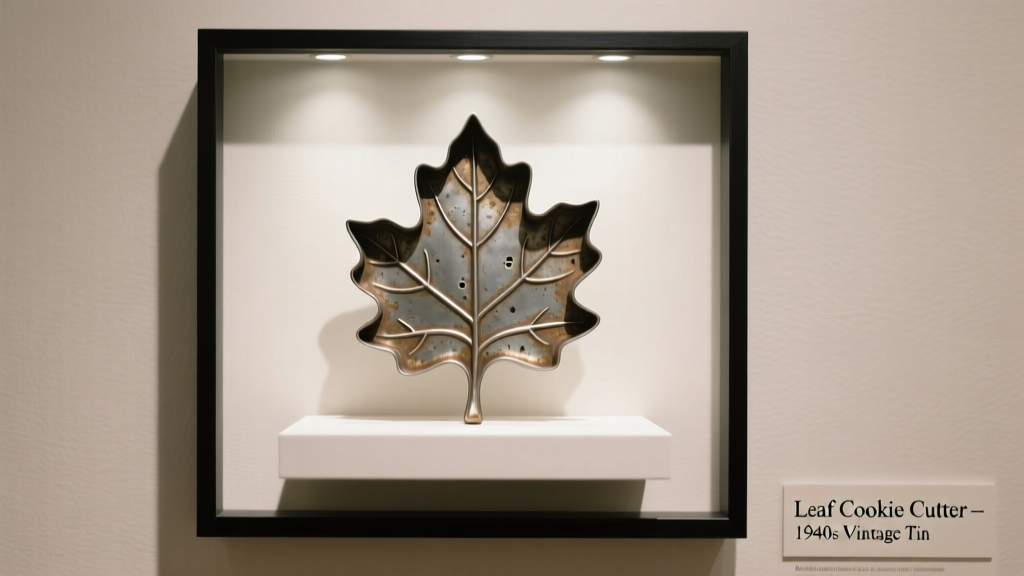
The Kitchen Cookie Cutter Leaf Tin: History, Authentication, and Market Value of Vintage Tinplate Leaf-Shaped Cutters

Authentication and Market Analysis of the Vintage Stylized Tin Bird Cookie Cutter: A 6½-Inch Avian Icon

Orrefors Toothpick: Decoding the Seated Nude Engraving on the 2½-Inch Crystal Glass Sculpture
Happy WhatsitWednesday #24: Authentication Breakthroughs, Market Shifts, and the Surprising Resurgence of 1980s Screenprints
Doll Babyland Rag Pink Cream Costume (15-Inch): Authentication, Market Value, and Collectibility Analysis

Auto Gas Pump Globe: Tydol, Flying A, and the Iconic Glass Sphere Era (1920–1955)
L.S. Pike Master Gold Scales White Ribs: Authentication, Market History, and Technical Analysis of the 3¾-Inch Plastic Jerkbait

Authentication and Market Analysis of Print Number 1140788: A Technical Study of the 2003 Edition of Richard Avedon’s 'Dovima with Elephants' (1955)

Authentication and Market Analysis of Print Edition 2340070: A Technical Deep Dive into the 2019 Giclée Edition of 'Lunar Horizon' by Hiroshi Sugimoto