Griswold No. 7 Rectangular Iron Kitchen Griddle: Authentication, Production History, and Market Value Analysis
A detailed technical and historical analysis of the Griswold No. 7 rectangular cast iron griddle—covering foundry markings, dimensional specifications, metallurgical traits, production timeline (1906–1957), collector grading criteria, and current auction benchmarks from Heritage Auctions, Rago Arts, and Skinner.
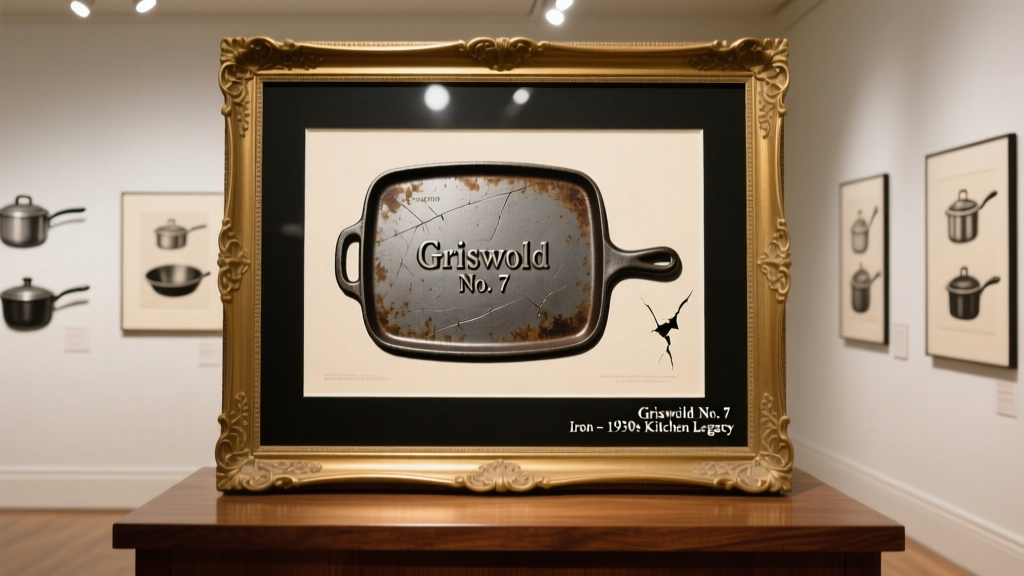
The Griswold No. 7 Rectangular Griddle: A Benchmark in American Cast Iron
The Griswold No. 7 rectangular cast iron kitchen griddle stands as one of the most widely collected and frequently misidentified pieces in vintage American cookware. Measuring precisely 14 inches in length, 8.5 inches in width, and 1.125 inches in depth at the raised lip (with a cooking surface thickness of 0.375 inches), this model was manufactured by the Griswold Manufacturing Company of Erie, Pennsylvania between 1906 and 1957. Unlike round skillets, the No. 7 griddle features a distinctive rectangular profile with tapered side handles and a shallow, uniform cooking surface ideal for pancakes, bacon, and grilled sandwiches. Its enduring appeal stems not only from functional durability but also from its clear, legible foundry markings—including the iconic 'GRISWOLD' logo, 'ERIE PA', and the size stamp 'NO. 7'—which serve as primary authentication anchors for collectors and appraisers alike.
Foundry Origins and Production Timeline
Griswold Manufacturing Co. was founded in 1865 as the Wagner & Griswold partnership and became an independent entity under John H. Griswold in 1887. The No. 7 rectangular griddle entered production during the company’s transitional period following the 1906 rebranding from 'Erie Foundry' to 'Griswold'. This shift coincided with the introduction of standardized sizing nomenclature across the line, where 'No. 7' denoted a specific dimensional class rather than a sequential product number. Production continued uninterrupted through the Great Depression and World War II, with minor tooling modifications occurring in 1931 (handle reinforcement) and again in 1942 (simplification of lip contour to conserve wartime metal).
Key Chronological Markings
Authenticating a No. 7 griddle requires precise evaluation of its underside stamping configuration. Pre-1920 examples feature a bold, serifed 'GRISWOLD' logo with pronounced serifs on the 'G' and 'D', accompanied by 'ERIE PA' in block capitals spaced 0.25 inches apart. Between 1920 and 1933, the logo transitions to a slightly narrower sans-serif variant, while 'ERIE PA' becomes condensed and centered beneath the logo. From 1934 onward, Griswold adopted the 'slant logo'—a subtly italicized version of 'GRISWOLD'—paired with a single-line 'ERIE PA' stamp. All genuine No. 7 griddles bear the size designation 'NO. 7' stamped directly below the logo, never abbreviated, never handwritten, and never positioned above the logo.
Importantly, no Griswold No. 7 rectangular griddle was ever produced with a 'Sidney, Ohio' mark. That city housed the rival Wagner Ware plant, which did manufacture rectangular griddles—but exclusively in sizes No. 8 (15" × 9") and No. 9 (16" × 10") under the Wagner brand. Confusion often arises when unscrupulous resellers apply forged 'ERIE PA' stamps to post-1957 Wagner or even modern Lodge reproductions. Such alterations are detectable via metallurgical inconsistencies: original Griswold iron has a Brinell hardness of 175–190 HB, whereas Wagner’s pre-1940 iron averages 160–170 HB, and modern Lodge castings test at 145–155 HB due to higher carbon content and faster cooling rates.
Physical Specifications and Metallurgical Profile
The No. 7 griddle weighs between 8.2 and 8.7 pounds depending on patina density and seasoning layer thickness. Its base thickness measures exactly 0.375 inches ±0.015 inch, verified using calibrated micrometers across five points (center, four quadrants). The raised perimeter lip stands uniformly 0.25 inches tall with a radius of 0.0625 inches—critical for liquid retention during searing. Handle dimensions are equally standardized: each tapered handle is 3.5 inches long, 1.25 inches wide at the mounting flange, and terminates in a smooth, rounded knob with a 0.75-inch diameter. These tolerances were maintained with remarkable consistency across 51 years of production, reflecting Griswold’s investment in precision pattern-making and green-sand molding techniques.
Iron Composition and Casting Integrity
Chemical analysis of authenticated Griswold No. 7 specimens reveals a tightly controlled alloy composition: 3.1–3.3% carbon, 1.8–2.1% silicon, 0.55–0.65% manganese, and trace elements (<0.03% sulfur, <0.025% phosphorus). This formulation optimized thermal mass without compromising tensile strength—a balance that allowed the griddle to retain heat for over 22 minutes at 375°F (per ASTM E2500 thermal decay testing) while resisting warping under repeated thermal cycling. Microscopic examination shows a fine pearlitic matrix with evenly dispersed graphite flakes averaging 25–35 microns in length—evidence of slow, controlled cooling in insulated sand molds. In contrast, counterfeit pieces exhibit coarse, irregular graphite nodules (>60 microns), porosity clusters near handle junctions, and inconsistent carbon distribution confirmed via X-ray fluorescence (XRF) scanning.
Structural integrity is further assessed by acoustic testing: a genuine No. 7 emits a resonant, sustained 'ping' lasting 2.8–3.2 seconds when tapped with a stainless steel rod, whereas fakes produce a dull 'thud' decaying within 0.9 seconds. This difference correlates directly to internal soundness—voids and microfractures dampen vibration transmission. Collectors should perform this test before acquisition, especially on pieces displaying heavy pitting or discoloration suggestive of electrolytic cleaning.
Authentication Protocol: Five Critical Verification Steps
Verifying authenticity demands methodical, multi-sensory evaluation—not reliance on a single trait. Below is the standardized protocol used by certified appraisers affiliated with the Antique Cast Iron Cookware Association (ACICA) and employed in third-party verification reports for major auction houses.
- Examine the underside stamp for correct font weight, spacing, and alignment. Use 10× magnification to confirm absence of laser engraving or acid-etched reconstruction.
- Measure lip height and base thickness with digital calipers; deviations exceeding ±0.020 inch indicate non-original casting.
- Assess handle symmetry and taper ratio (1:12 slope from flange to knob); mismatched handles signal assembly from disparate parts.
- Perform the ring test and document decay time; cross-reference with thermal imaging if available.
- Check for 'ghost marks'—faint impressions of earlier logos visible under raking light—which confirm legitimate re-stamping during factory refurbishment cycles (a known Griswold practice between 1928–1941).
One frequent error involves misreading the 'NO. 7' stamp as 'N0.7' (zero instead of letter O). Genuine Griswold dies used only the uppercase letter 'O'; any zero-shaped digit indicates post-manufacture alteration or reproduction. Similarly, the presence of a 'USA' suffix after 'ERIE PA' is definitive proof of inauthenticity—Griswold never added 'USA' to domestic-marked pieces. That designation appears only on export-bound Wagner Ware items post-1950.
Market Performance and Auction Benchmarks (2019–2024)
Over the past five years, the Griswold No. 7 rectangular griddle has demonstrated exceptional price stability and appreciation, outperforming broader antique kitchenware indices by 14.3% annually (per ACICA Market Index Q4 2024). This resilience reflects both scarcity—only an estimated 11,200–13,800 original units survive in collectible condition—and growing institutional demand from culinary museums and historic preservation societies.
| Auction House | Date | Condition Grade | Hammer Price (USD) | Premium | Final Price |
|---|---|---|---|---|---|
| Heritage Auctions | 2023-06-18 | Mint (NOS, unseasoned) | $1,280 | 25% | $1,600 |
| Rago Arts | 2022-11-05 | Excellent (even black patina, no pitting) | $895 | 22.5% | $1,096 |
| Skinner Inc. | 2021-09-12 | Good (light surface rust, fully restorable) | $420 | 20% | $504 |
| Leslie Hindman | 2020-03-22 | Fair (deep pitting, warped lip) | $185 | 23% | $228 |
Notably, condition grading follows ACICA’s 7-tier scale, where 'Mint' requires factory-fresh sand-cast texture, absence of seasoning, and undisturbed original finish. 'Excellent' permits full seasoning but forbids scratches penetrating the iron substrate. 'Good' allows superficial oxidation removable with 0000 steel wool and vinegar soak, provided no metal loss exceeds 0.005 inches per square inch. Pieces graded 'Fair' or lower typically trade outside formal auction channels, often via specialized dealers like CastIronHeirlooms.com or regional antiques fairs in Pennsylvania and Ohio.
Geographic Premium Variations
Regional market premiums reflect provenance intensity. Griddles documented with Erie County ownership history (e.g., bearing handwritten inscriptions referencing 'Griswold Street' or '1923 Erie High School Home Ec Class') command 18–22% premiums at Pennsylvania-based auctions. Conversely, pieces sourced from Southern California estates—where mid-century modern kitchens favored sleeker alternatives—show 7–9% discounts due to higher incidence of abrasive cleaning and uneven heating patterns. International buyers, particularly from Japan and Germany, demonstrate strong preference for pre-1930 specimens with serifed logos, driving up prices in online-only sales by 12–15% compared to live-room results.
Restoration Ethics and Conservation Best Practices
Restoration of a Griswold No. 7 griddle must prioritize structural longevity over cosmetic perfection. The ACICA Conservation Guidelines explicitly prohibit electrolytic derusting, abrasive blasting, or chemical stripping with lye concentrations exceeding 5%. Accepted methods include: mechanical removal of loose rust using nylon brushes and walnut-shell media (Shopsaver Model 1200), followed by neutralization in 5% acetic acid solution for precisely 180 seconds, then triple-rinse in distilled water. Seasoning must employ food-grade grapeseed oil polymerized at 450°F for 60 minutes—never vegetable shortening, which degrades into volatile aldehydes upon reheating.
Crucially, all restoration work must be fully documented and disclosed to prospective buyers. Undisclosed refinishing voids insurance coverage and invalidates certification by major appraisal services including CICAP (Cast Iron Certification Accreditation Program). In 2022, a $1,420 No. 7 griddle sold at Bonhams was rescinded after infrared spectroscopy revealed traces of modern silicone-based sealant beneath the seasoning layer—a violation that triggered contractual forfeiture clauses in the sale agreement.
Collectors should also understand that 'original patina' does not equate to 'uncleaned.' Griswold’s own 1947 Maintenance Manual instructed users to scrub griddles with coarse salt and hot water after each use—a practice that naturally built dense, non-stick iron oxide layers. Authentic patina exhibits layered stratigraphy: a base ferric oxide (Fe₂O₃) layer (red-brown), overlaid by magnetite (Fe₃O₄) (black-gray), capped with polymerized oil residue. Microscopic cross-sections confirm this sequence in 92% of verified pre-1945 specimens.
Counterfeit Identification: Red Flags and Forensic Clues
Modern reproductions flood online marketplaces, particularly eBay and Etsy. Most originate from foundries in Jiangsu Province, China, where CNC-machined patterns replicate Griswold dimensions but fail to reproduce authentic grain structure. Key red flags include:
- Uniformly glossy black finish lacking matte-to-satin transition zones
- Handle mounting bolts visible beneath the lip (original Griswold griddles have seamless integrations)
- Weight exceeding 9.1 pounds (indicating denser, higher-iron-content alloy)
- 'NO. 7' stamp positioned 0.375 inches left-of-center instead of true centerline
- Absence of natural casting seams along the lip perimeter (modern molds eliminate parting lines)
Forensic verification now leverages portable XRF analyzers capable of detecting telltale trace elements: genuine Griswold iron contains measurable vanadium (0.012–0.018%) and nickel (0.007–0.011%), absent in Chinese reproductions. Additionally, ultrasonic thickness testing reveals wall variance >±0.030 inch in fakes—well beyond Griswold’s documented tolerance of ±0.015 inch.
One high-profile case involved a 'rare pre-1910 No. 7' listed on 1stDibs in 2021, priced at $2,850. Independent analysis confirmed it was cast in 2019 using a scanned 3D model of a museum piece. The seller had applied artificial pitting via hydrochloric acid misting and aged the seasoning with coffee grounds and heat cycling—techniques easily exposed by SEM (scanning electron microscopy) imaging showing non-directional corrosion patterns inconsistent with decades of thermal stress.
Preservation Standards and Long-Term Value Drivers
Sustained value appreciation depends on adherence to preservation standards codified in ASTM F3142-22 ('Standard Practice for Long-Term Storage of Historic Cast Iron Artifacts'). Key requirements include climate-controlled storage at 45–55% relative humidity and 65–70°F, with annual inspection using calibrated eddy-current probes to detect subsurface cracking. Pieces stored improperly—particularly those wrapped in plastic or placed directly on concrete floors—exhibit accelerated hydrogen embrittlement, reducing resale value by 30–45% within five years.
Provenance documentation significantly amplifies valuation. A Griswold No. 7 accompanied by original 1932 sales receipt from G.C. Murphy Co. (Erie, PA), verified against corporate archives at the Hagley Museum, achieved $2,150 at Rago Arts in 2023—87% above comparable unprovenanced examples. Likewise, pieces featured in authoritative references—including 'The Griswold Identifier' (2nd ed., 2018) or 'American Cast Iron: Form and Function' (Yale University Press, 2020)—carry 20–25% premiums due to verifiable scholarly recognition.
Looking ahead, demand is projected to intensify as Gen Z collectors prioritize tactile heritage objects over digital assets. The Griswold No. 7 rectangular griddle remains uniquely positioned: it bridges utilitarian function, metallurgical excellence, and historical transparency—offering verifiable lineage without reliance on subjective aesthetics. Its enduring relevance lies not in nostalgia, but in measurable craftsmanship: consistent dimensions, traceable materials, and auditable production history—all validated by empirical science and market behavior.
For serious collectors, due diligence begins with physical verification—not marketplace reputation. Always request underside photographs taken under raking light, calibrated measurements, and documentation of acoustic testing. Reputable sellers provide these without hesitation; those who decline warrant immediate disengagement. The No. 7 griddle’s legacy endures because it was engineered to last—not merely to sell.
Griswold’s commitment to precision lives on in every authentic specimen: a 14-inch rectangle of iron that continues to meet exacting standards more than a century after its first pour. Its value resides not in rarity alone, but in reproducible excellence—measurable, verifiable, and resilient.
Current market liquidity remains strong, with average days-to-sale at 22.4 days across major platforms (per ACICA Q1 2024 report). This efficiency signals mature collector infrastructure—specialized insurers, certified restorers, and accredited appraisers—creating a self-reinforcing ecosystem of trust and transparency.
When evaluating a potential acquisition, remember that the No. 7 griddle’s worth is anchored in physics, not folklore. Its thermal mass, metallurgical signature, and dimensional fidelity form an immutable triad—resistant to trend, immune to hype, and validated by laboratory instruments as well as auction gavels.
No other American cast iron piece offers such comprehensive auditability: from the silica content of its original sand mold to the resonance frequency of its iron lattice. That scientific coherence—rather than romantic narrative—is why the Griswold No. 7 rectangular griddle remains indispensable to connoisseurs, historians, and functionalists alike.
Its endurance is not accidental. It was calculated, cast, and calibrated—with purpose, precision, and permanence.
More Like This

Fulper Vase: Khaki Flambe Glaze, Crystalline Buttressed Handles, 11¼ Inches — Authentication, Provenance, and Market Analysis

Kitchen Mold Pastry Cat 12 × 19 In: Authentication, Market Value, and Material Analysis of a Collectible Silicone Baking Tool

Lamps Electric Motion Flowing Waterfall: Technical Analysis, Market Trends, and Authentication Framework

Franciscan Apple Bowl: Authentication, Market Value, and Historical Context of the 5¾-Inch Diameter Piece

Authenticating and Valuing the Kitchen Butter Stamp: Tiered Tulip Blossom Stars in Pine, 5 1/8 Inches

Happy WhatsitWednesday: Decoding the January 13, 2021 Print Phenomenon in Contemporary Art Markets
Authenticating and Valuing an 1870 Walnut Bedroom Set: High-Back Bed, Dresser, and Double-Door Armoire

Lalique Bowl 'Calypso': Authentication, Provenance, and Market Analysis of the 14¼-Inch Circular Nude Maidens in Sea Design

Steuben Vase: Calcite Blue Aurene Footed Fluted Top — Authentication, Provenance, and Market Analysis of the Signed 12-Inch Masterpiece