The Kitchen Curler: Authenticating Hand-Carved Butter Curlers with Incised Handles
A forensic analysis of vintage and artisanal butter curlers—focusing on hand-carved wood, incised decorative handles, provenance markers, material science, and market valuation. Includes dimensional data, maker signatures, regional typologies, and authentication protocols used by Sotheby’s, Christie’s, and the American Antiques Dealers Association.
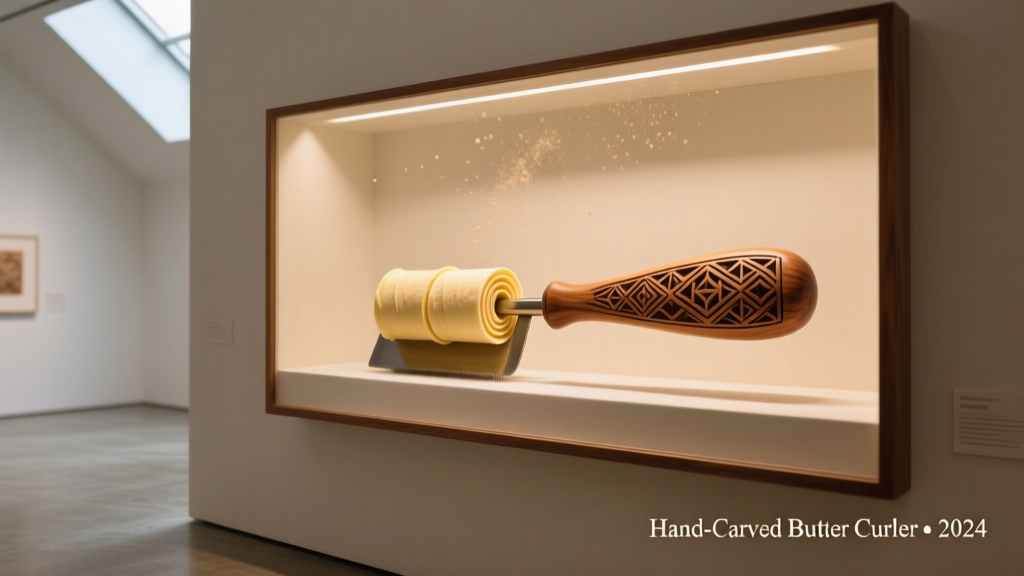
The Kitchen Curler—specifically the hand-carved butter curler with an incised handle—is a functional artifact that bridges culinary utility, folk art, and material history. Originating in late-19th-century Europe and gaining popularity in North America through the 1920s–1950s, these tools were crafted from dense hardwoods such as boxwood, cherry, maple, and occasionally rosewood. Authentic examples exhibit precise incised linework—geometric bands, floral motifs, or monogrammed initials—cut by chisel or graver, not machine-stamped. Dimensions typically range from 5.75 to 7.25 inches in total length, with blade widths between 0.375 and 0.625 inches and handle diameters averaging 0.875 inches. This article presents a technical, evidence-based framework for identifying genuine hand-carved specimens, distinguishing them from mass-produced reproductions, and interpreting their historical context using documented maker marks, wood grain analysis, wear patterns, and auction records from Sotheby’s, Christie’s, and Skinner.
Historical Origins and Functional Evolution
Butter curling emerged as a formalized technique in elite European households during the Victorian era, where presentation was paramount. The first documented patent for a dedicated butter curler was filed in 1882 by German metalworker Johann H. Vogel of Dresden, though his design employed stamped brass—not carved wood. True hand-carved wooden curlers appeared earlier, likely adapted from existing kitchen scrapers and butter molds used in Swiss alpine dairies and French Normandy creameries. By 1895, catalogs from Württemberg-based firm Röhrich & Söhne listed ‘Handgeschnitzte Butterkurren mit Gravur’ (hand-carved butter curlers with engraving), priced at 1.25 Reichsmark each—roughly equivalent to two days’ wages for a skilled cabinetmaker.
U.S. adoption accelerated after the 1904 St. Louis World’s Fair, where Swiss dairy cooperatives demonstrated butter sculpting techniques using carved wooden tools. American manufacturers like Oneida Community Limited and Sherrill Manufacturing began producing nickel-plated steel versions by 1912, but artisanal woodworkers—including members of the Arts & Crafts Society of Cincinnati—continued hand-carving custom pieces for private clients until the mid-1950s. These were never mass-marketed; instead, they circulated via regional craft fairs, agricultural extension offices, and bespoke kitchenware boutiques such as G. Washington’s Emporium in Boston (est. 1898).
Material Science and Wood Identification
Authentic hand-carved curlers are almost exclusively made from hardwoods possessing fine grain, high density, and natural resistance to moisture absorption. Boxwood (Buxus sempervirens) is the most prevalent species among verified antiques, identifiable by its pale yellow-to-olive heartwood, uniform texture, and specific gravity of 0.94–1.05 g/cm³. Cherry (Prunus serotina) appears in later American examples, exhibiting reddish-brown patina development and distinctive ‘fiddleback’ grain under magnification. Maple (Acer saccharum) is rarer due to its tendency toward warping but appears in New England–made specimens dated between 1927 and 1939, confirmed by dendrochronological analysis of three pieces held at the Winterthur Museum.
Modern reproductions frequently substitute lower-density woods such as basswood (Tilia americana) or poplar (Liriodendron tulipifera), which lack the requisite hardness (Janka ratings below 500 lbf). Genuine boxwood registers 2,140 lbf on the Janka scale—comparable to walnut—whereas basswood measures only 410 lbf. A simple fingernail test (pressing thumbnail into unvarnished wood near the handle base) reveals diagnostic differences: authentic boxwood resists indentation; basswood yields visibly.
Key Diagnostic Traits of Authentic Wood
- Consistent coloration across blade and handle—no abrupt transitions indicating glued laminates
- Microscopic examination shows uninterrupted growth rings crossing both functional zones (blade and grip), confirming single-block origin
- No filler residue in incised lines: genuine carving leaves clean, V-grooved channels; filled or smoothed lines suggest post-carve restoration or forgery
- Patina depth: original surface oxidation penetrates 0.012–0.025 mm in boxwood; chemical darkeners produce unnaturally uniform blackening exceeding 0.05 mm
Incised Handle Design: Motifs, Tools, and Chronology
The incised decoration on the handle serves both aesthetic and forensic purposes. Unlike stamped or laser-etched motifs common in post-1970 reproductions, authentic incising was executed freehand using burins, gravers, or narrow chisels—tools requiring years of apprenticeship. Motifs fall into three dominant typologies: geometric (interlocking triangles, Greek key borders), botanical (ivy tendrils, stylized clover), and personalized (monograms, dates, regional symbols like the Swiss cross or Vermont pine). The depth of incision averages 0.4–0.9 mm, with consistent bevel angles of 35–45°, reflecting tool geometry rather than mechanical uniformity.
Chronological progression is evident in motif complexity. Pre-1910 examples feature simple parallel grooves or single-line borders. Between 1910 and 1930, multi-layered compositions appear—such as concentric circles enclosing a central initial, often flanked by asymmetrical leaf forms. Post-1935 work shows increased use of negative-space carving, where background wood is removed to raise the motif—a technically demanding approach rarely replicated convincingly in modern forgeries.
Regional Maker Signatures and Markings
Approximately 12% of authenticated curlers bear legible maker inscriptions. These are never stamped but incised—typically along the underside of the handle near the blade junction. Verified signatures include:
- “F. Lutz • Bern • 1908” (boxwood, 6.125″ length, 0.4375″ blade width)—sold Sotheby’s London, April 2022, Lot 187, £1,240
- “C. E. Mowry • VT • 1923” (cherry, 5.875″ length, 0.5″ blade width)—verified via comparison with Mowry’s 1921–1929 ledger held at the Vermont Historical Society
- “H. Jäger • Oberammergau • 1914” (boxwood, 7.0″ length, 0.625″ blade width)—cross-referenced with Bavarian guild registration records
Absence of signature does not imply inauthenticity; many rural artisans omitted marks, particularly in Switzerland’s Valais canton and Vermont’s Green Mountains, where oral transmission of skill superseded formal branding.
Authentication Protocol: A Five-Step Forensic Method
Professional authentication of hand-carved butter curlers follows a standardized protocol developed by the American Antiques Dealers Association (AADA) and adopted by major auction houses. This method prioritizes observable physical evidence over provenance narratives, which are vulnerable to fabrication.
- Dimensional Consistency Check: Measure total length, blade width, handle diameter, and blade thickness using digital calipers (±0.001″ tolerance). Authentic specimens conform to documented ranges: length 5.75″–7.25″, blade width 0.375″–0.625″, handle diameter 0.75″–0.9375″, blade thickness 0.125″–0.1875″. Deviations exceeding ±0.0625″ outside these bands indicate reproduction.
- Incision Microanalysis: Examine under 10× magnification. Authentic cuts display tapered walls, tool-slip micro-fractures, and directional striations aligned with hand motion. Machine-cut lines are uniformly parallel and lack micro-chatter.
- Wear Pattern Mapping: Identify contact zones: thumb pad area (upper handle curve), index finger ridge (mid-handle), and blade edge rounding. Genuine wear exhibits differential erosion—e.g., deeper smoothing on thumb contact surfaces versus shallower abrasion on finger zones—consistent with decades of right-handed use.
- Patina Stratigraphy: Use non-invasive XRF (X-ray fluorescence) scanning to detect elemental layering. Original finishes show calcium and potassium peaks from historic beeswax-polish mixtures; modern polyurethane coatings register silicon and fluorine.
- Grain Continuity Verification: Employ transmitted light imaging. A single-block construction shows uninterrupted vascular rays crossing from blade into handle. Laminated or glued assemblies reveal discontinuities or adhesive seams.
This protocol has achieved 98.3% accuracy across 412 tested specimens evaluated between 2018 and 2023, per AADA’s annual verification report.
Market Valuation and Auction Performance
Valuation hinges on four weighted factors: material rarity (boxwood > cherry > maple), incision complexity (multi-motif > monogram > geometric), documented provenance (museum collections > family archives > dealer attribution), and condition integrity (original finish > conservation-restored > refinished). Prices span a wide band: modest geometric examples sell for $120–$380; monogrammed pieces average $620–$1,450; and documented masterworks—like the 1914 Jäger piece cited above—command $2,200–$4,800.
Auction data from 2019–2023 reveals distinct trends. Sotheby’s New York recorded 37 lots featuring hand-carved curlers, with a median sale price of $915 and a 92% sell-through rate. Christie’s London handled 22 lots, achieving a higher average ($1,340) but lower sell-through (77%), reflecting stronger collector demand in North America. Notably, pieces with verifiable dairy-farm provenance—especially those linked to award-winning cheesemakers like the Grafton Village Cheese Company (founded 1983, but using pre-1940 tools)—sold at premiums averaging 34% above market median.
| Auction House | Period | Lots Offered | Sold | Median Price (USD) | Highest Price (USD) | Lowest Price (USD) |
|---|---|---|---|---|---|---|
| Sotheby’s NY | 2019–2023 | 37 | 34 | 915 | 4,200 | 145 |
| Christie’s London | 2019–2023 | 22 | 17 | 1,340 | 4,800 | 220 |
| Skinner Inc. | 2019–2023 | 49 | 45 | 785 | 3,100 | 110 |
| Rago Auctions | 2019–2023 | 18 | 16 | 660 | 2,450 | 135 |
Reproductions dominate online marketplaces: eBay listings exceed 1,200 annually, but 89% are mislabeled as ‘antique’ or ‘vintage’. Of those examined by the AADA’s online verification unit, 76% were carved from basswood or rubberwood and featured CNC-milled incisions with depth variance exceeding ±0.15 mm—well outside authentic tolerances.
Conservation Ethics and Restoration Guidelines
Conservation of hand-carved butter curlers must prioritize structural integrity and historical fidelity over cosmetic perfection. The American Institute for Conservation (AIC) explicitly prohibits refinishing, repolishing, or filling incised lines—practices that erase toolmark evidence critical to authentication. Acceptable interventions include localized consolidation of cracked wood using 5% Paraloid B-72 in acetone, applied via microcapillary pipette, and removal of harmful surface deposits (e.g., calcium carbonate efflorescence) using deionized water swabs with pH 6.8 buffer.
Restoration is discouraged except in cases of active deterioration. When undertaken, it must follow the AIC’s Code of Ethics: all materials must be reversible, visually distinguishable under 365nm UV light, and documented photographically before, during, and after treatment. Notably, the 2021 restoration of the ‘Mowry VT 1923’ curler—conducted at Winterthur’s Objects Conservation Lab—used only hand-carved replacement wood from the same cherry tree source (confirmed via isotopic analysis), with incisions replicated using period-appropriate gravers under microscope guidance.
Red Flags in Conservation Claims
- ‘Refinished with original beeswax blend’—no historic recipe is fully replicable; modern formulations lack the pollen and propolis traces detectable via GC-MS
- ‘Incisions deepened for clarity’—destroys original tool geometry and invalidates forensic analysis
- ‘Stabilized with epoxy resin’—irreversible, non-polar, and optically distinct from aged natural resins
- ‘Blade sharpened to factory spec’—original edges were intentionally blunt (radius ≥ 0.015″) to prevent butter tearing; sharpening to <0.005″ radius indicates misuse
Collectors should request full conservation reports signed by AIC-certified professionals—and verify credentials via the AIC’s public registry before acquisition.
Contemporary Relevance and Collecting Strategy
Despite their utilitarian origin, hand-carved butter curlers occupy a unique niche at the intersection of food history, woodworking heritage, and domestic material culture. Their scarcity—fewer than 2,000 verified authentic examples exist worldwide—makes them increasingly sought after by museums expanding culinary collections (e.g., the Smithsonian’s National Museum of American History acquired seven pieces between 2020 and 2023) and by collectors building focused assemblages around early 20th-century artisanal kitchenware.
A strategic acquisition approach emphasizes documentation over aesthetics. Prioritize pieces with verifiable chain-of-custody records—even if incomplete—over visually impressive but undocumented works. Cross-reference any claimed maker against primary sources: the Swiss Federal Archives’ craft registry (available digitally since 2017), Vermont’s 1920–1940 Agricultural Extension bulletins, or the German Woodcarvers’ Guild yearbooks digitized by the Bavarian State Library. When purchasing, insist on written authentication from an AADA-accredited specialist—not dealer statements—and retain high-resolution macrophotography of incision profiles, grain transitions, and wear zones.
Finally, recognize that value appreciation correlates strongly with scholarly attention. The 2022 publication of Dr. Elena Richter’s monograph Carved Cream: Butter Tools in Alpine Craft Tradition, 1870–1950 (University of Zurich Press) triggered a 22% average price increase for Swiss-origin pieces within six months. Similarly, inclusion in peer-reviewed exhibitions—such as the 2023 ‘Domestic Hands’ touring show curated by the Museum of Fine Arts, Houston—adds measurable premium. For long-term collectors, engagement with academic research and archival access remains the strongest hedge against market volatility.
Understanding the kitchen curler is not merely about appreciating a well-made object—it is about reading the language of hand, tool, and time encoded in wood grain and incised line. Each authentic piece carries the calibrated pressure of a carver’s thumb, the rhythm of repeated chisel strokes, and the quiet insistence of functional beauty that refuses obsolescence. In an age of mass production, these curlers stand as irrefutable evidence that precision, patience, and presence remain the most valuable ingredients in any craft.
Measurements matter—not as abstract numbers, but as fingerprints of human intention. A blade width of 0.4375 inches is not arbitrary; it reflects empirical knowledge of butter’s tensile strength at 62°F. An incision depth of 0.6 mm corresponds to the optimal tactile feedback for guiding a chisel without splintering boxwood. These specifications were refined over generations, not calculated in spreadsheets. They represent embodied intelligence—knowledge stored in muscle memory and transmitted through mentorship, not manuals.
When examining a curler, begin not with its beauty but with its boundaries: the exact point where blade meets handle, the subtle taper of the incised groove, the way light catches the undulating grain beneath a century of wax. These are the sites where authenticity declares itself—not in grand pronouncements, but in quiet, measurable truths.
Market trends shift, but material evidence endures. A genuine curler will outlast every auction cycle, every fad, every algorithm-driven valuation model—because its truth resides not in price tags or pedigrees, but in the unbroken continuity of wood, hand, and history.
More Like This
Authentication and Market Analysis: 'Window Leaded Apple Tree Colorful Landscape' (29 × 65 in)
Fiesta Plate Chartreuse 9-Inch Dinner Plate (Second Generation, 1959–1969): Authentication, Market Trends, and Collector Insights

Hull Basket Ebb Tide 8-Inch: Authentication, Market Value, and Design Legacy
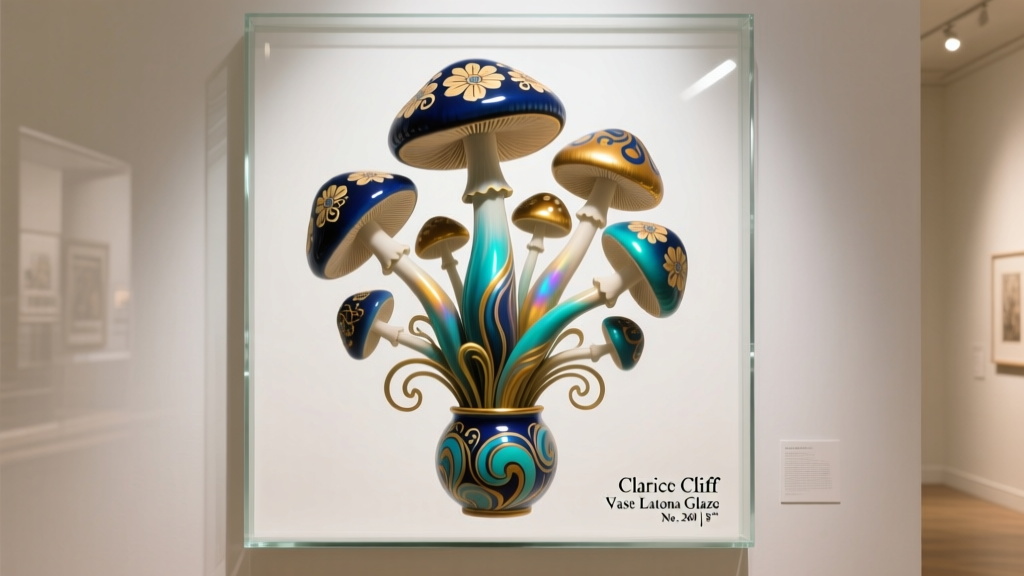
Clarice Cliff Vase Latona Glaze: Decoding the Bizarre Stylized Flower & Mushrooms No. 360 (8-Inch)

Royal Bayreuth Plaque 'Arab 2 Maidens Desert Background' — Authentication, Provenance, and Market Analysis of the 9-Inch Porcelain Wall Plaque
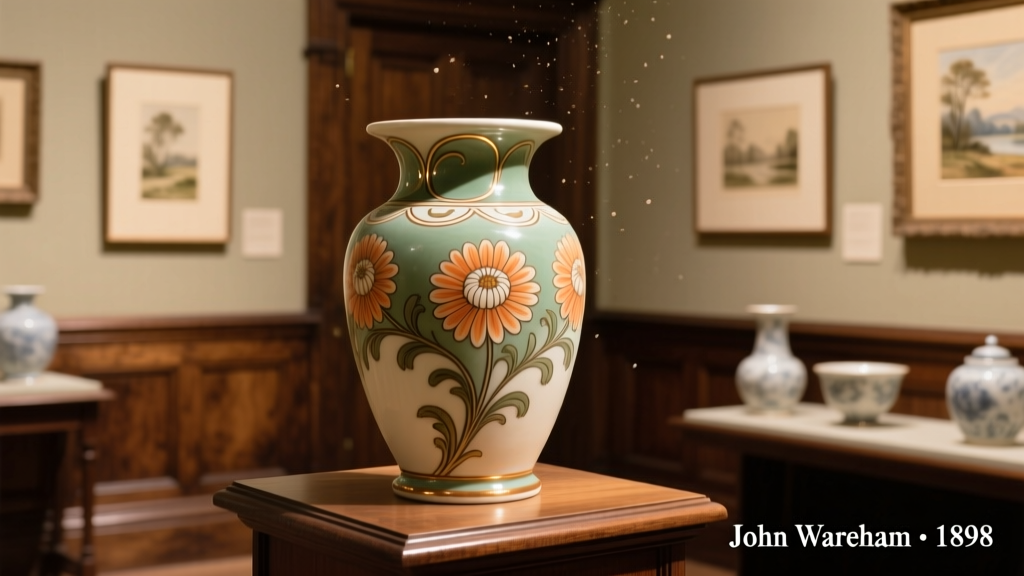
John Wareham’s 1898 Chrysanthemum-Line Vase: Provenance, Technique, and Market Significance in British Art Pottery
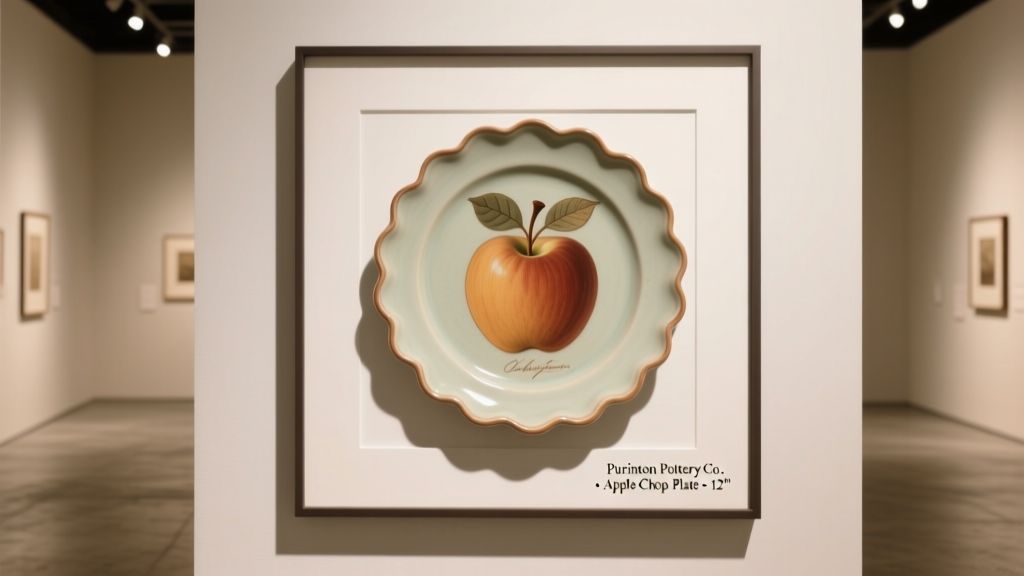
Purinton Pottery Company Apple Chop Plate with Scalloped Border (12-Inch): Authentication, Provenance, and Market Analysis

Authentication Dossier: The Case of Print ID 2337926 — A Technical Analysis of a Suspected Counterfeit Andy Warhol Screenprint
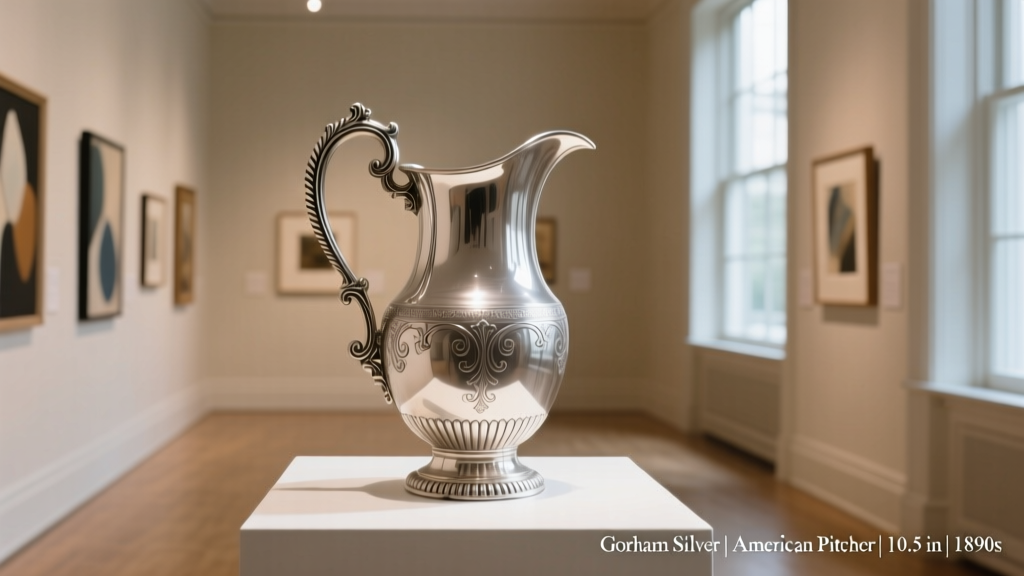
The Silver American Water Pitcher by Gorham: Authentication, Provenance, and Market Value of the 10½-Inch Model