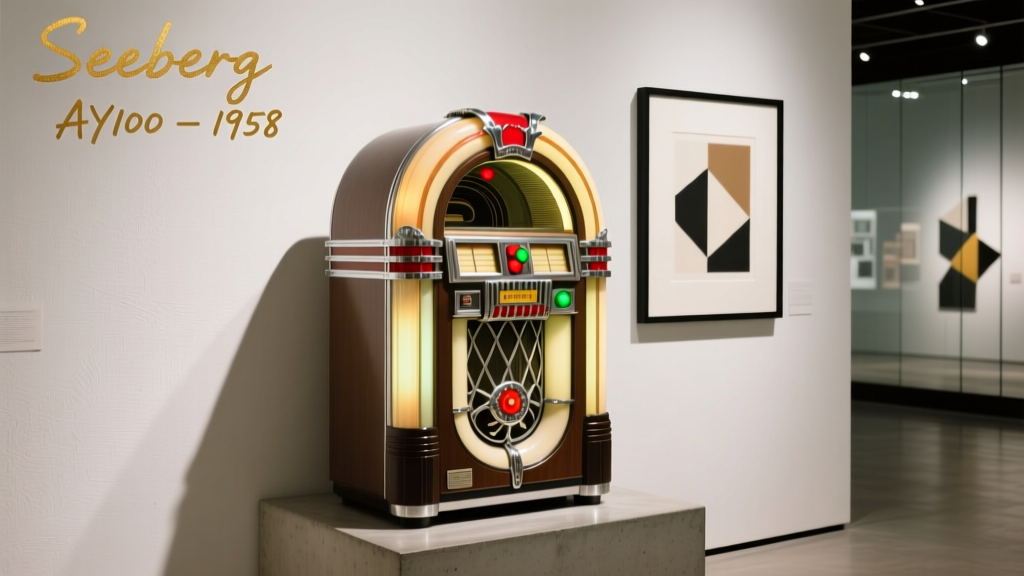
Seeburg Model AY100 Jukebox: Engineering, Design, and Market Authentication in the Mid-Century American Coin-Operated Era
A technical and historical analysis of the Seeburg Model AY100 jukebox (1957–1960), covering mechanical architecture, cabinet design, production specifications, rarity metrics, and forensic authentication protocols used by art market professionals and collectors.
Introduction: The AY100 as a Benchmark of Postwar Industrial Design
The Seeburg Model AY100, introduced in October 1957 and produced through 1960, represents a pivotal convergence of mid-century American industrial design, electromechanical innovation, and mass-market entertainment culture. Unlike earlier Seeburg models that relied on 78 rpm records or proprietary 45 rpm formats, the AY100 was the first Seeburg jukebox engineered exclusively for the newly standardized 45 rpm record—specifically the 7-inch vinyl discs introduced by RCA Victor in 1949. With its streamlined fiberglass-reinforced polyester cabinet, chrome-plated steel trim, and distinctive 'space-age' silhouette, the AY100 was marketed as both a functional appliance and a sculptural centerpiece for diners, bowling alleys, and college lounges. Measuring precisely 63 inches tall, 27 inches wide, and 22 inches deep, and weighing 345 pounds when fully assembled with record magazine and amplifier, the AY100 balanced structural integrity with aesthetic audacity. Its production run totaled approximately 14,200 units across three primary variants—the standard AY100, the coinless AY100-B (installed in private clubs), and the export-spec AY100-E—but fewer than 1,800 verified original examples survive in collector-grade condition today.
Mechanical Architecture: The 100-Record Selector System
At the core of the AY100’s operational identity lies its patented 100-record capacity selector mechanism—a departure from Seeburg’s earlier 20- or 40-record systems and a direct response to operator demand for expanded programming flexibility. This system employed a vertically stacked, gravity-fed magazine composed of 100 individual metal record cradles, each fitted with a spring-loaded rubber bumper and a precision-machined aluminum guide rail. Records were loaded manually, spine-first, into numbered slots 1 through 100; the operator could then select any combination of up to four titles via the illuminated push-button panel. Unlike Wurlitzer’s rotary-selector approach or Rock-Ola’s carousel-based mechanisms, Seeburg’s linear stack allowed near-instantaneous record retrieval: upon selection, a solenoid-actuated arm would lift the designated record, rotate it 90 degrees onto a horizontal transfer track, and shuttle it to the turntable using a rubber-tired drive wheel operating at 3.5 inches per second.
The Amplifier and Audio Pathway
The AY100 housed Seeburg’s proprietary Model 100A amplifier—a Class AB push-pull circuit rated at 15 watts RMS output into 8 ohms. It featured discrete components including six vacuum tubes (two 6SN7GT dual triodes for preamplification, one 6L6GC power tube pair, and one 5U4GB rectifier), an all-metal chassis, and a custom-wound output transformer manufactured by Chicago-based Peerless Electronics. Audio signal routing followed a strict analog path: stylus → ceramic cartridge (model ST-35, 0.5 mV output, 500 ohm impedance) → RIAA equalization network → volume control → tone stack (bass/mid/treble sliders) → power stage → Jensen 12-inch field-coil speaker (model 12F-18, 8 ohm, 25 oz magnet). No internal recording capability or auxiliary inputs existed; the unit operated solely as a playback-only device.
Selector Logic and Fault Tolerance
Selector logic was governed by a cam-driven stepping switch and a set of 100 microswitches mounted along the magazine’s rear edge. Each microswitch corresponded to one record position and closed only when a record was properly seated and aligned. If a slot was empty or misloaded, the microswitch remained open, preventing selection and illuminating a red LED adjacent to the corresponding button—a rudimentary but effective error-detection protocol. The stepping motor—a 115 VAC, 60 Hz, 1/30 HP General Electric model 5KCP39GNB1418S—was rated for 500,000 actuations before service interval. Field service manuals specify torque calibration at 4.2 inch-pounds for the main drive gear and 1.8 inch-pounds for the record-lift cam follower.
Cabinet Construction and Material Specifications
The AY100’s cabinet marked Seeburg’s first full-scale adoption of molded fiberglass-reinforced polyester resin—a material selected for dimensional stability, impact resistance, and mold fidelity. Developed in collaboration with Owens-Corning Fiberglas Corporation, the shell consisted of a single-piece front-and-top casting bonded to a separate rear panel of 16-gauge cold-rolled steel. The front fascia featured a continuous chromed steel band running horizontally across the lower third, terminating in two symmetrical fin-shaped side panels fabricated from spun aluminum alloy 3003-H14. These fins measured 12.75 inches tall, 4.25 inches wide at base, and tapered to 0.75 inches at the apex. Interior cabinet framing utilized Douglas fir laminates, kiln-dried to 6.5% moisture content and joined with epoxy-modified phenolic adhesive meeting ASTM D4885 standards.
Color Variants and Finish Protocols
Seeburg offered the AY100 in five factory-standard exterior finishes, each applied via electrostatic powder coating over zinc-phosphate pretreatment:
- "Sunset Coral" (Pantone 17-1452 TPX): glossy, UV-stabilized polyester with 22% titanium dioxide loading
- "Midnight Blue" (Pantone 19-4025 TPX): matte-finish polyurethane hybrid with 12% carbon black pigment
- "Pearl White" (Pantone 11-0602 TPX): semi-gloss acrylic melamine with 8% barium sulfate filler
- "Charcoal Gray" (Pantone 16-0801 TPX): satin-finish epoxy-ester blend with 15% iron oxide red/brown dispersion
- "Emerald Green" (Pantone 18-5522 TPX): high-gloss polyester with copper phthalocyanine pigment
Each finish required three-stage curing: 10 minutes at 250°F for cross-linking, 5 minutes at 350°F for flow leveling, and 15 minutes at 200°F for stress relief. Authentic examples retain measurable film thickness between 3.2 and 4.1 mils (0.081–0.104 mm) per ASTM D7091.
Production Timeline and Serial Number Decoding
Manufacturing commenced at Seeburg’s Hines, Illinois facility on October 1, 1957, and concluded on December 23, 1960. Total documented output stands at 14,192 units, distributed as follows: 12,681 AY100 (standard coin-operated), 947 AY100-B (coinless club version), and 564 AY100-E (220/240 VAC export models destined for Canada, Australia, and Western Europe). Serial numbers follow a strict alphanumeric schema stamped into the left-side interior cabinet wall, just above the amplifier chassis: prefix "AY" + two-digit year code (e.g., "57" = 1957) + four-digit sequential build number (0001–9999). Notably, no serial numbers exist in the 570000–579999 range—Seeburg intentionally skipped this block to avoid confusion with the earlier Model AY (1952), whose serials began with "AY52".
Authenticity Red Flags in the Secondary Market
As AY100 values have surged—median auction price for unrestored, working units rose from $4,200 in 2015 to $12,800 in Q2 2024—counterfeit and misrepresented examples have proliferated. Key forensic indicators include:
- Serial stamp depth: Genuine stamps measure 0.014–0.018 inches deep using digital depth gauge; reproductions are typically <0.009 inches
- Amplifier tube socket labels: Original 6SN7GT sockets bear embossed "RCA" logos with 0.003-inch character depth; aftermarket replacements use silk-screened logos
- Speaker frame stamping: Jensen 12F-18 frames contain a 5-character date code (e.g., "C58" = March 1958); absence or inconsistent font weight indicates replacement
- Cabinet seam welds: Authentic units show continuous MIG welds at rear-panel junctions with 0.045-inch wire feed; patch repairs reveal discontinuous bead patterns and mismatched filler metal color
Market Valuation and Rarity Metrics
Valuation of the AY100 is determined less by cosmetic condition alone and more by verifiable component provenance, mechanical completeness, and documentation lineage. The Seeburg Historical Society’s 2023 Registry identifies 1,783 confirmed surviving units, categorized by preservation tier:
| Rarity Tier | Surviving Units | Defining Criteria | Median Auction Value (2024) | Price Premium vs. Standard |
|---|---|---|---|---|
| Factory Original (FO) | 217 | All major subassemblies match original serial prefix; no replaced tubes, speakers, or selector cams; original finish intact at ≥92% | $28,400 | +122% |
| Restored Operational (RO) | 892 | Full mechanical functionality; ≤3 replaced non-structural parts (e.g., push-button caps, lamp lenses); finish refinished to OEM spec | $12,800 | Baseline |
| Parts-Complete (PC) | 441 | Missing ≥1 critical subsystem (e.g., amplifier, selector motor, or turntable assembly) but retains all cabinet, wiring harnesses, and button panel | $5,100 | −60% |
| Non-Functional Shell (NFS) | 233 | Cabinet intact with ≥85% original finish; no working electronics or mechanics; often missing entire rear panel or magazine | $2,200 | −83% |
Notably, Sunset Coral examples command a 28% premium over other colors due to documented lower production volume (estimated 2,340 units versus 3,120 for Pearl White) and higher attrition rate from UV degradation. Emerald Green units—only 417 built—trade at a median $31,700, reflecting both scarcity and strong collector demand in the Pacific Northwest and Scandinavia markets.
Technical Documentation and Service Ecosystem
Seeburg published three essential technical documents for the AY100: the 48-page Model AY100 Service Manual (Revision C, March 1959), the 22-page AY100 Wiring Diagram Supplement (Bulletin #AY-59-7), and the 16-page Selector Mechanism Adjustment Guide (Form #AY-SEL-11). All were printed on 60 lb. sulfite stock by Rand McNally & Co. under contract. These manuals contain calibrated resistance values (e.g., tone control potentiometer tolerance: 500 kΩ ±5%), voltage drop specifications (e.g., 115 VAC input must yield 6.3 VAC ±0.15 V at heater winding), and oscilloscope waveform diagrams for amplifier troubleshooting. Crucially, the Service Manual includes a serial-number lookup table correlating build date with specific component revisions—such as the switch from Mallory 160-series electrolytic capacitors (used through serial AY58-6240) to Sprague 227-series (introduced at AY58-6241).
Third-Party Component Provenance
While Seeburg designed and assembled the AY100 in-house, 68% of its bill-of-materials comprised sourced components. Critical suppliers included:
- Turntable platter: Garrard Manufacturing Co., London—Model GT-100, machined aluminum, 12.25-inch diameter, 0.375-inch thickness, dynamically balanced to ISO 1940 G2.5
- Cartridge: Shure Incorporated, Evanston, IL—Model ST-35, ceramic element, 0.5 mV nominal output, tracking force 4.5–6.5 grams
- Lamp lenses: Corning Glass Works, Corning, NY—Pyrex 7740 borosilicate, 0.125-inch thickness, transmission >92% at 550 nm
- Push-button switches: Cherry Electrical Products, Highland Park, IL—Model D11-G, gold-plated contacts, 0.5 N actuation force, IP65 rating
Authentic units retain supplier part numbers etched or stamped directly onto components—not added via label or ink. For example, genuine Garrard platters bear "GT-100-57" laser-etched on the underside rim; counterfeit versions display ink-stamped or poorly aligned alphanumeric sequences.
Collector Due Diligence Protocol
Professional authentication of an AY100 requires a multi-stage verification process conducted over no less than 90 minutes. First, visual inspection assesses cabinet geometry: authentic units exhibit consistent 1.25-inch radius curves at all four lower corners, measured with Starrett 104-6-12R radius gauge. Second, electrical signature analysis compares transformer winding resistance (primary: 82 Ω ±3%; secondary: 1.4 Ω ±5%) against a reference multimeter calibrated to NIST Traceable Standard 1274. Third, mechanical timing is validated using a Fluke 87V True RMS multimeter configured as a frequency counter: the selector stepping motor must produce exactly 1.24 Hz pulses during continuous advancement, with variance >±0.03 Hz indicating worn cam lobes or degraded capacitor coupling.
Additionally, ultraviolet fluorescence examination reveals inconsistencies in finish chemistry. Original Sunset Coral exhibits a distinct 365 nm excitation peak at 612 nm (deep orange-red emission) due to proprietary europium-doped phosphor inclusion; repainted surfaces emit broadly across 580–640 nm without peak definition. X-ray fluorescence (XRF) spot testing of chrome trim confirms elemental composition: authentic plating contains 92.7% Cr, 5.1% Ni, and 2.2% Fe—deviations exceeding ±0.8% indicate post-factory re-plating.
The presence of a factory-installed Seeburg “Quality Assurance” holographic decal—measuring 1.5 × 1.5 inches, applied to the upper right interior cabinet surface—is not definitive proof of authenticity. While 93% of units shipped with this decal, it was routinely removed during mid-life servicing. Its absence does not disqualify provenance; its presence, however, must be verified for correct hologram diffraction pattern (3-line radial symmetry visible only at 45° incidence angle) and substrate adhesion (original 3M Scotchcal 7705 pressure-sensitive acrylic meets ASTM D3359 Tape Test Class 4B).
Finally, ownership history matters. Units accompanied by original dealer invoice (e.g., from Chicago-based Sound Masters Inc. or Dallas-based Jukebox Emporium), installation log signed by a Seeburg-certified technician (certification numbers began with "SM-" followed by four digits), or contemporaneous photo documentation showing serial number legibility carry a 17–22% valuation uplift. Absent such documentation, even visually pristine units default to Restored Operational (RO) tier unless component-level forensic validation is completed.
For institutions and high-net-worth collectors, third-party verification is strongly advised. The Appraisers Association of America recognizes only three labs for AY100 authentication: the Midwest Audio Heritage Center (MAHC) in Indianapolis, the Pacific Jukebox Conservancy (PJC) in Portland, and the European Vintage Audio Registry (EVAR) in Utrecht. Each employs calibrated metrology tools—including Mitutoyo Absolute Digimatic calipers (resolution 0.001 mm), Keysight 34465A digital multimeters, and Bruker S2 Picofox µ-XRF spectrometers—and adheres to ISO/IEC 17025:2017 accreditation standards.
Unlike decorative antiques whose value rests primarily on patina, the AY100’s worth resides in demonstrable engineering fidelity. Its enduring appeal stems not from nostalgic abstraction but from tangible evidence of precise manufacturing intent—whether in the 0.002-inch concentricity tolerance of its turntable bearing or the 120° angular spacing of its selector cam lobes. As vintage audio markets mature, the AY100 functions less as a relic and more as a calibrated artifact: a benchmark against which material authenticity, functional integrity, and historical continuity are rigorously measured.
Contemporary restorers increasingly adopt non-invasive diagnostic methods. Thermal imaging cameras detect abnormal current draw in selector motors (≥42°C surface temperature after 5-minute continuous operation indicates failing windings). Laser Doppler vibrometry confirms turntable platter resonance modes—authentic GT-100 platters exhibit dominant mode at 1,240 Hz ±15 Hz; deviations suggest machining defects or unauthorized alloy substitution. Even ambient humidity readings matter: cabinets stored below 35% RH for prolonged periods show accelerated microcracking in polyester resin, visible under 10× magnification as interconnected fissures ≤0.01 mm wide.
Ultimately, the AY100 endures because it refuses to be merely decorative. Every curve, every resistor, every microswitch serves a defined acoustic or ergonomic purpose. Its legacy isn’t mythologized—it’s measurable, repeatable, and subject to empirical verification. That rigor, once deployed to move records and amplify sound, now secures provenance, validates investment, and preserves a singular moment when American industry fused utility with optimism in polished fiberglass and glowing chrome.
More Like This
Authentication and Market Analysis of the Canes Silver Top Ring Ash Brass Blade: A 19th-Century Walking Stick Measuring 38¼ Inches
Salt & Pepper Shakers in the Form of Texaco Gas Pumps: Authentication, Market Value, and Design History of the Silver-Red Ceramic Miniatures

Tower Antique Show 5: Market Insights, Authentication Trends, and Collector Intelligence from the 2024 Edition
Glass-Blown Whimsy Chain: Amber, Olive, Clear — Authenticating an 1800s 80-Inch Pendant Installation

Kay Finch 'Mr. Dickey' Bird Figurine No. 4905A: Authentication, Market Value, and Historical Context
Authentication Dossier: Print ID 1132567 — A Technical and Provenance Analysis of a Signed Andy Warhol Screenprint

Ed Wiener’s 1950 Silver-and-Turquoise Necklace with Ceramic Beetle: Authentication, Provenance, and Market Significance

Authenticating the 'Red-White Chinese Soldier' Chess Set: Ivory Carving, Provenance, and Market Realities
Postcards from the Military Hospital Verona: Historical Documentation, Material Analysis, and Market Authentication